
Avoid Door Delays: UAE Court Wedding Attire, Shoulders Covered

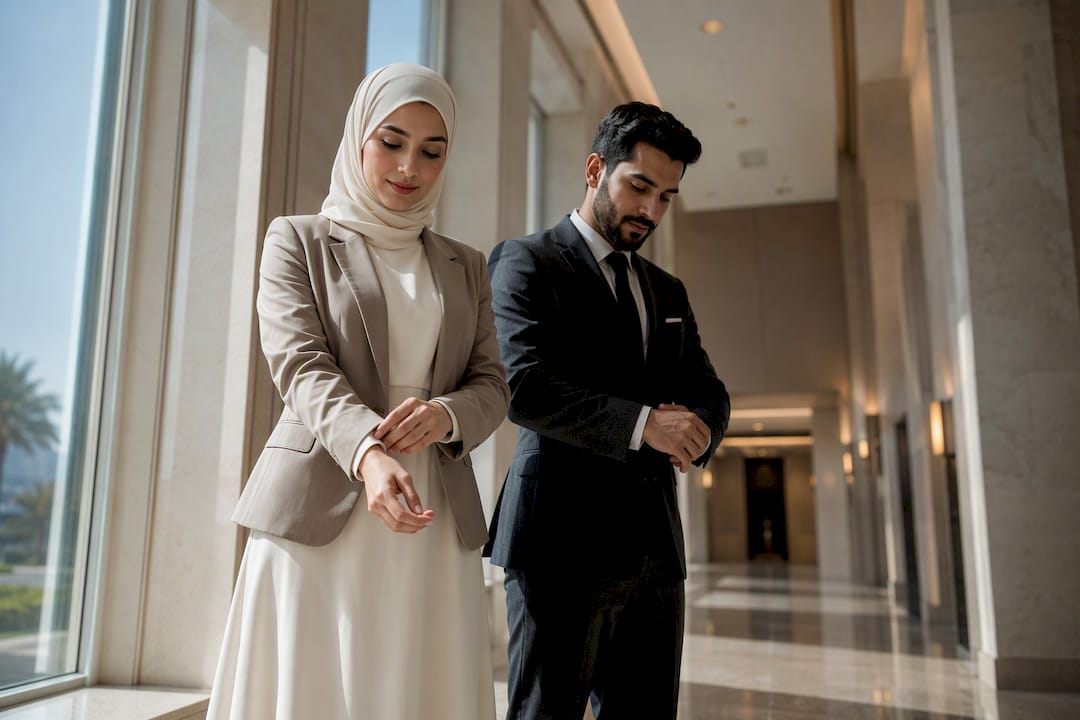
UAE courts require formal, modest clothing for every wedding appointment: shoulders covered, dresses or skirts at least mid-calf, and no shorts, slippers, torn denim, or clothing with obscene slogans. Guards check attire at the entrance before you’re allowed upstairs to the marriage section. Some courts keep a small stock of loaner coats for women who arrive underdressed, but treating that as your backup plan on your actual wedding day is a gamble you don’t want to take.
TL;DR:
Court wedding attire in the UAE requires shoulders covered, hemlines at or below mid-calf, and closed, formal shoes; casual clothing or revealing fabrics will be rejected.
Women should bring a cover-up for sleeveless or strapless dresses, while men are expected to wear a suit or blazer with dress trousers and formal shoes; shorts, sandals, and torn denim are strictly prohibited.
Security staff enforce dress codes at the entrance, and reliance on court coat-lending services for underdressed guests can lead to delays or rejection, so prepare your outfit a week in advance.
Court dress standards apply uniformly to everyone entering the marriage section, including witnesses and guests, regardless of nationality or faith, with additional head covering requirements for some Sharia courts.
The most common mistake is arriving without proper attire, so organizing your outfit, documents, and backup clothing early helps ensure a smooth wedding day without unnecessary delays.
Table of Contents
Court Wedding Attire in the UAE: The Baseline Rule
Before picking an outfit, it helps to know what “formal and modest” actually means inside a UAE courthouse, because the standard is stricter than most wedding-guest dress codes back home. Dubai Courts has posted signage at entrances spelling out the requirements, and staff have been briefed to enforce them consistently rather than leave it to individual judgment. Judge Mohammad Yousuf has publicly framed the policy as a matter of respect. Modest, formal dress, he’s said, reflects respect for the judicial system and the culture it operates within, which is why the rule applies to brides, grooms, witnesses, and anyone else walking into the marriage section that day.
This isn’t unique to Dubai. Courts across the Emirates apply a similar baseline, though the exact enforcement can vary slightly by emirate and by whether you’re appearing before a civil court or a Sharia court. If you’re unsure which court handles your case, it’s worth reviewing what court handles marriage in the UAE before you finalize your outfit, since Sharia courts in some emirates apply additional requirements around head covering.
Acceptable Court Wedding Outfits for Women
The rule of thumb is simple: cover your shoulders, keep hemlines at or below mid-calf, and skip anything sheer, clingy, or low-cut. Within those boundaries, you have more room to look put together than most brides expect.
A midi-length dress with a lightweight shawl or pashmina draped over bare shoulders
A long-sleeve sheath dress in a solid, neutral tone
A tailored trouser suit with a modest blouse underneath
A wrap dress paired with a cropped jacket or blazer
An abaya-style formal piece, especially appropriate if your court appointment includes a Nikah ceremony
A midi skirt with a structured, long-sleeve top and a fitted cardigan
Footwear should be closed or formal, think block heels, loafers, or neat flats rather than flip-flops or beach sandals, which are explicitly listed among the items that will get you stopped at the door. Keep jewelry and accessories understated; a courthouse isn’t the place for anything that reads as costume or overly casual.
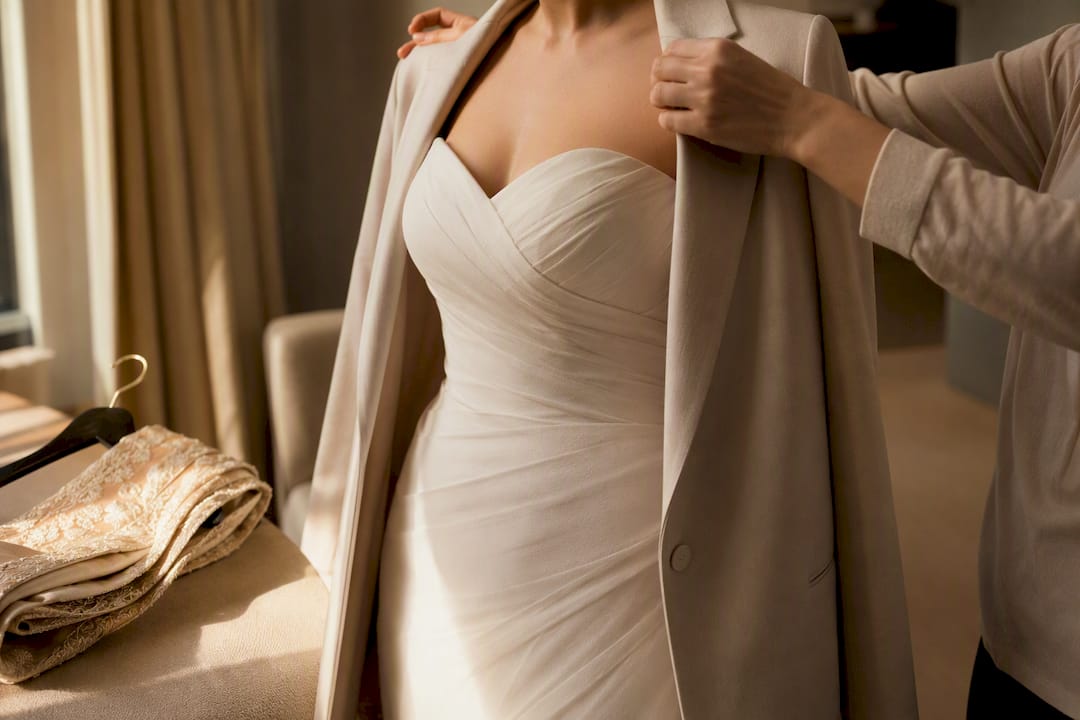
If your actual wedding gown is strapless, sleeveless, or has a plunging neckline, bring a cover-up specifically for the court moment. A tailored blazer, an embroidered stole, or a simple lightweight abaya worn over the dress solves the problem instantly, and you can remove it the second you step outside for photos.
Acceptable Court Wedding Outfits for Men
Men get less wiggle room here than the fashion industry might suggest, but the standard is straightforward: a suit or blazer with tailored trousers, and formal shoes.
A two-piece suit in navy, charcoal, or gray, paired with a collared dress shirt
A blazer over dress trousers if a full suit feels like overkill for the appointment
Formal leather shoes, never trainers, sandals, or anything athletic
A tie or pocket square if you want a slightly dressier finish, though it’s not strictly required
The items that will get a groom or a male guest denied entry are consistent across courts: shorts, cargo pants, slippers or flip-flops, shirts printed with obscene slogans, and torn or acid-wash denim. If you’re traveling light or your suit didn’t survive the trip well, a smart blazer over a clean dress shirt and proper shoes is an acceptable fallback, as long as nothing on that banned list makes an appearance.
What Gets You Turned Away, and How Courts Enforce It
Security staff check attire at the entrance before anyone reaches the marriage section, and the checklist they’re working from is short but non-negotiable.
Shorts of any length, including tailored or “smart casual” shorts.
Slippers, flip-flops, or open beach sandals.
Torn, ripped, or acid-wash denim.
Clothing printed with obscene graphics, slogans, or offensive imagery.
Sheer, see-through, or overly revealing fabrics, including anything sleeveless without a cover-up.
Dubai Courts has historically kept a coat-lending service on hand for women who show up underdressed, and reporting from The National noted the court lent appropriate clothing to many women over an extended period. That number tells you two things: the accommodation is real, and it gets used constantly, which means it’s absorbing a steady stream of people who didn’t plan ahead. Relying on it for your wedding appointment risks a delay while staff locate something in your size, which is not how you want to spend the morning of your court wedding.
Rules also aren’t perfectly uniform across the country. Some Sharia courts require women to cover their heads for certain proceedings, a requirement that doesn’t apply at every civil court. Confirm the specific expectations for your court before your appointment, particularly if you’re marrying under Islamic law. For background on how legal and cultural norms intersect here, UAE marriage traditions and legal requirements is worth a read ahead of your court date.
Where to Find Court-Appropriate Outfits in the UAE
Once you know the rules, translating them into an actual outfit is the easier part. Here’s how the pieces come together for three common scenarios.
Civil court wedding: A midi dress or trouser suit for her, a tailored suit for him, both in solid neutral tones.
Nikah ceremony: An abaya-style formal dress or modest embroidered kaftan for her, a suit or a formal thobe for him, depending on family preference.
Quick photos right after: A blazer or shawl that peels off easily so the court-appropriate look transitions into your actual bridal outfit without a full costume change.
For sourcing, you have three realistic paths. High-street retailers across the UAE carry modest, formal pieces at accessible price points that work well for a one-time court appearance. Mid-market and designer options push into higher price bands but offer better tailoring and fabric quality if you want the outfit to double as a guest dress at your reception. Bespoke tailoring is worth considering if you’re already having a suit or gown made for the main event and want a matching cover-up cut to fit. Rental houses are another option worth checking locally if you’d rather not buy a piece you’ll only wear once.
Pro Tip: Buy or rent your court cover-up at least a week ahead and try the full outfit on together with your shoes, not just the dress on a hanger. Fabric that looks fine on its own can turn sheer under courthouse lighting, and that’s not a discovery you want to make in the security line.
Day-of Checklist to Avoid Attire Delays
A few minutes of preparation the night before saves you from standing at the entrance while a guard explains why you can’t go in.
Pack a spare modest cover-up, a backup pair of formal shoes, and a small emergency repair kit (safety pins, a stain wipe, a spare button).
Confirm your appointment time in advance and arrive early to clear document and security checks without rushing.
Keep every required document in one organized folder so you’re not digging through bags if a clerk asks for something.
Brief your witnesses and immediate family on the dress code ahead of time, since a guest in shorts can hold up the whole group at the door.
Recommended Colors and Fabrics for a UAE Court Wedding
Solid, muted tones photograph well and read as appropriately formal without trying too hard. Navy, champagne, blush, soft gray, and ivory are safe, flattering choices for women’s dresses and suits, while charcoal, navy, and deep gray remain the standard for men’s suiting. Bold prints aren’t banned, but they can look busy against courthouse interiors that tend toward neutral, institutional decor.
Fabric choice matters more than color here. Structured cotton blends, crepe, and matte satin hold their shape and cover the body properly without clinging, while sheer chiffon or lace needs a lining or an underlayer to pass the modesty check. Avoid anything stretchy and body-hugging, even in a modest cut, since fit-tested fabrics can still read as too revealing under the same rule that governs necklines and hemlines. Linen and lightweight wool work well for men’s suits given the climate, holding a sharp look through a warm morning without wrinkling by the time you’re standing in front of the marriage officer.
Texture is where you can add personality without breaking any rule. A subtly embroidered shawl, a textured blazer, or a matte finish on a gown all add visual interest while staying within the formal, modest bracket courts expect. Save the sequins and heavy embellishment for the reception; courthouses aren’t the venue for them, and overly ornate pieces can also draw more scrutiny at the entrance check than a clean, well-tailored outfit ever will.
Cultural and Religious Context Behind the Dress Code
The dress code isn’t arbitrary bureaucracy. It’s rooted in the same modesty expectations that shape public life across the UAE more broadly, and courts apply them with particular strictness because the marriage proceeding is a formal legal and, for many couples, religious act. Judge Mohammad Yousuf’s public comments on the policy tie it directly to respect for the judicial system, positioning the dress code as part of the ceremony’s dignity rather than a bureaucratic inconvenience.
For Nikah ceremonies specifically, religious considerations layer on top of the general modesty rule. Head covering requirements vary by emirate and by the specific court handling the case, so what’s expected in one Sharia court may not be identical in another. Couples marrying under Islamic law should confirm this detail directly with the court before the appointment rather than assuming the civil court dress code covers every scenario. Reviewing court marriage requirements in the UAE ahead of time can help you map which rules apply to your specific ceremony type.
Non-Muslim couples marrying civilly aren’t exempt from the modesty standard either. The rule applies regardless of nationality or faith, which surprises some expats who assume court dress codes only track religious practice. It doesn’t. It tracks respect for the institution, and that expectation is applied evenly across every ceremony type the court handles.
How Court Wedding Attire Differs From Other UAE Wedding Types
A court appointment is the strictest dress environment you’ll encounter in your entire wedding process, and it’s worth understanding why before you assume your reception outfit will work for both. Hotel wedding venues, yacht ceremonies, and private outdoor celebrations set their own dress expectations, usually driven by the couple’s preferences rather than a legal institution’s rules. A strapless gown, a fitted cocktail dress, or a linen suit with no jacket are all fair game at a private reception. None of them pass at the courthouse.
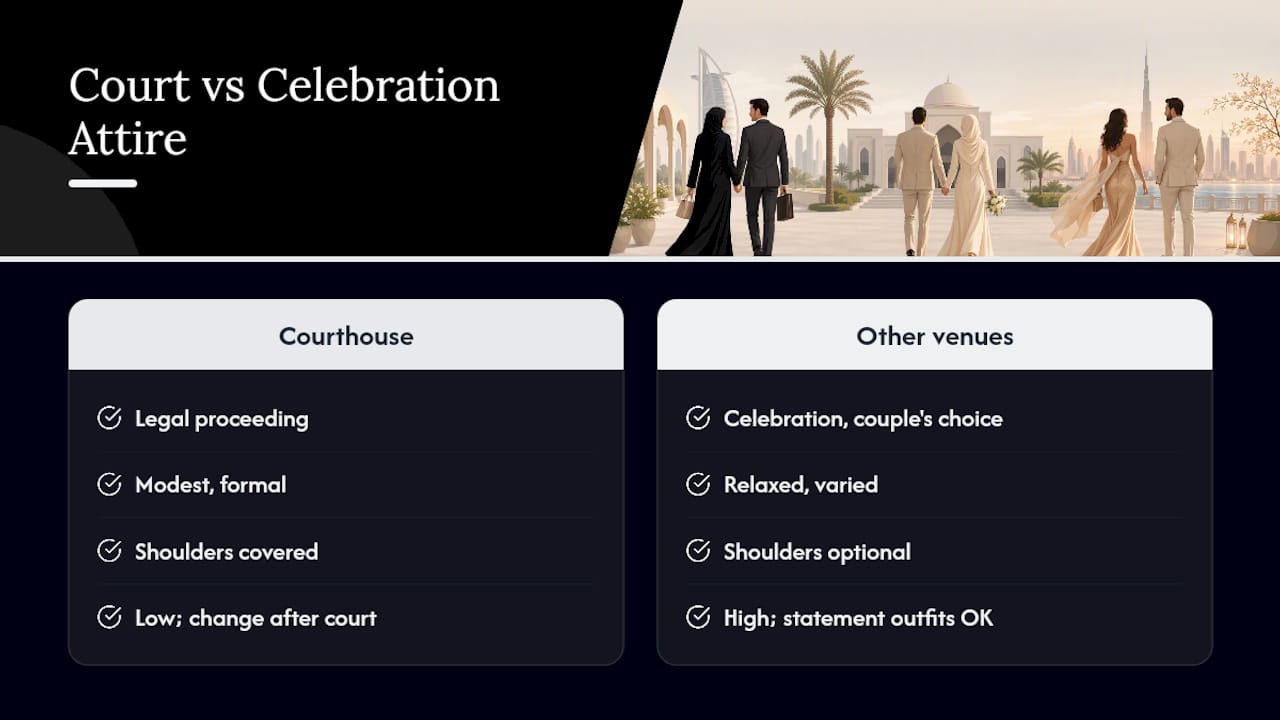
The court appointment is a legal proceeding first. Everything else, the photos, the reception, the yacht cruise, is a celebration layered around that legal core, and each layer can relax the dress code the courthouse enforces. Many couples solve this by treating court attire as a distinct outfit segment: modest and formal for the legal moment, then a change into the dress or suit meant for photos and celebration immediately after. This is exactly why the cover-up strategy works so well. It lets you meet the court’s standard without compromising the look you actually planned for your wedding photos.
If your celebration includes a separate ceremony, a yacht reception, or an outdoor event, know that none of those venues apply the courthouse’s rules. Save your statement outfit for wherever the party actually happens, and let the court appointment be the brief, modest formality it’s designed to be.
Harris’s Take: What Actually Trips Up Couples on Court Day
The mistake we see most often isn’t ignorance of the rules. It’s timing. Couples know the dress code exists but assume they’ll change into something appropriate in the car or borrow a coat at the entrance, and that’s exactly when a fifteen-minute appointment turns into an hour of waiting. Arrive already dressed correctly, with documents organized in one folder and a spare cover-up in your bag regardless of how confident you feel about your outfit. Professional services handle document preparation, attestation coordination, and day-of scheduling for couples going through this process, and the pattern is consistent: the weddings that run smoothly are the ones where attire was settled a week out, not the morning of.
— Harris
Let Harrisandcharms Handle the Paperwork While You Handle the Outfit
You’ve got the dress code sorted. The part that actually causes wedding-day stress for most couples in the UAE is everything else: document translation, attestation, scheduling the court slot, and making sure nothing gets rejected at the counter. This service is the alternative to piecing this together yourself across three or four different government offices, handling the paperwork and the day-of logistics so your only job on the actual morning is showing up dressed right.

The Basic Package covers document prep and court coordination for couples who just need the essentials handled, while the Express Package speeds up the timeline for couples working against a visa deadline or a travel date. Add-on options exist if you also need help with venue coordination or photography around the court appointment. For couples marrying under Islamic law, Islamic Marriage services in Dubai and Abu Dhabi follow the same hands-on model. Reach out to Harrisandcharms today to lock in your court date and get your paperwork moving before you even think about the outfit.
Where This Guidance Comes From
Court dress code details, enforcement patterns, and the coat-lending figures referenced in this guide come from Dubai Courts’ public statements and reporting by Gulf News and The National. Outfit pricing examples reflect listings from UAE retailers such as Ounass, used here for general inspiration rather than vendor endorsement.
FAQ
Can I wear a sleeveless dress to a UAE court wedding?
No. Shoulders must be covered for the court appointment, so a sleeveless or strapless dress needs a shawl, blazer, or light cover-up over it. You can remove the cover-up immediately after for photos.
Will I be turned away for wearing sandals?
Open sandals and flip-flops are on the list of prohibited footwear, and staff check shoes at the entrance along with the rest of your outfit. Closed or formal shoes, like flats, loafers, or heels, are the safe choice.
Does the dress code apply to wedding guests too?
Yes. Anyone entering the marriage section, including witnesses and family members, must meet the same formal, modest standard, so it’s worth briefing your group before the appointment.
What does a court wedding in the UAE typically cost through Harrisandcharms?
The Basic Package costs 2850 AED, with an Express VIP option priced at 7500 AED for couples who need faster processing and added support. Both cover document preparation and coordination so attire is the only thing left to plan yourself.
Do the rules differ for a Nikah ceremony versus a civil marriage?
The core modesty standard, shoulders covered, formal clothing, closed shoes, applies to both. Some Sharia courts additionally require head covering for Nikah proceedings, so confirm that specific requirement with your court ahead of time.
Recommended
Comments