
UAE Residents: Start Attestation Now to Avoid Spouse Visa Rejection


Yes, you can sponsor your spouse for a UAE residence visa right after marriage, provided you meet three conditions: you hold a valid UAE residence visa and Emirates ID, your marriage certificate is properly attested, and you clear the salary or salary-plus-accommodation threshold. Start the attestation chain immediately because this step is often the main cause of delays. Golden and Green visa holders face a lighter documentary load than standard employment-visa sponsors.
TL;DR:
Providing attested marriage certificates from abroad is crucial, as incomplete chains are the leading cause of application rejections in the UAE.
The minimum salary requirement for sponsoring a spouse is AED 4,000 per month unless accommodation is provided, in which case the threshold drops to AED 3,000.
Most applications take two to six weeks to process, withDubai offering faster turnaround times for fully attested documents.
Rejected applications are often due to missing or expired attestations, mismatched salary documents, or unregistered accommodation proof.
Golden and Green visa holders enjoy longer sponsorship validity and simplified documentation processes compared to standard employment visa sponsors.
Table of Contents
Who Can Sponsor a Spouse Visa After Marriage in the UAE?
Sponsoring a spouse isn’t limited to one visa category. Salaried employees, business owners, free-zone workers, investors, and Golden or Green visa holders can all sponsor a spouse, as long as they hold a valid UAE residence visa and Emirates ID at the time of filing. Where you file depends on your emirate: Dubai residents go through GDRFA (General Directorate of Residency and Foreigners Affairs), while residents elsewhere typically apply through ICP (Federal Authority for Identity, Citizenship, Customs and Port Security) or its emirate-level counterparts.
The salary test is where most applications stumble. The UAE government sets the minimum sponsor income at AED 4,000 per month, or AED 3,000 per month if the employer provides accommodation. That accommodation has to be documented, usually through a company letter confirming housing is provided, not just verbally promised.
Proving income cleanly matters more than the number itself. The strongest combination is:
An employer-issued salary certificate, ideally in Arabic
Recent WPS (Wage Protection System) payslips showing the full monthly amount
A copy of the employment contract stating the salary
Business owners and investors follow a different path, usually substituting trade license copies and bank statements for a salary certificate. If your own residence visa gets cancelled, whether from a job loss or company closure, your spouse’s visa is tied to it and typically enters a grace period rather than expiring immediately, though acting fast to transfer sponsorship or secure a new visa avoids complications. If your salary comes through a split arrangement (base pay plus allowances from different accounts), make sure your WPS record shows the consolidated figure or get HR to confirm it in writing. Immigration officers reject split-salary submissions more often than any other income document.
What Documents Do You Need for a UAE Spouse Visa?
Two document sets run in parallel here: yours as the sponsor, and your spouse’s as the applicant. Miss one item and the file bounces back, costing you a week or more.
Sponsor documents:
Passport copy and current UAE visa page
Emirates ID (front and back)
Salary certificate or employment contract
Ejari (tenancy contract) or title deed proving accommodation
A recent utility bill, if requested by the processing center
Spouse documents:
Valid passport copy with at least six months remaining
Passport-style photographs meeting UAE specifications (white background, specific sizing)
Attested marriage certificate
Certified Arabic translation of the certificate, where the original isn’t in Arabic
The attestation chain is the part that trips up most first-time applicants. A marriage certificate issued abroad needs authentication in the country of origin first, then attestation by the UAE embassy in that country, and finally attestation by the UAE Ministry of Foreign Affairs (MOFA) once it arrives in the Emirates. Submitting a certificate with only one or two links in that chain completed is one of the most common reasons applications get rejected outright, not just delayed.
Pro Tip: Start the attestation process in your spouse’s home country the same week you marry, not the week you plan to file. This single chain routinely takes several weeks, and it’s the one step you can’t rush from inside the UAE.
Depending on your situation, you may also need a no-objection certificate from a free-zone employer, additional bank statements if you’re self-employed, or copies of any previous UAE visas held by your spouse. Readers who married abroad, particularly in India, should check our marriage certificate attestation guide for India for country-specific document requirements, and our [7-step checklist for UAE marriage documents](https://harrisandcharms.com/post/7-step-checklist-for-u ae-marriage-documents-guide-expats) for a full prep list before you file.
How Does the Spouse Visa Application Process Work?
The process runs through five stages, and skipping the order almost guarantees a rejection notice.
Open a sponsor file. Dubai residents do this through GDRFA’s smart services or an Amer center; residents in other emirates use ICP channels. This step registers you as an eligible sponsor and requires your Emirates ID, salary proof, and tenancy documents.
Apply for an entry permit, if your spouse is still outside the UAE. This permit carries a validity period that allows your spouse sufficient time to enter the country before it expires, typically measured in weeks. If your spouse is already in the UAE on a visit visa, you can usually apply for a status change instead, skipping the exit-and-reentry step.
Complete the medical fitness test after the entry permit is issued. This applies to anyone aged 18 and over, and must happen at an approved government medical center, not a private clinic.
Apply for the Emirates ID and attend biometric capture. This step is handled through ICP, and it’s where fingerprints and photos are formally registered.
Visa stamping. Once the medical clearance and Emirates ID biometrics clear, the residence visa gets stamped into the passport, and the card itself typically arrives by mail shortly after.
You can track status through the GDRFA smart services app for Dubai filings or the ICP portal (smartservices.icp.gov.ae) for federal applications. For a documented head start on the paperwork itself, our guide on filing a spouse sponsorship on a AED 4,000 salary walks through what to prepare before you ever visit a service center.
How Long Does It Take and What Does It Cost?
Budget two to six weeks from a clean file to a stamped visa, assuming every document clears attestation and salary checks on the first pass. Individual stages typically run:
Entry permit approval: 3 to 7 working days
Medical test results: 24 to 48 hours
Emirates ID biometrics to card issuance: 1 to 2 weeks
Visa stamping: 3 to 10 working days
Most straightforward spouse visa applications complete within 2 to 4 weeks when the sponsor files from Dubai with fully attested documents in hand, according to process breakdowns from UAE relocation specialists. Costs stack up across several components: entry permit fees, sponsor file opening, the medical test itself, Emirates ID issuance, and final stamping. Applying for a status change from inside the UAE (rather than processing an entry permit from abroad) tends to raise the total fee slightly, but it saves your spouse a trip out of the country and back in. Some emirates also add local service charges, commonly called knowledge dirham or innovation fees, on top of federal costs, so the final number varies depending on where you file.
Why Do Spouse Visa Applications Get Rejected?
Attestation gaps cause more rejections than any other single issue. Government portals and UAE media consistently flag incomplete or missing MOFA attestation as the top reason files bounce back. Right behind it: expired passports (on either the sponsor’s or spouse’s side), salary documentation that doesn’t match WPS records, unregistered tenancy proof, and a missing or expired medical test result.
Most of these are avoidable with a five-minute check before submission:
Confirm every stamp in the attestation chain is present: origin country, UAE embassy, and MOFA
Verify your Ejari is current and matches the address on your utility bill
Make sure your salary certificate figure matches your WPS payslip exactly
Check that the marriage certificate translation carries a certified translator’s stamp, not just a printed translation
If your file does get rejected, you generally have the option to correct and resubmit rather than filing a formal appeal, and most corrections process faster the second time since the file already exists in the system. If the rejection cites something you don’t understand, or if the attestation chain gets complicated by a home country with an unusual authentication process, that’s the point to bring in help rather than guessing. Our marriage certificate attestation guide for Dubai breaks down exactly which stamps go in which order.
Pro Tip: Photograph every attested document immediately after each stage of the chain. If a page goes missing between the embassy and MOFA, you’ll need proof of what was already completed to avoid restarting the whole process.
What Happens After Your Spouse Arrives in the UAE?
Landing in the country on the entry permit is only the halfway point. Four tasks convert that permit into an actual residence visa.
Complete the medical fitness test at an ICP-approved center. Applicants 18 and older go through a blood test and chest X-ray, typically completed in one visit.
Attend Emirates ID biometric capture. Bring the entry permit, passport, and passport photos. The physical card usually arrives by courier within one to two weeks.
Arrange health insurance that meets your emirate’s minimum coverage requirements. Dubai and Abu Dhabi both mandate coverage for dependents, and you’ll often need proof of an active policy before the visa stamping finalizes.
Confirm the visa stamp is in the passport once the Emirates ID and insurance are in order.
One detail catches people off guard: a spouse visa doesn’t automatically grant work rights. If your spouse wants a job later, that typically means switching to an employer-sponsored visa, which is a separate process. Also keep in mind that staying outside the UAE for six consecutive months or longer can put a residence visa at risk of cancellation, so plan travel accordingly.
How Long Does a UAE Spouse Visa Last and Renewal Rules
Spouse visas in the UAE are generally issued for two or three years, tied to the sponsor’s own residence visa validity and the specific emirate processing the application. If your own visa runs on a two-year cycle, your spouse’s visa typically mirrors that timeline rather than running independently.
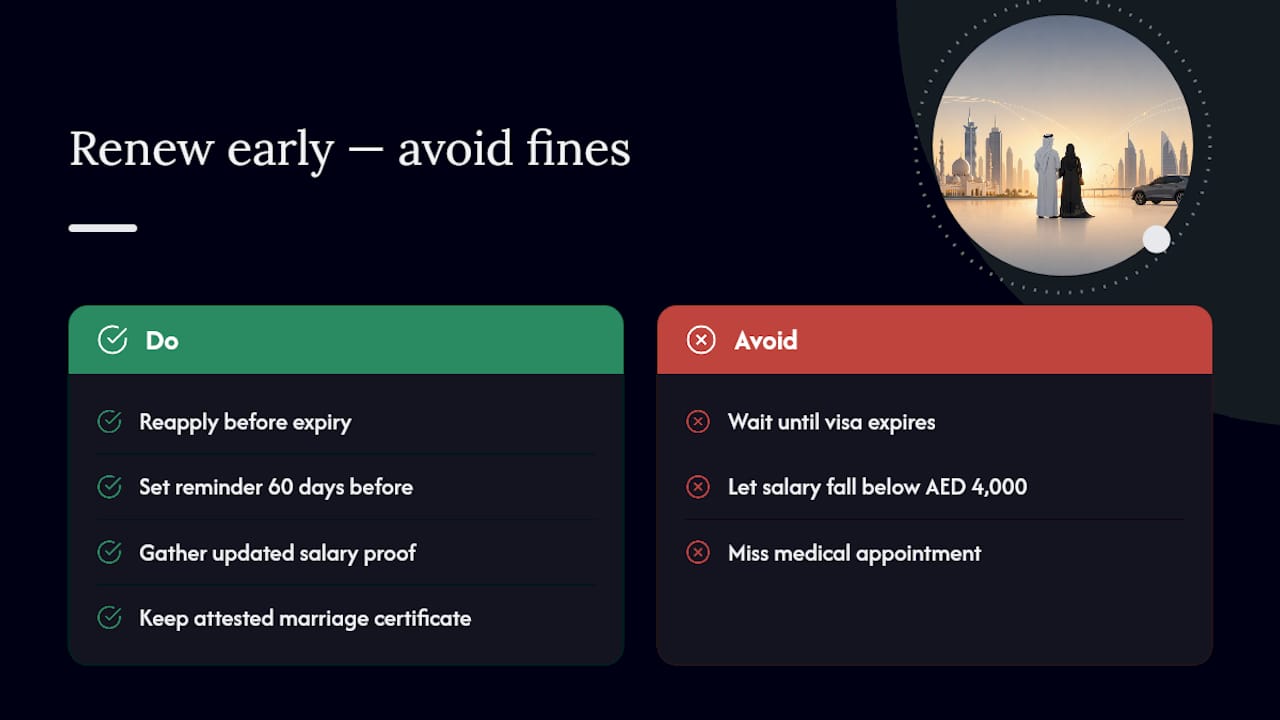
Renewal isn’t automatic. You’ll need to reapply before the expiry date, and the documentation looks almost identical to the original filing: updated salary proof, current Ejari or title deed, valid Emirates ID for both sponsor and spouse, and a fresh medical fitness test in most cases. The marriage certificate attestation doesn’t need to be redone since it’s a one-time requirement, but keep the original attested copy on file since some renewal filings ask for it again.
Golden and Green visa holders get a real advantage at renewal time. Their family sponsorship terms often run longer than the standard two-year cycle, sometimes matching the sponsor’s own longer-duration visa, which means fewer renewal cycles and less repeated paperwork over the years.
One mistake we see often: sponsors wait until the visa has already expired to start renewal. That triggers overstay complications for the dependent spouse, including fines that accumulate daily. Set a calendar reminder at least 60 days before expiry, since that gives enough runway to gather updated salary documents and book a medical appointment without rushing. If your salary situation changed since the original filing, whether you got a raise, changed employers, or moved to a different accommodation arrangement, expect the renewal reviewers to check those details fresh. A drop below the AED 4,000 (or AED 3,000 plus accommodation) threshold at renewal time can jeopardize the extension even if the original visa was approved without issue.
What Rights Does a Spouse Visa Actually Grant?
A UAE spouse visa gives your partner legal residency, the ability to open bank accounts, sign tenancy contracts, and travel in and out of the country freely, subject to the visa remaining valid. It does not automatically include work authorization. If your spouse wants to take a job, they generally need an employer to sponsor a separate work permit, or they apply for a freelance or self-employment permit through the relevant free zone, which converts their status from dependent to independent sponsee.
Travel comes with one real restriction worth flagging: absences from the UAE longer than six consecutive months can flag the residence visa for cancellation under standard residency rules. If your spouse travels frequently for family visits or work, keep a rough log of trip dates so you’re not caught off guard.
Dependents inclusion works in the other direction too. Once your spouse holds valid residency, they may in some cases sponsor your children under their own file if circumstances require it, though most families keep the primary sponsor role with whichever parent holds the higher income or the original residence visa. The spouse visa does not extend to sponsoring the spouse’s own parents or siblings. That requires a separate, more restrictive process with its own income thresholds.
Health insurance coverage is tied to the visa’s validity in most emirates, meaning your spouse needs an active policy the entire time the residence permit is valid, not just at the point of initial stamping. Letting insurance lapse can complicate visa renewal down the line even if every other document is in order.
What Happens to the Spouse Visa After a Divorce?
A spouse visa is directly tied to the marriage itself, so divorce or legal separation triggers a cancellation process rather than an automatic expiry. The sponsoring spouse, or in some cases the courts, initiates the cancellation through the same authority that issued the visa, whether that’s GDRFA in Dubai or ICP federally.
Once cancellation is filed, the sponsored spouse typically receives a grace period, commonly around 30 days, though the exact window can vary by case and emirate, to arrange a new visa status, leave the country, or transfer sponsorship if they qualify independently through employment. This grace period matters enormously for anyone who built a life, a job, or children’s schooling around UAE residency, since running out the clock without a plan can mean an abrupt departure.
Sponsors should be aware that failing to formally cancel a spouse’s visa after divorce, assuming the relationship has ended, can create ongoing liability. As sponsor, you generally remain responsible for a dependent’s legal status until the cancellation is officially processed, even after a divorce is finalized in court. That includes potential fines if the visa lapses into overstay territory while cancellation paperwork sits unfiled.
Custody and children’s visas add another layer. If children were sponsored under the marriage, divorce proceedings often need to address who retains sponsorship responsibility for them, separate from the spousal visa question entirely. Courts handle this alongside custody rulings, and immigration authorities generally require a court order or settlement agreement before transferring a child’s sponsorship from one parent to the other.
What Are a Sponsor’s Legal Obligations Under UAE Law?
Sponsoring a spouse isn’t a one-time paperwork exercise. It comes with ongoing legal responsibility for as long as the visa remains active. As sponsor, you’re financially and legally accountable for your spouse’s residency status, which means covering visa renewal costs, maintaining the salary threshold that justified the original approval, and ensuring health insurance coverage stays current.
If your spouse violates UAE law in a way tied to their residency status, sponsors can face scrutiny too, particularly around visa validity and reporting obligations. Overstaying, for instance, generates fines that the sponsor is typically expected to help resolve, since the dependent’s legal presence in the country runs through the sponsor’s file.
You’re also obligated to report major status changes promptly. That includes job loss (which affects your ability to maintain the salary threshold), a change of address (which affects your Ejari-based accommodation proof), or the end of the marriage itself. Sitting on these changes without notifying GDRFA or ICP can create bigger problems later, including fines or complications at the next renewal cycle.
One obligation that catches sponsors off guard: if your own residence visa gets cancelled for any reason, your spouse’s visa is directly affected, generally triggering a grace period during which you need to either secure a new sponsor visa or help your spouse transition to independent status. Treat this like a countdown clock, not a formality. Waiting past the grace period risks fines for your spouse and complications for your own future applications.
Do Spouse Visa Rules Differ by Nationality?
The core process, attested marriage certificate, salary threshold, medical test, Emirates ID, applies regardless of where you or your spouse are from. But a few real differences show up depending on nationality and visa category.
GCC (Gulf Cooperation Council) nationals working in the UAE sometimes face lighter income verification requirements, since employment patterns and salary structures within the GCC are often already recognized by UAE authorities. Non-GCC expatriates, which covers the large majority of sponsors filing spouse visas, go through the standard salary certificate and WPS verification process described earlier, with no exceptions based on passport.
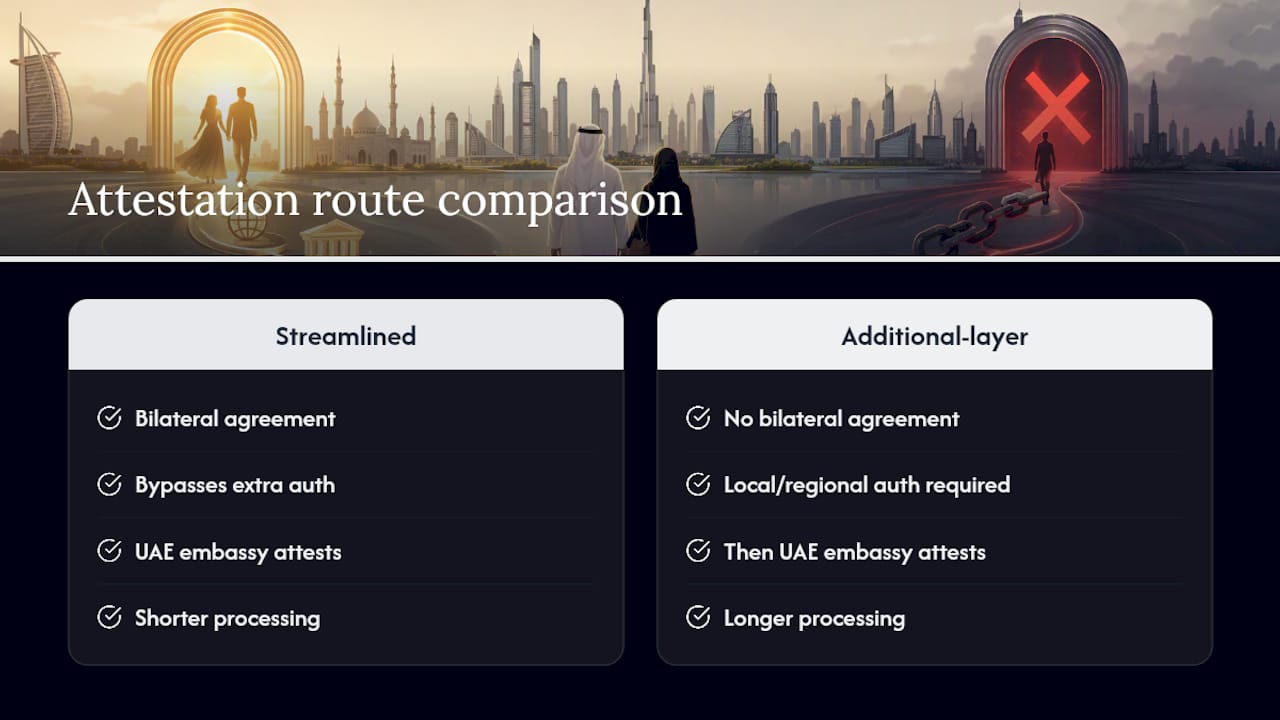
The attestation chain varies significantly by home country, and this is where nationality actually matters most in practice. Some countries have streamlined bilateral attestation agreements with the UAE that shorten the process by days or weeks. Others require additional layers, particularly countries where marriage registration itself happens at a local or regional level rather than nationally, adding an extra authentication step before the UAE embassy attestation can even begin.
Golden and Green visa holders, regardless of nationality, benefit from a genuinely different set of rules: longer visa validity for sponsored dependents, sometimes reduced documentary requirements, and in many cases a more direct filing path that skips some of the standard verification steps required of employment-visa sponsors. If you or your spouse hold either visa category, it’s worth confirming your specific entitlements with ICP directly, since the benefits can shift with policy updates.
Same-sex marriages, regardless of where they were legally performed, are not recognized for UAE spouse visa sponsorship purposes, since UAE family law does not extend residency sponsorship to those unions.
Harris & Charms’ Take on Getting the Paperwork Right
We work with couples through exactly this process, reviewing documents before submission, coordinating attestation across embassies and MOFA, and helping sponsors avoid the salary-proof mismatches that trigger rejections. One pattern shows up constantly: couples who married abroad and assumed a “certified” translation from their home country would satisfy MOFA requirements, only to discover it needed re-certification once it reached the UAE.
— Harris
Get Hands-On Help With Your Spouse Visa Filing
DIY attestation runs and repeat trips to service centers eat weeks you don’t have, especially when a single missing stamp sends your file back to the start. Harrisandcharms is the practical alternative to navigating GDRFA, ICP, and MOFA attestation on your own. Our team reviews your documents before submission, coordinates the attestation chain end to end, and books your appointments so you’re not learning the process by trial and error.
Beyond spouse visas, Harrisandcharms also handles the marriage itself: civil and Islamic ceremony arrangements, court application support, venue management, and even yacht wedding packages for couples who want their celebration on the water before the paperwork begins. We also support premium marriage registration for Golden visa holders, whose sponsorship terms and documentation needs differ from standard employment-visa cases. A consultation starts with a document checklist specific to your nationality and visa category, moves into attestation handling, and ends with filing support through the correct portal for your emirate. Check our comprehensive marriage services page to book a consultation and get your document checklist started this week.
Recommended
Comments