
Guidelines for Expat Marriages in Abu Dhabi: 2026 Guide

TL;DR:
Expat marriages in Abu Dhabi can be conducted via civil or Islamic routes, both requiring thorough document attestation and registration through the ADJD. Proper preparation, especially completing the multi-layered attestation process early, ensures smoother application and digital ceremony options. Understanding legal and cultural requirements prevents delays and helps couples navigate Abu Dhabi’s marriage system confidently.
The guidelines for expat marriages in Abu Dhabi define two legally recognized routes: civil marriage for non-Muslim expatriates and Islamic marriage under Sharia law for Muslim residents. Both paths require documented proof of eligibility, multilayered document attestation, and formal registration through the Abu Dhabi Judicial Department (ADJD). The UAE has also introduced digital ceremony options through the TAMM app, making the process more accessible than ever. Whether you are planning a civil signing or a religious ceremony, understanding the legal framework from the start saves you weeks of avoidable delays.
What are the legal requirements for expat marriages in Abu Dhabi? Guidelines for Expat Marriages in Abu Dhabi:
The fundamental eligibility criteria are:
Age and consent: Both parties must be at least 18 years old and provide full, voluntary consent. No forced or underage marriages are legally permitted under any circumstance.
Marital status: Each applicant must prove they are legally free to marry. Single applicants submit a certificate of no impediment. Divorced applicants provide a final divorce decree. Widowed applicants provide a death certificate for the former spouse.
No prohibited relationships: Marriage between close blood relatives is not permitted under UAE law, regardless of whether the couple is Muslim or non-Muslim.
Religion-based route: Non-Muslim expats qualify for civil marriage. Muslim expats, including those from countries where civil marriage is the norm, must follow Islamic marriage procedures in Abu Dhabi.
Residency status: Resident expats holding an Emirates ID have the most straightforward access to ADJD services. Non-resident expats can still marry in Abu Dhabi but may need additional documentation to establish their legal status in the UAE.
A common misunderstanding is that a tourist visa disqualifies you from marrying in Abu Dhabi. It does not. Non-residents can apply, though the documentation requirements are the same and the process is no faster. Check the eligibility criteria for 2026 before you begin any paperwork.
What documents are required and how does attestation work?
Document preparation is the single most time-consuming part of the marriage process for expats. Getting this wrong delays everything else, including your ceremony date.
The core documents required for both parties are:
Valid passport (original and copy)
Emirates ID for UAE residents
Proof of marital status: a certificate of no impediment, divorce decree, or death certificate
Visa copy if applicable
Certified translation of all non-English and non-Arabic documents
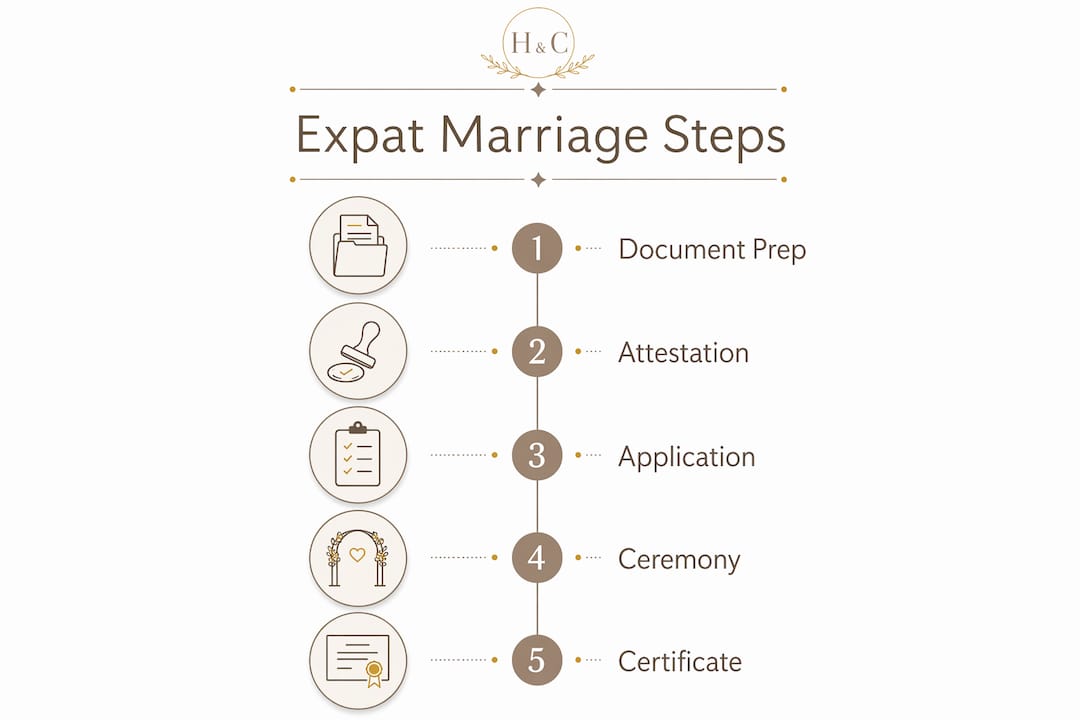
Once you have gathered these, every foreign document must go through a multilayered attestation process before the ADJD will accept them. The steps are:
Notarization in your home country by a licensed notary public
Home country foreign affairs attestation by your national Ministry of Foreign Affairs or equivalent authority
UAE embassy attestation at the UAE embassy in your home country
MOFAIC authentication at the UAE Ministry of Foreign Affairs and International Cooperation after you arrive in the UAE
Name consistency is the most overlooked detail in this entire process. Your name must appear identically across your passport, translated documents, and any certificates you submit. A single spelling variation, such as “Mohammed” on one document and “Mohammad” on another, triggers a review delay that can add weeks to your timeline.
Pro Tip: Start the attestation process at least 8 to 12 weeks before your intended wedding date. Do not book a venue or set a ceremony date until your documents have cleared MOFAIC. Attestation is the bottleneck, not the ADJD application itself.
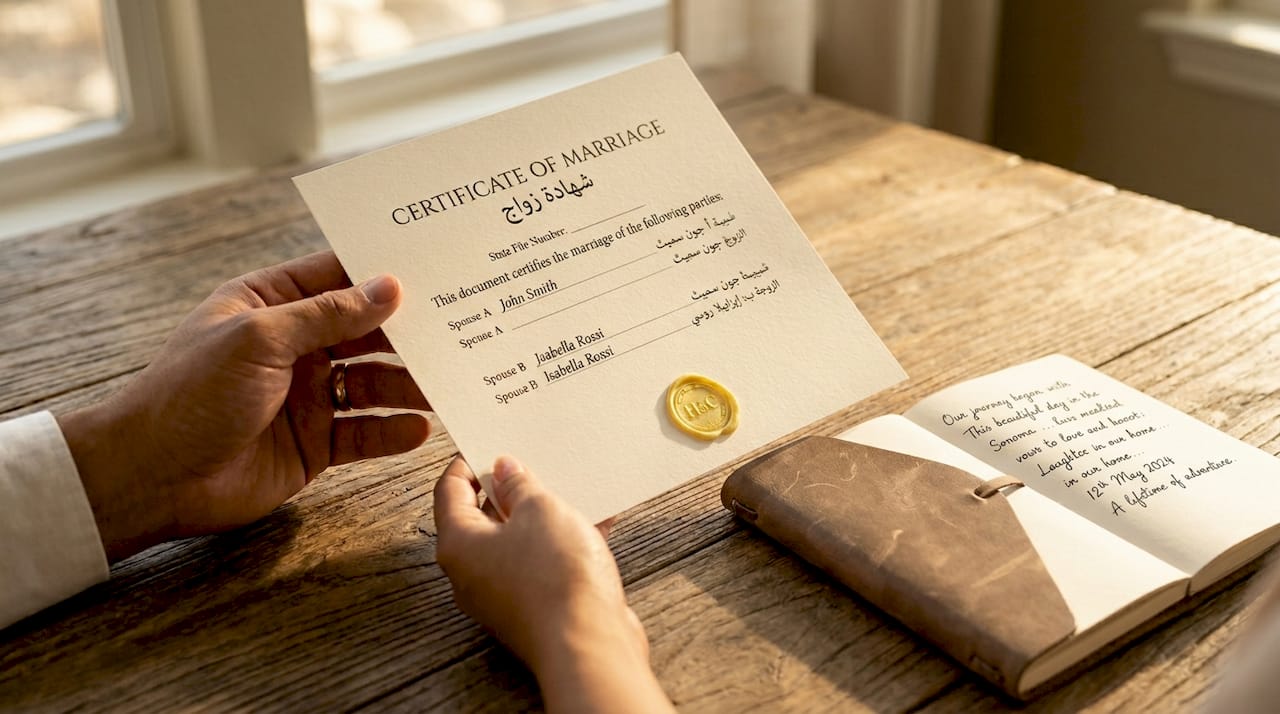
Civil marriage certificate validity in countries like the USA, UK, Canada, and Australia depends entirely on this attestation chain being complete and correct from the start.
How does the civil marriage process work, including digital options?
Once your documents are attested and ready, the actual application process through the ADJD is straightforward. You apply online through the ADJD portal, submit your documents for review, and once approved, schedule your signing ceremony.
Feature | Standard Service | Express Service |
Processing time | 1 working day | |
Cost | AED 300 | Approximately AED 2,500 |
Best for | Couples with flexible timelines | Couples with urgent needs |
Key condition | Documents must be complete | Documents must be 100% accurate at first submission |
The express service is not simply a fee upgrade. It only delivers on its one-day promise if your documents are fully complete and accurately submitted on the first attempt. Any mismatch or missing item resets the timeline regardless of what you paid.
For the ceremony itself, Abu Dhabi now offers a fully digital option. The ADJD conducts online wedding ceremonies through the TAMM app for AED 800, conducted via a secure WebEx link. The marriage certificate issued uses a UAE Pass digital signature rather than a physical stamp, which improves document security and is accepted for official purposes. This option is particularly useful for couples where one partner is abroad, though both parties still need court approval and completed document verification before booking the ceremony.
Pro Tip: The digital ceremony via TAMM does not bypass any legal document requirements. All attestation and translation steps must be completed before you can book a ceremony slot. Treat the app as a delivery mechanism, not a shortcut.
For a detailed walkthrough of the full application, the 2026 civil marriage guide covers every step from portal registration to certificate collection.
What are the cultural considerations for expat couples in Abu Dhabi?
Cultural considerations for expat marriages in Abu Dhabi matter beyond legal compliance. The type of marriage you choose shapes your ceremony experience, your legal rights within the UAE, and how your union is recognized abroad.
Key differences and cultural points to understand:
Islamic marriage requirements: Muslim expats must follow Sharia procedures. This includes the presence of a wali (a male guardian for the bride in many interpretations), two adult male witnesses, and a formal marriage contract that includes Mahr, a mandatory gift from the groom to the bride. These are legal requirements, not optional traditions.
Civil marriage ceremony style: Civil ceremonies are secular, brief, and conducted in a court or digitally. There is no religious component. The legal scope covers property rights, inheritance, and spousal visa eligibility within the UAE framework.
Embassy and consulate weddings: Some nationalities can marry through their home country’s embassy or consulate in Abu Dhabi. This is common for couples who want a ceremony recognized specifically under their home country’s law. The resulting certificate still requires attestation for UAE legal purposes.
Intercultural couples: When one partner is Muslim and the other is not, UAE law requires the non-Muslim partner to convert to Islam before an Islamic marriage can take place. Civil marriage is not available to Muslim expats under ADJD rules. This is one of the most frequently misunderstood aspects of marriage laws for expats in the UAE.
Local customs and respect: Abu Dhabi is a Muslim-majority city. Public displays of affection are discouraged, and wedding celebrations should respect local noise and gathering regulations. Private venues and licensed hotels are the standard choice for receptions.
Understanding these distinctions before you begin the process prevents both legal complications and cultural missteps that can affect your experience in the emirate.
What practical advice helps expat couples avoid delays?
Most delays in the expat marriage process in Abu Dhabi are predictable and preventable. The couples who move through the process smoothly are the ones who treat document preparation as the primary task, not an afterthought.
Prioritize attestation above everything else. Document attestation timelines are the most common bottleneck. Start this process before you set any dates.
Check the ADJD portal regularly. Requirements and fee structures are updated periodically. Always verify current requirements directly on the official ADJD website or through a licensed service provider before submitting.
Budget accurately. Factor in translation costs (typically AED 150 to AED 300 per document), attestation fees at each stage, ADJD application fees, and the ceremony fee. Express service adds approximately AED 2,200 on top of the standard fee.
Consult a professional for complex cases. If either partner has been previously married, holds dual nationality, or has documents from a country with limited UAE embassy presence, professional legal guidance is worth the cost.
Do not assume digital means faster. The TAMM app ceremony requires prior court approval and completed document verification before you can book a slot. Plan accordingly.
Pro Tip: If you are applying from outside the UAE, contact the UAE embassy in your home country early to confirm current attestation requirements. These can vary by country and change without broad announcement.
Key takeaways
Following the guidelines for expat marriages in Abu Dhabi requires completing document attestation before any other step, choosing the correct legal route based on religion, and using official ADJD channels for application and ceremony booking.
Point | Details |
Choose the right legal route | Non-Muslims use civil marriage via ADJD; Muslim expats follow Sharia procedures through religious courts. |
Attestation is the critical path | All foreign documents need notarization, home foreign affairs, UAE embassy, and MOFAIC attestation before submission. |
Digital ceremonies are real options | The TAMM app offers legally valid ceremonies for AED 800, but full document approval must come first. |
Express service has conditions | The one-day express processing at AED 2,500 only works with complete, accurate documents at first submission. |
International recognition requires extra steps | Abu Dhabi civil marriage certificates are accepted in the USA, UK, and Australia after proper MOFAIC and embassy attestation. |
What I have learned from watching expat couples navigate this process
The single pattern I see most often is couples who underestimate the attestation timeline and overestimate how much the digital ceremony option simplifies things. The TAMM app is genuinely useful. Conducting a legally valid marriage ceremony via WebEx from two different countries is a remarkable development. But I have watched couples book ceremony slots before their documents cleared MOFAIC, and the result is always the same: a cancelled booking, a rescheduled date, and a lot of unnecessary stress.
The other thing worth saying plainly is that the civil versus Islamic marriage distinction is not just a cultural preference. It is a legal boundary. I have spoken with intercultural couples who assumed they could choose whichever ceremony type felt right for them. When one partner is Muslim, that choice is made by UAE law, not by the couple. Knowing this before you start planning saves a significant amount of confusion.
The broader trend I find encouraging is how much the ADJD has invested in making the process accessible. Online applications, digital certificates with UAE Pass signatures, and app-based ceremonies represent a genuine shift toward a system that works for the international community Abu Dhabi has built. The legal framework is not the obstacle. Preparation is. Couples who treat document attestation as the first and most important task consistently have the smoothest experience.
— Harris
How Harrisandcharms helps expat couples marry in Abu Dhabi
Harrisandcharms was built specifically for expat couples who want expert support through every stage of the marriage process in Abu Dhabi. From document preparation and attestation guidance to civil and Islamic ceremony coordination, the team handles the details so you can focus on the occasion itself. Whether you need a full civil and Islamic marriage package or targeted help with a specific part of the process, Harrisandcharms offers personalized service backed by direct experience with the ADJD system. Reach out through the contact page to discuss your situation and get a clear picture of exactly what your marriage process will involve.
FAQ
Can non-Muslim expats get married in Abu Dhabi?
Yes. Non-Muslim expats can apply for civil marriage through the Abu Dhabi Judicial Department (ADJD) portal. Both residents and non-residents are eligible, provided they meet the age, consent, and documentation requirements.
How long does the civil marriage process take in Abu Dhabi?
Standard processing takes approximately 10 working days at a cost of AED 300. Express service completes in one working day for approximately AED 2,500, but only if all documents are complete and accurate at first submission.
What documents do expats need to marry in Abu Dhabi?
Both parties need valid passports, proof of marital status (certificate of no impediment, divorce decree, or death certificate), and Emirates ID if resident. All foreign documents must be notarized, attested by the home country’s foreign affairs ministry, attested by the UAE embassy, and authenticated by MOFAIC.
Is a digital wedding ceremony legally valid in Abu Dhabi?
Yes. The ADJD conducts legally valid online ceremonies through the TAMM app for AED 800 via a secure WebEx link. The marriage certificate uses a UAE Pass digital signature and is accepted for official purposes, but court approval and full document verification must be completed before booking.
Is an Abu Dhabi civil marriage certificate recognized abroad?
Abu Dhabi civil marriage certificates are recognized in countries including the USA, UK, Canada, and Australia after proper attestation by UAE MOFAIC and the relevant home country embassy. This makes the certificate suitable for immigration, visa applications, and family registration overseas.
Recommended
Comments