
Legal age of marriage in UAE: Rules, exceptions, steps


TL;DR:
The UAE sets the legal minimum marriage age at 18 for all, with strict approval processes for exceptions.
Courts thoroughly review underage or large age-gap marriages to prioritize the individual’s welfare.
Expats face additional documentation and attestation steps to ensure marriage validity both locally and internationally.
Many couples assume the UAE has one universal marriage age rule that applies to everyone equally. That assumption can lead to costly delays, missing paperwork, or even a wedding that cannot legally proceed. The reality is more layered: while 18 is the standard minimum age for both civil and Sharia marriages, exceptions exist, court approval processes apply in specific situations, and expats face documentation requirements that UAE nationals never encounter. Whether you are a UAE national planning a Sharia marriage or a foreign national navigating a civil union, understanding these distinctions before you book a venue can save you significant time and stress.
Table of Contents
Key Takeaways
Point | Details |
Minimum marriage age | Both Muslim and non-Muslim marriages generally require both parties to be at least 18 years old in the UAE. |
Court exceptions | Marriages under age 18 or with large age gaps require strict court approval for protection. |
Expats’ requirements | Expats must prepare documents like passports, single status proofs, translations, and may need embassy attestation. |
Premarital screening | Medical screening is mandatory for Sharia marriages but not for civil ones. |
Understanding the legal age of marriage in the UAE
The legal age for marriage in the UAE is 18 for both men and women. This applies to Muslim UAE nationals, Muslim expats, and most non-Muslim foreigners seeking a civil marriage. The rule is consistent across the board, but the procedures that follow are anything but identical.
For Muslim residents and nationals, marriages fall under Sharia law and are administered through the courts of personal status. For non-Muslims, civil marriages can be conducted through the Abu Dhabi Civil Family Court or the DIFC Courts in Dubai, depending on your circumstances. The legal framework differs, but the age floor stays the same.
Key age rules at a glance:
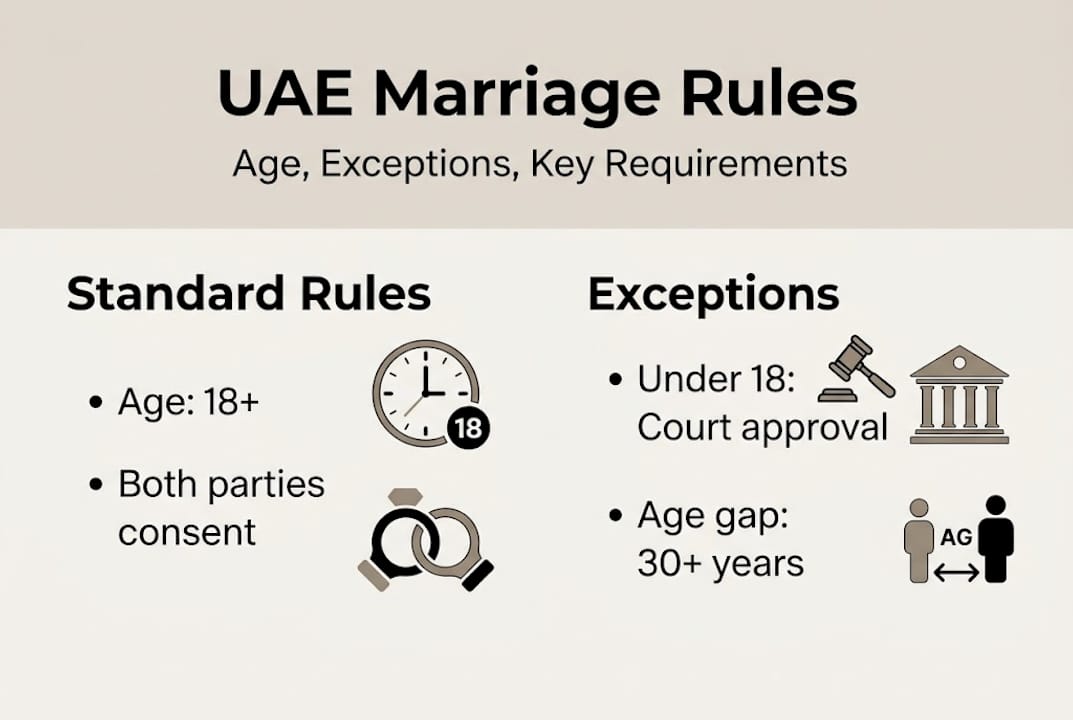
Minimum age is 18 for all marriages, regardless of religion or nationality
Marriage below 18 requires a court order before the ceremony can proceed
If the age gap between two partners exceeds 30 years, the court must also approve the union
Guardian objection or absence can also trigger mandatory judicial review
Requirement | Muslim (Sharia) marriage | Civil marriage |
Minimum age | 18 | 18 |
Below-18 exception | Court approval required | Court approval required |
Large age gap (30+ years) | Court approval required | Court approval required |
Guardian involvement | Required for women | Not required |
Medical screening | Mandatory | Not mandatory |
The age 18+ requirement applies uniformly to Muslim UAE nationals and Muslim expats, with no exceptions granted simply based on cultural practice. What surprises many couples is the 30-year age gap rule. This is not widely discussed in general wedding planning guides, yet it is a real legal trigger that adds a layer of court review to what might otherwise be a straightforward process.
Exceptions to the legal marriage age: Court approval process
Now that the standard rules are clear, it is crucial to understand what happens if you do not fit the standard age requirements. The UAE does allow marriage age exceptions under specific conditions, but the bar is deliberately high.
Under UAE legislation (2024), persons under 18, or those facing guardian objections, can only marry with explicit judicial authorization. This is not a rubber-stamp process. The court conducts a thorough review before issuing any approval.
Here is how the court approval process typically unfolds:
Submit a formal petition to the Personal Status Court with full documentation of both parties
Medical examination of the minor to confirm physical readiness and assess potential health risks
Psychological assessment to evaluate emotional maturity and readiness
Welfare review by the court, which may involve social workers or family counselors
Parental and guardian testimony reviewed to determine intent and circumstances
Final judicial ruling, which must explicitly confirm the marriage serves the minor’s best interest
“The UAE’s judicial process for underage marriage prioritizes the minor’s best interest through multi-disciplinary review, actively working to reduce culturally motivated early marriages.” UAE new rules on underage marriage
This multi-step process is not bureaucratic red tape. It reflects a deliberate policy choice to protect younger individuals from being pressured into marriage. Courts frequently reject petitions that do not meet a clear welfare standard.
The same level of scrutiny applies when the age gap between partners exceeds 30 years. In those cases, even if both parties are adults, the court examines whether the relationship is voluntary and free of coercion or financial exploitation.
Pro Tip: If you or your partner is under 18 or your age difference is over 30 years, start the court petition process at least 3 to 4 months before your planned wedding date. Approval timelines vary by emirate and case complexity.
Marriage document requirements for expats and foreign nationals
With the age and approval process outlined, couples need to know the paperwork required, especially expats who face extra documentation steps that nationals do not. Getting this right early prevents the most common wedding planning delays we see.

Expats must provide valid passports, Emirates IDs (for UAE residents), proof of single status such as a certificate of no impediment, and translated, attested versions of any non-Arabic documents.
Core documents required for most UAE marriages:
Valid passport copies for both parties
Emirates ID (for UAE residents)
Certificate of no impediment or single status certificate from your home country
Birth certificates (translated into Arabic where required)
Divorce decree or death certificate if either party was previously married
No-objection letter from your employer or sponsor (required by some emirates)
Document attestation is not optional. Any document issued outside the UAE must be authenticated by your home country’s relevant authority, then attested by the UAE embassy in that country, and finally attested by the UAE Ministry of Foreign Affairs. This chain of attestation confirms your documents are legally valid in the UAE.
Requirement | Civil marriage | Sharia marriage |
Passport | Required | Required |
Proof of single status | Required | Required |
Emirates ID | Required for residents | Required for residents |
Attested documents | Required | Required |
Medical screening | Not required | Mandatory |
Guardian (wali) presence | Not required | Required for women |
For UAE marriage documentation to be recognized when you return home, you may also need your marriage certificate attested by your home country’s embassy in the UAE. Many couples skip this step and face problems claiming spousal benefits, changing last names, or applying for family visas back home. Knowing about recognizing UAE marriage abroad before your wedding date protects you from avoidable complications later.
Premarital screening and additional legal requirements
Now that you know what paperwork is required, do not overlook health-related obligations and legal details that could impact your entire marriage process. These steps are easy to dismiss as formalities, but missing them can halt your registration entirely.
Premarital screening is mandatory for all Sharia marriages in the UAE. The screening checks for hereditary blood disorders like sickle cell anemia and thalassemia, as well as infectious diseases. Results do not legally prevent marriage in most cases, but both parties must be informed of the findings before the ceremony proceeds.
What you need to know about premarital screening:
Available at government hospitals and approved health centers across all emirates
Must be completed before the marriage contract is signed
Both parties attend separately for testing
Results are issued as an official premarital certificate, which you submit during registration
Recommended to complete at least 4 to 6 weeks before your planned wedding date
Civil marriages do not have a mandatory health check requirement. However, couples pursuing the civil marriage process still need to ensure all their documents are correctly translated, attested, and submitted in the right order. A missing attestation seal or an expired certificate of single status can push your registration back by weeks.
Research shows that premarital counseling benefits go beyond health checks, helping couples align on expectations and reduce early conflict. While not legally required, it is a step many couples who go through the UAE’s structured marriage process find genuinely valuable.
Pro Tip: Book your premarital screening appointment and start document translation at least two months before your wedding. Even a single missing document can delay your marriage registration and, by extension, your residency or visa applications.
Our take: What most guides miss about UAE marriage laws
Most articles on UAE marriage law reduce everything to a simple checklist: age 18, get your documents, done. That framing misses something important.
The court approval system for under-18 marriages and large age gaps is not a loophole. It is evidence of a legal framework that genuinely wrestles with protecting vulnerable individuals. The high threshold for approval, the multi-disciplinary review, and the welfare-centered standard mean that early marriages are not easily sanctioned. Media coverage often frames this issue as a cultural failing, but the legal architecture tells a different story.
For expats, the process can feel overwhelming. Multiple attestations, translated documents, and unfamiliar court procedures are a real challenge. But the reason for all of this is that the UAE wants every marriage registered on its soil to be legally airtight, both locally and internationally. Understanding the marriage steps for expats in full means you are not just completing a checklist. You are building a marriage that holds up legally in any country you might call home.
That is worth the extra paperwork.
Need help navigating UAE marriage requirements?
If you are planning a wedding in the UAE and the legal side feels like a maze, you are not alone. Most couples, especially expats, underestimate how much preparation goes into the documentation and registration process.

At Harris & Charms, we have helped couples from dozens of countries get legally married in the UAE without the confusion. Whether you are looking for civil marriage packages in Dubai or need support with the full spectrum of UAE marriage services, we handle the legal, logistical, and ceremonial details so you can focus on the moment itself. Ready to take the next step? Speak to one of our UAE marriage experts and get personalized guidance for your specific situation.
Frequently asked questions
Can you get married in the UAE if you are under 18?
Yes, but judicial approval is required before the marriage can proceed, and the court applies strict welfare standards to protect the minor involved.
Does the legal marriage age differ for expats and UAE nationals?
The minimum age is 18 for all parties regardless of nationality, though expats face additional documentation and attestation requirements that nationals do not.
Is premarital medical screening required for marriage in the UAE?
Premarital screening is mandatory for Sharia marriages but is not a legal requirement for civil marriages conducted through UAE courts.
What if my home country does not recognize my UAE marriage certificate?
You will likely need embassy attestation and correctly authenticated documentation to ensure your UAE marriage certificate is legally valid in your home country.
Recommended
Comments