
List of UAE Marriage Officiants: 2026 Guide for Couples


Getting married in the UAE involves choosing between civil and Sharia pathways, each with distinct officiants, requirements, and procedures. Civil marriages are accessible to non-Muslim expats and tourists, while Muslim couples must work with licensed Mazoons for a Sharia nikah, which has specific legal elements. Couples should treat legal registration and celebrant ceremonies as separate events, ensuring both are properly managed for a legally recognized and personalized wedding experience.
Getting married in the UAE is genuinely exciting. It’s also more layered than most couples expect when they first start searching for a list of UAE marriage officiants. The country runs two parallel legal frameworks: civil marriage for non-Muslims and some non-citizen Muslims, and Sharia marriage, which is mandatory for UAE Muslim nationals. Each pathway has its own authorized officiants, documentation requirements, and ceremony experience. Whether you’re an expat couple wanting a personalized celebrant ceremony or a Muslim couple navigating Sharia court procedures, knowing exactly who can legally marry you, and what they offer, saves you weeks of confusion.
Table of Contents
Key takeaways
Point | Details |
Two legal pathways exist | The UAE offers civil and Sharia marriage routes, each with distinct authorized officiants and eligibility rules. |
Civil courts are expat-friendly | Tourists and residents can marry at Abu Dhabi Civil Family Court without a UAE residency requirement. |
Sharia requires specific roles | A bride’s guardian (wali) and two male Muslim witnesses are legally mandatory for Sharia marriage registration. |
Celebrants add ceremony depth | Licensed wedding celebrants handle personalization and emotional storytelling beyond the court’s legal formalities. |
Costs differ significantly | Civil ceremony fees start around AED 300, while Sharia marriage costs vary by emirate and process. |
1. Understanding the list of UAE marriage officiants and who legally qualifies
Before you book anyone, understand that not all UAE wedding officiants hold the same legal authority. The UAE government authorizes specific individuals and institutions to conduct legally binding marriages. Booking a celebrant who is not legally authorized for your marriage type will leave you with a beautiful ceremony and no legal marriage certificate.
Civil and Sharia marriages represent two entirely separate systems. Civil officiants operate under civil law courts, primarily in Abu Dhabi and Dubai. Sharia officiants, known as Mazoons, are appointed by Islamic Affairs authorities in each emirate. Knowing which system applies to you is step one.
Pro Tip: If you are a non-Muslim expat, you almost certainly fall under the civil marriage pathway. Muslim couples who are UAE nationals must use the Sharia route, regardless of personal preference.
2. Key criteria for selecting the right officiant
Choosing from the list of wedding officiants UAE has to offer means filtering by several practical factors, not just personal feel. Here’s what matters most:
Legal recognition: Confirm the officiant is authorized by the relevant UAE court or Islamic authority for your specific marriage type.
Religious and cultural alignment: A Sharia Mazoon will not conduct a civil ceremony, and a civil court judge cannot perform a Sharia nikah. Match the officiant to your legal pathway.
Location: Dubai’s Personal Status Courts and Abu Dhabi’s Civil Family Court serve different areas. Some officiants travel; most operate within a fixed jurisdiction.
Language accessibility: The Abu Dhabi Civil Family Court provides ceremony proceedings in seven languages via pre-recorded voiceover, while private celebrants often offer live multilingual services.
Style preference: Court officiants follow formal, procedural scripts. Private celebrants craft fully personalized ceremonies. Both are valid; they serve very different emotional experiences.
Cost: Civil ceremony costs start around AED 300 at the court level. Private celebrant packages can range from AED 2,000 to AED 8,000 or more depending on inclusions.
Pro Tip: Book your court appointment first, then layer a private celebrant celebration on top if you want the emotional, personalized ceremony experience. Legal registration and celebration are two different events in the UAE, and the best couples treat them that way.
3. Profiled list of top civil marriage officiants in the UAE
Civil marriage is available to non-Muslims and some non-citizen Muslims, making this pathway the most commonly used by expat couples in the UAE. Here are the key civil officiants and institutions you need to know.
Abu Dhabi Civil Family Court: The gold standard for civil marriages in the UAE. This court accepts tourists, expats, and residents from other emirates, with no residency requirement. A ceremony takes approximately 15 minutes to complete, and no witnesses or medical tests are required. Fees start at AED 300. It is one of the most accessible civil marriage venues in the Gulf.
Dubai Personal Status Court (Non-Muslim Section): Handles civil marriages for Dubai residents who are non-Muslim. The process involves document submission, appointment booking, and a formal brief ceremony. Less flexible than Abu Dhabi’s court for non-residents, but fully recognized.
Darryl Rees (Dubai Wedding Celebrant): One of the best-known private marriage celebrants in UAE, Darryl Rees specializes in crafting personalized ceremonies that reflect each couple’s unique story. He offers vow writing support, symbolic rituals, and ceremonies in multiple languages. He does not replace the court process but elevates the celebration around it.
Wedding Celebrant Companies in Dubai: Several boutique celebrant agencies operate across Dubai, Abu Dhabi, and Ras Al Khaimah. These companies assign dedicated celebrant professionals who consult with you on vows, readings, and ceremony structure. They are especially popular with destination wedding couples who want ceremony customization the courts simply do not offer.
Embassy-Assisted Civil Ceremonies: Couples from certain countries can arrange civil marriages through their home country’s embassy in the UAE. British, American, and several European embassies have facilitated this for nationals. The resulting marriage certificate is recognized both in the UAE and back home, though the process timeline varies.
Harris and Charms Partner Officiants: Harrisandcharms works with a network of recognized civil officiants and celebrants across Dubai and Abu Dhabi, connecting couples directly to the right professional for their ceremony type, residency status, and style preference.
4. Profiled list of recognized Sharia marriage officiants in the UAE
For Muslim couples, particularly UAE nationals, the Sharia pathway is not optional. It carries specific procedural mandates that every authorized officiant must follow.
Mazoons (Licensed Sharia Marriage Officiants): Mazoons are government-appointed religious officiants authorized by the Islamic Affairs and Charitable Activities Departments of each emirate. They conduct the nikah contract, verify documentation, and record the marriage with the court. Every emirate has its own roster of licensed Mazoons.
Dubai Islamic Affairs Mazoons: Dubai’s Islamic Affairs department maintains a registry of Mazoons available for appointment. Couples apply through the Personal Status Court, and a Mazoon is assigned based on location and schedule.
Abu Dhabi Judicial Department Sharia Officiants: Abu Dhabi handles Sharia marriages through the Abu Dhabi Judicial Department. Like Dubai, they assign court-appointed officiants following strict procedural guidelines.
Sharjah, Ajman, and Northern Emirates Courts: Each emirate operates its own Sharia court system with appointed officiants. For couples outside Dubai and Abu Dhabi, the local Personal Status Court in the respective emirate is the correct starting point.
Regardless of which Mazoon conducts the ceremony, the legally mandatory elements remain constant: the bride’s guardian (wali) must be present, two male Muslim witnesses must attend, and a premarital medical screening must be completed. These are not suggestions. They are legal requirements. You can learn more about the full Islamic marriage registration process to prepare your documents correctly.
Some Mazoons also offer a degree of personal ceremony enrichment within the bounds of Islamic law, including short khutbahs (religious addresses), recitations, and culturally meaningful elements that make the nikah feel celebratory rather than purely administrative.
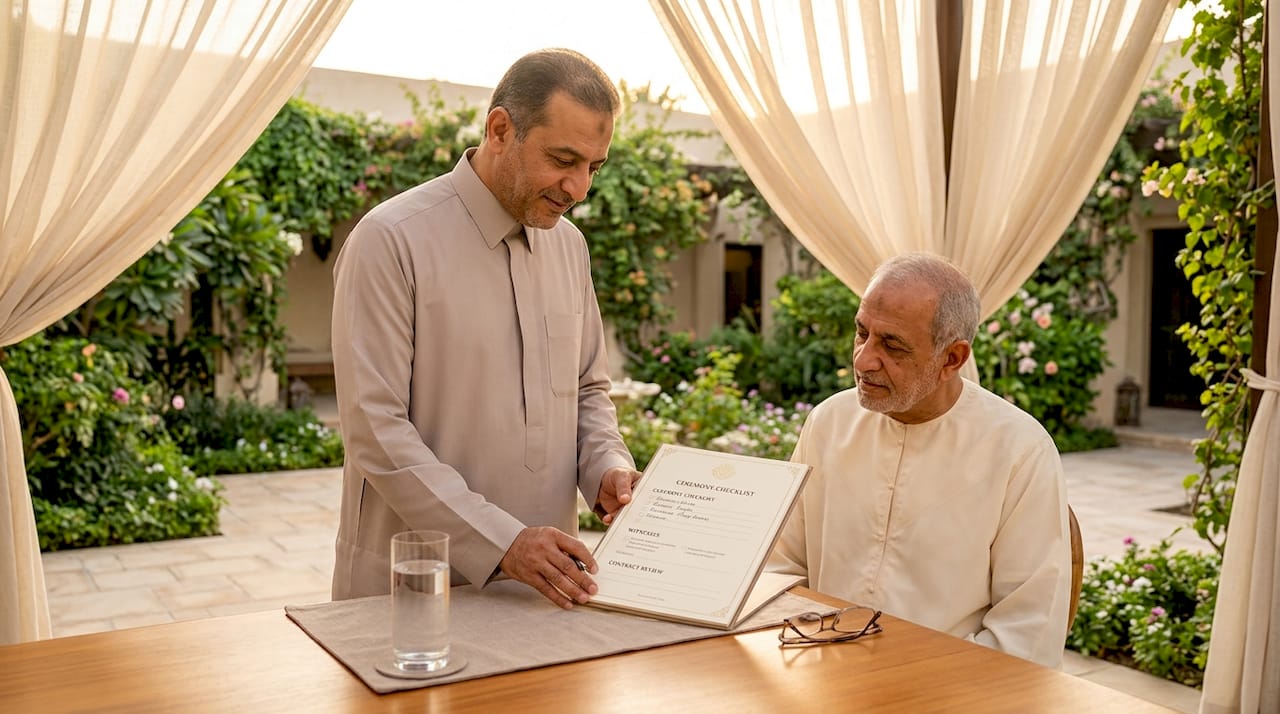
5. Civil vs. Sharia officiants: a side-by-side comparison
Category | Civil officiants | Sharia Mazoons |
Legal authority | UAE Civil Family Court | Islamic Affairs Department |
Who it applies to | Non-Muslims and eligible non-citizen Muslims | Muslim UAE nationals (mandatory); Muslim expats by choice |
Witnesses required | Not required | Two male Muslim witnesses (mandatory) |
Medical screening | Not required | Premarital screening required |
Ceremony duration | Approximately 15 minutes | Varies, typically 20 to 45 minutes |
Personalization options | Low (court); High (private celebrants) | Moderate within Islamic legal bounds |
Estimated base cost | From AED 300 | Varies by emirate court |
Language options | Seven languages available (Abu Dhabi) | Arabic primary; translation services available |
Best suited for | Non-Muslim couples, expats, destination weddings | Muslim couples, UAE nationals |
Pro Tip: Even if your legal marriage takes just 15 minutes at the court, there is nothing stopping you from planning a full celebrant ceremony at a venue of your choice that same weekend. Many UAE couples do both, and it works beautifully.
6. Situational guidance: which officiant fits your situation
Choosing the right officiant from the full list of UAE marriage officiants comes down to your specific circumstances. Here is a practical breakdown.
Muslim Emirati couples: You must use a licensed Mazoon through your emirate’s Sharia court. There is no civil alternative. Work with the Personal Status Court in your emirate to get assigned a Mazoon, and prepare your wali, witnesses, and medical screening documentation in advance.
Muslim expat couples: You have a choice. You may use a Mazoon for a Sharia marriage or, depending on your nationality and legal status, access the civil pathway. Many Muslim expat couples choose the civil route for its simplicity, then hold a separate religious celebration.
Non-Muslim expat couples: The Abu Dhabi Civil Family Court is your most accessible and affordable option. Foreigners and tourists can marry there without UAE residency, making it a popular choice for destination couples.
Mixed-religion or mixed-nationality couples: Civil marriage through the Abu Dhabi court or Dubai Personal Status Court (non-Muslim section) is the standard pathway. Adding a private celebrant to craft the ceremony around your shared story is highly recommended.
Couples prioritizing ceremony personalization: Hire a recognized private celebrant like those Harrisandcharms connects you with, and treat the court registration as a separate legal step. The celebrant’s role is to create the emotional experience; the court’s role is to create the legal record.
Couples on tight timelines: The Abu Dhabi Civil Family Court is your fastest option. With correct documentation, the entire ceremony can be completed in under an hour from arrival.
My honest take on choosing a UAE marriage officiant
I’ve worked with enough couples in the UAE to say this clearly: the biggest mistake people make is treating legal registration and the wedding ceremony as the same thing. They are not. They never have been, especially here.
The court process, whether civil or Sharia, exists to create a legal record. It is efficient, procedural, and largely impersonal by design. There is nothing wrong with that. What I’ve seen, though, is that couples who try to force emotional meaning out of a 15-minute court appointment end up disappointed. And couples who skip the legal step entirely because they only want the “real” ceremony end up with no official recognition of their marriage at all.
What actually works is treating them as two distinct events that serve two different purposes. Let the court do its job. Then let a skilled celebrant do theirs. The best marriage celebrants in UAE I have encountered don’t just read from a script. They sit with you, learn your story, and build a ceremony around it. That is where ceremony personalization becomes genuinely powerful.
My strong advice: do not shortcut either step. Get the legal side right first, then invest in the celebrant experience. You will be glad you did on both counts.
— Harris
How Harrisandcharms helps you find the right UAE officiant
Planning a wedding in the UAE, especially as an expat, means managing legal paperwork, court appointments, document attestation, and ceremony logistics at the same time. Harrisandcharms was built specifically to remove that pressure.

Through Harrisandcharms’s civil wedding packages in Dubai, you get matched with recognized civil officiants, receive full documentation support, and have a team managing your timeline from start to finish. For couples who want both legal registration and a personalized celebrant ceremony, the comprehensive marriage services cover both under one roof. Whether you are a local, an expat, or a tourist marrying in the UAE, the team at Harrisandcharms knows exactly how to find UAE officiants who are legally authorized, personally suited to your ceremony style, and ready to make your wedding genuinely meaningful. Reach out through the contact page to start your conversation today.
FAQ
Who can legally officiate a civil marriage in the UAE?
Civil marriages in the UAE are officiated by judges at the Abu Dhabi Civil Family Court or Dubai Personal Status Court (non-Muslim section). Private celebrants can lead personalized ceremonies but must work alongside the court process for legal recognition.
Do I need witnesses for a civil marriage in the UAE?
No. Civil marriages in the UAE do not require witnesses, unlike Sharia marriages, which legally require two male Muslim witnesses to be present.
Can tourists get married in the UAE without residency?
Yes. The Abu Dhabi Civil Family Court accepts both tourists and non-residents, making it one of the most accessible civil marriage venues in the region for destination and expat couples.
What is a Mazoon in the UAE?
A Mazoon is a government-licensed Sharia marriage officiant authorized by each emirate’s Islamic Affairs Department to conduct legally binding nikah ceremonies for Muslim couples in the UAE.
How much does a civil marriage ceremony cost in the UAE?
Civil marriage ceremony fees start at approximately AED 300 at the Abu Dhabi Civil Family Court. Adding a private celebrant for a personalized ceremony typically costs between AED 2,000 and AED 8,000 depending on services included.
Recommended
Comments