
What is a court wedding: a complete UAE guide


TL;DR:
Couples can be legally married in Abu Dhabi in as little as 15 minutes through a simple, secular court wedding process. This system serves non-Muslim expats and tourists without witnesses, religious ceremonies, or medical tests, offering internationally recognized certificates. The straightforward application requires minimal documentation and can be expedited with early planning, making it an efficient choice for diverse couples in the UAE.
Most couples assume that getting legally married in the UAE involves months of paperwork, religious approval, and navigating a maze of government offices. The reality of what is a court wedding in Abu Dhabi is dramatically different. You can be legally married in as little as 15 minutes, with no witnesses, no religious ceremony, and no medical tests. For the thousands of expat couples and tourists who choose the UAE as their backdrop for starting a legal union, the civil marriage route is fast, recognized globally, and far simpler than most people expect.
Table of Contents
Legal requirements and the application process for court weddings
Court wedding versus religious marriage in the UAE: key differences
Expert tips and common pitfalls when planning a court wedding in the UAE
Why court weddings are the preferred choice for many expat couples in the UAE
How Harris N Charms simplifies your court wedding journey in the UAE
Understanding court weddings in the UAE
A court wedding, also referred to as a civil marriage, is a legally binding marriage contract conducted through the Abu Dhabi Civil Family Court. It is entirely secular, meaning no religious component is required. Think of it as the legal version of “I do” without the church, mosque, or temple attached.
The civil marriage in Abu Dhabi system was designed specifically to serve the UAE’s large and diverse non-Muslim population. The country recognized early on that expats and tourists needed a legal pathway to marriage that did not conflict with their personal beliefs or nationalities. As a result, Abu Dhabi’s Civil Family Court offers civil marriage accessible to non-Muslim expats and tourists with no witnesses or religious ceremony involved.
What makes the court marriage definition unique in the UAE context is who it serves:
Non-Muslim expatriate couples living in the UAE
Tourists who want to get legally married during a visit
Interfaith couples who do not qualify for Sharia marriage
Couples of any nationality where at least one person is not a Muslim UAE national
The absence of witness requirements alone sets it apart from nearly every other marriage system in the Middle East. You walk in as two people, you walk out as a married couple with a government-issued certificate in hand.
Legal requirements and the application process for court weddings
Understanding the court wedding legal process starts with knowing exactly what documents you need and how the system flows. The good news is that the requirements are minimal compared to most countries.
What you need to bring:
Valid passport or Emirates ID for both parties
Proof of single status (a certificate of no impediment or its equivalent from your home country)
Divorce decree or death certificate if previously married, properly attested if the document is foreign
No medical tests, no guardian approval, no witnesses
The court wedding process requires that couples be at least 18 years old, provide passports or Emirates ID, submit proof of single status or divorce and death certificates, and pay the applicable fees, with no medical tests or guardian required.
Step-by-step application process:
Create a UAE Pass account (this is the digital ID system that grants access to government portals, including for tourists)
Log in to the Abu Dhabi Judicial Department (ADJD) portal
Complete the online marriage application form and upload your documents
Wait for court confirmation of your appointment
Attend the Abu Dhabi Civil Family Court in person on your scheduled date
Complete the short ceremony, sign the contract, and receive your marriage certificate
The online application through ADJD involves document upload, court confirmation, in-person ceremony, and issuance of your marriage certificate, all within a structured and predictable process.
Fees and timing:
Service type | Cost | Processing time |
Standard service | AED 300 | 10 working days |
Express service | AED 2,500 | 1 working day |
The express service also includes same-day certificate issuance, which is ideal for couples on tourist visas or those working around tight travel schedules. Express slots fill up quickly, so booking early is not optional.
Pro Tip: You can submit a prenuptial agreement during the online application stage at no additional cost. This is one of the most overlooked advantages of the civil process. It creates legal clarity around assets, debts, and inheritance from day one, which is especially important for couples with property or financial interests in multiple countries.
Court wedding versus religious marriage in the UAE: key differences
Knowing what happens at a court wedding only tells half the story. To make a fully informed decision, you need to understand where it stands relative to a Sharia marriage.
The civil vs Islamic marriage differences come down to legal framework, requirements, and who administers the union. A civil court wedding emphasizes free consent, a contract-based union, and handles family matters under civil law, rather than Sharia’s requirements.
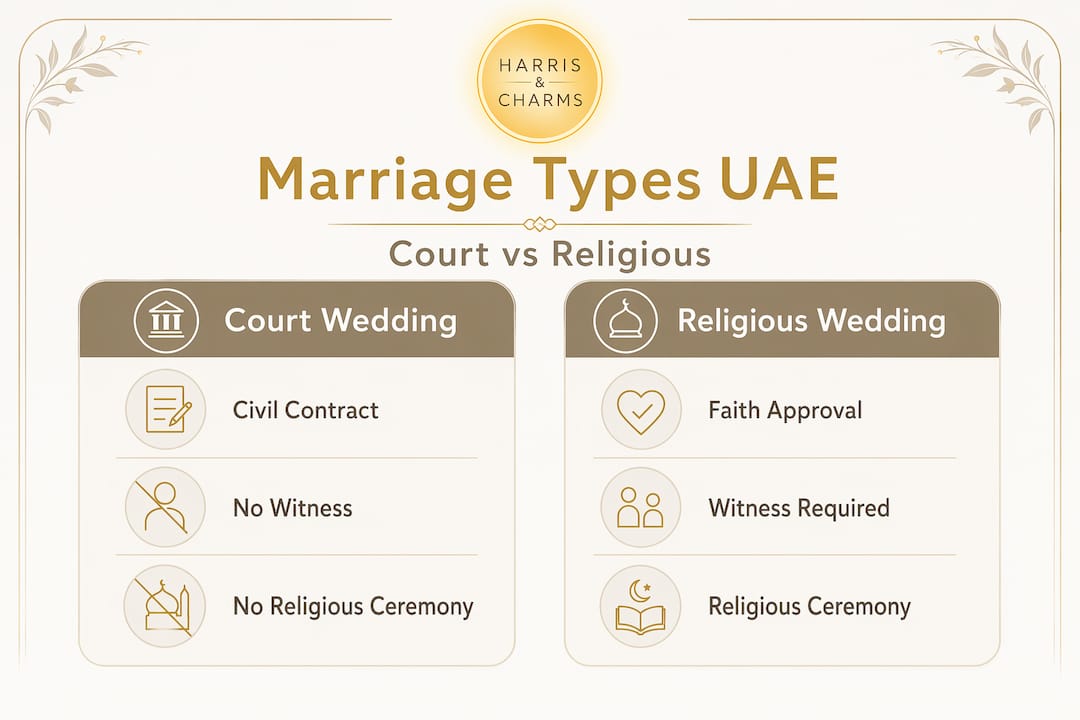
Here is a direct comparison:
Feature | Court (civil) wedding | Sharia marriage |
Religious ceremony | Not required | Required |
Witnesses | Not required | Required (male witnesses) |
Medical test | Not required | Often required |
Guardian (wali) consent | Not required | Required for female Muslim brides |
Eligible parties | Non-Muslim expats and tourists | Muslims, including Emirati nationals |
International recognition | Widely accepted | Accepted in Muslim-majority countries |
Residency requirement | Not required in Abu Dhabi | May apply depending on emirate |
Prenuptial agreement | Allowed at application | Not standard under Sharia |
The advantages of court marriage are clearest for expat couples who come from different religious backgrounds, or no religious background at all. There is no third party imposing conditions on your union. The entire process is grounded in mutual consent and legal contract, not doctrine.

Civil certificates also carry strong weight internationally. Most embassies, immigration departments, and foreign civil registries accept a UAE civil marriage certificate without additional religious validation. That matters enormously when you are planning to relocate, apply for spousal visas, or update financial and estate documents back home.
Expert tips and common pitfalls when planning a court wedding in the UAE
The court wedding process is straightforward, but couples consistently run into the same preventable problems. Knowing what they are puts you ahead.
Common mistakes and how to avoid them:
Skipping attestation: Applicants often overlook document attestation requirements and UAE Pass login for the online application, causing rejections or delays. Every foreign document must be attested by your home country’s foreign affairs ministry AND the UAE embassy in that country before submission.
Not setting up UAE Pass early: This step surprises tourists the most. You cannot access the ADJD application portal without a UAE Pass account. Set it up before you land, not the morning of your application.
Leaving express slots too late: The AED 2,500 express option sounds available on demand, but slots, especially Friday and weekend adjacent bookings, disappear fast.
Forgetting printed copies: The court may request both digital and physical copies of documents on ceremony day. Bring both.
Arriving late to the court: Security checks, document verification, and court check-in take time. Build in at least 30 to 45 minutes before your appointment.
The Abu Dhabi civil court marriage guide walks through these logistics in full, which is worth reviewing before your application date.
One thing many couples do not realize: you can personalize your court ceremony. You are allowed to exchange vows, wear formal attire, bring a photographer, and include a ring exchange. The court does not charge extra for any of this. It is a legal proceeding, but it does not have to feel like one.
Pro Tip: If you plan to use your marriage certificate abroad, request multiple certified copies on the same day as your ceremony. Getting additional attested copies later involves extra trips and fees. Ask for at least three to four copies at issuance.
Why court weddings are the preferred choice for many expat couples in the UAE
Here is an honest take that most guides skip over: the court wedding is not just a backup option for couples who do not qualify for religious marriage. For a large portion of expats in the UAE, it is genuinely the better choice.
The argument that traditional weddings carry more weight is largely cultural noise. A UAE civil marriage certificate carries the same legal standing as any other government-issued document. Embassies process it. Immigration authorities accept it. Banks update your records based on it. The legal certainty is identical.
What the civil route adds is something religious routes structurally cannot: the absence of preconditions based on faith. For interfaith couples, where one partner might be Christian and the other agnostic, or one Hindu and the other Jewish, the Sharia system has no pathway. The civil court does not ask those questions.
There is also a dignity argument worth making. Requiring a couple to obtain religious permission or guardian approval to marry, when those requirements conflict with their own values and legal traditions back home, creates a friction point that should not exist in a country that positions itself as a global hub for professionals and families. Abu Dhabi’s civil marriage system removes that friction entirely.
The non-Muslim marriage UAE legal pathways have matured significantly over the last few years, and the result is a system that treats marriage as a legal contract between consenting adults, plain and simple. Faster processing, no unnecessary gatekeepers, and a certificate your home government will recognize without question.
For expats building lives in the UAE, that combination of speed, legal clarity, and international acceptance is not a compromise. It is the right fit.
How Harris N Charms simplifies your court wedding journey in the UAE
Knowing the process and executing it correctly are two different things. Document rejections, attestation errors, and missed express slots are common, and each one costs time and money.

Harris N Charms specializes in guiding couples through every step of the court wedding process in the UAE. From confirming your documents are properly attested, to setting up your UAE Pass, to coordinating your Abu Dhabi Civil Family Court appointment, the team handles the complexity so you focus on the moment itself. We offer personalized support for cross-cultural and interfaith couples, multiple attested marriage certificate copies for immigration and visa use, and direct coordination with Abu Dhabi courts for express bookings. Explore the full range of comprehensive marriage services or reach out directly to contact Harris N Charms and start your process today.
Frequently asked questions
Who is eligible for a court wedding in the UAE?
Non-Muslim expatriates and tourists are eligible, provided at least one party is not a UAE Muslim citizen. Muslim Emirati nationals are directed to Sharia marriage routes administered through separate courts.
How long does the court wedding process take in Abu Dhabi?
The express service processes in one working day with a 15-minute marriage ceremony, while the standard service takes approximately 10 working days, with certificates issued the same day in both cases.
What documents are required for a court wedding in Abu Dhabi?
You need a valid passport or Emirates ID and proof of single status, plus divorce or death certificates if applicable. No medical test or guardian consent is required, but any foreign documents must be properly attested before submission.
Can tourists get married through a court wedding in the UAE?
Yes. Tourists can complete the online application from outside the UAE and travel to Abu Dhabi for their ceremony. Note that Dubai civil marriage requires at least one partner to hold Dubai residency, which makes Abu Dhabi the more accessible option for visitors.
Do court weddings in the UAE require witnesses or a religious ceremony?
No. Civil marriages in the UAE do not require witnesses or any religious ceremony, which makes the process simpler and fully secular compared to Sharia-based marriage registration.
Recommended
Comments