
Sponsor Your Spouse in UAE on AED 4,000 Salary: What to File First
- haris haneef
- 2 days ago
- 11 min read


Yes, if you hold a valid UAE residence visa, you can sponsor your spouse. Three things decide whether the application moves forward: your residence status and Emirates ID validity, a minimum monthly salary of AED 4,000 (or AED 3,000 with employer-provided housing), and proof of adequate accommodation through Ejari or a title deed. Start attesting the marriage certificate immediately and confirm whether ICP or GDRFA handles your emirate before you file anything else.
TL;DR:
Golden Visa and Green Residence holders face fewer requirements and do not need to meet the national minimum salary threshold for spouse sponsorship.
Attestation delays and mismatched documentation, especially for marriage certificates, are the main causes of processing delays across all emirates.
Sponsorship eligibility depends on documents proving valid residence status, a minimum salary, and adequate accommodation, with stricter enforcement in some emirates.
The entire sponsorship process, including medical tests and visa stamping, typically takes 3 to 7 working days, but attestation can add several weeks if not started early.
If the sponsor changes jobs or loses employment, the spouse’s visa can be affected within a 30-day grace period, and ongoing compliance with minimum financial requirements is essential for renewal.
Table of Contents
Who Qualifies for UAE Spouse Sponsorship?
Eligibility hinges on your residence visa and Emirates ID both carrying at least six months of remaining validity at the time you apply. Both employees and employers can act as sponsor, and job title alone no longer disqualifies anyone. What matters is documented salary and a legitimate place to live.
The salary threshold sits at a minimum level of a few thousand dirhams per month, dropping if your employer provides accommodation as part of your package. Practical enforcement varies slightly by emirate. Dubai’s GDRFA and the federal ICP system both apply the same baseline figures, but the paperwork proving income (a WPS-verified salary certificate versus a self-employed bank statement) gets scrutinized differently depending on whether you’re salaried, a business owner, or working through a free zone.
Housing proof usually means an Ejari tenancy contract registered in your name, or a title deed if you own property. Employer-provided accommodation counts too, but you’ll likely need a formal letter from HR confirming it. If your Ejari has a gap or your name isn’t on it, a recent utility bill paired with an employer accommodation letter sometimes bridges that gap, though you should confirm acceptance with your specific emirate authority before relying on it.
Two groups get a notably easier path:
Golden Visa holders are exempt from the standard minimum-salary rule entirely, along with more flexible sponsorship terms overall.
Green Residence holders also benefit from relaxed requirements compared to standard employment visas.
Investors and free-zone owners often qualify through business ownership documentation rather than a salary slip.
If you’re already holding a Golden Visa for property investment, business ownership, or specialized talent, this is one of the few places where UAE bureaucracy actually works in your favor.
What Documents Do You Need to Sponsor a Spouse?
Get the paperwork right the first time. Resubmissions cost more in delay than almost anything else in this process.
Sponsor’s documents:
Passport copy and current UAE residence visa page
Emirates ID (front and back)
Salary certificate on company letterhead or labor contract, ideally backed by WPS records
Ejari tenancy certificate or property title deed
A recent utility bill, if the receiving authority requests one
Spouse’s documents:
Passport valid for at least six months, plus recent passport-sized photos
Marriage certificate, attested and translated into Arabic by a certified translator
Proof of health insurance coverage
Copies of any prior UAE visas the spouse has held
The attestation chain is where most applications stall. It runs through multiple official steps including authorization in the issuing country, UAE embassy attestation, UAE Ministry of Foreign Affairs attestation, and a certified Arabic translation inside the UAE. Skip a step, and the whole chain gets rejected at the next one.
Pro Tip: Double-check that the spelling of both names on the marriage certificate matches the spelling on both passports exactly. A single transposed letter between “Mohammed” and “Muhammad” has derailed more applications than any missing document ever has.
For a fuller breakdown of what to gather before you start, this 7-step checklist for UAE marriage documents walks through the sequence in more detail.
How Do You Apply for a UAE Spouse Visa Step by Step?
Where you file depends entirely on which emirate issued your residence visa. Dubai residents go through GDRFA (General Directorate of Residency and Foreigners Affairs), either online or via an Amer center for in-person support. Everyone else, including Abu Dhabi and the Northern Emirates, applies through the federal ICP (Federal Authority for Identity and Citizenship) smart services portal. Authorized typing centers exist in every emirate if you’d rather not navigate the portals yourself.
The sequence looks like this:
Open the sponsor file and apply for an entry permit. Upload the sponsor’s Emirates ID, salary proof, and Ejari, and pay the file-opening fee.
Bring the spouse in on the entry permit (or adjust status if already in the UAE), then book the medical fitness test. Anyone 18 or older must complete this, typically a blood test and chest X-ray at an approved government health center.
Apply for the Emirates ID and attend the biometric appointment, usually scheduled right after medical clearance comes through.
Get the visa stamped into the spouse’s passport. Validity is tied to how long the sponsor’s own residency runs, not a fixed standalone term.
Miss the medical test window and the whole file goes on hold until it’s rescheduled, so book it the same week the entry permit clears.
What Does Spouse Sponsorship Cost and How Long Does It Take?
Four fee categories make up most of the bill: the entry permit, the file-opening fee, the Emirates ID, the medical fitness test, and final visa stamping. Exact amounts shift slightly by emirate and visa duration, so treat any number you see online as a starting estimate rather than a quote.
When documents are complete, processing from submission to Emirates ID delivery commonly takes 3 to 7 working days. Attestation, though, is a separate clock entirely and can add several weeks on top of that if you haven’t started it in advance.
What stretches a timeline beyond that window almost always traces back to one of three things:
Marriage certificate attestation still in progress when the visa file is submitted
Ejari missing, expired, or not matching the sponsor’s name
Name spelling mismatches between passport, Emirates ID, and marriage certificate
If your timeline is tight, a paid fast-track service or filing through an experienced agency can shave days off the government-side steps, though nothing speeds up attestation happening in another country.
Why Does Marriage Certificate Attestation Cause So Many Delays?
Attestation is sequential by design, which means every step has to finish before the next one starts. There’s no way to parallelize it, and that’s exactly why it’s the single biggest bottleneck in spouse sponsorship applications.
The most common mistakes: starting attestation only after the entry permit is already filed, using a translator who isn’t certified for legal documents, letting name spellings drift between the original certificate and the UAE-side translation, and assuming an employer will produce salary documentation on short notice when payroll teams often need a week or more.
Start the attestation chain the moment you know you’re sponsoring, not after the entry permit is submitted.
Confirm your translator holds certification recognized by the UAE Ministry of Foreign Affairs before paying for translation.
Build in extra lead time for countries where consular attestation isn’t fast, particularly outside major capital cities.
Pro Tip: If your home country isn’t part of the Hague Apostille Convention, budget at least two to three extra weeks purely for the embassy attestation step before the document even reaches UAE MOFA.
Harris & Charms coordinates this exact chain for clients regularly, and the marriage certificate attestation guide for Dubai breaks down country-specific attestation routes if yours isn’t straightforward.
Are There Age Limits for a Sponsored Spouse?
The relationship itself, not the spouse’s age, is what UAE authorities scrutinize most closely. There’s no separate minimum age for the spouse beyond legal adulthood, but the marriage certificate has to reflect a legally recognized union. Authorities may request additional documentation if the marriage was registered outside the UAE and the certificate format looks unfamiliar to reviewing officers.
Same-sex spouses aren’t eligible for sponsorship under current UAE family law, which recognizes only marriages between a man and a woman for residency purposes. Polygamous marriages carry their own documentation requirements, since UAE law permits sponsoring multiple wives under Islamic family law provisions, but each requires separate proof of the marriage and separate housing adequate for the household.
One detail that trips people up: if the marriage happened very recently, some reviewing officers ask for supporting evidence beyond the certificate itself, such as wedding photos or a residency history showing the couple lived together before applying. This isn’t a universal rule, but it shows up often enough in Dubai and Abu Dhabi processing that it’s worth having on hand rather than scrambling for it after a request comes in.
How Long Is the Spouse Visa Valid and How Do You Renew It?
A sponsored spouse’s residence visa runs on the same clock as the sponsor’s own visa, typically issued for one, two, or three years depending on the sponsor’s employment or investor status. It isn’t a fixed standalone term. When the sponsor’s residency renews, the spouse’s visa renews alongside it, and when the sponsor’s visa lapses or gets cancelled, the spouse’s status is directly affected.
Renewal follows a similar document trail to the original application: an updated salary certificate, a current Ejari or title deed, and Emirates ID renewal for both parties. The marriage certificate attestation doesn’t need to be redone once it’s on file, which is one small mercy in an otherwise document-heavy process.
Start renewal paperwork at least 30 days before expiry. Overstaying past the visa’s expiry date triggers fines that accumulate daily, and a lapsed visa complicates future renewals even after the fine is paid. If your own residency status is changing, whether a new employer, a new investor visa, or a Golden Visa upgrade, the spouse’s file needs to be updated in step, not left to catch up later.
What Can a Sponsored Spouse Do and Not Do in the UAE?
A sponsored spouse’s residence visa grants the right to live in the UAE, but employment isn’t automatic under that status alone. To work legally, the sponsored spouse needs a separate work permit tied to an employer, which the employer typically sponsors through the Ministry of Human Resources and Emiratisation once a job offer is in hand. Working without that permit, even for a sponsoring spouse’s own household or business, breaches visa conditions.
Studying is more straightforward. A sponsored spouse can enroll in university or vocational programs without needing a separate student visa, since the residence visa already permits it.
Healthcare access requires separate health insurance, which is mandatory in every emirate regardless of sponsorship status. Owning property, opening a bank account, and holding a driving license all remain available to a sponsored spouse independent of the sponsor, though banks sometimes request the sponsor’s salary documentation for larger transactions or loan applications.
The restriction that catches people off guard most often: a sponsored spouse’s legal status in the country is entirely dependent on the sponsor’s visa remaining active. There’s no independent standing until the spouse secures their own employment visa or another qualifying residency route.
What Happens if the Sponsor Loses Their Job or Changes Employers?
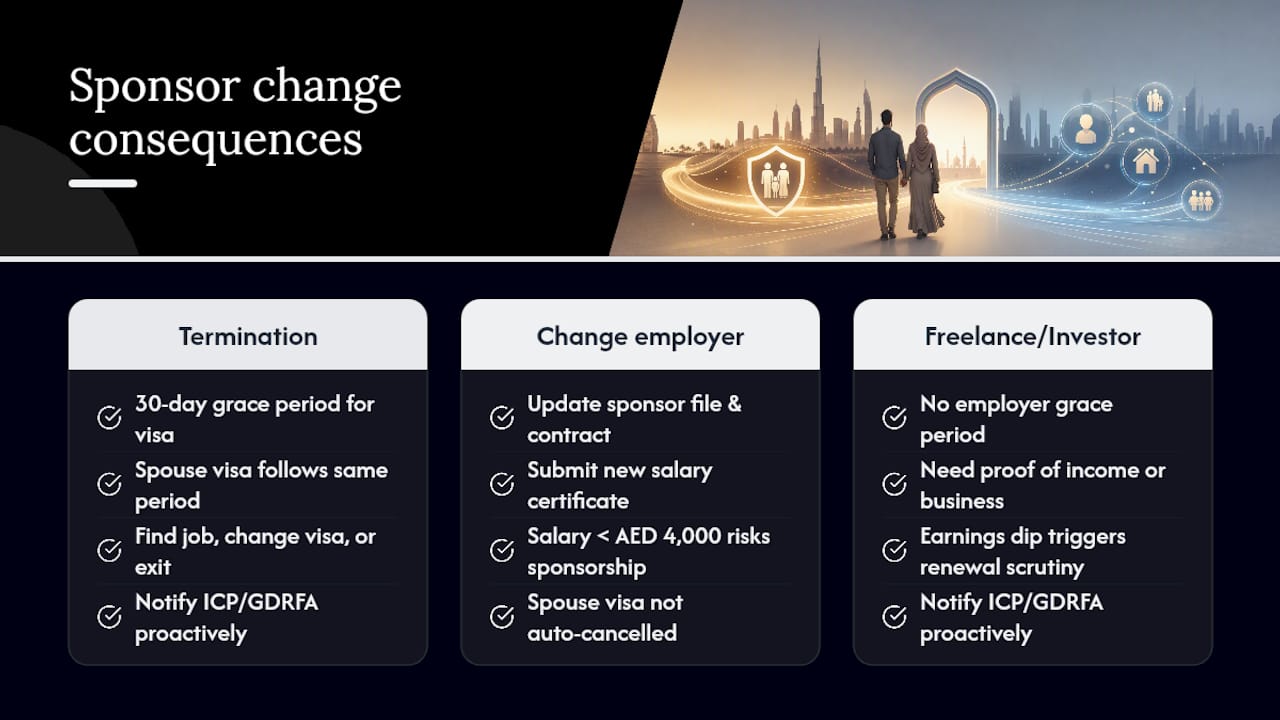
A sponsor’s employment status directly controls whether the spouse’s visa remains valid, and this is where a lot of families get caught off guard. If a sponsoring employee is terminated or resigns, their residence visa typically enters a grace period, commonly 30 days, during which they need to secure new employment, switch to another visa category, or leave the country. The spouse’s visa is tied to that same grace period.
Changing employers doesn’t automatically cancel the spouse’s visa, but it does require updating the sponsor’s file with the new employment contract and, in most cases, a new salary certificate showing the updated income still clears the minimum threshold. If the new salary falls below AED 4,000 (or AED 3,000 with accommodation), the spouse’s sponsorship eligibility comes into question even if the visa hasn’t formally lapsed yet.
Freelance visa holders, investors, and business owners face a slightly different risk profile: instead of an employer-driven grace period, their sponsorship eligibility depends on continued proof of income or active business registration. A dip in verifiable earnings, even without a formal “termination,” can trigger the same scrutiny at renewal time.
The safest move if your employment situation is shifting: notify the relevant portal (ICP or GDRFA depending on your emirate) proactively rather than waiting for a renewal cycle to flag the mismatch.
When Does UAE Spouse Sponsorship Get Cancelled?
Cancellation happens most often for one of three reasons: the sponsor’s own residence visa is cancelled or expires without renewal, the sponsor and spouse divorce, or the sponsor fails to meet the minimum salary and housing requirements at renewal.
Divorce is the most legally complex trigger. Once a divorce is finalized, the sponsor is required to report it, and the former spouse’s visa is cancelled, typically with a grace period (commonly 30 days) to arrange alternative status, whether through new employment, a different sponsor, or departure from the UAE.
Deportation is a separate, more severe outcome, generally reserved for cases involving fraudulent documentation, misrepresentation during the sponsorship application, or a criminal conviction. Submitting a forged marriage certificate or falsified salary documentation doesn’t just get an application rejected; it can result in a ban from future UAE entry for both parties.
If a sponsor’s visa is cancelled voluntarily (resignation without immediate re-employment, for instance), the spouse’s visa is cancelled simultaneously, and both parties typically have the same grace period to regularize status or exit the country.
What Harris & Charms Sees Most Often in Spouse Sponsorship Cases
Attestation delays and mismatched documentation account for the overwhelming majority of the slowdowns we help couples untangle. Harris & Charms works alongside couples navigating UAE marriage and residency paperwork, coordinating the attestation chain, preparing Ejari and salary documentation to the exact format each portal expects, and submitting through whichever channel (ICP or GDRFA) actually applies to the sponsor’s emirate.
What consistently makes the difference isn’t luck. It’s sequencing: getting the marriage certificate into the attestation pipeline before the entry permit is filed, not after. Clients who start that way tend to avoid the resubmission cycle that eats up weeks for everyone else. It’s also why we handle document prep and medical/biometric scheduling as one coordinated process rather than three separate errands.
— Harris
Get Help With Your UAE Spouse Visa Application
Doing this yourself is entirely possible, and everything above gives you the real sequence. But attestation coordination, Ejari verification, and portal submission eat weeks when you’re juggling a full-time job and a growing document pile, and one mismatched name spelling can send you back to square one. Harris & Charms handles the entire spouse-sponsorship package end to end: attestation coordination across the full chain, a document checklist matched to your specific emirate’s portal, submission through ICP or GDRFA, and scheduling for medical fitness and Emirates ID biometrics.
Fees for done-for-you support run higher than filing everything yourself, but for most couples the trade is straightforward: fewer resubmissions, no guessing which attestation office to call next, and a fixed sequence instead of an open-ended one. Harris & Charms also handles the marriage registration and documentation side for couples applying under the Golden Visa track, along with wedding planning, event photography, and yacht wedding packages for couples marrying in the UAE. If you’re ready to start, get in touch through the comprehensive marriage services page and tell the team where you are in the process. Our companion piece on the UAE spouse visa and family residence process is worth a read first if you want the fuller timeline before you call.
Where to Verify UAE Spouse Sponsorship Rules Directly
Cross-check anything time-sensitive against the source before you file. ICP (icp.gov.ae) handles federal, Abu Dhabi, and Northern Emirates submissions and lists current document requirements. GDRFA (gdrfad.gov.ae) governs Dubai-specific procedures, with Amer centers available for in-person help. u.ae consolidates official guidance across all emirates in one place, and DIAC publishes practical advisory content on Golden Visa and family sponsorship exceptions worth reading alongside the official pages.
Recommended
Comments