
Get Your UAE Spouse Visa Approved First Time: Attest Then Translate

Updated: Sep 14

Foreign marriage certificates must be attested in the country of issue, either through an apostille or an embassy chain, and then translated into Arabic by an MOJ-licensed translator before GDRFA or ICP will accept them for a spouse visa. Skip a step or reverse the order, and the file gets bounced. The Ministry of Justice (MOJ), the Ministry of Foreign Affairs (MOFA), and GDRFA/ICP each check a different link in that chain, and the sponsor’s salary eligibility still has to clear separately.
TL;DR:
Attestation must be completed in the correct order, starting with apostille or embassy verification, then MOFA stamping, before translating the document with an MOJ-licensed translator.
Marriage certificates issued within the UAE typically do not require attestation, but religious marriages not civilly registered may need additional civil verification steps.
Submitting documents with name mismatches, incorrect attestation sequencing, or non-MOJ-certified translations is the main cause of visa rejections and delays.
Costs for attestation and translation vary by country, with apostille processing taking several days and translations priced per page, requiring careful budget planning.
Using unlicensed translators or skipping verification of the attestation chain frequently results in rejections, so verify licenses and follow recommended procedures closely.
Table of Contents
The Correct Attestation Sequence: Apostille, Embassy, MOFA, Then Translation
Why GDRFA And ICP Reject Spouse Visa Files (And How To Avoid It)
What Attestation And MOJ Translation Actually Cost, And How Long They Take
Harris & Charms’ Practical Checklist For Getting This Right The First Time
Have Attestation And Translation Procedures Changed Recently?
Certified Translator Or Notarized Translation: What’s The Difference?
Let Harris & Charms Handle The Paperwork While You Focus On The Wedding
Document Checklist For A UAE Spouse Visa Translation
Every spouse visa file splits into two piles: the sponsor’s paperwork and the spouse’s paperwork. Only some of it needs translation, and only one document in the whole stack needs the full attestation plus MOJ-translation treatment.
Sponsor documents:
Valid passport and Emirates ID copies (no translation needed if already in English or Arabic)
Salary certificate from the employer, translated into Arabic only if issued in a third language
Ejari or Tawtheeq tenancy contract proving suitable accommodation
Recent bank statements, translation-only (no attestation) if issued abroad in a language other than English or Arabic
Spouse documents:
Passport copy and recent photograph
Foreign marriage certificate, which is the document that must be attested in the country of issue and then translated into Arabic by an MOJ-licensed translator
Entry permit or current visa status page, if already in the UAE
Marriage certificates issued inside the UAE by a UAE court typically arrive already in Arabic or bilingual format, so they skip the attestation chain entirely. Religious-only marriages carry an extra wrinkle: if the ceremony was never civilly registered in the country where it happened, GDRFA may ask for civil registration or a court confirmation before it will even look at a translation. Divorce history from a prior marriage sometimes needs its own attested and translated decree if the sponsor or spouse was previously married, since GDRFA cross-checks marital history against national ID records in some nationalities.
The practical rule of thumb: if a document proves identity, income, or housing and was issued in English, you usually just submit it. If it proves a foreign civil status (marriage, divorce, birth in some cases), assume it needs the full attestation and MOJ translation treatment unless a Harris & Charms coordinator or the GDRFA checklist tells you otherwise for your specific nationality.
The Correct Attestation Sequence: Apostille, Embassy, MOFA, Then Translation
Getting this order wrong is the single most common reason spouse visa files stall for weeks. Translation has to come last, after every attestation stamp is in place, because an MOJ translator is certifying the accuracy of a document that authorities already recognize as legitimate. Translate first and you’ll likely pay for the translation twice.
Determine your country’s attestation route. If your marriage certificate was issued in a country that’s part of the Hague Apostille Convention, you get a single apostille stamp from the designated authority in that country. If your country isn’t part of that convention, you need embassy attestation instead, meaning the document goes to your home country’s foreign ministry, then to the UAE embassy or consulate in that country.
Complete the attestation in the country of issue first. This step happens before the document ever reaches the UAE. Skipping it, or attempting to substitute a notary stamp for a genuine apostille or embassy attestation, is a guaranteed rejection.
Get the UAE Ministry of Foreign Affairs (MOFA) stamp once the document is in the UAE. MOFA reviews the apostille or embassy attestation and adds its own stamp, confirming the UAE recognizes the foreign legalization. This step happens locally, usually through an authorized service center.
Hand the MOFA-stamped original, plus a clear copy, to an MOJ-licensed translator. The translator needs to see the attestation stamps physically on the page, not just the certificate text, because the Arabic translation typically includes a line referencing the attestation.
Verify every stamp is legible and in the correct order before submission. A missing MOFA stamp on an otherwise apostilled document is one of the most common gaps applicants miss, since the apostille alone doesn’t satisfy UAE requirements without that additional MOFA layer.
Translating before attestation causes rejection because the MOJ translator has no attestation to reference, and GDRFA will not accept a translation of an unattested certificate no matter how accurate the wording is.
How To Find A Legitimate MOJ-Licensed Arabic Translator
Every licensed legal translator in the UAE carries a Ministry of Justice registration number, and that number should appear directly on the translation stamp, not buried in a separate document. Legitimate offices display this openly, and you can ask to see it before you commit.
What a proper deliverable includes:
A stamped hard copy bearing the translator’s name, MOJ registration number, and official seal
A signed statement from the translator attesting to the accuracy of the Arabic text
A clean, submission-ready PDF version for online GDRFA uploads
The translation physically referencing or attached to the attested original, not a photocopy alone
Turnaround varies. Standard service for a single marriage certificate often runs a couple of business days, while express or same-day service is common for straightforward documents once the attestation is already complete. Some providers advertise guarantees around MOJ acceptance, but that guarantee only holds if the attestation chain was correct before the document reached them.
Pro Tip: Before handing over your certificate, check that the spelling of names on the marriage certificate matches your passport exactly. If it doesn’t, tell the translator upfront so they can add a formal note aligning the two, rather than finding out after GDRFA flags the mismatch.
Prepare your passport, the fully attested original, and a legible scan before you walk in. A rushed handoff with missing pages is the easiest way to add an extra day to a translation that should have taken hours.
Why GDRFA And ICP Reject Spouse Visa Files (And How To Avoid It)
Name mismatches, wrong attestation order, and incomplete stamps account for most of the rejections applicants run into, and each one is preventable with a five-minute check before submission.
Name mismatch between certificate and passport: married names, maiden names, or missing middle names create discrepancies GDRFA officers flag immediately; ask your translator to add an explanatory note mapping the certificate name to your passport name.
Wrong attestation order: translating before MOFA stamping, or submitting an apostille without the required UAE MOFA layer, sends the file back for rework.
Religious-only marriage without civil registration: if your marriage was never civilly registered in the country it happened, confirm with GDRFA or a Harris & Charms coordinator whether the religious certificate alone will be accepted before you pay for translation.
Missing originals or partial attestation: submitting a scan of an attestation stamp instead of the physically stamped original, or attesting only part of a multi-page certificate, both trigger a request for resubmission.
Officials commonly cite incorrect or uncertified translations as a leading cause of GDRFA delays on family visa files, and that single category covers a wide range of avoidable mistakes, from expired translator licenses to certificates translated before attestation was complete. Running through this list before you submit anything catches most of them.
What Attestation And MOJ Translation Actually Cost, And How Long They Take
Budget both time and money in stages, because attestation, MOFA stamping, and MOJ translation are billed and scheduled separately.
Country-of-origin attestation: apostille processing in Hague countries often takes a few business days by mail or courier; embassy attestation in non-Hague countries tends to run longer, sometimes one to three weeks depending on how many ministry layers are involved.
UAE MOFA stamping: typically a same-day to next-day service once the attested document is physically in the UAE.
MOJ-certified translation: priced per page, with Typical translation turnaround varies, with some providers offering faster service options for urgent cases.
Courier and handling fees: add these in if your certificate needs to travel internationally for embassy attestation before it ever reaches UAE soil.
Bundling attestation checks with your translation order, rather than handling each step with a separate provider, tends to cut down on the back-and-forth that adds days to a file. Be cautious of any provider promising a blanket refund or unconditional acceptance guarantee. Most legitimate guarantees are conditional on the attestation chain being correct before translation starts, and a provider that doesn’t mention that condition at all is worth a second look.
Submitting Your Translated Certificate To GDRFA/ICP
Once your marriage certificate is fully attested and translated, how you submit it depends on whether you’re applying from outside the UAE or changing status while already inside the country.
Choose the right application path. Applicants outside the UAE typically apply for an entry permit first, with the attested and translated certificate uploaded as part of that initial request. Spouses already in the UAE on another visa status often apply for an in-country status change instead, using the same document set.
Upload scanned PDFs for initial review. GDRFA and ICP portals generally accept clear PDF scans for the first submission stage, but keep the physical stamped originals on hand, since visa stamping and Emirates ID processing later in the process usually require them in person.
Complete post-approval steps. Once the entry permit or status change is approved, expect a medical fitness test, Emirates ID application, and final visa stamping, each with its own short processing window.
Track status and respond quickly to requests. If an officer flags a document, usually a translation discrepancy or a missing stamp, resolving it fast keeps the rest of the timeline from slipping. Most portals show a status update within a few business days of each submission stage.
Harris & Charms’ Practical Checklist For Getting This Right The First Time
Handling document prep for couples across the UAE has shown us the same three failure points over and over: wrong attestation order, name mismatches, and translators without a valid MOJ registration. Here’s the sequence we walk clients through:
Confirm which attestation route your certificate needs (apostille or embassy) based on the issuing country
Cross-check every name spelling against the passport before translation begins
Coordinate the MOJ-certified translation only after MOFA stamping is confirmed
Arrange courier handling for documents still moving between countries
Follow up on the GDRFA/ICP submission and respond to any officer requests on your behalf
Our team reviews documents before they go anywhere near a translator, checks the attestation chain against GDRFA’s current requirements, and coordinates with translation partners directly so nothing gets translated out of order. If you’re also planning the celebration side, from a civil ceremony to a yacht wedding, we handle that alongside the paperwork so you’re not juggling two separate providers.
Do Nationality Or Country Of Marriage Change The Rules?
The core sequence, attestation then MOJ translation, applies regardless of nationality, but the attestation route itself depends entirely on where the marriage certificate was issued. A certificate from a Hague Convention country gets a single apostille stamp and moves relatively fast. A certificate from a country outside that convention needs full embassy attestation, which usually means routing the document through your home country’s foreign ministry and then the UAE embassy or consulate there, a process that takes noticeably longer.
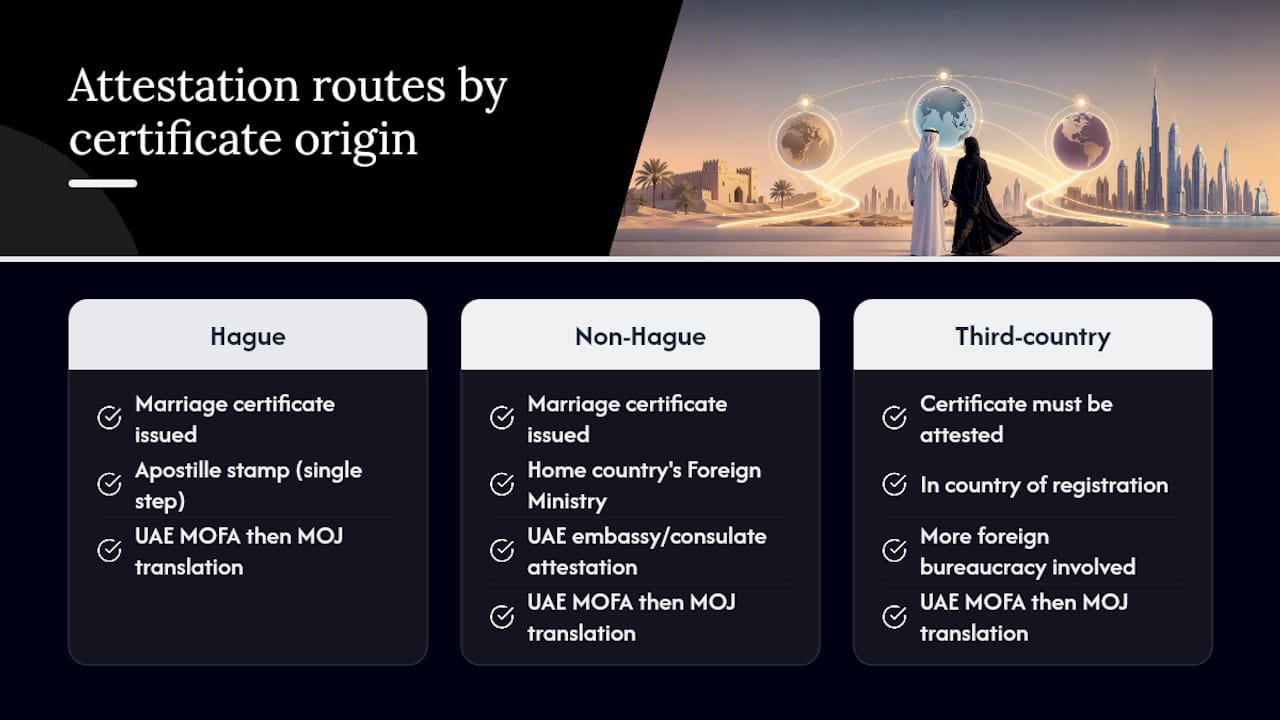
Marriages that took place abroad but between two nationals of a third country add another layer: the certificate has to be attested in the country where the marriage was actually registered, not necessarily either spouse’s home country. This trips up a fair number of applicants who assume their embassy of nationality can attest a document issued somewhere else entirely.
Religious marriages performed abroad carry the extra requirement mentioned earlier: confirm the marriage was civilly registered in that country, because a religious ceremony without civil registration often isn’t recognized as a valid marriage certificate for attestation purposes at all. Couples who married in a country neither spouse is a citizen of should expect the attestation process to take longer simply because more foreign bureaucracy is involved before the document ever reaches UAE MOFA.
Have Attestation And Translation Procedures Changed Recently?
Processing windows for embassy attestation and MOFA stamping have generally sped up as more services move online, with several UAE government portals now accepting digital submissions at earlier stages than they used to. That shift reduced the need for in-person visits at certain steps, though physical stamped originals are still required later in the process, particularly at visa stamping.
Some countries expanded their apostille eligibility in recent years by joining the Hague Convention, which changed the attestation route for applicants from those countries from a multi-step embassy process to a single apostille stamp. If your home country recently joined the convention, it’s worth double-checking which route currently applies rather than assuming the older, slower process still stands.
The underlying requirement, attest first and translate second through an MOJ-licensed office, hasn’t changed. What’s shifted is mostly the delivery mechanism: more courier and digital handoffs, fewer mandatory in-person queues at earlier stages. Confirming current processing times directly with MOFA or your embassy before you plan your timeline is still the safest move, since windows can shift with little public notice.
Certified Translator Or Notarized Translation: What’s The Difference?
These two terms get confused constantly, and mixing them up wastes time and money. A certified legal translation in the UAE means the translator holds an active MOJ registration and stamps the document with their official seal and registration number. This is the only type of translation GDRFA and ICP accept for a foreign marriage certificate.
A notarized translation is a different animal entirely. Notarization means a notary public witnesses a signature or confirms a document’s authenticity, but a notary doesn’t necessarily verify translation accuracy or hold an MOJ translator license. In some countries, notarized translations are standard practice for local use, but that credential doesn’t transfer to UAE government submissions.
The confusion usually comes from applicants translating a document in their home country through a notary, assuming that satisfies UAE requirements, only to have GDRFA reject it because the translator wasn’t MOJ-licensed. If your marriage certificate was already translated somewhere else, before attestation, before reaching a UAE MOJ office, that translation almost certainly needs to be redone. The only translation that counts here is one stamped by a translator registered with the Ministry of Justice.
Spotting Fraudulent Or Uncertified Translation Services
Cheap translations from an unregistered office are a false economy nearly every time, since GDRFA will reject the document and you’ll pay for a second, correct translation anyway. A few checks before you commit protect both your money and your timeline.
Ask to see the translator’s MOJ registration number directly, and if the office hesitates or can’t produce one on the spot, walk away. Legitimate offices display this information openly, often on their storefront signage or website, and the registration number should also appear printed on the stamp itself, not just mentioned verbally. Cross-check the physical seal against the sample stamps MOJ publishes for licensed translators when you’re unsure.

Be wary of any provider quoting a price dramatically lower than others for the same document, since that’s often a sign the translator isn’t actually MOJ-registered or is cutting corners on the formal statement of accuracy GDRFA expects. A legitimate office will also never ask you to submit the translation without the physically attested original in hand, since a proper Arabic translation references the attestation stamps directly.
Where The Conventional Spouse Visa Advice Falls Short
Most guides treat attestation and translation as a single administrative footnote, one bullet point buried in a longer eligibility checklist. That undersells it. In practice, the attestation and translation sequence is where the majority of preventable delays happen, not the sponsor’s salary threshold or the accommodation proof, which are comparatively straightforward to satisfy.
The mistake we see most often isn’t ignorance of the requirement. It’s applicants who know they need attestation and translation but assume any order works, or that any translator with an Arabic stamp qualifies. Neither is true, and the gap between “translated” and “MOJ-certified translation, attested in the correct order” is exactly where files stall for weeks.
If there’s one priority to take from this, it’s sequencing. Confirm your attestation route before you touch a translator, verify the MOFA stamp is in place, and only then get the MOJ translation. Everything else, the checklists, the cost estimates, the timelines, only matters once that order is locked in.
— Harris
Let Harris & Charms Handle The Paperwork While You Focus On The Wedding
Harris & Charms coordinates the full document chain for couples across the UAE, attestation guidance, MOJ-certified translation arrangement, name-match review, and courier handling, so your marriage certificate arrives at GDRFA correctly sequenced the first time instead of bouncing back for rework.

Before reaching out, gather scans of your marriage certificate, both spouses’ passport pages, and any attestation stamps already completed. If you’re still deciding on the wedding itself, from a civil ceremony to a yacht celebration on the water, we handle that planning alongside the document work, so nothing falls through the cracks between the paperwork and the day itself. Our team reviews your documents, confirms which attestation route applies to your certificate’s country of issue, and coordinates directly with translation partners to keep the sequence correct. Get in touch through our civil marriage packages page to start, or browse our full marriage services in the UAE if you’re still comparing what’s included.
Where To Verify These Requirements Yourself
Government sources move faster than any guide, so it’s worth checking the primary pages directly before you submit anything.
The Ministry of Justice publishes translator registration details, useful for confirming any offices MOJ license before you pay for a translation. Our own breakdown of marriage certificate translation requirements walks through what a compliant stamp looks like.
MOFA’s attestation services pages describe the stamping process for foreign-issued documents, which pairs well with our attestation guide for Dubai covering country-specific notes.
GDRFA and ICP family visa pages list current document checklists and salary thresholds, and our spouse visa guide covers eligibility rules alongside the document list.
Recommended
Comments