
Civil Marriage in Abu Dhabi: Your Complete Legal Guide


TL;DR:
Abu Dhabi’s civil marriage law allows non-Muslim expats and tourists to marry legally without religious requirements.
The process requires attested, translated documents and can be completed online or in person within a few days.
Civil marriage offers faster, more flexible options compared to Islamic marriage, with international recognition.
Many expats and interfaith couples arrive in Abu Dhabi with a simple goal: get legally married. What stops them cold is the paperwork maze, the eligibility questions, and the fear of choosing the wrong process. Abu Dhabi actually made this significantly easier with a dedicated civil marriage law that bypasses religious court requirements entirely. Whether you are a tourist, a long-term resident, or part of an interfaith couple navigating family expectations, this guide breaks down the law, the documents, the steps, and the real differences between your options so you can move forward with confidence.
Table of Contents
Key Takeaways
Point | Details |
Clear eligibility rules | Non-Muslim expat couples including tourists may marry civilly in Abu Dhabi with straightforward criteria. |
Simple documentation | You only need identification, proof of status, and official forms—plus attestation for foreign documents. |
Flexible ceremony options | Choose in-person, express, or digital ceremonies to suit your schedule, even virtually if abroad. |
Significant legal differences | Unlike Sharia marriage, Abu Dhabi’s civil process has no guardian, no medical test, and more flexibility. |
Legal support recommended | Expert help ensures international acceptance of your marriage certificate and smooth processing. |
Understanding civil marriage law in Abu Dhabi
Abu Dhabi did something genuinely groundbreaking in 2021. It created a standalone legal framework for civil marriages that has nothing to do with Sharia courts or religious affiliation. Civil marriage in Abu Dhabi is governed by Law No. 14 of 2021 on Civil Marriage and Its Effects, applicable exclusively to non-Muslim non-UAE nationals aged 18 and above, who are not closely related, are single, and have given mutual consent. That last part matters more than people realize. Both parties must actively agree. There is no proxy consent, no family override.
So who exactly qualifies? The eligibility criteria are actually broader than most people expect:
Both partners must be non-Muslim
Neither partner can be a UAE national
Both must be 18 or older (those under 21 may need parental consent)
The couple must not be closely related by blood
Both must be legally single at the time of application
Here is where Abu Dhabi stands out from other Emirates. It allows civil marriage eligibility for interfaith couples, expats living here full time, and even tourists visiting the country. In fact, expats and tourists are eligible, meaning a setup where one partner is a UAE resident and the other is simply visiting is perfectly acceptable under the law.
This flexibility is not available everywhere in the UAE. Other Emirates still route non-Muslim marriages through their embassies or home country channels, which can mean months of waiting and significant travel. Abu Dhabi’s model is genuinely designed for modern, internationally mobile couples.
“Abu Dhabi’s civil marriage law represents one of the most progressive legal shifts for expat couples in the Gulf region, offering a secular, accessible path previously unavailable within the UAE.”
One increasingly popular feature of this framework is the option to register a prenuptial agreement. Rising numbers of expats are choosing prenups specifically because the law provides clear rules about how assets and custody are handled, often allowing couples to apply their home country’s laws to any future divorce or child-related proceedings. The benefits of marrying in Abu Dhabi extend well beyond the ceremony itself, touching property rights, inheritance, and international legal standing. Government guidance for non-Muslim marriages provides further detail on how this law integrates with broader UAE personal status regulations.
Requirements and documents needed
Once you understand eligibility, the next step is assembling your documents. This is where most couples hit their first real obstacle, not because the list is unreasonable, but because international paperwork rules are strict and unforgiving.

Required documents include valid passports or Emirates IDs for both partners, proof of single status (such as a divorce decree or death certificate if applicable), and a completed application form. Foreign documents often need legal attestation and certified translation before the Abu Dhabi court will accept them.
Here is a numbered breakdown of what to prepare:
Valid passport copies for both partners (originals required at submission)
Emirates ID if either partner is a UAE resident
Proof of single status: a government-issued document confirming no current marriage exists
Divorce certificate if previously married, with attestation and Arabic translation
Death certificate of former spouse if widowed, also attested and translated
Completed application form obtained from the Abu Dhabi Judicial Department (ADJD) or a typing center
Parental consent letter if either partner is under 21 years old
The step-by-step civil marriage guide we provide goes deeper into each document’s specific requirements. But the key concept to understand here is attestation, which means having your document officially verified by the issuing country’s government and then by the UAE Ministry of Foreign Affairs (MOFA). Without proper attestation, your foreign document simply will not be accepted.
Translation works alongside attestation. Any document not in Arabic must be translated by a UAE-licensed legal translator. This is not optional, and using an unlicensed translator can void the entire application. For attestation and translation of complex international documents, professional services save significant time and prevent costly errors.
Pro Tip: If you have a previous marriage, divorce, or name change in your records, start gathering those documents at least six to eight weeks before your intended wedding date. International attestation chains take time, and rushing them is the most common reason couples miss their target date.
Application and ceremony: Step-by-step process
With your documents ready, the application process itself is more straightforward than many couples expect. Abu Dhabi has built multiple channels to make this accessible.
Here is how the process flows:
Gather and attest all required documents as listed above
Submit your application through the ADJD website, an approved typing center, or the TAMM smart government platform
Pay the applicable fee based on your chosen service tier
Receive appointment confirmation and attend your scheduled ceremony
Complete the civil ceremony before the judge at the ADJD
Collect your marriage certificate and begin any needed international attestation
Application via ADJD can be made through the ADJD website, typing centers, or the TAMM platform, with standard service costing AED 300 and taking around 10 days, while express service costs AED 2,500 and is completed in one business day.
For couples who cannot travel or prefer a fully remote process, Abu Dhabi introduced a digital marriage contract service. Digital marriage via TAMM is a fully online process including a virtual ceremony, costs AED 800, takes approximately 24 hours, and is open to all nationalities with a UAE Pass account.
Service type | Cost | Timeline | Ceremony format |
Standard | AED 300 | ~10 business days | In-person at ADJD |
Express | AED 2,500 | 1 business day | In-person at ADJD |
Digital (TAMM) | AED 800 | ~24 hours | Virtual ceremony |
During the in-person ceremony, a judge presides. The process is brief, typically under 30 minutes. Both partners must be present. The ceremony can be conducted in Arabic with translation available, and a small number of guests or a photographer may attend depending on the venue arrangements. For more detail on what to expect, the civil court marriage guide and our in-person civil wedding details page walk through the experience visually. Couples with tight timelines should review the express civil marriage process before committing to a date.
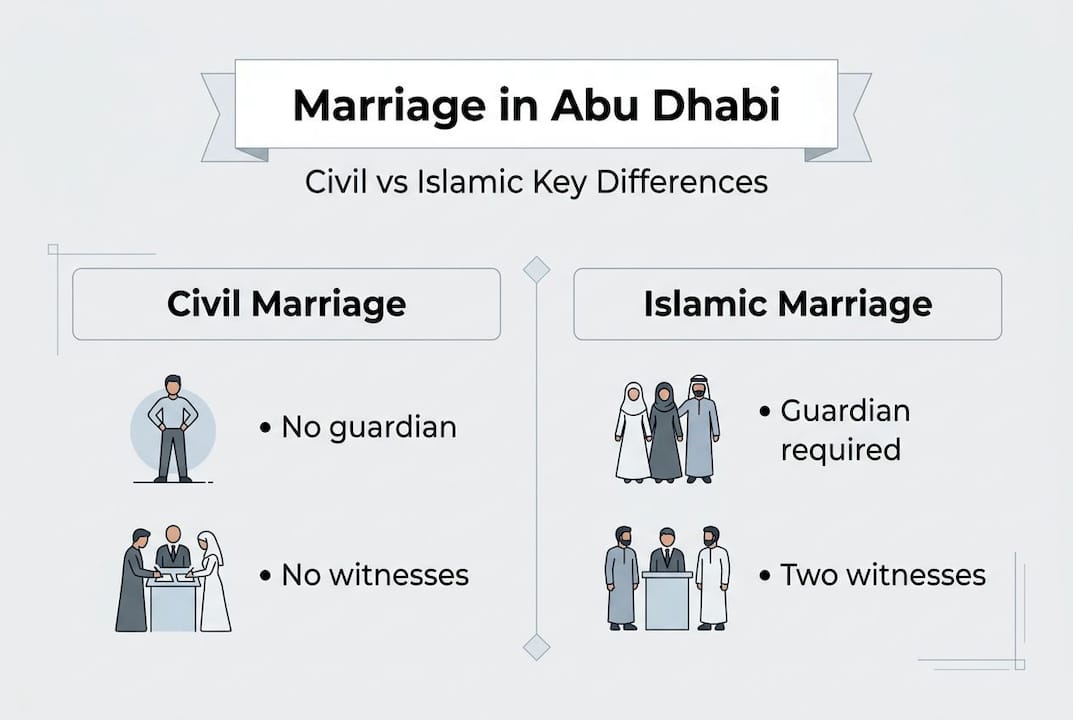
Civil marriage vs Islamic marriage: What’s different?
Understanding the contrast between civil and Islamic marriage processes in the UAE helps you make a fully informed choice, especially if you have family members pushing for a specific path.
Feature | Civil marriage | Islamic marriage |
Guardian (wali) required | No | Yes (for bride) |
Medical test required | No | Often required |
Processing time | 1 to 10 days | Varies, often longer |
Who can apply | Non-Muslim non-nationals | Muslim couples |
Prenuptial agreements | Allowed | Limited |
Applicable divorce law | Home country laws | Sharia |
The differences are significant in practice. Civil vs Sharia marriage reveals no guardian or medical test is needed under the civil process, the timeline is faster, and couples can apply their home country’s divorce laws to any future proceedings. This last point is particularly important for international couples who plan to live outside the UAE long-term.
Key reasons expats and interfaith couples prefer civil marriage:
No religious conversion or affiliation requirement
No need for a male guardian’s permission
Faster and simpler documentation process
Marriage certificate recognized internationally (with MOFA attestation)
Ability to structure financial agreements through a prenup
Prenuptial agreements are growing in popularity among expat couples in Abu Dhabi specifically because the civil law framework gives them legal teeth. For a detailed breakdown of how these two paths diverge legally, the civil vs Islamic marriage comparison is worth reading before you decide.
Our perspective: What most guides miss about civil marriage in Abu Dhabi
Most articles about Abu Dhabi civil marriage stop at the checklist. They tell you what documents to bring and how much to pay. What they rarely mention is what happens after the ceremony, and that is often where the real complexity lives.
We have worked with many couples who were thrilled with their Abu Dhabi civil marriage certificate, only to hit a wall when they returned home and found their country’s immigration or legal system did not recognize it without MOFA attestation and embassy verification. International certificate validity is a step that cannot be skipped if you plan to use your certificate abroad.
The digital and express options are genuinely powerful tools, but they require advance planning. If you have international guests flying in, a 24-hour turnaround sounds perfect until you realize the UAE Pass registration alone can take several days for first-time users.
Our strongest advice: do not treat the ceremony as the finish line. Think about where you will live, which country’s laws will govern your future, and whether your certificate needs to work in multiple jurisdictions. That planning changes your document strategy entirely.
Pro Tip: Build your documentation timeline backward from the day you need your attested certificate in hand, not from your ceremony date.
How Harris & Charms supports your civil marriage journey
Knowing the rules is one thing. Executing them correctly under time pressure, with international documents and an unfamiliar system, is another challenge entirely.

At Harris & Charms, we support couples at every stage of the civil marriage process in the UAE. From helping you understand exactly which documents need attestation and translation, to coordinating your ceremony logistics and post-marriage certificate processing, we handle the details so you can focus on the moment. Our Dubai civil marriage packages cover everything from legal compliance to event planning, and our civil marriage services in Dubai team works with couples across all nationalities and situations. Ready to get started? Contact us and we will map out your personalized plan.
Frequently asked questions
Can tourists get legally married in Abu Dhabi?
Yes. Tourists are eligible to marry under Abu Dhabi’s civil law, including situations where only one partner holds UAE residency and the other is simply visiting.
Do I need witnesses or a guardian for a civil marriage?
No. The civil marriage process in Abu Dhabi requires no guardian or external witnesses, as the presiding judge fulfills that role during the ceremony.
What documents need to be translated or attested?
Foreign documents such as divorce decrees or death certificates must be legally translated into Arabic and attested before the Abu Dhabi court will accept them.
Is a civil marriage certificate from Abu Dhabi valid internationally?
Yes, but only after completing MOFA attestation and, in most cases, additional verification through your home country’s embassy in the UAE.
Recommended
Comments