
Civil ceremony marriage in the UAE: Guide for couples

TL;DR:
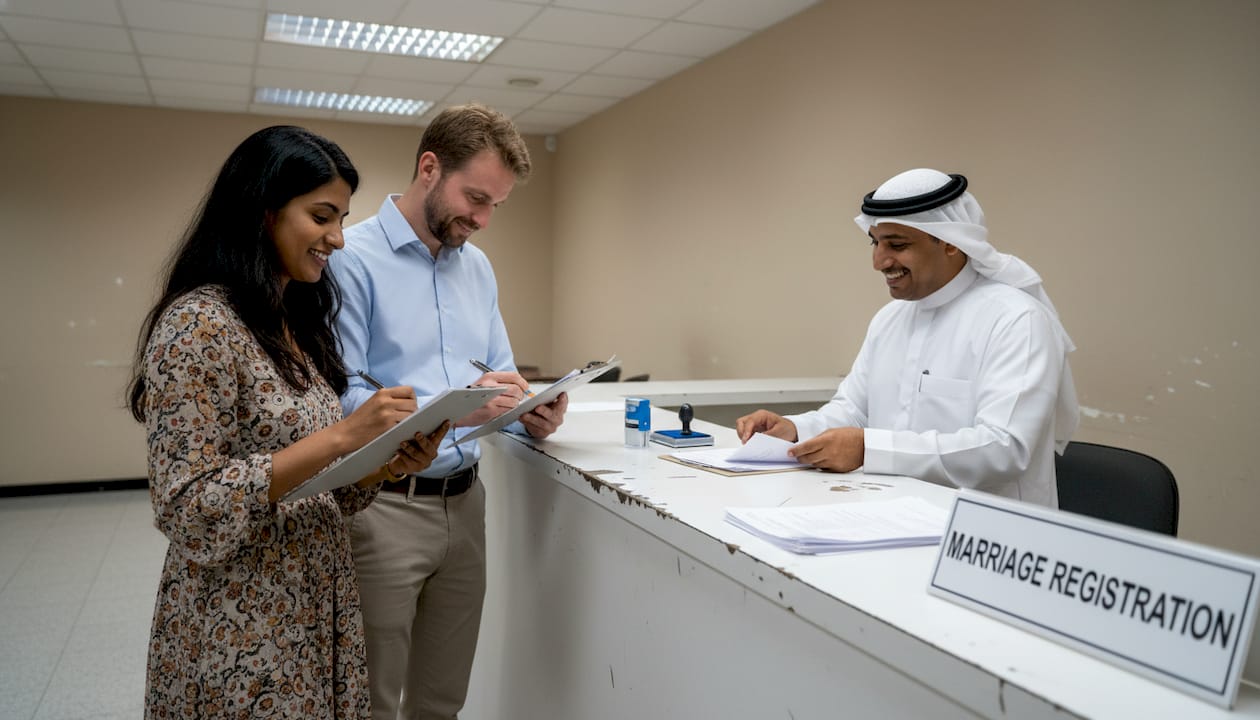
Civil marriage in the UAE is a secular, legally binding process officiated by a government official.
Eligibility requires both partners to be over 18, with mutual consent, and not closely related.
The process involves online registration, document attestation, and can be recognized internationally.
Abu Dhabi’s civil marriage numbers tell a striking story. The Abu Dhabi Civil Family Court registered 19,000 civil marriages in 2025, a 17% year-over-year increase that reflects a genuine shift in how couples in the UAE approach legal union. Yet despite this surge, many couples, especially expats and mixed-faith pairs, still feel lost about the exact steps, documents, and eligibility rules. This guide cuts through the confusion. Whether you are planning your ceremony or simply researching your options, you will leave with a clear, practical understanding of how civil ceremony marriage works in the UAE.
Table of Contents
Eligibility and requirements for civil ceremony marriage in the UAE
Legal process and documentation: Navigating UAE civil ceremonies
Civil ceremony marriage versus Islamic marriage: Fundamental differences
Expert perspective: What most couples miss about UAE civil marriage
Get personalized wedding support for your civil ceremony marriage in the UAE
Key Takeaways
Point | Details |
Civil ceremony is secular | A civil ceremony marriage is a non-religious, legally binding union overseen by a government official. |
Eligibility is straightforward | Couples just need to meet age, consent, kinship, and marital status criteria with no witnesses or medical tests required. |
Legal documents ensure global validity | A bilingual UAE marriage certificate, backed by MOFA attestation, is recognized internationally. |
Civil versus Islamic marriage | Civil marriages offer equal rights and flexibility compared to gender-specific, religious Islamic marriages. |
Professional support streamlines process | Using personalized marriage packages and expert documentation services eliminates common frustrations and setbacks. |
Defining civil ceremony marriage: What sets it apart
With civil marriages rising fast across the UAE, understanding what actually makes a ceremony “civil” is the right place to start. A civil ceremony marriage is a non-religious, legally binding union officiated by a government official, without any religious rituals involved. That means no prayers, no faith-based vows, and no clergy. The legal authority comes entirely from the state.
This structure matters for a lot of reasons. Many couples in the UAE come from different faith backgrounds, different nationalities, or simply prefer a secular approach to formalizing their relationship. A civil ceremony gives them a legally recognized path that does not require either person to compromise their beliefs or adopt religious customs.
Here is what defines a civil ceremony marriage in practice:
Officiated by a judge or civil registrar with legal authority granted by the government
No religious elements are required or incorporated into the ceremony itself
Legally binding in the UAE and, with proper attestation, internationally recognized
Equal legal rights for both spouses under the personal status law for non-Muslims
Open to mixed-faith couples, international residents, and tourists
For a deeper look at how this compares to other marriage types in the UAE, the civil vs Islamic marriage differences breakdown explains the key contrasts clearly.
One thing couples often miss: a civil ceremony is not a “lesser” form of marriage. It carries full legal weight. As the civil marriage overview on Wikipedia explains, civil marriage has been the standard legal framework in many countries for over a century. In the UAE context, it fills a genuine gap for the large expat population.
“Civil ceremony marriage gives couples a legally sound, faith-neutral foundation for their life together, without bureaucratic compromise or religious obligation.”
For expat couples especially, this structure offers clarity and flexibility that religious marriage routes do not always provide.
Eligibility and requirements for civil ceremony marriage in the UAE
Once you understand what a civil ceremony marriage is, the next step is confirming whether you qualify. The good news is that the eligibility rules are straightforward.

According to UAE civil marriage eligibility rules, both parties must be at least 18 years old, have mutual consent, not be closely related by blood, not currently be married to someone else, and be mentally capable of making the decision. Notably, no witnesses or medical tests are required, which simplifies the process significantly compared to other jurisdictions.
Here is a practical checklist to confirm your eligibility:
Age: Both partners must be 18 or older
Consent: Both must agree freely, without pressure
Marital status: Neither can be currently married
Kinship: Close blood relatives cannot marry each other
Mental capacity: Both must be of sound mind
Prior marriages: Divorce certificate or death certificate required if previously married
Nationality: Non-UAE nationals only; the court does not serve UAE citizens
Tourists visiting the UAE also qualify, which surprises many people. You do not need to be a resident. The UAE government civil marriage info confirms this directly.
For a complete list of what you need to bring, the civil marriage requirements UAE page covers document specifics in detail. You can also review the UAE civil marriage eligibility guide for edge cases like prior divorces or dual-nationality situations.
Pro Tip: Start your application well before your intended ceremony date. UAE courts observe closures during Ramadan and public holidays, and processing times can stretch longer than expected if documentation is incomplete.
Legal process and documentation: Navigating UAE civil ceremonies
With your eligibility confirmed, the next challenge is handling the paperwork. The process is more manageable than many couples expect, but it does require careful attention to detail.
You can apply through the ADJD (Abu Dhabi Judicial Department) online app or visit the Abu Dhabi Personal Status Court directly. The full civil marriage process UAE involves these key steps:
Register on the ADJD app and create your applicant profile
Upload required documents: valid passports, visa pages, prior marriage dissolution certificates if applicable
Schedule your court appointment for the ceremony
Attend the ceremony before a judge or civil registrar
Receive your bilingual marriage certificate (Arabic and English)
Obtain MOFA attestation or apostille for international recognition
Your certificate is valid internationally with MOFA attestation, which makes it recognized in most countries. A prenuptial agreement is also recommended, particularly for couples with assets in multiple countries, as it strengthens both financial protection and cross-border legal recognition.
Step | Action required | Estimated time |
Profile registration | ADJD app setup | 1 to 2 days |
Document submission | Upload and verification | 3 to 5 days |
Court appointment | Scheduled hearing | 1 to 2 weeks out |
Certificate issuance | Same day as ceremony | Day of |
MOFA attestation | External process | 5 to 10 days |
For a city-specific walkthrough, the Abu Dhabi civil marriage guide and civil marriage legal requirements pages offer step-by-step breakdowns.
Pro Tip: Before your ceremony, contact your home country’s embassy to confirm exactly what attestation format they accept. Some countries require an apostille; others need MOFA authentication plus a consular stamp.
Civil ceremony marriage versus Islamic marriage: Fundamental differences
Understanding the legal process naturally leads to a bigger question many couples ask: how does civil marriage compare to Islamic marriage in the UAE? The differences are real, and they affect everything from legal rights to how divorce works.
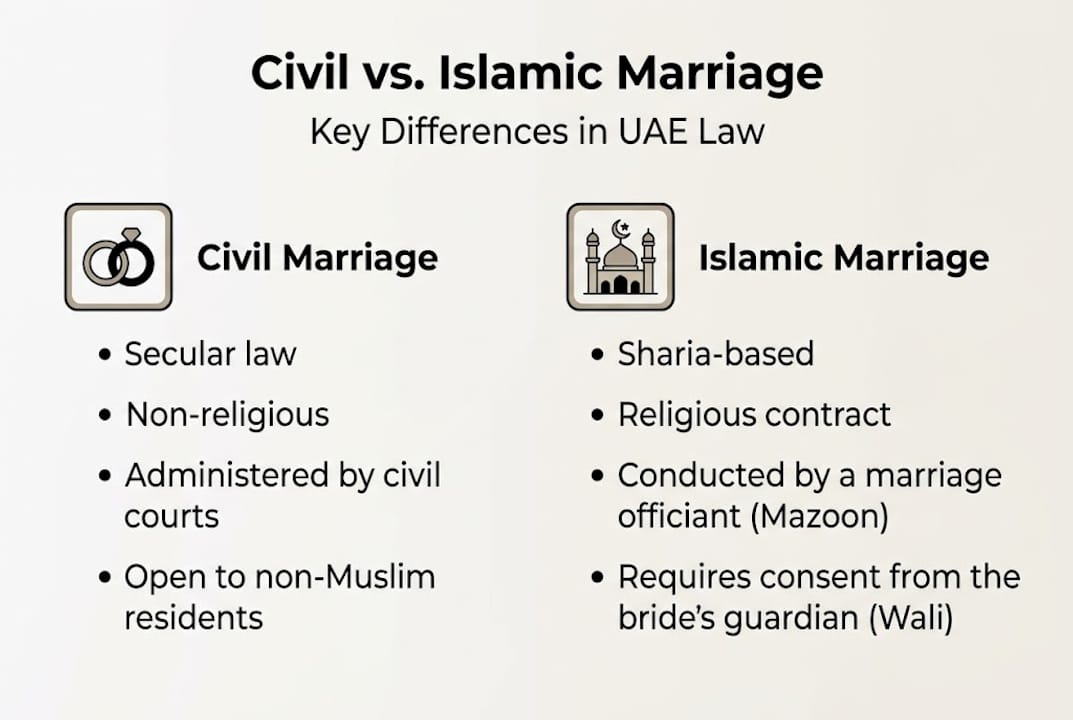
According to the civil vs Islamic marriage UAE comparison, here is how the two frameworks break down:
Feature | Civil marriage | Islamic marriage |
Religious basis | None, fully secular | Based on Sharia law |
Officiant | Judge or civil registrar | Islamic cleric or Qadi |
Witnesses | Not required | Required (male witnesses) |
Polygamy | Not permitted | Permitted (up to four wives) |
Divorce | No-fault, flexible process | Gender-specific rights apply |
Legal rights | Equal for both spouses | Different by gender |
The civil and Islamic marriage rights contrast also highlights that civil marriages fall under the Personal Status Law for Non-Muslims, which was updated to reflect modern, equal rights frameworks. Islamic marriage in the UAE operates under Sharia-informed personal status codes that treat spouses differently in some legal situations.
For couples coming from different faith backgrounds, civil marriage removes the pressure of choosing one tradition over another. It is especially practical for the international expat community.
Here is what makes civil marriage particularly suited for mixed-faith and international couples:
No requirement to convert, adopt rituals, or declare a faith
Equal rights in property, inheritance, and custody decisions
Simplified divorce process without gender-based asymmetry
Broader international recognition due to its secular legal foundation
The UAE civil marriage expat process page expands on how these rights apply in practical, day-to-day situations for residents and those who eventually relocate.
The 19,000 civil marriages registered in 2025 is not just a statistic. It is a signal that more couples are actively choosing secular, equal-rights unions over religious alternatives.
Expert perspective: What most couples miss about UAE civil marriage
We work with couples at every stage of the civil marriage process, and the biggest mistake we see is underestimating attestation complexity. Most people think getting the certificate is the finish line. It is not.
If you plan to use your UAE marriage certificate in another country, whether for a visa application, property transfer, or residency process, international attestation requirements vary significantly by destination. Some countries require a specific apostille format. Others need a chain of authentication that can take weeks. Starting this process early is not optional; it is essential.
Another gap we consistently see: couples in Dubai assume they can complete the civil marriage process locally. Right now, Dubai does not have its own civil marriage court. Abu Dhabi remains the primary venue for civil marriage applications in the UAE. Planning around this logistical reality saves couples real time and frustration.
Prenuptial agreements also deserve more attention than they typically get. They are not just for wealthy couples. For anyone with assets, business interests, or property in more than one country, a prenup tied to the civil marriage certificate creates a much cleaner legal foundation internationally. Do not skip it.
Get personalized wedding support for your civil ceremony marriage in the UAE
Now that you have a clear picture of the civil marriage process, the next step is making it happen without unnecessary stress or paperwork surprises.

At Harris & Charms, we specialize in guiding couples through every stage of their civil ceremony marriage in the UAE. From document preparation to court appointments and ceremony planning, our team handles the details so you can focus on your moment. Whether you need a Dubai civil marriage package or are exploring civil marriage services Dubai, we offer tailored support for both cities. Browse our full range of UAE marriage services and reach out to start your journey with a team that has been through this process themselves.
Frequently asked questions
Can UAE nationals have civil ceremony marriages?
Civil marriage through the Abu Dhabi Civil Family Court is available to non-UAE nationals only; UAE citizens are excluded from this process by law.
What documents do couples need for a civil ceremony marriage in the UAE?
You will need valid passports, visa copies, completed application forms, and divorce or death certificates if either partner was previously married. Your certificate needs attestation if you plan to use it outside the UAE.
Is a civil ceremony marriage legal outside the UAE?
Yes. With MOFA attestation or an apostille, your bilingual certificate is internationally recognized in most countries. Always confirm specific requirements with your destination country’s embassy beforehand.
Can tourists get married in a civil ceremony in the UAE?
Yes. Tourists are eligible for UAE civil marriage provided they meet all eligibility criteria and complete the standard application process through the ADJD.
Do couples need witnesses for a UAE civil ceremony marriage?
No. Under current UAE regulations, witnesses are not required for a civil ceremony marriage, which makes the process notably simpler than many religious or foreign marriage frameworks.
Recommended
Comments