
Court marriage for Muslims in UAE: full legal guide

TL;DR:
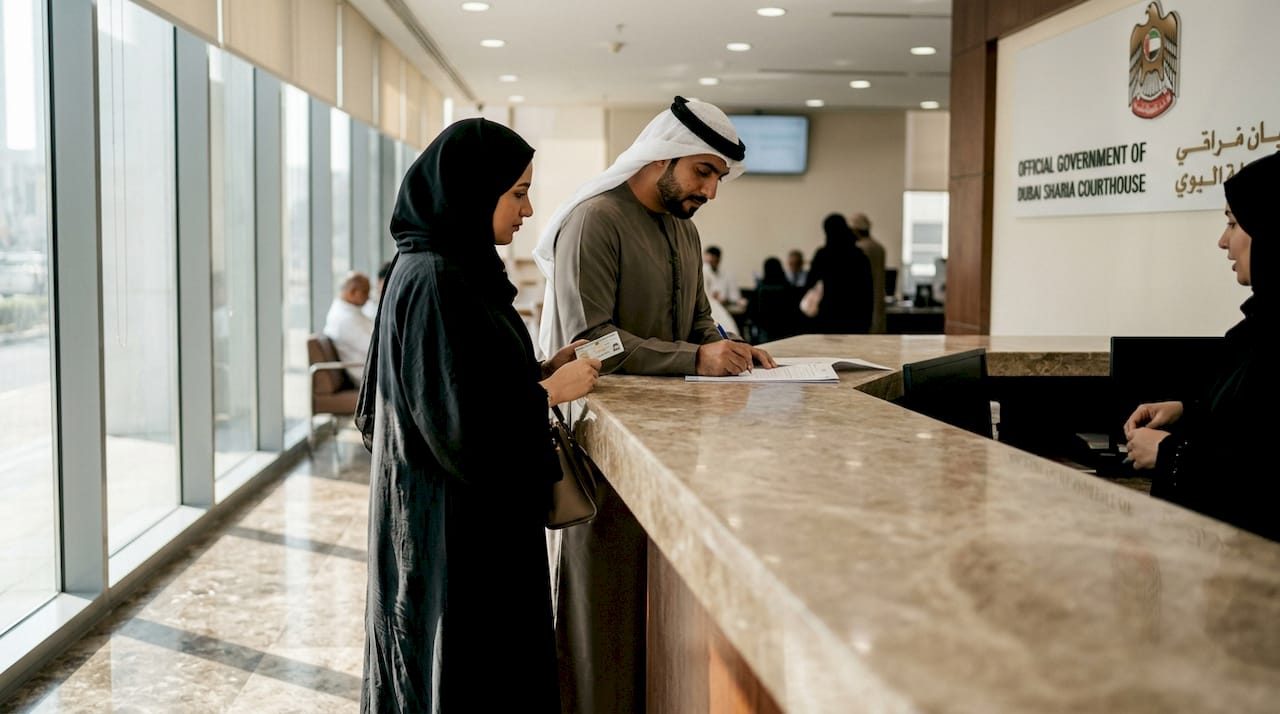
Muslim court marriage in UAE is conducted by Sharia courts or authorized Ma’zoons, ensuring religious and legal validity.
Key requirements include valid passports, proof of single status, premarital medical tests, wali consent, and witnesses.
The process typically takes 1 to 3 weeks, with attestations needed for international recognition.
Planning a court marriage as a Muslim couple in the UAE can feel like solving two puzzles at once. You need to satisfy Sharia requirements while also navigating government paperwork, medical screenings, and document attestation. Many couples start the process confident, then hit unexpected walls around guardian consent or certificate validation. This guide clears all of that up. Court marriage for Muslims in Dubai and Abu Dhabi refers to Sharia-compliant marriage registration conducted in Sharia Courts or by authorized Ma’zoons, ensuring both religious and legal validity. We’ll walk you through every stage, from understanding what court marriage actually means to getting your certificate recognized internationally.
Table of Contents
Key Takeaways
Point | Details |
Sharia and legal compliance | Court marriage for Muslims in the UAE fulfills both religious and government requirements for marital validity. |
Clear, step-by-step process | Following the correct sequence—from document gathering to registration—avoids delays and ensures smooth completion. |
Legal protection for couples | Courts safeguard women’s rights, offer solutions for consent disputes, and enable internationally valid certification. |
Professional planning advantage | Using expert planners minimizes paperwork hassle, legal risks, and event stress throughout the marriage process. |
Understanding court marriage for Muslims in the UAE
Let’s start with the basics, because there’s a lot of confusion between different marriage types in the UAE. Court marriage for Muslims is not the same as civil marriage. Civil marriage in the UAE is primarily available to non-Muslim couples, registered in Abu Dhabi or Dubai under a separate legal framework. For Muslim couples, the legally recognized path is through the Sharia Court or a government-authorized Ma’zoun, an officially licensed officiant who conducts Islamic marriage contracts.
Some couples ask whether they can pursue both a Nikah (Islamic marriage contract) and a civil registration for dual validity. The answer is: Muslims and non-Muslims can register civil marriage in the UAE, but for Muslim couples, Sharia court registration is what ensures full religious compliance and legal recognition under UAE family law. Opting only for an unregistered Nikah without court documentation leaves you without legal protection in areas like divorce, inheritance, and custody.
So what’s the difference in practical terms? Here’s a quick comparison:
Feature | Sharia court marriage | Civil marriage |
Who it’s for | Muslim couples | Non-Muslim couples primarily |
Conducted by | Ma’zoun or Sharia judge | Civil registry authority |
Religious validity | Yes | No |
Legal recognition UAE | Yes | Yes (for eligible couples) |
Required for Muslim divorce law | Yes | No |
Understanding civil vs Islamic marriage differences helps you choose the right path from the start, avoiding costly restarts later. The Sharia courts in UAE marriages play a central administrative and judicial role, not just a ceremonial one. According to UAE federal law, Sharia marriage law UAE governs all Muslim marriages, making court registration non-negotiable for legal standing.
“A registered Sharia court marriage is the only way Muslim couples in the UAE can guarantee both religious and legal protection under one document.”
Court marriage requirements and eligibility criteria
Before you book any appointment, make sure you understand exactly what’s required. Missing even one document causes delays that can push your timeline back by weeks.
Core document checklist:
Valid passports for both parties
Emirates ID (for UAE residents) or valid visa for visitors
Proof of single status: certificate of no impediment or divorce/death certificate if previously married
Premarital medical certificate from an approved health center
Completed Nikahnama (Islamic marriage contract) form
Two Muslim male witnesses with valid ID
Wali (guardian) details and consent documentation
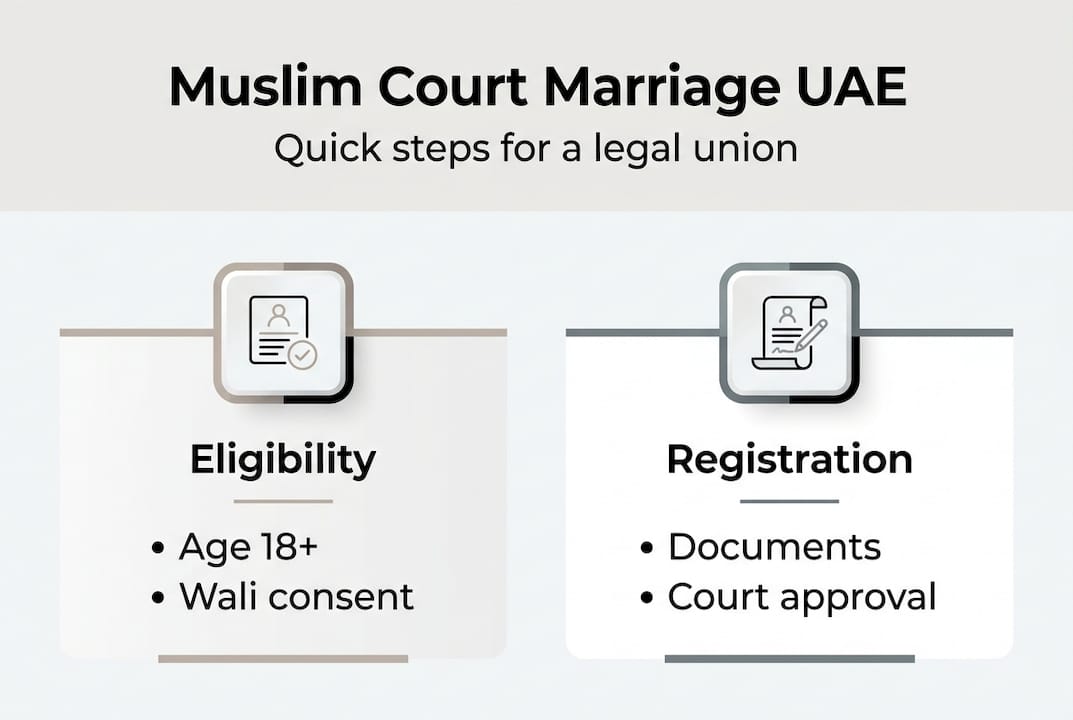
The Sharia marriage rules UAE set a minimum age of 18 Gregorian years for both parties. If either applicant is under 18, a judge’s special approval is mandatory before the process moves forward. The bride’s wali, typically her father or a qualified male relative, must provide formal consent. If no male relative is available, a court-appointed wali can fill the role.
Here’s a summary of key eligibility factors:
Requirement | Detail |
Minimum age | 18 years (judge approval under 18) |
Wali consent | Required from father or eligible male relative |
Witnesses | Two Muslim male witnesses |
Mahr agreement | Agreed dowry amount specified in contract |
Medical screening | Mandatory premarital health test |
Mutual consent | Both parties must affirm freely |
The mahr (dowry) is a specific sum or asset agreed upon before the marriage and written into the Nikahnama. It’s not symbolic. It’s a legal obligation and part of the contract’s validity. Learn more about Muslim marriage rules UAE to understand how these rules apply to your specific situation, including residency status and nationality differences. For further context on marriage consent UAE, legal guidelines clarify when consent is considered valid and when courts may intervene.

Pro Tip: Begin your medical screening and document collection at least four weeks before your intended marriage date. Government-approved health centers sometimes have waiting periods, and attestation of overseas documents can take longer than expected.
For a detailed walkthrough of each step from this point, the Islamic marriage steps in Dubai guide is a reliable reference to keep on hand.
Step-by-step process: How to register your court marriage
Once your documents are ready, the actual registration process is more straightforward than most people expect. Here’s the sequence:
Collect and attest all required documents. If any documents are from outside the UAE, get them attested by the issuing country’s authorities and then by the UAE embassy before arrival.
Complete premarital medical screening. Both parties attend approved health centers. Results are submitted directly to the court system in most emirates.
Apply through the court portal or an authorized service provider. Many couples use the Dubai Courts online platform or an equivalent in their emirate. Authorized service providers can handle submissions on your behalf.
Attend the ceremony with your Ma’zoun or judge. The Ma’zoun reads and witnesses the signing of the Nikahnama. Both parties affirm consent, the wali provides approval, and witnesses sign.
Register within 30 days. After the ceremony, the marriage must be formally registered to receive the official certificate. Missing this window requires reapplication.
The full court marriage process from document collection to certificate issuance typically takes 1 to 3 weeks, depending on paperwork readiness and court scheduling. That timeline assumes no complications. Factor in extra time if either party is a non-resident or holds documents issued abroad.
Pro Tip: Book your Ma’zoun appointment as early as possible. Popular slots fill quickly, especially during weekends and Islamic occasions. Some authorized services let you lock in a preferred date and time when you submit your application.
For a full visual breakdown, the Islamic marriage process guide and Muslim marriage ceremony steps resources walk through the specifics at each stage. You can also reference the Sharia marriage procedures page for emirate-specific variations.
Special cases, troubleshooting, and legal protection
Not every court marriage follows a smooth, textbook path. Here are the most common edge cases and what UAE law says about each.
Guardian refusal. If the bride’s wali refuses consent without a valid Islamic or legal reason, the couple can petition the Sharia Court. The UAE laws on parental consent confirm that if a guardian refuses without valid reason, the court can approve the marriage and transfer guardianship to another eligible person or the court itself. This is not a loophole; it’s a built-in protection.
Age gap rules. When an unmarried woman is marrying a man more than 30 years older, the court requires a special permit before proceeding. The judge reviews the case to confirm no coercion is involved.
Interfaith marriages. A Muslim woman may only marry a Muslim man under UAE Sharia law. A Muslim man may marry a Muslim, Christian, or Jewish woman. Marriages outside these parameters are not recognized.
Proxy and remote marriage. In limited circumstances, proxy or remote ceremonies are possible, but they require explicit court authorization and are handled case by case.
“Court intervention protects a bride’s rights when a wali obstructs a suitable match. Updated laws from 2024 to 2026 reinforce women’s rights within marriage contracts, covering maintenance, consent, and post-divorce entitlements.”
For context on how these rules affect your rights long term, understanding Sharia marriage impact UAE is worth your time. If you’ll need your certificate recognized in another country, the marriage attestation UAE process is the critical next step. Additional marriage regulations UAE guidelines clarify how courts handle contested or complicated applications.
Costs, certificate validation, and planning support
Let’s talk numbers and practicalities, because this part often surprises couples.
Fee breakdown:
Basic government registration fees: AED 220 to AED 1,000 depending on emirate and nationality
Full-service packages including legal support, document translation, and ceremony coordination: AED 3,500 to AED 7,500
Additional attestation fees vary based on the country where the certificate will be used
The court marriage fee range reflects a real difference in experience. Basic government fees cover the legal registration only. Full-service packages handle logistics, translations, appointments, and follow-up, which most couples find worth the investment given the complexity.
Making your certificate internationally valid:
A UAE Sharia court marriage certificate is internationally valid once it goes through the proper attestation chain. This typically means:
Ministry of Justice attestation in UAE
Ministry of Foreign Affairs (MOFA) stamp
Embassy attestation of the destination country (if required)
For couples planning to use the certificate outside the UAE, starting the marriage attestation and validation process immediately after receiving the certificate saves weeks of back-and-forth later.
Pro Tip: If you’re planning to relocate or apply for a spouse visa in another country after marriage, tell your planner or legal advisor upfront. They can sequence the attestation steps in the right order to avoid rejected applications abroad.
Working with professionals who understand both the Islamic marriage UAE requirements and the legal documentation side means fewer surprises. These services often include multilingual document assistance, which is critical when original documents are in Arabic, Urdu, or other languages. More details on available court marriage support Dubai services show what a fully managed experience looks like.
Our expert take: Pitfalls and practical shortcuts for Muslim court marriage in UAE
Here’s something most online guides won’t tell you: the biggest source of delay is not missing documents. It’s misreading which documents are required for your specific situation based on nationality, residency status, and whether either party was previously married. Generic checklists assume a standard case, and most couples aren’t standard.
The second most common mistake is underestimating how long guardian-related issues take to resolve. If your wali is overseas, getting notarized and attested consent documents back in time requires planning weeks in advance, not days.
Our practical shortcut: work with a team that handles both the legal and the event side together. Why? Because scheduling conflicts between court appointments, ceremony venues, and document deadlines are the most preventable source of stress. A step-by-step Islamic marriage guide is useful for orientation, but it doesn’t make calls on your behalf or catch a missing apostille on your birth certificate.
For couples planning to use their certificate internationally, professional planners handle docs, translations, and appointments in a coordinated way that avoids the cascade of delays that hits self-managed applications. Start with attestation in mind. That single decision saves you months of work if you’re moving abroad after marriage.
Get professional support for your Muslim court marriage in the UAE
Navigating Sharia court requirements, document attestation, and ceremony planning at the same time is genuinely complex. You shouldn’t have to manage all of it alone.

At Harris & Charms, we’ve helped Muslim couples across the UAE go from confused to officially married without the paperwork headaches. Our marriage services UAE cover everything from document collection and translation to Ma’zoun scheduling, venue arrangements, and post-ceremony attestation. For specifically Sharia-aligned weddings, our Islamic marriage services are tailored to meet every religious and legal requirement in one coordinated package. Reach out today and let us handle the details so you can focus on what actually matters.
Frequently asked questions
What makes Muslim court marriage in UAE legally valid?
Registration in a Sharia court or with an authorized Ma’zoun, combined with documented compliance with all legal and religious requirements, ensures full validity. A Sharia-compliant registration conducted by licensed officiants in Dubai and Abu Dhabi carries both religious and legal standing under UAE law.
If the bride’s guardian refuses consent, what can the couple do?
The court can transfer guardianship and approve the marriage if the guardian refuses without valid grounds. UAE law explicitly provides this court-approved guardianship transfer as a legal remedy for unjustified refusals.
Can a Muslim court marriage certificate be used abroad?
Yes, a UAE Sharia court marriage certificate becomes internationally valid when attested through the proper Ministry of Justice, MOFA, and destination country embassy chain.
How long does the court marriage process take?
Most Muslim court marriages in UAE are completed within 1 to 3 weeks, though overseas documents and guardian-related steps can extend the timeline.
What documents are required for Muslim court marriage in UAE?
Couples need passports, Emirates IDs, proof of single status, a premarital medical certificate, two Muslim male witnesses, and a completed Nikahnama with an agreed mahr. The full Sharia marriage requirements also include wali consent documentation and mutual consent affirmations from both parties.
Recommended
Comments