
How to register your marriage in Ras Al Khaimah
- haris haneef
- Apr 30
- 10 min read


TL;DR:
Ras Al Khaimah offers both civil and Sharia marriage options, depending on religious background.
Correct eligibility and complete documents are crucial to avoid delays and rejection.
Expert guidance simplifies the process, especially for complex cases and remote registration.
Getting married in Ras Al Khaimah sounds romantic, but the registration process can feel surprisingly complicated, especially if you are an expat who is unsure whether you qualify for a civil ceremony or must follow Sharia procedures. The wrong starting point means lost time, rejected paperwork, and unnecessary stress right before one of the biggest moments of your life. This guide breaks down both civil and Sharia marriage registration in RAK, step by step, so you can walk into the process confident, prepared, and with every document in order.
Table of Contents
Key Takeaways
Point | Details |
Choose the right route | Civil marriage is for non-Muslim couples only; Muslims must follow Sharia procedures. |
Prepare all documents | Gather required documents early to avoid delays in the application process. |
Online options available | Civil marriages can be registered online in RAK, making the process accessible and efficient. |
Confirm certificate validity | Ensure your marriage certificate is validated and attested for use in the UAE and abroad. |
Understanding marriage registration options in Ras Al Khaimah
Before you book a venue or print a single form, you need to figure out which marriage route applies to you. Getting this wrong is the single most common and costly mistake couples make.
Civil marriage vs. Sharia marriage
In Ras Al Khaimah, two distinct legal pathways exist for marriage registration. The first is the civil marriage route, managed through RAK Courts, and it is specifically designed for non-Muslim couples. The second is the Sharia marriage route, which applies whenever at least one spouse is Muslim. Civil marriage in RAK is for non-Muslim couples only, and that eligibility rule is absolute.
The civil route is relatively straightforward, with the RAK Courts offering a streamlined, modern service that includes online applications and even remote signing options. Understanding civil vs Islamic marriage differences early will save you from gathering the wrong documents.
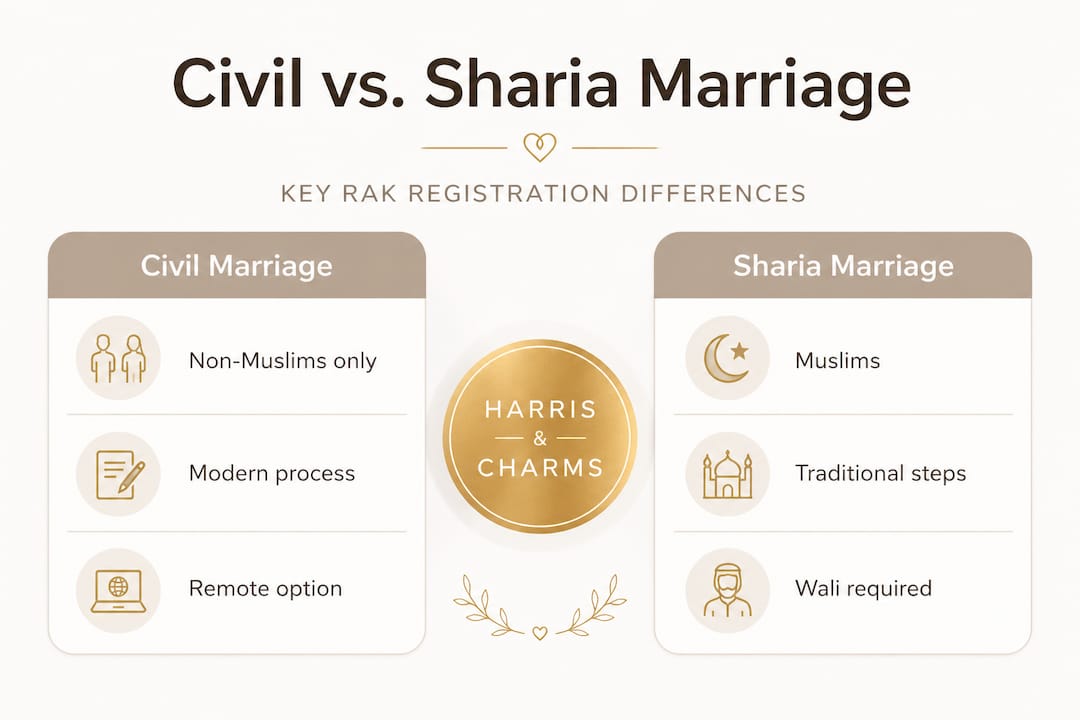
The Sharia marriage route is more structured and involves Islamic law. When at least one party is Muslim, Sharia marriage laws apply for all UAE nationals and expatriate residents. This route requires a guardian (wali) for the bride in many cases, the presence of witnesses, and compliance with specific Islamic marriage conditions.
Here is a quick comparison to help you decide which path is yours:
Feature | Civil marriage | Sharia marriage |
Eligible couples | Non-Muslim only | Muslim or interfaith |
Handled by | RAK Courts civil service | Sharia court or religious authority |
Guardian required | No | Often yes (wali for the bride) |
Witnesses required | Yes (typically 2) | Yes (minimum 2 male witnesses) |
Remote option | Available | Generally in-person |
Ceremony location | Courthouse or approved venue | Sharia court |
Key eligibility points to confirm before you start:
Both spouses must be non-Muslim for the civil route
If either spouse converted to Islam, the civil route is no longer applicable
Interfaith couples where one spouse is Muslim must follow the Sharia path
Residency or visa status does not change the religious eligibility rule
“Getting clarity on your eligibility before you gather a single document is the single most time-saving thing you can do in this process. One piece of missing or wrong information can push your timeline back by weeks.”
For a deeper understanding of the full legal landscape, the UAE marriage registration guide covers all routes in detail.
What you need: Documents and requirements
Once you’ve confirmed your eligibility, the next job is assembling your paperwork. Both routes have distinct document requirements, and missing even one item means your application will not proceed. Think of this section as your personal checklist before you make any appointments.

Documents for civil (non-Muslim) marriage
The civil marriage process in RAK requires a standard but specific set of documents. Here is what you typically need:
Valid passports for both parties (with clear, unexpired copies)
Residence visas or entry permits (for UAE residents)
Birth certificates (attested and translated to Arabic if not already)
Single status or no-objection certificates from your home country embassy
Recent passport-size photographs
Completed application form from RAK Courts
Documents for Sharia marriage
The Sharia marriage route requires additional elements due to Islamic legal requirements:
Valid passports and Emirates IDs
Birth certificates
Proof of Muslim faith (conversion certificate if applicable)
A wali (male guardian) for the bride, or court documentation if a guardian is absent
Two Muslim male witnesses
Divorce or death certificate if either party was previously married
Any required approvals from the Sharia court
Costs and fees
Published civil marriage costs typically distinguish between the base certificate fee and optional costs for ceremony formats or dedicated venues. RAK’s civil service also offers privacy-friendly venues that give couples a more personal experience than a standard courthouse room.
Cost type | Civil marriage | Sharia marriage |
Base certificate fee | AED 100 to 300 (approx.) | Varies by court |
Optional ceremony venue | Additional fee applies | Not typically applicable |
Document attestation | Varies by origin country | Varies by origin country |
Translation fees | Depends on language | Depends on language |
These figures are estimates. Always confirm the latest fees directly with RAK Courts or a qualified marriage service provider before submitting your application, as fees can change without broad public notice.
Pro Tip: Confirm your eligibility and gather all documents before paying any fees. Many couples pay for attestation on documents they ultimately do not need, simply because they started without confirming their correct marriage route.
A useful starting point is the civil marriage requirements checklist, which outlines exactly what to prepare for the civil route. And once you have your certificate, a quality marriage certificate holder is a practical way to store and present this important document safely.
Step-by-step: How to register your marriage in Ras Al Khaimah
With your documents ready, the process itself is manageable when you know the sequence. Here is the complete walkthrough for both routes.
Civil marriage registration steps
Complete the online application. Visit the RAK Courts e-services portal and fill in your personal details, upload scanned copies of your required documents, and select your preferred appointment type (in-person or remote video conference).
Pay the registration fee. After your application is reviewed and approved for processing, you will be prompted to pay the applicable fee through the online portal.
Attend the court session. For couples in the UAE, you can attend in person at RAK Courts. Remote/video conference completion is available for civil marriages, making it an excellent option for couples who are currently abroad or have scheduling constraints.
Sign the marriage contract. Both spouses must sign the legal marriage contract in the presence of the judge. For remote sessions, this is done via video link under the judge’s supervision.
Receive your marriage certificate. After the court session, your civil marriage certificate is processed and issued. In many cases, this happens within a few days of the completed session.
For a more detailed breakdown of each step, the civil marriage procedure guide provides additional context on what to expect at each stage.
Sharia marriage registration steps
Consult the Sharia court. Visit the relevant Sharia court in RAK to understand any case-specific requirements, especially if your situation involves an interfaith element, a previous marriage, or an absent guardian.
Prepare and submit your documents. Bring all required documents including your passports, proof of faith, and birth certificates. Ensure your wali (guardian) and two witnesses are present and have their own valid ID.
Complete the marriage contract (Aqd al-Nikah). The judge officiates the Islamic marriage contract. Both parties, the guardian, and the witnesses must all be present. The groom proposes formally and the bride accepts.
Receive the marriage certificate. After the contract is signed and verified, the Sharia court issues a marriage certificate. Additional certified copies can often be requested at this stage.
Pro Tip: Book your court appointment slot as early as possible, especially during peak months like October through December when couples flock to the UAE for weddings. Court slots can fill up weeks in advance. Starting your application at least four to six weeks before your intended date is a safe standard.
One underrated aspect of the civil process is the option for remote marriage registration, which has made the process significantly more accessible for international couples. Before applying, it is worth running online legal checks for marriage to ensure document authenticity and avoid fraud-related issues, particularly when documents come from multiple countries.
After registration: Certificate validation and what’s next
The court session is done, the contract is signed, and your certificate is in your hands. But there are still important steps to protect the legal value of that document, both inside the UAE and internationally.
Collecting and verifying your certificate
For civil marriage, your certificate is typically issued by RAK Courts and carries an official seal. For Sharia marriage, the Sharia court issues the certificate and it is recognized under UAE law for all official purposes.
Immediately after receiving your certificate:
Check all names, dates, and details for spelling errors
Request multiple official copies while you are still at the court
Store the original in a secure but accessible location
Attestation and legalization
If you plan to use your marriage certificate outside the UAE, such as for immigration, visa sponsorship, bank accounts, or property matters in your home country, you will likely need attestation and legalization. This process confirms the document’s authenticity for foreign governments.
Use case | Required action |
UAE residency visa sponsorship | MOFAIC attestation in UAE |
Home country immigration/visa | UAE foreign ministry + home country embassy |
Bank or property matters | Notarized copy, often bank-specific |
Employment or HR records | Employer-specific requirements |
The process of getting your certificate recognized internationally can take two to six weeks, depending on the countries involved. Start early and use a reputable attestation service to avoid delays.
For couples who want to have a civil wedding in RAK and are still deciding on the emirate, there are real advantages. RAK offers a more relaxed pace, attractive venue options, and efficient court services compared to larger emirates. Detailed reasons to consider this route are covered in why choose RAK for marriage.
Once you have your attested documents, protecting them matters. A well-designed marriage certificate protection solution keeps your certificate both safe and presentable for future official uses.
“Your marriage certificate is a legal document you will use throughout your life, for visas, property, banking, and more. Treating it like the critical document it is from the first day pays dividends for years.”
Our perspective: What most guides miss about RAK marriage registration
Most guides walk you through the official steps and stop there. But after supporting dozens of couples through the RAK marriage process, we’ve noticed patterns that the step-by-step checklists simply do not address.
The biggest recurring problem is eligibility confusion. Couples, especially expats from diverse religious backgrounds, often assume they can choose whichever route seems more convenient. They start gathering civil marriage documents, pay for attestations, and only discover at the court stage that one spouse’s Muslim background requires the Sharia route instead. That mistake costs real money and real time. Confirming eligibility is not a formality. It is the foundation of the entire process.
The remote/online option for civil marriages is a genuine game-changer, and it is quietly becoming more popular than in-person registration for expat couples. What couples do not always realize is that remote registration places a heavier burden on document quality. A blurry scan or a missing stamp that might be corrected quickly in person can cause a remote session to be rescheduled by weeks. If you are going the remote route, treat your digital documents with the same care you would give to originals.
Interfaith and complex-background couples are the group most likely to benefit from expert guidance before applying. The benefits for expats marrying in RAK are real, but navigating the edge cases, such as a previously divorced party, one spouse who converted to Islam, or couples from countries with restrictive marriage laws, requires someone who has handled those situations before. Generic online guides cannot anticipate your specific circumstances. A proper consultation can prevent an application rejection that sets your entire wedding timeline back by months.
The most prepared couples we work with are the ones who treat marriage registration as a project, not a single task. They confirm eligibility first, build a document list from their specific circumstances, and plan their timeline backward from the wedding date with buffer time built in. That mindset, more than any single document, is what makes the process smooth.
Next steps: Let us simplify your RAK marriage journey
Planning a marriage in Ras Al Khaimah involves many moving parts, from eligibility checks and document attestation to booking your ceremony and protecting your certificate afterward. If any step of the process feels uncertain or your circumstances are not straightforward, expert support makes a measurable difference.

At Harris & Charms, we have guided couples through both civil and Sharia marriages in RAK, handling the documentation, scheduling, court coordination, and venue logistics so you can focus on the celebration. Whether you are looking for civil marriage packages tailored to your situation, or want to explore our full range of comprehensive marriage services covering everything from attestation to venue styling, we are here to make it seamless. Reach out today through contact Harris & Charms for a complimentary consultation and let us handle the paperwork while you plan the memories.
Frequently asked questions
Can expats have a civil marriage in Ras Al Khaimah if one spouse is Muslim?
No, civil marriage in RAK is for non-Muslim couples only. If either spouse is Muslim, you must follow Sharia marriage procedures regardless of nationality.
Is it possible to register a marriage in Ras Al Khaimah fully online?
Yes, key civil marriage steps can be completed online, including application submission and a remote/video conference session with the judge for contract signing.
What documents are required for Sharia marriage registration in RAK?
You typically need valid passports, birth certificates, proof of Muslim faith, a wali (guardian) for the bride when applicable, and two Muslim witnesses, as governed by Sharia marriage law in the UAE.
How long does it take to get a civil marriage certificate in RAK?
With RAK’s streamlined civil marriage service, the certificate is often issued within a few business days after the completed court session, especially when the online application is used.
Recommended
Comments