
UAE Civil Wedding Requirements: Your Complete Guide


TL;DR:
Civil weddings in the UAE are simplified, secular, and mainly for non-Muslims and tourists.
Requirements include attestation of foreign documents, no guardians or witnesses needed, and quick processing.
Abu Dhabi allows tourists to marry civilly without residency, making it a popular destination.
Getting legally married in the UAE is far simpler than most couples imagine, especially for expats and international visitors. Civil marriages in the UAE are available primarily for non-Muslims under Federal Decree-Law No. 41 of 2022, with Abu Dhabi offering even broader access under Law No. 14 of 2021. Whether you are a long-term resident or flying in as a tourist, there is a legal pathway designed for you. This guide breaks down exactly what you need, what to expect, and how to move forward without second-guessing every step.
Table of Contents for UAE Civil wedding requirements
Key Takeaways
Point | Details |
Civil marriage access expanded | Non-Muslims and many expats can now marry in the UAE with straightforward requirements. |
Documentation is essential | Carefully gather and attest all needed documents to avoid application delays or rejection. |
Multiple options for couples | Abu Dhabi offers the broadest access, including to tourists and non-resident expats. |
No medical or witness needed | Civil weddings require no health checks or witnesses, simplifying the process. |
Certification and attestation | Get your certificate attested for international and visa use after the ceremony. |
What is a civil wedding in the UAE?
A civil wedding in the UAE is a legally recognized, secular marriage ceremony that sits entirely outside the Islamic Sharia framework. It was designed specifically to serve the country’s massive expat population and international visitors who do not follow Islamic law. And with more than 88% of the UAE’s population being foreign nationals, this system fills a critical legal need.
The civil marriage system under Federal law is available primarily for non-Muslims, though Abu Dhabi’s more progressive legislation extends access to non-citizen Muslims as well. That is a meaningful distinction if you are a Muslim expat who prefers a civil process over a religious one.
“Civil marriage in the UAE is a secular legal contract. It does not require religious elements, a guardian for the bride, or community witnesses. It is designed to be inclusive, accessible, and legally binding under UAE national law.”
Here is how civil and Sharia marriages differ at a practical level:
Civil marriage: No requirement for a Wali (male guardian), no religious ceremony, no premarital medical tests, no mandatory witnesses, and paperwork is relatively straightforward.
Sharia marriage: Requires a Wali for the bride, two male Muslim witnesses, specific Islamic vows, and premarital health screening in most cases.
Ceremony tone: Civil weddings are brief, secular, and conducted at a civil court. Sharia weddings follow Islamic tradition and are typically more ceremonial.
Eligibility: Civil is for non-Muslims and certain non-citizen Muslims (Abu Dhabi). Sharia is mandatory for UAE Muslim citizens.
For a broader breakdown of what the UAE civil marriage overview looks like from start to finish, it helps to understand first whether you and your partner even qualify.
Civil marriage is simpler than Sharia marriage in terms of documentation and ceremony requirements, making it a preferred route for most non-Muslim couples and mixed-nationality pairs.
Who can get a civil marriage? Key eligibility rules
Now that you know what a civil wedding is, let’s see if you and your partner qualify. Eligibility rules differ slightly between Abu Dhabi and Dubai or other federal jurisdictions, so knowing which applies to your situation saves you real time.
The core eligibility requirements are:
Both parties must be at least 18 years old in Abu Dhabi, or 21 years old in Dubai and under the federal framework.
Both must give free and informed consent with no coercion.
Neither person can currently be married to someone else.
The couple must not be closely related (first or second-degree relatives are prohibited).
The couple must be of opposite sexes under current UAE law.
Where it gets more nuanced is residency status. Tourists can marry civilly in Abu Dhabi with no residency visa required, which makes the emirate a legitimate destination wedding hub. Dubai, however, requires at least one partner to hold UAE residency. UAE Muslim citizens are excluded from the civil marriage system entirely and must follow Sharia procedures regardless of preference.
Here is a quick comparison to keep things clear:
Eligibility factor | Abu Dhabi | Dubai / Federal |
Minimum age | 18 | 21 |
Residency required | No (tourists allowed) | Yes (at least one partner) |
Non-citizen Muslims | Eligible | Not eligible |
UAE Muslim citizens | Not eligible | Not eligible |
Witnesses needed | No | No |
Medical test required | No | No |
Pro Tip: If you are both non-residents or tourists, Abu Dhabi is your only realistic option for a UAE civil marriage. Do not waste time researching Dubai Courts if neither of you holds a residency visa.
For a detailed breakdown of your specific situation, check the UAE civil marriage eligibility guidelines, or follow this step-by-step eligibility guide to confirm your status before gathering documents.
Essential documents and application process
Once you know you are eligible, assembling the correct paperwork is your next step. The good news is that the document list for a UAE civil wedding is shorter than most people expect. No medical reports. No witnesses to organize. No religious endorsements.
Here is what you need to gather:
Valid passports for both parties (copies and originals).
Emirates ID or residency visa if either party is a UAE resident.
Proof of single status, such as a certificate of no impediment, birth certificate, or statutory declaration depending on your home country.
Divorce or death certificate if either party was previously married (must be original or certified copy).
Completed application form from the relevant court or portal.
Arabic or English translations of all foreign-language documents.
According to Abu Dhabi civil marriage requirements, no medical tests or witnesses are required, which dramatically simplifies the preparation process compared to many other countries.

The part that trips most couples up is document attestation. Foreign documents must be attested through a three-step chain: first authenticated in your home country, then verified at your country’s UAE embassy, and finally stamped by the UAE Ministry of Foreign Affairs (MOFA). This process can take anywhere from a few days to several weeks depending on your nationality, so start it early.
Pro Tip: If your home country issues apostille certificates (countries party to the Hague Convention), the attestation process is faster. Check whether your country qualifies before booking your wedding date.
Here is a simple comparison of document requirements for residents versus tourists:
Document | Residents | Tourists |
Valid passport | Required | Required |
Emirates ID | Required | Not required |
Proof of single status | Required | Required |
Residency visa | Required | Not required |
Attested foreign documents | If applicable | Required for most |
Arabic/English translation | If applicable | If applicable |
For the full attesting marriage documents process and what it looks like for specific nationalities, working with a professional service can save you significant time. You can also review the official civil marriage application procedure for a step-by-step walkthrough.
Process, fees, timelines, and special cases
Understanding the steps, cost, and options in detail helps you plan your timeline and budget accurately. The civil wedding process in the UAE is structured and predictable once you know the sequence.
Here is how the standard process unfolds:
Submit your application online via the Abu Dhabi Judicial Department (ADJD) portal, or in person at Dubai Courts or the relevant emirate’s family court.
Documents are reviewed by court officials. They will flag any missing or incorrectly attested paperwork at this stage.
Pay the applicable fees. In Abu Dhabi, standard processing costs AED 300 and takes approximately 10 business days. Express processing costs AED 2,500 and can be completed in as little as one day.
Attend the ceremony at the Civil Family Court in Abu Dhabi or at the DIFC courts or Dubai Courts depending on your chosen emirate.
Receive your marriage certificate, which is issued immediately or within a few days of the ceremony.
AED 300 standard fee | 10 business days processing | AED 950 additional for a prenuptial agreement | AED 2,500 for same-day express service
The ceremony itself is fast and secular, typically taking under 30 minutes. Vows can be delivered in multiple languages, and no religious content is required. For couples who want a more memorable experience, many add a separate celebration outside the courtroom after the legal ceremony is done.
Special cases worth knowing about:
Tourists in Abu Dhabi: Can apply directly through the ADJD portal or in person. No residency proof is needed, but all foreign documents must be properly attested before arrival if possible.
Prenuptial agreements: Available as an add-on during the civil marriage process for AED 950. This is particularly useful for couples with assets in multiple countries.
Post-marriage attestation: After your certificate is issued, you will need to attest it at MOFA or MOJ for it to be recognized internationally, especially if you plan to apply for a spouse visa or use the certificate in your home country.
If you want more detail on the full Abu Dhabi civil wedding process, or need a step-by-step Abu Dhabi marriage breakdown, including timelines by nationality, resources are available to help you plan precisely. For couples on a tight schedule, the Abu Dhabi express marriage guide covers the fast-track option in full detail.
Civil vs. Sharia marriage: Key differences
One last source of confusion is the difference with tradition. Let’s set that straight with a direct comparison so you can confidently choose the right route.
The most important point is this: civil marriage was built for simplicity. No premarital medical screening, guardian, or witnesses are required, unlike Sharia marriages. The ceremony is secular, vows can be spoken in multiple languages, and the entire process can be completed by just the two of you plus a court official.
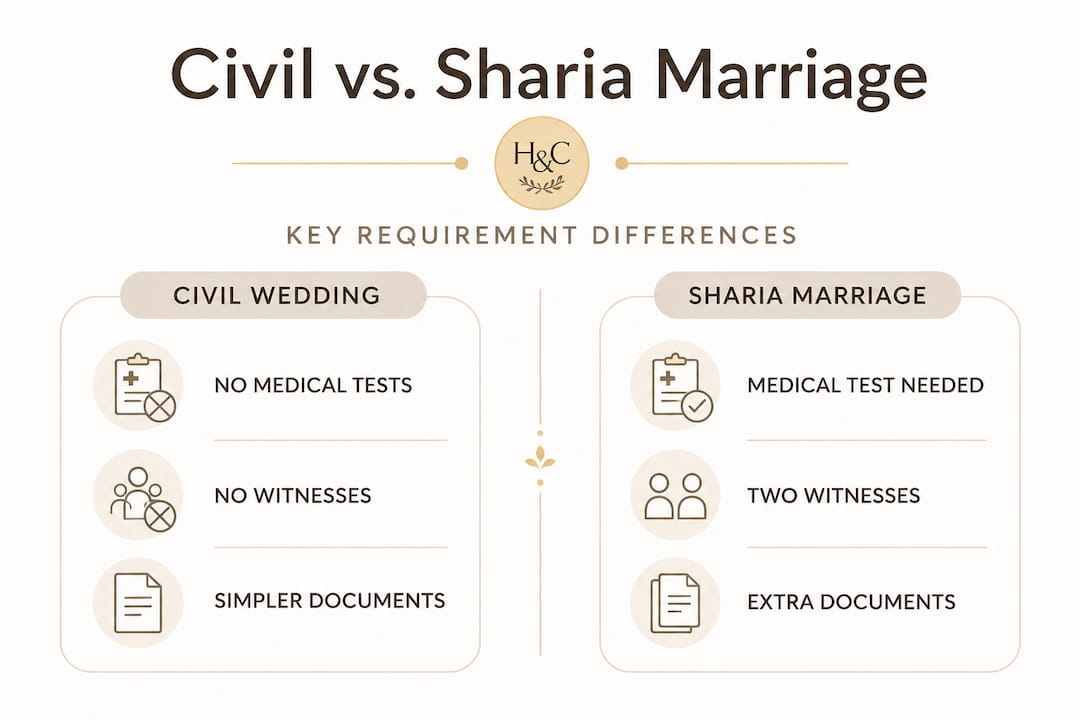
Feature | Civil marriage | Sharia marriage |
Who it’s for | Non-Muslims, non-citizen Muslims (AD) | Muslims (mandatory for UAE citizens) |
Guardian (Wali) required | No | Yes (for bride) |
Witnesses required | No | Yes (two male Muslim witnesses) |
Medical screening | No | Usually required |
Religious vows | No | Yes |
Prenup option | Yes | Not standard |
Tourist eligible | Yes (Abu Dhabi) | No |
Ceremony language | Any | Arabic/Islamic |
For mixed-nationality couples where one or both partners are not Muslim, the civil route offers something invaluable: clarity and legal certainty without religious prerequisites. There is no need to convert, seek religious permission, or find community endorsement. The marriage is a legal contract between two consenting adults, recognized by the UAE state.
“For expat couples, civil marriage is not just a convenient option. It is often the only legally available route, and it carries the same full legal weight as any other marriage under UAE law.”
For a complete side-by-side review of civil vs Sharia requirements, including documentation differences by emirate, the details matter when making your final decision.
Why the simplest route is often overlooked: A practitioner’s insight
Here is something we have observed working closely with couples through the UAE civil marriage process: the biggest obstacle is almost never the paperwork itself. It is the mental model couples arrive with.
Most people assume that getting married in the UAE involves bureaucratic complexity, religious gatekeeping, and months of preparation. That assumption leads them to either delay indefinitely or spend money on unnecessary steps, like organizing witnesses, booking medical tests, or seeking approvals that simply do not apply to civil marriages.
We have seen couples spend weeks trying to get letters from religious institutions, only to discover none of that was needed. We have seen expat pairs pay for premarital health screenings that civil courts never asked to see. These mistakes are not just wasteful, they are avoidable with accurate information.
The real challenge in a UAE civil marriage is precision, not volume. The document list is short, but every item on it must be correct, attested properly, and in the right language. A single missing apostille or an incorrectly translated birth date can delay your application. That is where most real-world complications arise, not from complexity in the system itself but from errors in preparation.
Our honest advice: ignore forum posts from three years ago, ignore friends who went through Sharia marriages, and go directly to official sources. The ADJD portal for Abu Dhabi and the Dubai Courts website for Dubai are both well-maintained and current. And if your situation involves any edge case, such as a previous marriage, a non-standard nationality, or a tight timeline, get professional support early rather than halfway through.
For civil marriage for expats, the system genuinely works. You just need to engage with it correctly from the start.
Let us simplify your UAE civil wedding journey
The civil marriage process in the UAE is genuinely accessible, but “accessible” does not always mean “easy to navigate alone.” Document attestation chains, portal submissions in Arabic, and jurisdiction-specific rules can still feel overwhelming, especially when you are planning from abroad or working within a tight schedule.

At Harris & Charms, we work with couples every day who want a legally sound, beautifully organized UAE civil marriage without the back-and-forth confusion. From document preparation and attestation guidance to ceremony coordination and post-marriage certification, our UAE wedding services cover every step. If you are dreaming of something beyond the courtroom, we also offer destination wedding options for couples wanting a more scenic celebration. Ready to get started? Speak to a wedding consultant and let us map out the fastest, cleanest route to your UAE marriage certificate.
Frequently asked questions
Can tourists get married in the UAE without residency?
Yes, Abu Dhabi allows tourists to marry civilly with no residency requirement. Dubai requires at least one partner to be a UAE resident.
Do we need a medical test or witnesses for a civil wedding?
No. No medical screening or witnesses are required for a civil marriage in the UAE. These requirements apply only to Sharia marriages.
What documents must be attested for a UAE civil wedding?
Any foreign-issued status documents or divorce certificates must be attested and legalized through your home country, UAE embassy, and MOFA, and translated into English or Arabic if needed.
How fast can we get a UAE civil marriage certificate?
Standard processing in Abu Dhabi takes 10 business days at AED 300. The express option delivers a certificate in as little as one day for AED 2,500.
Is a UAE civil wedding recognized internationally?
Yes. Once attested through MOFA or MOJ, your UAE civil marriage certificate is valid for spouse visa applications and recognized by most countries worldwide.
Recommended
Comments