
Embassy role in UAE marriages: clear steps & tips

TL;DR:
Embassies in the UAE mainly authenticate documents, not perform marriage ceremonies.
Key documents include notarized single status affidavits and attested marriage certificates for legal recognition.
Focusing on proper document preparation and attestation streamlines the marriage process and legal validation.
Most expat couples planning to marry in the UAE assume their home embassy will host the ceremony, handle the paperwork, and send them off with a legally binding certificate. That assumption is almost always wrong. Foreign embassies in the UAE do not generally perform marriage ceremonies, with narrow exceptions for specific nationalities. What embassies actually do is quieter, less glamorous, and far more important: they authenticate the documents that make your UAE marriage legally recognized everywhere from Abu Dhabi to your hometown. Understanding this distinction can save you weeks of confusion and protect your legal rights as a married couple.
Table of Contents
Key Takeaways of Role of Embassy in Marriage
Point | Details |
Embassy ceremonies are limited | Most expats cannot marry at their embassy in the UAE and must use UAE courts. |
Essential embassy documents | Single status affidavits and NOCs from your embassy are often required for court marriage applications. |
Attestation for global recognition | To use your UAE marriage certificate abroad, you must get it attested by MOFA and then your embassy. |
Civil vs. Islamic marriage needs | Both routes require embassy support for documents, but procedures vary depending on religion and nationality. |
What embassies do—and don’t do—in UAE marriages
Let’s clear up the biggest misconception first. Walking into your home country’s embassy expecting a wedding officiant is going to disappoint you. Embassy-performed marriages are limited to specific nationalities, such as Filipino nationals, whose embassy in Abu Dhabi does conduct ceremonies under certain conditions. For virtually everyone else, the UAE’s civil courts and Sharia courts are where the legal marriage actually happens.
So what do embassies actually do? Their role is documentary and notarial, not ceremonial. Think of them as the legal backstop that gives your UAE marriage credibility both locally and internationally. Here’s a quick breakdown of what falls inside and outside their scope:
Embassy function | Applies to UAE marriages? |
Performing marriage ceremonies | Rarely (nationality-specific only) |
Notarizing single status affidavits | Yes, almost universally required |
Issuing No Objection Certificates (NOCs) | Yes, for certain nationalities |
Attesting UAE marriage certificates | Yes, after MOFA attestation |
Registering your UAE marriage | No, not required |
The core functions embassies serve for marrying couples in the UAE include:
Notarizing affidavits of eligibility to marry (also called single status affidavits)
Issuing NOCs for nationalities whose home governments require them
Attesting your UAE marriage certificate after the wedding for use abroad
Providing general guidance on whether your home country recognizes UAE marriages
“The embassy’s role in a UAE marriage is primarily administrative. Couples who treat it as a document support office rather than a ceremony venue move through the process far more efficiently.”
Understanding the difference between civil vs Islamic marriage options in the UAE also shapes how much embassy involvement you’ll need. Non-Muslim expats typically marry through civil courts under Federal Decree-Law 41/2022, while Muslim couples use Sharia courts. Both paths require UAE marriage requirements that include embassy-issued documents, but the specific forms differ. The UAE government confirms that civil court marriage is open to all non-Muslim expats regardless of nationality, making it the most accessible route for international couples.
Embassy documents required for UAE marriage applications
With the embassy’s real role established, let’s look at the exact documents they provide and why you need them for your UAE marriage application.

The single most important document your embassy will provide is the affidavit of eligibility to marry, sometimes called a single status affidavit or certificate of no impediment. Embassy notarial services issue and notarize this document, confirming that you are legally single and free to marry under your home country’s laws. UAE courts require this because they cannot independently verify your marital status in another country.
Here’s what you’ll typically need to gather before your embassy appointment:
Valid passport (original and copies)
Proof of UAE residency (visa page or Emirates ID)
Any divorce certificates or death certificates if previously married
Completed embassy application form for notarial services
Payment for notarial fees (varies by embassy)
For certain nationalities, embassies also issue a No Objection Certificate (NOC), which is a formal statement that your home government has no legal objection to the marriage. This is separate from the single status affidavit and is required by some UAE courts depending on your nationality.
Pro Tip: Book your embassy appointment at least two to three weeks before your planned court marriage date. Some embassies, particularly those of larger countries, have significant wait times for notarial services. Getting this step done early prevents last-minute delays at the court stage.
Once notarized, your embassy documents typically need to be translated into Arabic by a UAE-certified legal translator before submission to the court. The civil marriage requirements guide outlines exactly which documents need translation and which courts accept originals. For a full walkthrough of the civil marriage legal process, including timelines and fees, it helps to review the specific court’s requirements in advance, since Abu Dhabi Civil Court and Dubai Courts have slightly different procedures.
The UAE government’s guidance on personal status affairs for non-Muslims confirms that embassy-issued documents like single status affidavits and NOCs are a standard part of the civil court marriage application.
Civil vs. Islamic marriage: How embassy involvement differs
Now that you know what documents are needed, let’s compare how the process changes for civil versus Islamic marriages and where embassies fit in.
The core embassy documents are similar for both paths, but the legal context and post-marriage requirements diverge significantly. Here’s a side-by-side comparison:
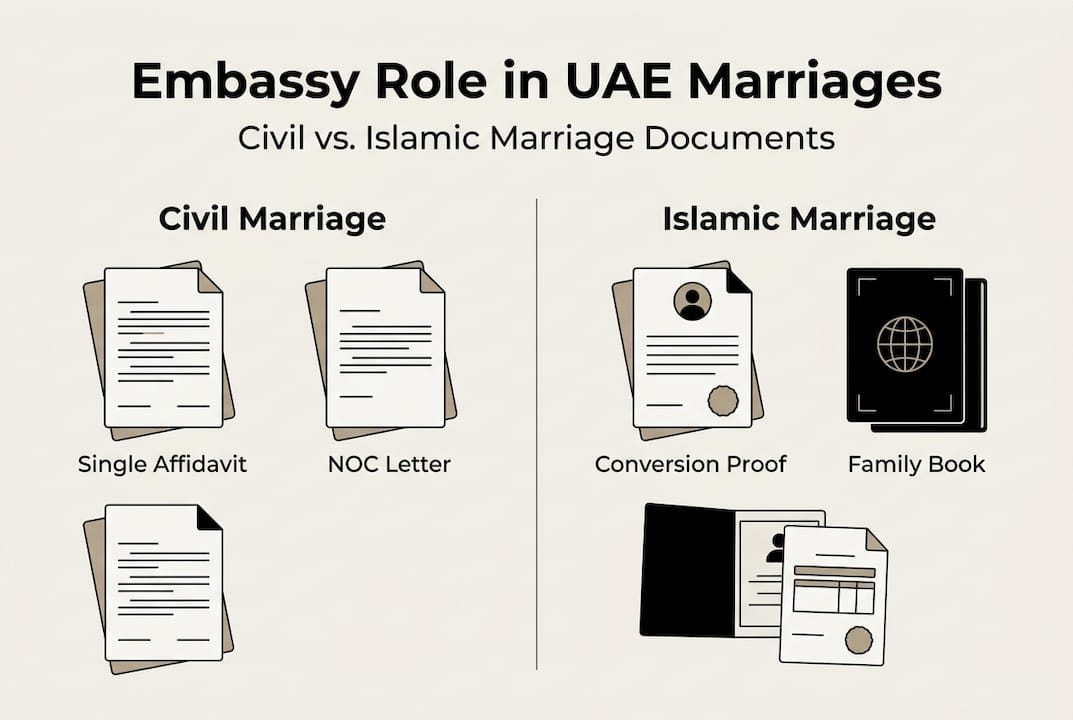
Factor | Civil marriage | Islamic marriage |
Governing law | Federal Decree-Law 41/2022 | UAE Sharia courts |
Who can use it | Non-Muslim expats | Muslims (and some mixed couples) |
Embassy docs needed | Single status affidavit, NOC | Single status affidavit, NOC |
Court venue | Abu Dhabi Civil Court or Dubai Courts | Sharia court |
Post-marriage attestation | MOFA, then home embassy | MOFA, then home embassy |
For a civil marriage, the process follows these steps:
Obtain single status affidavit and NOC from your home embassy.
Get documents translated into Arabic by a certified translator.
Submit the full application to the relevant civil court.
Attend the court appointment (both parties must be present).
Receive the civil marriage certificate.
Proceed to MOFA attestation and then home embassy attestation.
For an Islamic marriage, the steps are similar but the legal framework shifts. The UAE government outlines that civil courts handle non-Muslim marriages, while Sharia courts manage Islamic marriages. Embassy support for pre-marriage documents is essentially the same, but Sharia court marriages involve additional religious requirements, including a wali (guardian) for the bride in some cases, and specific witnesses.
Post-marriage, both civil and Islamic marriages require MOFA attestation followed by home embassy attestation for international use, particularly for visa sponsorship and family residency applications. The civil vs Islamic marriage differences page breaks this down further if you’re still deciding which path fits your situation.
Attesting your marriage: Post-wedding embassy steps for global recognition
Once the wedding is official, the next step is crucial if you plan to use your marriage certificate internationally.
Many couples complete their UAE court marriage and assume the certificate is automatically valid everywhere. It is not. For your UAE marriage to be legally recognized in your home country, for purposes like tax filing, name changes, or spousal visas, the certificate must go through a two-stage attestation process.
Here’s the exact sequence:
Obtain your official UAE marriage certificate from the court that performed the marriage.
Submit to UAE MOFA (Ministry of Foreign Affairs) for attestation. This confirms the document is genuine and issued by a recognized UAE authority.
Submit the MOFA-attested certificate to your home embassy in the UAE. The embassy then applies its own stamp, confirming the document is valid for use in your home country.
Translate if required by your home country’s government for official use.
Use the attested certificate for any legal purpose abroad, including spousal visa applications, name changes, or joint tax filings.
After a UAE marriage, the certificate must be attested by UAE MOFA and then by your home embassy for international recognition. Importantly, no registration is required with your home embassy, only attestation. This is a common point of confusion: registration and attestation are not the same thing.
Pro Tip: Keep at least three certified copies of your marriage certificate before starting the attestation process. MOFA and embassies sometimes retain originals, and having extras prevents delays if you need the document for multiple purposes simultaneously.
For a detailed breakdown of the UAE marriage certificate process, including fees and processing times, it’s worth reviewing the current requirements. The document legalization for UAE marriages guide also covers apostille requirements for countries that are part of the Hague Convention. And if you want a full picture of the role of embassy in marriages, that resource ties together both the pre-marriage and post-marriage embassy functions.
Expert perspective: Why embassy support matters more than ceremonies
Here’s something most wedding planning guides won’t tell you: the couples who stress the least about their UAE marriage are the ones who stopped looking for an embassy to host their ceremony and started treating the embassy as their legal document partner.
We’ve seen couples spend weeks trying to arrange an embassy-based wedding, only to discover their nationality doesn’t qualify. Meanwhile, UAE civil courts can process a marriage in days once the paperwork is in order. The civil marriage process for expats is genuinely efficient when you approach it correctly.
The real value your embassy provides is speed and legal weight. A notarized single status affidavit from your embassy carries enormous legal authority in UAE courts. Without it, your application stalls. With it, you move forward. And the post-marriage attestation your embassy provides is what transforms a UAE court document into something your home government actually recognizes.
Focus your energy on getting your embassy appointment booked early, your documents correctly prepared, and your attestation sequence planned in advance. That’s where the real work is, and that’s where getting it right actually changes your legal life as a couple.
Stress-free UAE marriage: Professional help for every step
Navigating embassy appointments, court submissions, MOFA attestation, and home country recognition is a lot to coordinate, especially while planning a wedding at the same time.
At Harris & Charms, we specialize in making this entire process manageable for expat couples. Our team handles the documentation coordination, embassy appointment guidance, translation requirements, and attestation sequencing so you don’t have to piece it together alone. Whether you’re pursuing a civil or Islamic marriage, our UAE marriage services cover every stage from your first embassy visit to your final attested certificate. Ready to take the first step? Contact the team and let’s map out your process together.
Frequently asked questions
Can foreigners get married at their embassy in the UAE?
Most embassies in the UAE do not perform marriage ceremonies. The exception applies to specific nationalities, such as Filipino nationals, whose embassy conducts ceremonies under defined conditions.
What is an affidavit of eligibility to marry, and why is it needed?
It is a notarized document issued by your home embassy confirming you are legally single and free to marry. UAE courts require this because they cannot independently verify your marital status in another country.
Do I need to register my UAE marriage with my home embassy?
No. You only need to have your UAE marriage certificate attested by your embassy, not registered. Attestation is what gives the document legal standing in your home country.
What is the attestation process for a UAE marriage certificate?
First, get your marriage certificate stamped by UAE MOFA. Then submit the MOFA-attested document to your home embassy for their stamp. This two-step process is what makes your UAE marriage certificate internationally recognized.
Which is faster: embassy or court marriage for expats in the UAE?
Court marriages are generally faster for expats once the required embassy documents are in hand. Embassies primarily assist with notarizing affidavits and NOCs, not with conducting the marriage itself.
Recommended
Comments