
UAE Residency Requirements Marriage: Legal Guide to Marrying in 2026

TL;DR:
Residency is not a requirement for civil marriage in the UAE; non-residents can marry legally.
Document requirements vary but generally include passports, Emirates ID or residency visa, and proof of previous marriage dissolution.
The UAE offers a simplified, accessible marriage process for both residents and tourists, with support available for smooth navigation.
Most couples planning to marry in the UAE assume they must hold a UAE residency visa before they can legally wed. That assumption is wrong, and it stops many couples from moving forward. The UAE has expanded its civil marriage framework to welcome non-residents and even tourists, making it one of the most accessible marriage destinations in the Gulf region. Whether you are a resident expat, a visitor on a tourist visa, or somewhere in between, this guide breaks down exactly what residency means for your marriage plans, what documents you actually need, and how to move through the process with confidence.
Table of Contents
Key Takeaways of Residency Requirements Marriage
Point | Details |
Residency not required | You do not need to be a UAE resident—tourists and visitors can legally marry in the UAE. |
Choose your marriage type | Civil marriages have fewer residency and document requirements compared to Islamic ceremonies. |
Have documents ready | Bring both passports, Emirates ID if available, and proof of previous marriage dissolution for a smooth process. |
Application process is simple | The civil marriage process can often be completed online with transparent fees. |
Residency and marriage: Understanding the basics
The first thing to clear up is that residency and the right to marry are not the same thing in the UAE. Many couples conflate the two, assuming that without a UAE residency visa, a legal marriage is off the table. That is simply not accurate.
For civil marriages, the UAE has made significant strides in accessibility. Civil marriage eligibility now extends to non-residents, and as Gulf News reports, residency is not a barrier to marriage itself since civil marriage explicitly allows non-residents and tourists to marry at UAE courts. This is a major shift from older rules and from how most neighboring Gulf countries operate.
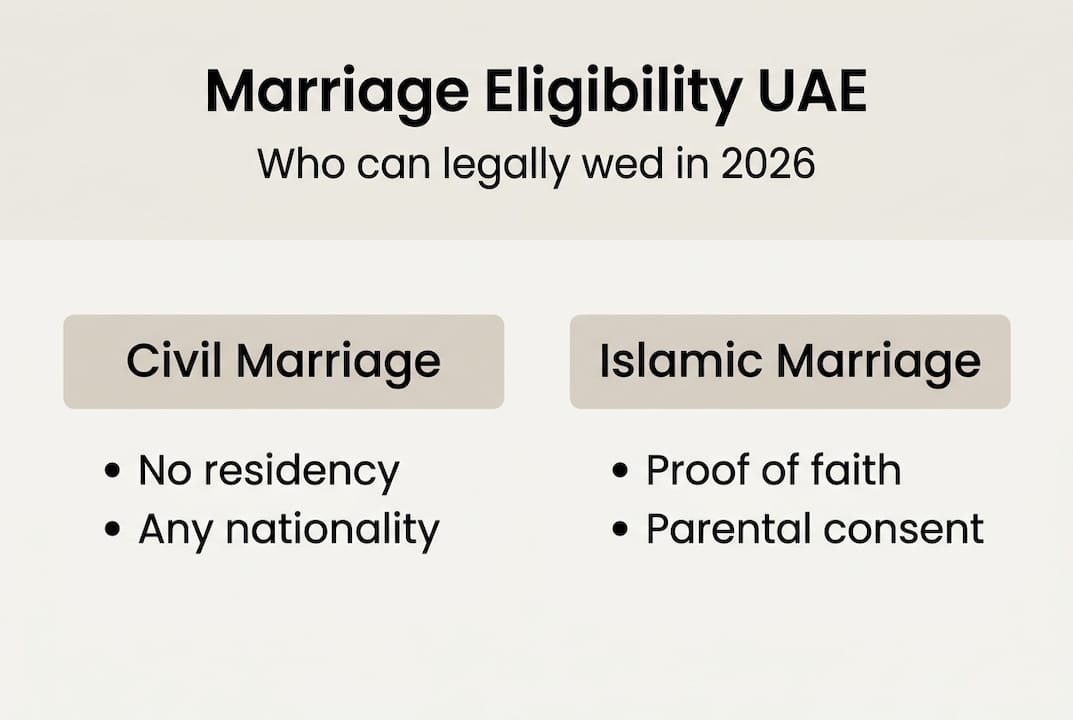
Islamic marriage in the UAE is a different path. It carries more documentation requirements, including mandatory medical tests for both parties, and some nationalities may need a local sponsor or a representative from their country’s embassy. Residency status plays a bigger role here, not because non-residents are excluded, but because the paperwork trail is longer and more complex.
Here is a quick breakdown of what residency actually affects:
Civil marriage: Non-residents and tourists can apply. Residency documents (like Emirates ID) are submitted if available but are not mandatory for all applicants.
Islamic marriage: Typically requires more documentation tied to your legal status in the UAE, including proof of religion and sometimes a local wali (guardian or representative).
Document complexity: Residents generally have a smoother process because their identity is already verified in UAE systems. Non-residents need to bring more external documentation.
Processing timelines: Residents may experience faster turnaround due to integrated government databases.
“The UAE civil marriage framework has been designed to serve a diverse, internationally mobile population. Non-residents are not an afterthought; they are explicitly included.”
Understanding the differences between civil and Islamic marriage early in your planning process saves enormous time. Many couples spend weeks researching the wrong path simply because they assumed their residency status locked them into one option. It does not. You have choices, and knowing them gives you real leverage.
For a broader look at how residency intersects with other legal matters in the UAE, the legal requirements for Dubai expats resource offers useful context on how your visa category shapes your rights and obligations.
Key documents required for marriage in the UAE
Once you understand the residency picture, the next step is gathering your documents. This is where many couples lose momentum because the lists look long and confusing. Let’s simplify it.
For civil marriage, Gulf News confirms that required documents include passports, Emirates ID or residency visa if applicable, and proof of prior marriage dissolution for anyone who has been previously married. That last point is critical. If you are divorced or widowed, you cannot skip this step.
Here is the standard document checklist for civil marriage:
Valid passports for both partners (copies and originals)
Emirates ID, if either or both partners are UAE residents
Residency visa copy, if applicable
Proof of divorce (court-issued decree) or death certificate of former spouse, if previously married
No-objection certificate or equivalent from your home country’s embassy, in some cases
Completed application form from the relevant court or ADJD (Abu Dhabi Judicial Department) portal
For Islamic marriage, the list expands. You will also need proof of religion (often a certificate from an Islamic authority), results from a mandatory medical screening, and in some cases a letter from a local sponsor or wali.
Document | Civil marriage | Islamic marriage |
Passport | Required | Required |
Emirates ID | If applicable | If applicable |
Proof of divorce/widowhood | Required if relevant | Required if relevant |
Medical test results | Not required | Required |
Proof of religion | Not required | Required |
Local sponsor or wali | Not required | Sometimes required |
Pro Tip: If you are a tourist or non-resident, get your passport and any prior divorce documents officially attested (legally certified for use abroad) before arriving in the UAE. Unattested foreign documents are routinely rejected, and re-doing this step from inside the UAE adds weeks to your timeline.
The full breakdown of required marriage documents and a detailed UAE marriage document checklist are worth reviewing before you compile anything. Different nationalities also face slightly different requirements, so check whether your country of origin has specific embassy protocols. Understanding Dubai visa types can also help clarify which residency category applies to your situation.
Step-by-step process: Marrying with or without UAE residency
Knowing what documents you need is only half the picture. The other half is understanding how the actual process unfolds, and where residency status changes the experience.
Here is the civil marriage process from start to finish:
Gather and attest all documents before submitting anything. Attestation means having your documents verified by the relevant authority in your home country and then by the UAE embassy there.
Create an account or log into the ADJD portal (for Abu Dhabi) or the relevant emirate’s court system. Civil marriage via the ADJD portal costs AED 300 for standard processing or AED 2,500 for express processing.
Submit your application with all required documents uploaded digitally.
Attend the scheduled appointment at the court. Both partners must be present.
Sign the marriage contract in front of a judge or authorized official.
Receive your marriage certificate, which is issued by the court and legally recognized in the UAE.
The process is largely the same for residents and non-residents, but there are meaningful differences in how each group navigates it.
Step | UAE residents | Non-residents or tourists |
Identity verification | Emirates ID simplifies this | Passport plus additional proof needed |
Document attestation | Often partially done | Full attestation from home country required |
Portal access | Linked to UAE ID | Requires manual registration |
Processing time | Typically faster | May take longer due to manual checks |
Fees | AED 300 to 2,500 | AED 300 to 2,500 (same) |
The civil marriage procedure in Abu Dhabi is well-documented, and applying for civil marriage is more straightforward than most couples expect once they have their documents in order. For a broader view of how this compares to other expat legal processes, the Dubai expat marriage process resource is a helpful reference.
One thing that surprises many couples: the UAE does not require a waiting period between application and ceremony for civil marriages, unlike many Western countries. Once your documents are approved, the ceremony can happen quickly.
Civil vs. Islamic marriage: Residency and legal differences
Choosing between a civil and Islamic marriage is not just a personal or religious decision. It is a legal one, and residency plays a different role in each path.
Civil marriage is the more flexible option from a residency standpoint. Non-residents are explicitly permitted, the document list is shorter, and the process is largely standardized across the UAE. It is secular in nature, meaning it does not require either partner to be Muslim.
Islamic marriage operates under Sharia law and is administered differently. As Gulf News notes, Islamic marriage is more document-heavy and includes mandatory medical screening for both partners. This screening checks for communicable diseases and genetic conditions, and the results must be submitted before the marriage can proceed.
Here is how the two paths compare on the factors that matter most to couples navigating residency:
Non-resident access: Civil marriage is open to all. Islamic marriage may require additional steps depending on nationality and residency status.
Medical requirements: Civil marriage has none. Islamic marriage requires a government-approved medical test.
Sponsor or wali: Not needed for civil marriage. Some nationalities require a wali or local representative for Islamic marriage.
Processing time: Civil marriage is generally faster. Islamic marriage involves more review steps.
Legal recognition abroad: Both are legally recognized in the UAE, but recognition in your home country depends on their laws.
Pro Tip: If you are a non-Muslim couple or a mixed-faith couple, civil marriage is almost always the simpler and faster route. If Islamic marriage is important to you for religious reasons, start the process at least two months early to allow time for medical tests and additional documentation.
For a side-by-side breakdown, the civil vs. Islamic marriage comparison and the full civil marriage requirements pages offer detailed, current information.
Our take: What most couples get wrong about UAE residency and marriage
After working with hundreds of couples navigating this process, one pattern stands out clearly. The biggest mistake is not a missing document or a wrong form. It is starting with the wrong assumption.
The belief that you must be a UAE resident to marry here is remarkably persistent, even among people who have lived in the UAE for years. We have spoken with long-term expats who were convinced their tourist-visa partners could not be on the marriage certificate. That is simply not true.
What makes this worse is what couples do as a result. They fly home to marry in their country of origin, then spend months getting that foreign marriage certificate attested for use in the UAE. That process is often more expensive, more time-consuming, and more stressful than just marrying here directly.
The smarter move is to evaluate both the civil and Islamic paths early, based on your actual documents and residency situation, not on what a friend told you or what you read in an outdated forum post. Understanding civil versus Islamic rules from a current, reliable source is the single best investment of time you can make before starting any paperwork.
The UAE has built one of the most internationally accessible marriage systems in the region. Use it.
Make your UAE marriage stress-free with guided support
Navigating residency rules, document attestation, and court portals while planning a wedding is a lot to manage. Most couples underestimate how much time the legal side takes until they are already in the middle of it.

At Harris & Charms, we specialize in guiding both resident and non-resident couples through every stage of the UAE marriage process. From clarifying which documents apply to your specific residency situation to coordinating with courts and handling attestation, our team removes the guesswork. Browse our marriage services in the UAE to see how we support couples at every step, or contact us for guidance to get personalized advice based on your situation. You focus on the celebration. We handle the paperwork.
Frequently asked questions
Do I need UAE residency to get married in the UAE?
No. Non-residents and tourists can legally marry under UAE civil marriage laws without holding a residency visa.
What documents are required for a civil marriage in the UAE?
You need both partners’ passports, Emirates ID or residency visa if applicable, and proof of prior marriage dissolution if either partner has been previously married.
Is a medical test required for civil or Islamic marriage?
A medical exam is required for Islamic marriages but not for civil marriages, as confirmed by UAE authorities.
What is the cost of getting married in the UAE?
Civil marriage fees range from AED 300 for standard processing to AED 2,500 for express service through the ADJD portal.
Can I get married in the UAE if I am divorced or widowed?
Yes, but you must present official proof of dissolution or a death certificate as part of your document submission.
Recommended
Comments