
Understanding Talaq in the UAE: Islamic Divorce Explained


TL;DR:
Merely saying “I divorce you” three times is insufficient; court registration and legal procedures are required in UAE.
UAE courts follow specific talaq procedures, including reconciliation, waiting periods, and official registration.
Expat couples face additional challenges like jurisdiction recognition, embassy involvement, and cross-cultural legal differences.
Many people assume that saying “I divorce you” three times is all it takes to legally end an Islamic marriage in the UAE. That assumption is not only wrong but can lead to serious legal complications for both partners. Talaq, the Islamic term for divorce, operates under a clear framework in the UAE that blends religious tradition with formal civil law requirements. Whether you are a Muslim national or an expat navigating cross-border marriage laws, understanding exactly how talaq works here can protect your rights, your children, and your future.
Table of Contents
Key Takeaways
Point | Details |
Talaq definition clarified | Talaq is an Islamic divorce initiated by the husband and recognized under Sharia law in the UAE. |
Legal process required | All talaq declarations in the UAE must be registered with Sharia courts to be legally valid. |
Expat differences | Expat couples should consider additional legal and jurisdictional factors before initiating talaq. |
After-divorce rights | Post-talaq, parties have specific rights and obligations concerning property, custody, and support under UAE law. |
Avoiding pitfalls | Understanding common mistakes ensures a smoother, legally-compliant talaq process in the UAE. |
What is talaq in Islamic law?
Talaq literally means “release” or “divorce” in Arabic, and it describes the legal act by which a husband dissolves a marriage under Islamic law. It is one of the most widely recognized mechanisms for ending a marriage in Muslim-majority legal systems, and the UAE formally incorporates it into its family law structure. As noted in the Muslim marriage rules UAE guide, talaq is an Islamic divorce initiated by the husband, recognized by Sharia law and outlined in marriage statutes in the UAE.
There are three primary forms of talaq recognized within the broader Islamic tradition:
Talaq-e-sunnat: This is the most approved form, following the Sunnah (practice) of the Prophet. It includes two sub-types: ahsan (a single revocable pronouncement followed by the waiting period) and hasan (three pronouncements across three menstrual cycles).
Talaq-e-biddat: Sometimes called “triple talaq,” this is a controversial form involving three simultaneous pronouncements. Many Islamic scholars and several Muslim-majority countries have moved away from recognizing it, though its legal weight varies by jurisdiction.
Khula: This is the wife-initiated form of divorce, where she requests separation, often returning the mahr (dowry) paid at marriage. It requires court approval and is fully recognized under UAE Sharia courts.
“Divorce in Islamic law is not intended to be a rash act. The structure of talaq, including waiting periods and opportunities for reconciliation, reflects a deliberate intention to preserve family stability wherever possible.”
Understanding these distinctions matters because UAE courts evaluate which form of talaq is being sought before proceeding. The type you use affects the waiting period, revocability, and legal outcomes for your entire family.
Legal procedures for talaq in the UAE
Now that you know what talaq is, let’s look at the legal steps involved in the UAE. Knowing the procedure ahead of time prevents costly errors and unnecessary delays.
The UAE follows specific legal protocols for registering a talaq through Sharia courts. Here is the general process most couples go through:
Verbal declaration: The husband makes a formal declaration of talaq. However, this verbal step alone does not legally finalize the divorce.
Notification to spouse: The wife must be formally informed of the declaration. Silent or secret talaq has no legal standing in UAE courts.
Filing at Sharia court: The husband must file a petition at the local Sharia court. Relevant documents, including the marriage certificate, Emirates IDs, and passports, are submitted.
Reconciliation session: UAE courts require at least one reconciliation attempt, usually facilitated by a court-appointed counselor. This is mandatory and cannot be skipped.
Waiting period (iddah): The wife observes an iddah, a waiting period of approximately three menstrual cycles or 90 days, during which the divorce can still be revoked if it was a first or second talaq.
Final registration: Once the iddah ends and no reconciliation occurs, the court issues a final divorce certificate.
Pro Tip: Keep copies of every document you submit and every court notice you receive. Losing paperwork mid-process can extend the timeline significantly.
The Sharia courts’ role in UAE marriages is central to this entire process. These courts hold jurisdiction over all Muslim personal status matters, including marriage and divorce, regardless of the couple’s nationality.
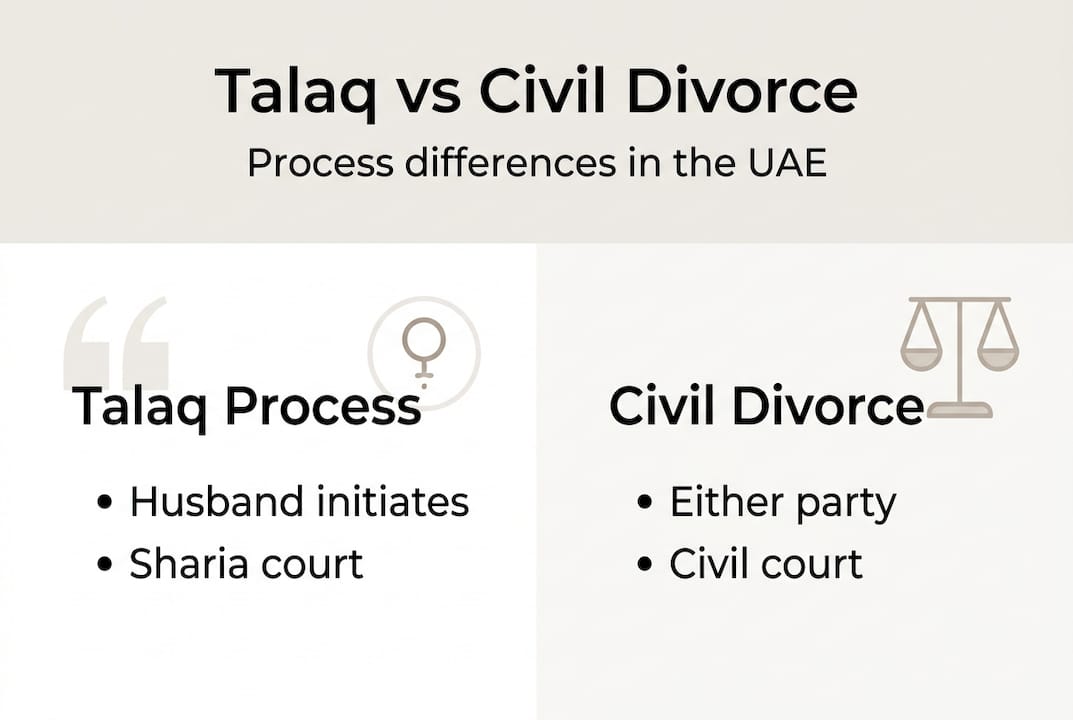
Here is a comparison to help clarify how talaq differs from a civil divorce in the UAE:
Aspect | Talaq procedure | Non-Muslim civil divorce |
Initiating party | Typically husband (or wife via khula) | Either spouse |
Court type | Sharia Personal Status Court | Civil/Family Court |
Mandatory reconciliation | Yes | Not always required |
Waiting period | Iddah (up to 90 days) | No formal waiting period |
Religious oversight | Yes | No |
Legal certificate issued | Yes, by Sharia court | Yes, by civil court |
Review the Islamic marriage legal requirements to ensure all your documentation is accurate before approaching the courts. Missing even one document can delay your case by weeks.

Talaq for expat couples: Key considerations
The process changes if you’re an expat or in a cross-cultural marriage. Here’s what you need to know.
Expat couples may face additional considerations depending on nationality, resident status, and interpretation of Sharia. These added layers of complexity are often underestimated by couples who assume the process works exactly the same for them as for UAE nationals.
Here are the most common issues expats face:
Cross-jurisdiction recognition: A talaq registered in the UAE may not be automatically recognized in your home country. Some countries require additional legal steps, such as re-registering the divorce or obtaining a court order locally.
Embassy involvement: Some nationalities must notify their home embassy of the divorce for it to be recorded in national records. Failing to do so can create problems with future marriage applications.
Madhab differences: Islam has several main schools of legal thought (madhabs), including Hanafi, Maliki, Shafi’i, and Hanbali. UAE courts primarily follow the Maliki madhab for many personal status decisions, which may differ from the school practiced in your home country.
One partner is non-Muslim: If one partner is not Muslim, the legal pathway changes. UAE courts do not apply Sharia law to non-Muslims in the same way, and alternate procedures may apply. Exploring non-Muslim marriage pathways in the UAE can help you understand the distinctions.
Challenge | Typical scenario | Practical solution |
Home country non-recognition | Pakistani couple divorcing in UAE | Legalize UAE divorce certificate via embassy |
Madhab conflict | Hanafi husband, Maliki court ruling | Consult a specialist Islamic family lawyer |
Non-Muslim spouse | Muslim husband, Christian wife | File under civil divorce framework instead |
Visa status changes | Wife’s residency tied to husband’s visa | Apply for independent visa or dependent status review immediately |
Property in two countries | Assets in UAE and home country | Engage attorneys in both jurisdictions |
Pro Tip: If your marriage was registered outside the UAE, you may still need to initiate talaq proceedings in UAE courts if you are currently UAE residents. Always confirm jurisdiction with a legal expert before filing.
Understanding Sharia marriage impact for expats is essential if you want to avoid gaps between what the UAE recognizes and what your home country accepts.
After talaq: Rights, responsibilities, and next steps
Once talaq is declared, it’s vital to understand your rights and what to expect after the process completes.
The end of a marriage does not mean the end of legal obligations. Following talaq, there are legal implications for child custody, financial support, and post-divorce rights for both parties.
Here is an overview of what typically follows a finalized talaq:
Asset distribution: UAE family law and Sharia principles guide how shared property and assets are divided. Generally, each spouse retains what they personally own, but jointly held assets require negotiation or court arbitration.
Mahr payment: If the full mahr (dowry) was deferred, the wife is entitled to receive it upon divorce. This is a legally enforceable obligation, not a cultural formality.
Child custody: Under UAE law, mothers typically have physical custody of young children, while fathers maintain legal guardianship. The exact arrangement depends on the ages of the children and the court’s assessment of best interests.
Financial support (nafaqa): The husband is obligated to provide financial support during the iddah period. If the wife is pregnant, support extends until after the birth of the child.
Remarriage: After the iddah, the wife is free to remarry. The husband may remarry sooner, but if the talaq was a third and final pronouncement, he cannot remarry the same woman unless she has been married to and divorced by another man (a rule known as halalah).
“Your rights after talaq are not optional courtesies. They are legally binding obligations recognized by UAE courts, and you have every right to pursue them fully.”
Here is a summary of post-talaq responsibilities:
The ex-husband pays nafaqa during iddah
Mahr settlement must be completed promptly
Custody arrangements must be formalized in writing with court approval
Both parties should update legal documents, visas, and financial accounts
Consulting a legal counselor familiar with the Nikah guide for UAE marriage and divorce proceedings can help you navigate these obligations without confusion.
Common misconceptions and pitfalls about talaq in the UAE
Given the complexity, many people fall into easy traps. Recognizing these ensures you avoid problems.
Many individuals mistakenly believe verbal talaq alone ends a marriage; legal registration in UAE courts is mandatory. This single misunderstanding causes more legal trouble than almost any other talaq-related issue.
Here are the most damaging myths and the realities behind them:
Myth: Saying talaq three times immediately ends the marriage. Reality: In the UAE, no verbal declaration holds legal weight without court registration and the completion of the required process.
Myth: Expats do not need to go through UAE courts. Reality: Any Muslim residing in the UAE who wishes to be legally divorced must use the UAE Sharia court system, regardless of where the marriage originally took place.
Myth: Skipping the reconciliation session speeds things up. Reality: Reconciliation sessions are mandatory under UAE law. Attempting to bypass them will result in your case being suspended.
Myth: The divorce is final the moment the iddah ends. Reality: You still need to obtain and register the official divorce certificate from the court. Without it, you may not be recognized as divorced in the eyes of the law.
Myth: Children automatically stay with the mother. Reality: Custody is determined on a case-by-case basis, and fathers retain certain rights even when mothers have primary physical custody.
Review the Islamic marriage ceremony steps to understand how formal the marriage structure is. Divorce carries the same level of formal obligation.
Pro Tip: Keep all communication with your former spouse regarding the divorce in writing wherever possible. Verbal agreements during separation often lead to disputes later, especially around custody and finances.
Ignoring the financial implications for children is another critical mistake. Child support is not negotiable based on informal agreements. Courts set enforceable amounts, and failing to pay can have serious legal consequences.
Editorial perspective: What couples should really consider before initiating talaq
Most articles about talaq focus heavily on paperwork and procedure. That’s important, but we believe it misses something even more critical: the human and relational dimensions of the decision itself.
From our experience supporting couples through marriage and its challenges in the UAE, we have noticed that couples often reach the legal stage without having addressed the underlying issues through qualified counseling. Islamic tradition strongly encourages reconciliation, not as a bureaucratic formality, but as a genuine effort to preserve the family. The UAE legal system reflects that intention by requiring it.
Many couples also underestimate how talaq affects extended family, community standing, and children’s emotional health. These are not secondary concerns. They are often the most lasting consequences of the divorce, far outlasting the paperwork.
We encourage couples to approach legal advice and cultural or religious counseling as equally important. Understanding the Islamic marriage essentials that formed the foundation of your marriage can also inform how you approach its end with integrity and care. Thinking beyond legality to long-term family well-being is not weakness. It is wisdom.
Need guidance with talaq or marriage in the UAE?
Navigating talaq in the UAE is rarely something you should handle alone. Between Sharia court requirements, documentation, iddah rules, and cross-border complications, the details add up fast.

At Harris & Charms, we work closely with couples across the UAE to make both marriage and difficult transitions easier to manage. Our team connects you with trusted experts in Islamic law, documentation processing, and legal attestation, so you are never left guessing. Whether you need support understanding marriage services in the UAE or want to speak directly with someone who understands the local legal framework, we are here to help. Take the first step and contact our experts for a personalized consultation today.
Frequently asked questions
Can a wife initiate talaq in the UAE?
While talaq is traditionally husband-initiated, a wife can pursue khula, a form of judicial divorce governed by Sharia courts in the UAE. Under UAE divorce statutes, a wife may initiate this process through the court directly.
Do expat couples need to register talaq with UAE courts?
Yes, all talaq actions must be registered with Sharia courts in the UAE, regardless of nationality, for legal recognition. All talaq cases in the UAE must go through Sharia courts without exception.
What documents are required for talaq in the UAE?
Couples typically need marriage certificates, identification, and any court orders to process a talaq in the UAE. Documents required for talaq include valid passports, Emirates IDs, and the original marriage certificate.
How long does the talaq process take in the UAE?
The process length varies by case, but generally includes a waiting period and reconciliation meetings set by the courts. Talaq involves a waiting period (iddah) of up to 90 days, plus additional time for court scheduling and final registration.
What happens to children after talaq is finalized?
Post-talaq, decisions regarding child custody and support follow UAE family law and Sharia court guidance. Child custody after talaq is determined through court review, with the child’s best interests as the primary standard.
Recommended
Comments