
Islamic court marriage in the UAE: legal steps and expert tips

TL;DR:
Islamic court marriage in the UAE requires strict adherence to religious and legal procedures, including court registration and documentation.
The process involves premarital screening, gathering specific paperwork, booking appointments, and attending court with witnesses and a Wali.
Accurate, properly attested documents and early planning are essential to avoid delays and ensure legal recognition of the marriage.
Getting legally married under Islamic law in the UAE feels straightforward until you’re standing in front of a government portal wondering what a Wali is, whether your premarital screening certificate has expired, and why the system keeps asking for a document you’ve never heard of. Many couples assume this is a quick formality. It isn’t. But once you understand the structure, the logic, and the sequence, it becomes manageable. This guide walks you through every stage of the Islamic court marriage process in the UAE, from paperwork to certificate, so you arrive at your court appointment ready and confident.
Table of Contents
Key Takeaways
Point | Details |
Clear process steps | Following the official sequence makes Islamic court marriage in the UAE straightforward and legally sound. |
Essential paperwork | Having all required documents ready helps you avoid delays and surprises at the court. |
Timelines vary | Certificate processing usually takes one to three weeks, but digital services can speed up some tasks. |
Expert support helps | Professional wedding planners can simplify the journey, especially for expat and complex cases. |
Understanding Islamic court marriage in the UAE
Islamic court marriage is not simply a religious ceremony blessed by an imam. It is a legally binding union processed and registered through the UAE’s Sharia courts. That distinction matters more than most couples realize, especially for expats who may assume their home country’s marriage traditions will transfer smoothly into UAE law.
What sets it apart from civil marriage?
Civil marriage in the UAE is governed by personal status law and is typically available to non-Muslim couples. An Islamic court marriage, by contrast, applies to Muslim couples and is processed by Sharia authorities. The Islamic marriage requirements are specific: both parties must meet religious eligibility criteria, a Wali (the bride’s male guardian) must typically be present or officially represented, and the marriage must be witnessed and contracted in a way that complies with Sharia.
Why does court registration matter?
Without proper court registration, your marriage may not hold legal weight in the UAE. This has downstream effects on residency sponsorship, inheritance rights, healthcare decisions, and even child custody. A religiously conducted ceremony alone, without the official contract and court record, is not recognized by UAE authorities. The UAE legal court marriage guide explains in detail why skipping or rushing the court process can create serious legal complications down the line.
Which courts and portals handle the process?
Two main systems come into play. The Ministry of Justice’s eZawaj platform handles appointments and document submission at the federal level. Dubai Courts operates its own marriage registration services. Depending on where you live in the UAE, you’ll interact with one or both of these systems. Sharia courts in Abu Dhabi, Sharjah, and other emirates have their own procedures, though the core requirements overlap significantly.
Here’s what the Sharia court process is designed to protect:
The rights of both spouses under Islamic personal status law
Proof of free and informed consent from both parties
A verified and witnessed contract (Aqad) that is enforceable
Documentation of the Mahr (dower) agreed upon
Prevention of invalid or fraudulent marriages
“Islamic court marriages follow a specific sequence and must align with Sharia requirements, including screening, witness presence, and signing contracts through authorized courts.”
Understanding this foundation helps you see why the UAE process has multiple steps. Each checkpoint is there for a legal and religious reason, not just bureaucratic friction.
Step-by-step process for Islamic court marriage
Now that you know what Islamic court marriage involves, let’s go through the process in sequence. Missing any step or completing them out of order is one of the most common reasons couples experience delays.
Complete premarital screening. Both the bride and groom must undergo a medical examination at an approved health center. This screens for genetic conditions and communicable diseases. The resulting certificate has a validity window, typically six months, so don’t complete this step too far ahead of your planned court date. The premarital screening guide covers which health centers are approved and what the certificate must include.
Attend premarital counseling (if required). Some emirates or court systems require a counseling session as part of the registration. This is especially common for first-time marriages and is usually conducted by a government-approved counselor.
Book your court appointment. Use UAE PASS to log into the eZawaj system or Dubai Courts portal. You’ll need to upload documents before the system allows you to book a slot. Appointments at busy courts can be several weeks out, so don’t wait until the last moment.
Gather all parties: Wali and two male witnesses. The Wali is the bride’s guardian, usually her father or another close male relative. He must attend or provide a documented authorization. Two adult Muslim males serve as witnesses and must be present during the contract signing.
Attend the court appointment and sign the marriage contract. At the court, a Sharia judge or authorized marriage officiant oversees the Aqad ceremony. Both parties declare consent, the Mahr is confirmed, witnesses observe, and the Wali fulfills his role. The contract is signed and submitted.
Wait for official certificate issuance. According to UAE government guidelines, the full process runs: premarital screening, appointment via UAE PASS or eZawaj, court attendance with Wali and witnesses, signing the contract, and then registration for the official certificate, which typically takes 1 to 3 weeks. Online and remote options exist but must still comply with Sharia.
Pro Tip: Book your premarital screening appointment at least 8 to 10 weeks before your intended court date. Certificate validity windows and court appointment availability often create a tight scheduling puzzle. Starting early gives you buffer time if anything needs to be redone.
One common pitfall is assuming the court appointment and certificate issuance happen the same day. They don’t. Plan your honeymoon and travel after the certificate is confirmed, not after the court session.
Read the full registration steps for a detailed breakdown of each stage with current processing notes.
Required paperwork and legal documentation
Documentation is where most couples stumble. The list isn’t impossibly long, but the details matter. A document that lacks an apostille stamp, a certified translation, or an official signature will stall your application.
Here’s an overview of the core documents required:
Document | Who provides it | Notes |
Valid passport (copies + original) | Bride and groom | Must be current and unexpired |
UAE residency visa or Emirates ID | Bride and groom | Required for expats |
Premarital screening certificate | Bride and groom | Issued by approved health center |
Birth certificate (attested) | Bride and groom | Foreign documents need legalization |
Proof of marital status | Bride and groom | Divorce decree or death certificate if previously married |
Wali’s passport and ID | Guardian (bride’s) | Plus authorization letter if not attending in person |
Witness IDs and passports | Two male Muslim witnesses | Must be adult Muslims |
No-objection letter from employer | Groom (some cases) | Required by certain courts |
For expat couples, the documentation layer gets more involved. Foreign documents, including birth certificates and marital status certificates, must go through a legalization process. This means getting them notarized in your home country, then authenticated by that country’s foreign ministry, and finally attested by the UAE embassy in your home country before they’re valid in the UAE.

Pro Tip: If your home country does not use apostilles under the Hague Convention, your documents will need consular legalization instead. This can add 3 to 6 weeks to your timeline if you haven’t factored it in. Always check your country’s specific path and get started well in advance.
The Islamic marriage process UAE page has current country-specific guidance for common nationalities. Understanding the role of marriage witnesses is also worth reviewing, because witness eligibility is strictly defined under Sharia and courts do reject unsuitable witnesses.
Official registration requires valid documentation at every stage, and certificate processing can take 1 to 3 weeks from the date of submission. Delays almost always trace back to incomplete or improperly attested documents.
Recognition, timelines, and online marriage options
Once you’ve completed your court appointment and submitted all documents, the clock starts ticking on certificate issuance. Understanding the timeline and your options helps you plan practically.
How long does recognition take?
The official certificate typically processes in 1 to 3 weeks, though courts during peak periods, especially wedding season months, can run longer. Once issued, your marriage is legally recognized across all UAE government systems immediately. You can then update residency sponsorships, apply for a family visa, and update your Emirates ID status.
The growth in UAE marriages
Marriage rates in the UAE have been trending upward. Dubai Emirati marriages rose steadily: 983 both-Emirati marriages in 2022, growing to 1,104 in 2023, and 1,244 in 2024. In the first nine months of 2025 alone, Dubai recorded 4,782 total marriages. UAE-wide registered contracts continue to climb. This means court systems are handling higher volumes, which is another reason to book appointments and start documentation early.
In-person vs. digital/remote registration: a comparison
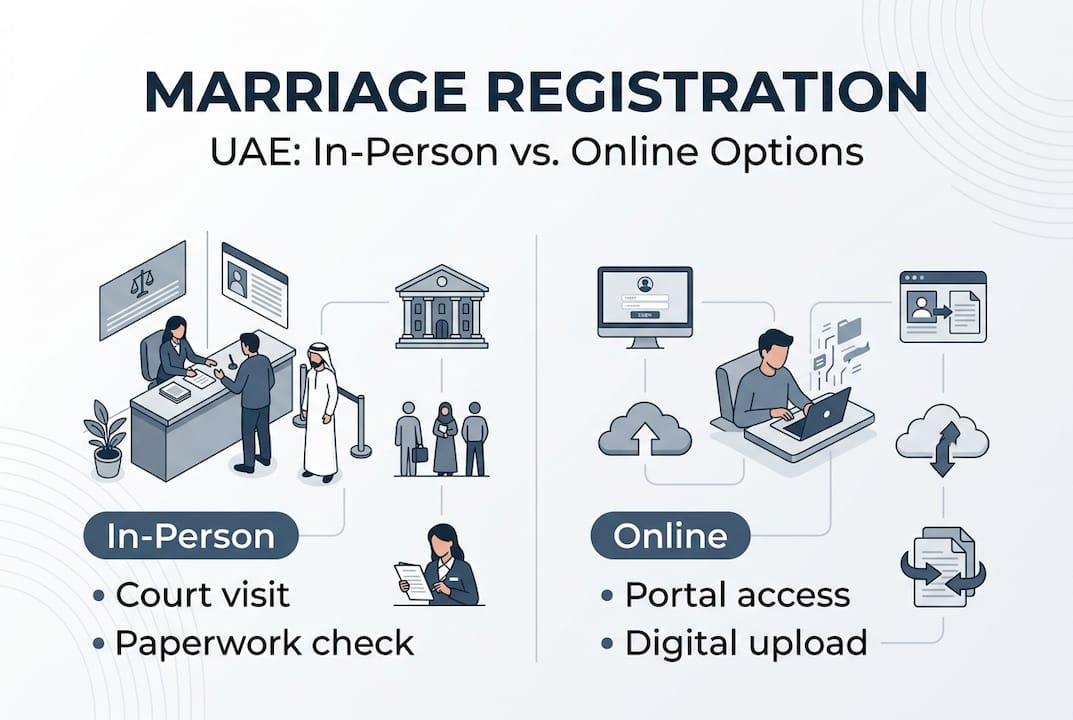
Feature | In-person | Online/remote |
Appointment booking | Court office or eZawaj portal | eZawaj portal or Dubai Courts app |
Document submission | Physical copies required | Upload via portal (certified copies) |
Contract signing | Must be in-person | Some steps remote; final steps in-person |
Sharia compliance | Fully verified at court | Still required; compliance steps checked remotely |
Processing time | 1 to 3 weeks | Similar, with possible delays for verification |
Best suited for | All couples, especially first-timers | Expats pre-checking documents; follow-up steps |
Who can use online and remote options?
The UAE has invested in digital government services, and some marriage registration steps can now begin online. However, online and remote options must still comply with Sharia. The actual Aqad (contract signing) cannot be replaced by a video call in most cases. Remote options are better understood as digital process management rather than a fully remote marriage.
Key considerations for this route:
Both parties must still be physically reachable by UAE Sharia authorities
Witnesses must fulfill Sharia-defined roles and this cannot be waived digitally
Document verification remotely can flag issues faster than waiting for an in-person appointment
Online marriage registration explains the exact steps and compliance requirements for expats considering this path
If complications arise, such as a rejected document or a rescheduled court date, contact the relevant court’s customer service immediately and ask for a case reference number. Don’t wait for the system to update on its own. The Islamic marriage steps for expats covers common complications and how to resolve them quickly.
What most couples miss about Islamic court marriage in the UAE
Here’s the honest part. After seeing many couples go through this process, one pattern keeps showing up: people underestimate how detailed this process actually is, and they find out at the worst possible moment, usually days before a planned ceremony.
The paperwork alone feels manageable on a checklist. But each document has its own conditions: it must be current, attested correctly, translated by a certified translator, and sometimes carry additional stamps depending on your nationality. What looks like a simple step from the outside often has three sub-steps inside it.
Remote and online options create a false sense of ease. Couples sometimes assume that because they uploaded documents online, the hard part is done. Then they discover that witnesses still need to appear, that the Wali’s authorization has a specific format the court requires, or that their premarital screening certificate expired because the court date got pushed back.
The practical advice that most guides leave out is this: working with a team that has done this before cuts your error rate dramatically. Not because the process is mysterious, but because experienced coordinators know which courts want what format, which document translations courts accept, and how to prepare witnesses properly. The step-by-step Dubai guide offers a useful framework, but pairing that knowledge with professional support on your actual documents is what prevents a stressful court-day surprise.
Read both government pages and experience-based guides. Rely on neither alone. And don’t assume that because something worked for a friend two years ago, it will work exactly the same way today. Procedures update, portal interfaces change, and document requirements can shift without much public announcement.
Plan your Islamic court marriage with expert help
Ready to move forward but want someone experienced guiding the process alongside you?

At Harris & Charms, we’ve helped couples across the UAE and from around the world navigate Islamic court marriage from first inquiry to official certificate. We manage document checklists, coordinate premarital screening appointments, prepare witness briefings, and communicate with courts so you’re not chasing paperwork alone. Our team is especially experienced with expat and cross-cultural weddings, where document legalization and translation add extra complexity. Whether you need full support or just want someone to review your documents before your court date, explore our Islamic wedding packages or get personalized advice directly from our team.
Frequently asked questions
What is the difference between Islamic court marriage and civil marriage in the UAE?
Islamic marriages must align with Sharia requirements and are processed through Sharia courts, while civil marriage in the UAE is governed by personal status law and is typically available to non-Muslim or multi-faith couples.
How long does it take to get an Islamic court marriage certificate in the UAE?
The official certificate generally takes 1 to 3 weeks after your court appointment, with the 1 to 3 week processing window starting once all documents are verified and submitted.
Can I complete the Islamic court marriage process online in the UAE?
Some steps like document submission and appointment booking can be done online, but online options must comply with Sharia, meaning key stages like the contract signing typically still require physical attendance or appearance before authorized officials.
Do non-Emiratis need special documents for Islamic court marriage?
Yes, expat couples usually need additional paperwork including legalized birth certificates, valid passports, and certified proof of marital status from their home country, all attested according to UAE requirements before submission.
Recommended
Comments