
Islamic marriage in Dubai: step-by-step guide for couples

Getting legally married under Islamic law in Dubai involves more moving parts than most couples expect. Between gathering attested documents, booking court appointments, arranging a wali (bride’s guardian), and meeting Sharia compliance rules, the process can feel like a maze. One wrong document or missed step can delay your legal status or affect how your marriage is recognized abroad. This guide walks you through every stage of the Islamic marriage registration process in Dubai, from eligibility checks to receiving your official certificate, so you can move forward with confidence.
Table of Contents
Key Takeaways
Point | Details |
Sharia compliance is essential | Dubai requires marriage registration at Sharia Court with defined roles for wali and witnesses. |
Documentation is the biggest hurdle | Prepare all documents early, follow translation and attestation rules, and secure your premarital medical certificate. |
Follow each step carefully | Use the court’s online or in-person portal, and do not miss ceremony requirements or deadlines. |
Expert help saves time | Professional planners simplify paperwork, ensure no missed steps, and speed up the workflow for expats. |
Understanding the Islamic marriage process in Dubai
Dubai’s Islamic marriage system operates under Sharia law and is administered by the Dubai Courts Sharia Court. This is not the same as a civil marriage, and the distinction matters a great deal depending on your background and religion.
Since 2022, the UAE has offered a civil marriage option for non-Muslims that requires no religious oversight, no wali, and no Sharia compliance. But for Muslim couples, the Sharia process remains the required path. The two systems are completely separate, and mixing up which one applies to you is one of the most common early mistakes.
Here is what makes the Islamic process distinct:
A wali (the bride’s male guardian, typically her father) must be present and give consent
Two adult Muslim male witnesses are required
A mahr (dowry) must be agreed upon and stated in the marriage contract
The ceremony is officiated by a licensed Maozoun (marriage officiant) or a judge
All documentation must comply with Sharia standards
“The Islamic marriage process in Dubai is built around Sharia compliance. Every element, from the wali to the witnesses, serves a legal and religious function that the court verifies before issuing a certificate.”
If you are an expat Muslim couple, understanding these requirements early saves you from confusion later. You can also review a detailed breakdown of Islamic marriage steps for expats to see how the process applies to your specific situation.
Eligibility and document requirements
Before you book any appointments, you need to confirm that both parties meet the legal eligibility criteria and that your paperwork is complete. Missing even one document can push your timeline back by weeks.
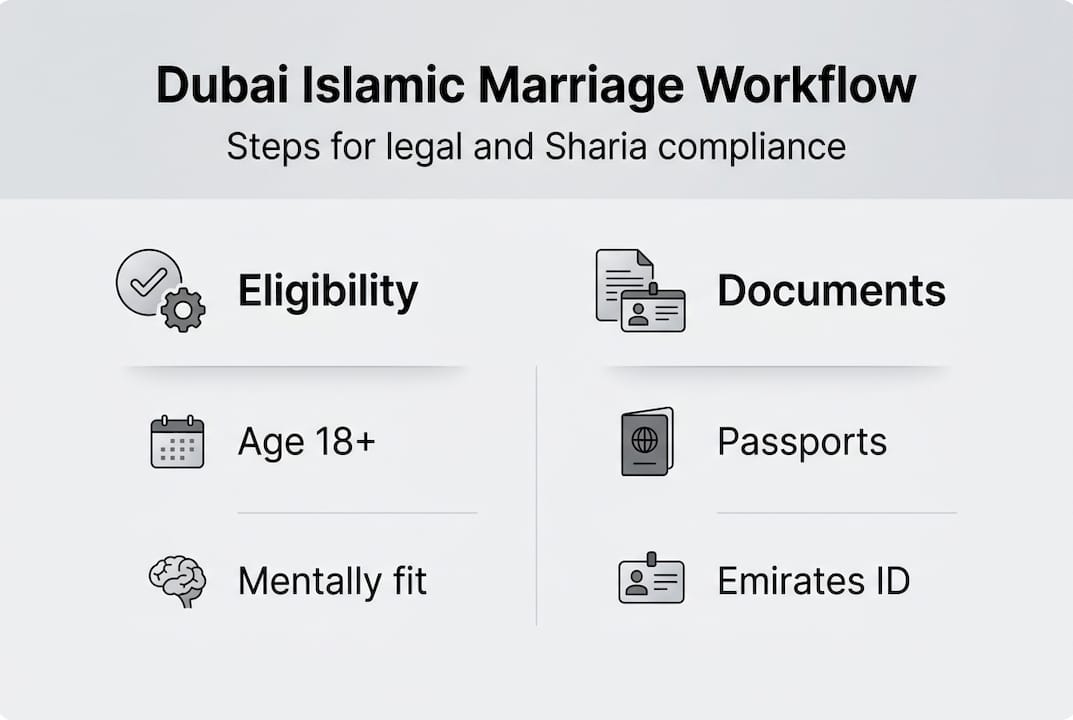
Eligibility basics: Both parties must be at least 18 years old, mentally fit, and not currently married to someone else. For religious eligibility, both parties are typically required to be Muslim, though a Muslim man may marry a woman from the People of the Book (Christian or Jewish). A Muslim woman cannot marry a non-Muslim man.

Here is a quick overview of what you will need:
Document | Notes |
Valid passports | Both parties |
Emirates ID / UAE residency visa | If applicable |
Birth certificates | Attested and translated to Arabic |
Proof of marital status | Single certificate, divorce decree, or death certificate |
Premarital medical fitness certificate | From an approved UAE facility |
No-objection letter (if required) | Employer or sponsor letter in some cases |
All foreign documents must be translated into Arabic and attested by the UAE Ministry of Foreign Affairs (MOFA). This step alone can take one to two weeks if you are not prepared.
Additional requirements to keep in mind:
Premarital screening must be completed at a UAE Ministry of Health approved clinic
Divorce certificates must be court-issued and officially attested
If either party was previously married, additional documentation may be required
Pro Tip: Start collecting and attesting your documents at least four to six weeks before your intended marriage date. Attestation timelines vary by country of origin, and rushing this step is the number one cause of delays. Review the full marriage requirements for couples to make sure nothing is missed, and check the legal steps and key requirements for a detailed checklist.
Step-by-step workflow: Registering your Islamic marriage
With your documents ready, here is exactly how the registration process works from start to finish.
Gather and attest all documents. Collect every required document, get foreign ones translated into Arabic, and complete MOFA attestation.
Complete premarital medical screening. Both parties must visit an approved UAE clinic. The certificate is valid for a limited period, so time this step carefully. Learn more about pre-marital screening rules before booking.
Submit your application. Apply through the Dubai Courts online portal using UAE PASS, or visit the Sharia Court in person. The eZawaj platform is also available for online submissions.
Schedule your appointment. Once your application is reviewed and approved, you will receive a date for the ceremony.
Attend the ceremony. The bride’s wali, two male Muslim witnesses, and the Maozoun or judge must all be present. The marriage contract is signed, and the mahr is formally agreed upon. Understand the witness roles and requirements so everyone arrives prepared.
Receive your marriage certificate. After the contract is signed and registered, the official certificate is issued.
Here is a quick comparison of the two main submission methods:
Method | Best for | Processing time |
Online via UAE PASS / eZawaj | Tech-comfortable couples | Slightly faster |
In-person at Sharia Court | Complex cases or first-timers | Same day guidance available |
Pro Tip: Use the online portal if your documents are fully in order. It saves a trip and often speeds up the review stage. For the full step-by-step workflow, Harris & Charms has a detailed guide that walks through each stage.
Common pitfalls and how to avoid them
Even couples who do their research run into problems. Most delays are avoidable with the right preparation.
The most frequent issues include:
Submitting documents that are attested but not translated into Arabic
Applying under the wrong category (Sharia vs. civil) for your situation
Missing the premarital medical certificate or letting it expire before the ceremony
Not accounting for the wali’s availability on the ceremony date
Forgetting that incomplete or wrongly attested documents are the leading cause of timeline delays
“Registration must be completed within 30 days of the ceremony. Missing this window creates legal complications that are far harder to resolve than getting the paperwork right the first time.”
The 30-day registration window is a hard deadline. Once the ceremony takes place, the clock starts. Do not wait.
For couples planning to use their marriage certificate outside the UAE, MOFA attestation is not optional. Without it, many countries will not recognize your marriage as legally valid. You can learn about the MOFA attestation for international use process and follow the marriage certificate attestation steps to get it done correctly.
Special circumstances and legal nuances
Not every marriage follows the standard path. Dubai’s Sharia courts have specific rules for situations that fall outside the norm.
Here are the key edge cases to know:
Large age gap: If the age difference between the couple exceeds 30 years, additional court approval is required before the marriage can proceed
Wali objection: The wali’s consent is mandatory, but recent 2024/2025 law changes allow a woman’s consent to override a wali’s objection if she formally accepts the mahr
Interfaith marriages: A Muslim man may marry a Christian or Jewish woman. A Muslim woman cannot marry a non-Muslim man unless he converts to Islam
Polygamy: Muslim men may have up to four wives, but each additional marriage requires court approval and proof that the man can provide equally for all wives
These nuances are important to understand before you begin the process. If your situation involves any of these factors, it is worth consulting a specialist early. You can also explore Islamic marriage package options that include legal guidance for complex cases.
Personalized planning services: Simplifying your marriage workflow
If the workflow above still feels like a lot to manage, you are not alone. Many couples, especially expats navigating a foreign legal system, choose to work with a professional service to handle the logistics.
Here is what a full-service Islamic marriage planning team typically handles:
Document collection guidance and Arabic translation coordination
MOFA attestation management
Court appointment booking and follow-up
Ceremony coordination, including confirming wali and witness attendance
Post-ceremony certificate processing
Specialized services like Harris & Charms typically start at AED 2,500 and can save you significant time and stress, especially if you are managing international documents or tight timelines. For expat couples dealing with multilingual paperwork and overseas attestations, the cost is often worth every dirham.
The real value is not just speed. It is knowing that someone with direct court experience is checking every box so you do not have to. You can get full process help and understand exactly what is included before committing.
Trusted help for your Islamic marriage in Dubai
Now that you have a clear picture of the process, the next step is deciding how much of it you want to handle on your own. Harris & Charms specializes in making Islamic marriage in Dubai straightforward, personal, and stress-free for couples at every stage.

From your first document checklist to the final certificate attestation, the team manages every detail so you can focus on what actually matters: starting your life together. Whether you need help with a single step or want someone to handle everything from start to finish, Harris & Charms offers flexible support tailored to your situation. Explore the full range of comprehensive marriage services or browse the available Islamic marriage packages to find the right fit for your needs.
Frequently asked questions
How long does Islamic marriage registration take in Dubai?
The process typically takes 2 to 6 weeks depending on how quickly your documents are ready and how soon a court appointment is available. Having all paperwork attested before you apply is the fastest way to shorten the timeline.
What is the average cost for Islamic marriage registration?
Total fees range from approximately AED 1,000 to AED 3,000, covering court fees, the premarital medical screening, and attestation costs. Using a planning service adds to this but reduces the time and effort required.
Do both parties need to be Muslim for a Sharia marriage in Dubai?
Generally yes, but a Muslim man may marry a Christian or Jewish woman under Sharia rules. A Muslim woman cannot marry a non-Muslim man without his conversion to Islam.
Can I use my Dubai marriage certificate abroad?
Yes. Once you complete MOFA attestation, your Dubai marriage certificate is legally recognized in most countries. Without this step, international recognition is not guaranteed.
What is the role of the wali in an Islamic marriage in Dubai?
The wali is the bride’s guardian, usually her father, and his consent is a legal requirement. However, recent law updates allow the bride’s own consent to take precedence if she formally accepts the mahr and the wali’s objection is deemed unreasonable.
Recommended
Comments