
Marriage in Georgia: Civil and Islamic paths for UAE expats


TL;DR:
For UAE expats, choosing between marriage in Georgia (U.S. state or country) or within the UAE depends on their nationality, documentation needs, and recognition goals. The Georgia (U.S. state) process involves county-level licenses issued on the same day, requiring no residency and straightforward legalization through apostille. The country of Georgia offers a quick, accessible destination wedding without residency constraints, but requires document authentication and legalization for UAE recognition.
Planning a marriage as a UAE expat sounds straightforward until the word “Georgia” enters the picture. Are you looking at a quick civil ceremony in the American South, a destination wedding in the Caucasus, or a completely different pathway inside the UAE itself? That confusion is more common than you’d think, and it carries real legal consequences. Getting the wrong documents, skipping an authentication step, or choosing the wrong jurisdiction can delay residency applications or leave your marriage unrecognized. This guide cuts through that confusion and maps the right pathway for your situation.
Table of Contents
Key Takeaways
Point | Details |
Clarify Georgia definition | Always confirm whether ‘Georgia’ refers to the U.S. state or the destination country to avoid legal confusion. |
License process varies | Marriage license steps and document requirements differ significantly between Georgia (state), Georgia (country), and UAE. |
UAE legal frameworks matter | Civil and Islamic marriage in the UAE is governed by federal and emirate-specific laws, including Federal Decree-Law No. 41 of 2022. |
Document authentication is key | Proper embassy legalization and translation are necessary for marriage documents to be valid across borders. |
Expert support recommended | Partnering with experienced marriage service providers streamlines documentation and avoids costly mistakes. |
Clarifying ‘Georgia’: State or destination country?
Before making any marriage plans involving Georgia, you need to know exactly which Georgia you’re talking about. The name refers to two completely different legal systems, two different sets of paperwork, and two entirely different experiences.
Georgia as a U.S. state is a Southern American state where civil marriage licenses are issued through county Probate Courts. The license is a county-level document, meaning Clayton County, Fulton County, and Cobb County each have their own offices, fees, and submission processes. The legal framework is federal at its core but administered locally. Marriages conducted here fall under U.S. law, and recognition abroad requires apostille certification under the Hague Convention.
Georgia as a country sits at the intersection of Eastern Europe and Western Asia, bordering the Black Sea. In recent years it has become a popular destination for expats and foreign nationals seeking straightforward civil marriages, largely because of its accessible requirements for non-residents. The country follows its own legalization workflow for document recognition, which typically involves embassy authentication and translation for use in third countries.
As Clayton County Probate Court’s guidance makes clear, the key mismatch is real: “Georgia” can mean the U.S. state where marriage licenses are issued by county Probate Courts, or the country of Georgia where foreign-friendly destination-marriage workflows and document legalization are commonly discussed. Mixing up the two during your planning can lead to significant errors in documentation.
Here is a quick comparison of the two to set context:
Feature | Georgia (U.S. state) | Georgia (country) |
License authority | County Probate Court | Civil Registry Agency |
Residency requirement | None | None for most nationals |
Document legalization | Apostille (Hague) | Embassy authentication |
Primary users | U.S. residents and tourists | International expats and tourists |
UAE recognition process | Apostille plus translation | Embassy attestation plus translation |
For UAE expats specifically, the most important question is not which Georgia is “better” but which one aligns with your nationality, your time constraints, and your need for UAE-recognized documentation. For those already based in the UAE, understanding court marriage options within the Emirates themselves is often the most practical starting point.
Key factors that determine which Georgia is relevant to you:
Your nationality and whether your country has simplified treaties with either Georgia
Whether you need the marriage recognized in the UAE, your home country, or both
Your travel availability and budget for a destination ceremony
Whether one or both partners have prior marriages requiring documentation
Marriage process in Georgia (U.S. state)
The civil marriage process in the U.S. state of Georgia is relatively streamlined compared to many other American states. Here is what the process looks like step by step:
Identify your county Probate Court. The application must be filed in a Georgia county. You do not have to be a Georgia resident, but you do need to appear in person.
Gather required documents. Both parties need valid government-issued photo ID. Social Security numbers are commonly required, or a declaration if you do not have one as a foreign national.
Provide prior divorce documentation. If either party was previously married, you must bring certified divorce decrees or death certificates for the prior marriage.
Apply together. Both partners must appear at the Probate Court at the same time to apply.
Receive your license immediately. Once the application is approved and the fee is paid, the license is issued on the spot.
Conduct your ceremony. An authorized officiant, which can be a judge, magistrate, or ordained minister, must perform the ceremony.
File the completed license. After the ceremony, the officiant returns the signed license to the issuing Probate Court for recording.
One fact that surprises many couples: Georgia has no waiting period between receiving the license and getting married. You can apply in the morning and hold your ceremony the same afternoon. This makes it particularly attractive for couples traveling specifically for the marriage.
Requirement | Details |
Minimum age | 18 (with exceptions for 16 and 17 year olds with parental consent) |
Residency | Not required |
Waiting period | None |
License validity | Varies by county (typically 30 days) |
Fee | Varies by county (approximately $56 to $75) |
Officiant required | Yes, must be legally authorized |
Pro Tip: Contact your specific county Probate Court before traveling. While Georgia’s state law sets the framework, each county controls its own scheduling, fees, and exact document checklists. Calling ahead saves you from an unexpected trip back.
For UAE-based expats who go this route, the marriage certificate will need an apostille from Georgia’s Secretary of State office before it can be used internationally. After that, it requires translation and UAE Ministry of Foreign Affairs attestation for recognition within the Emirates. Understanding the differences between civil and Islamic marriage in the UAE will help you decide whether this pathway actually fits your UAE life goals.
Destination wedding in Georgia (country): Key workflows
The country of Georgia has built a quiet reputation as one of the most expat-friendly destinations for civil marriages. The process is genuinely accessible, often completed within one to three business days for couples with the right paperwork in hand.
Why expats choose the country of Georgia for marriage:
No residency requirement. Foreign nationals can marry without establishing any prior residency.
Fast processing. The Civil Registry Agency in Tbilisi can process civil marriages quickly once documents are submitted.
Relatively low cost. Compared to Western European destination weddings, Georgia offers affordable ceremony options.
Strategic location. For UAE-based couples from Central Asia, Eastern Europe, or the Caucasus region, Georgia is geographically accessible.
Growing expat infrastructure. Translation services, legal support, and wedding agencies familiar with international documentation are widely available in Tbilisi.
The typical workflow for a foreign couple marrying in the country of Georgia looks like this:
Obtain original documents from your home country (birth certificate, passport, divorce decree if applicable)
Have documents translated into Georgian by a certified translator
Authenticate documents through your home country’s embassy or apostille process
Submit to the Civil Registry Agency and schedule the ceremony
Receive the Georgian marriage certificate
Legalize the Georgian certificate through the UAE Embassy in Tbilisi or through your country’s embassy for onward UAE recognition
“Destination marriages in Georgia (country) are popular precisely because the process respects international couples. But the real work begins after the ceremony, when documents need to travel back to your home country or the UAE for recognition.”
UAE recognition of foreign marriages is a multi-step process. It always involves translation, attestation, and sometimes additional verification by the Ministry of Foreign Affairs and International Cooperation. Working with an agency that understands this chain from start to finish prevents costly mistakes.
Pro Tip: Do not leave Georgia without getting multiple certified copies of your marriage certificate. UAE document processing often requires original certified copies at several stages, and getting additional copies from abroad later is time-consuming.
Civil and Islamic marriage in the UAE: Legal frameworks and practical tips
For expats already living in the UAE, conducting the marriage locally often makes the most practical sense. The UAE provides legal pathways for both civil and Islamic marriages, each with distinct frameworks and documentation requirements.

Civil marriage for non-Muslims was formally established under Federal Decree-Law No. 41 of 2022, which introduced a dedicated personal status law for non-Muslims. Abu Dhabi leads this framework, with the Abu Dhabi Judicial Department operating specific courts for non-Muslim civil marriages. Dubai has its own civil court procedures as well. This is not a workaround; it is a fully recognized legal framework.
Steps for a civil marriage in the UAE:
Confirm eligibility under the non-Muslim personal status framework for your emirate
Gather required documents: valid passports, residence visas, birth certificates, and proof of single status (certificate of no impediment from your home country)
Submit prior divorce certificates if applicable, authenticated and translated
File your application with the relevant court or registry
Attend the scheduled court ceremony
Receive your UAE civil marriage certificate
Islamic marriage follows Sharia-based procedures administered through the UAE’s Personal Affairs Courts or through licensed Islamic marriage registrars. For Muslim couples, this is the standard pathway. Documentation typically includes Emirates ID, passport, family book or similar national document, and a wali (guardian) for the bride in many cases.
Key requirements vary between emirates. Non-Muslim marriage procedures differ from Islamic ones not just in ceremony but in the documents, witnesses, and officiants required. Similarly, understanding Islamic marriage specifics in the UAE is essential for Muslim couples.
Pro Tip: Always verify current requirements directly with UAE government sources before preparing your document package. Requirements under civil marriage frameworks in Abu Dhabi and Dubai do evolve, and what applied six months ago may have been updated.
Useful checklist for UAE expat marriages:
Valid passport copies for both parties
UAE residence visa copies
Original birth certificates with translation and attestation
Certificate of no impediment from your home country’s embassy
Prior divorce or death certificates if applicable
Two witnesses with valid UAE ID
Appointment confirmation from the relevant court or registry
Comparing marriage pathways: Georgia versus UAE
With all three options understood, here is a direct comparison to help you decide which route fits your situation.
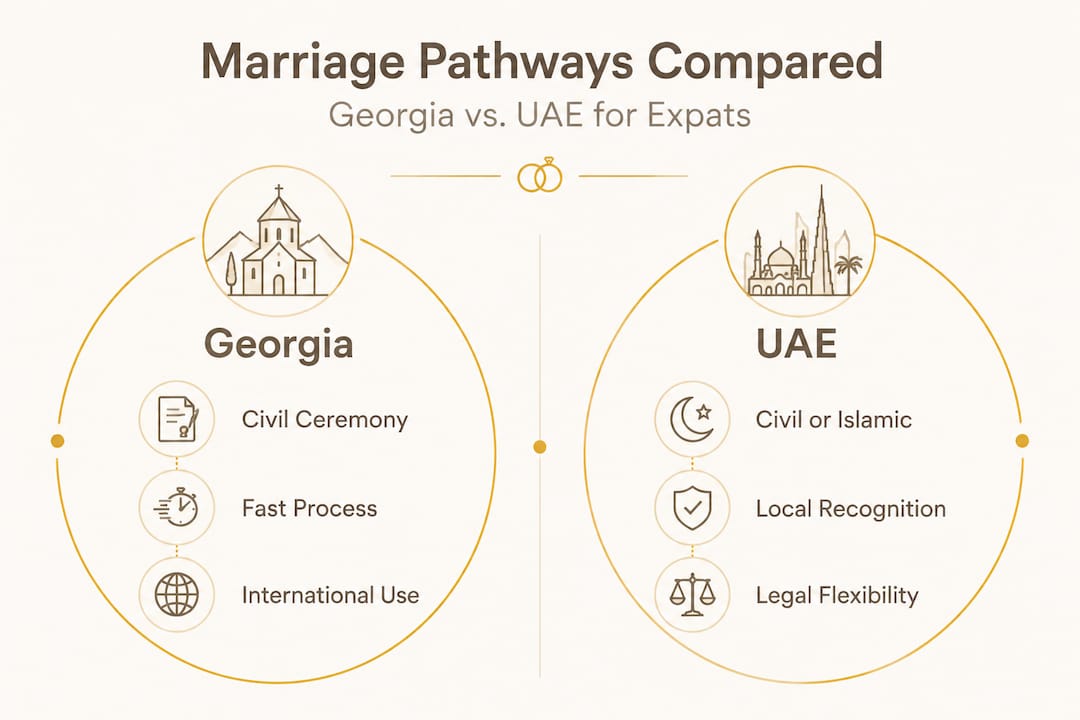
Factor | Georgia (U.S. state) | Georgia (country) | UAE civil marriage | UAE Islamic marriage |
Residency required | No | No | UAE residency preferred | UAE residency typical |
Speed | Same day possible | 1 to 3 business days | 2 to 4 weeks typical | 1 to 3 weeks typical |
Cost | Low ($56 to $200+) | Low to moderate | Moderate | Moderate |
UAE recognition | Apostille then attestation | Embassy auth then attestation | Direct | Direct |
Best for | U.S.-connected couples | International expats | UAE-based non-Muslims | Muslim couples in UAE |
As confirmed by Federal Decree-Law No. 41 of 2022, the UAE now offers a robust civil marriage framework that removes much of the need to travel abroad. For couples already holding UAE residency, getting married locally is often faster and simpler than organizing an overseas ceremony and then navigating the legalization process back in the UAE.
That said, some couples have compelling reasons to marry abroad. Clayton County Probate Court’s process works well for couples with U.S. ties or those planning to reside in the U.S. eventually. The country of Georgia remains appealing for its speed, accessibility, and lower cost for nationals who face longer processing timelines in the UAE.
Key decision factors to weigh:
Do you need immediate UAE recognition or is international recognition the priority?
How much time do you have before you need the marriage certificate?
Does your nationality complicate UAE-based applications?
Are you planning to use the marriage certificate for visa or residency applications?
Understanding the differences between Dubai and Abu Dhabi marriage laws is especially relevant here, because the emirate you reside in can meaningfully affect your timeline and documentation checklist. A civil vs. Islamic marriage comparison in the UAE context also helps clarify which pathway is open to you.
Our expert take: Why clarity matters most for UAE expats
Here is something we see over and over again: couples arrive convinced they need a foreign marriage because they assume the UAE process is too complicated. Many waste weeks researching Georgia (country) or Georgia (U.S. state) when the simplest, fastest, and most directly recognized option is a UAE civil marriage right in Abu Dhabi or Dubai.
The “one-size-fits-all” approach to expat marriage does not exist. What works for a British-Indian couple may not work for a Lebanese-Filipino couple. Nationality combinations affect which embassies you need, which documents they will certify, and how quickly each step moves.
The hidden risk most couples miss is document chain integrity. A single untranslated page, a certificate from the wrong issuing authority, or a missed authentication step can invalidate months of work. We’ve seen couples complete a beautiful ceremony in Tbilisi only to find their certificate unusable in the UAE because one apostille was missing.
Our honest advice: start with the UAE Muslim marriage rules and requirements for 2026 if you’re a Muslim couple, or with the civil marriage framework if you’re non-Muslim. If your nationality genuinely creates a barrier, then explore Georgia (country) as a destination. If you have strong U.S. ties, Georgia (state) may serve you well for that jurisdiction.
Working with experienced professionals who understand both the UAE legal framework and cross-border legalization chains is not a luxury. For expats navigating two legal systems simultaneously, it is the difference between a marriage certificate that opens doors and one that sits in a folder unused.
Comprehensive marriage support for UAE couples
Navigating Georgia (state), Georgia (country), or the UAE’s civil and Islamic marriage frameworks can feel like solving a puzzle with missing pieces. Harris & Charms specializes in exactly this kind of complexity, supporting expat couples through every step of the process with personalized guidance built on real experience.

Whether you need help with civil marriage packages in Dubai, cross-border document authentication, or end-to-end ceremony planning, our team has the expertise to make your marriage legally solid and personally meaningful. Explore our full UAE marriage service packages to find the right fit for your situation and nationality. We handle the paperwork so you can focus on the commitment.
Frequently asked questions
Can UAE expats use a Georgian (country) marriage for residency or visa purposes?
Yes, civil marriages conducted in Georgia (country) can be recognized by embassies and used for residency, visa, or family status applications after proper document legalization and authentication. The key is completing the full legalization chain before submitting to UAE authorities.
Is there a waiting period for marriage in Georgia (U.S. state)?
No, Georgia has no waiting period between obtaining the marriage license and conducting the ceremony, meaning couples can marry the same day they receive their license.
What documents do UAE expats need for a civil marriage in the UAE?
UAE expats typically need valid passports, residence visas, authenticated birth certificates, a certificate of no impediment, and prior divorce papers if applicable. Requirements vary by emirate, so always verify with UAE government sources under Federal Decree-Law No. 41 of 2022.
Are Islamic marriages and civil marriages legally equivalent for UAE expats?
Both are legally recognized in the UAE but follow different ceremony structures, documentation requirements, and religious customs. Recognition abroad depends on the destination country’s civil vs. Islamic marriage standards and local processing rules.
How can I ensure my marriage documents from Georgia (state or country) are valid in the UAE?
Valid UAE recognition typically requires apostille or embassy legalization, certified translation into Arabic, and attestation by the UAE Ministry of Foreign Affairs. Requirements vary depending on the issuing country, so confirm the exact chain with UAE authorities before you begin.
Recommended
Comments