
Polygamy Law UAE: Legal Steps and Realities for Expats

Questions often arise for expat couples in the United Arab Emirates when polygamy enters the marriage conversation. The UAE allows polygamous unions for Muslim men, but stringent legal requirements and judicial oversight create a complicated process that surprises many newcomers. Learning how financial capacity, documentation, and court approval shape every step helps protect your marriage plans and ensures your rights are clear in a country with unique family law traditions.
Table of Contents
Key Takeaways
Point | Details |
Polygamous Marriage Conditions | Muslim men in the UAE can marry up to four wives with strict legal requirements, including financial capacity and equitable treatment. |
Judicial Oversight | All polygamous marriages must receive court approval to ensure fairness and compliance with legal standards. |
Documentation Needs | Comprehensive documentation, including proof of financial stability and consent from all parties, is essential for valid polygamous marriages. |
Legal Protections | Wives in polygamous unions are entitled to equal financial support, individual rights, and legal protections against inequitable treatment. |
Polygamy Laws in the UAE Explained
Polygamy in the United Arab Emirates represents a complex legal landscape governed by Islamic Shariah principles and federal regulations. While permitted for Muslim men under specific conditions, the practice involves intricate legal requirements that demand careful navigation and judicial oversight.
Under Federal Law No. 28 of 2005, Muslim men are legally allowed to marry up to four wives simultaneously, but with strict procedural safeguards designed to ensure fairness and protection for all parties involved. The law imposes several critical conditions for polygamous marriages:
Financial Capacity: The husband must demonstrate sufficient financial resources to support multiple wives and their children equally
Equitable Treatment: Mandatory legal requirement to provide identical housing, financial support, and emotional care to all wives
Judicial Consent: Mandatory court approval before entering a polygamous marriage
Age and Consent: Strict adherence to legal age requirements and consent protocols
The legal implications of marriage in the UAE are particularly nuanced when polygamy is involved. Courts scrutinize each potential polygamous marriage to prevent potential exploitation or unfair treatment. Judges typically require comprehensive documentation proving the husband’s ability to maintain multiple households without compromising the financial or emotional well-being of existing family members.
Importantly, women do not have reciprocal rights to polyandry under UAE law. The legal framework explicitly reserves polygamous marriage rights exclusively for Muslim men who can meet stringent legal and financial requirements. This one-sided approach reflects traditional Islamic jurisprudence while attempting to introduce modern protections against potential marital inequities.
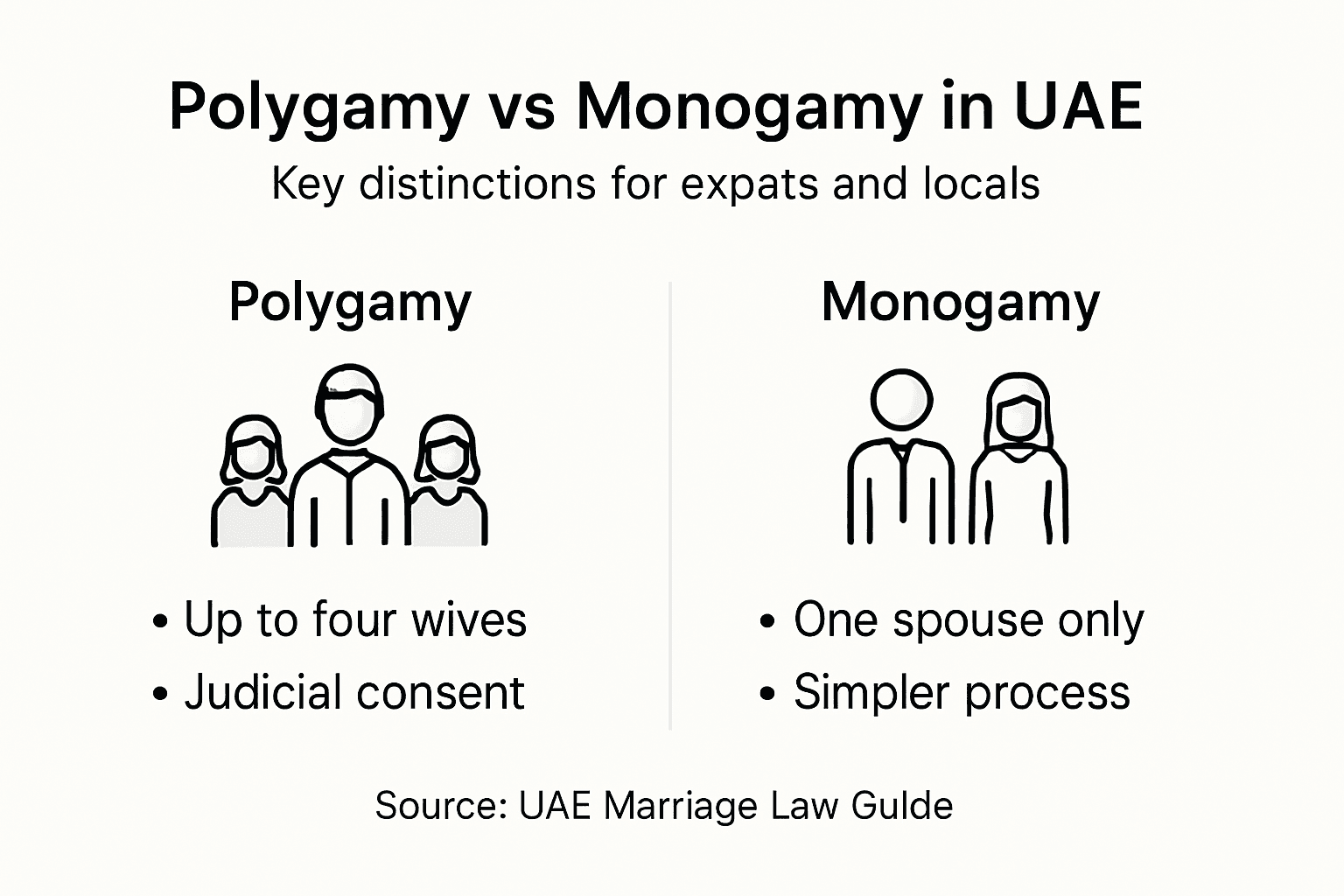
Here is a summary comparing polygamous and monogamous marriage requirements under UAE law:
Aspect | Polygamous Marriage (UAE) | Monogamous Marriage (UAE) |
Spouses allowed | Up to four wives (Muslim men only) | One spouse only |
Financial proof | Extensive documentation required | Basic financial capacity needed |
Judicial approval | Mandatory before marriage | Usually required |
Consent protocols | Written consent, all parties | Standard mutual consent |
Additional legal scrutiny | Comprehensive court investigation | Moderate court verification |
Rights for women | No polyandry permitted | Equal rights; monogamy enforced |
Pro tip: If considering a polygamous marriage in the UAE, consult a specialized legal professional who understands the intricate court requirements and can guide you through the complex documentation process.
Legal Requirements for Polygamous Marriages
Polygamous marriages in the United Arab Emirates involve a stringent legal framework designed to protect the rights and welfare of all parties involved. The process goes far beyond simple permission, requiring extensive judicial scrutiny and comprehensive documentation to ensure fairness and compliance with Islamic legal principles.
To legally enter a polygamous marriage, a Muslim man must meet several critical legal requirements that are rigorously evaluated by UAE courts:
Financial Stability Proof: Demonstrating sufficient income to support multiple households equally
Judicial Disclosure: Complete transparency about existing marital relationships
Consent Documentation: Obtaining legal consent from all parties involved
Age Verification: Confirming all parties meet the minimum legal marriage age
Equitable Treatment Commitment: Providing documented evidence of ability to treat wives fairly
The Islamic marriage process in the UAE involves multiple layers of legal verification for polygamous unions. Courts conduct thorough investigations to ensure that potential polygamous marriages do not create financial strain or emotional distress for existing family units. This includes comprehensive background checks on the husband’s financial records, existing family obligations, and capacity to maintain multiple households.
Specifically, UAE law mandates that a man seeking a polygamous marriage must obtain judicial permission, which involves presenting detailed evidence of his ability to provide equal treatment across multiple marriages. This includes proving capacity to offer identical housing, financial support, emotional attention, and legal protection to each wife. Judges have the explicit authority to reject marriage applications if they determine the husband cannot meet these stringent requirements.
Polygamous marriage in the UAE is a privilege, not an automatic right, with the legal system prioritizing the protection and welfare of all potential spouses.
Pro tip: Consult with a specialized UAE family law attorney who understands the complex legal requirements before pursuing a polygamous marriage to navigate the intricate judicial process effectively.
Documentation and Wedding Process for Expats
Navigating the marriage documentation process in the United Arab Emirates requires careful preparation and understanding of the intricate legal requirements, particularly for expatriates seeking to formalize their marital status. Each step involves precise documentation and compliance with local regulations that can vary significantly from international practices.
Expats planning to marry in the UAE must compile a comprehensive documentation package that typically includes:
Valid Passport: Original and copies with at least six months remaining validity
Residency Permit: Current Emirates ID and valid residence documentation
Certificate of No Impediment: Official document proving previous marital status
Birth Certificate: Translated and authenticated by official authorities
Divorce/Death Certificate: If previously married, legally translated proof of marital status
The step-by-step marriage registration guide for UAE expats emphasizes the critical importance of document authentication. All foreign-issued documents must be legalized through a multi-step process involving embassy attestation, Ministry of Foreign Affairs verification, and translation by certified translators. Non-Arabic documents require complete translation and official authentication to be considered legally valid.
Specifically for Muslim expats, the wedding process involves additional religious and legal protocols. A marriage contract must be drafted in Arabic, witnessed by authorized Islamic officials, and registered with local Sharia courts. Non-Muslim expatriates have alternative registration pathways, but must still adhere to strict documentation requirements and obtain proper marriage licenses from relevant judicial authorities.
Meticulous document preparation is not just recommended, but absolutely essential for successfully navigating the UAE’s complex marriage registration system.
Pro tip: Always maintain multiple certified copies of all translated and authenticated documents, and consider engaging a specialized legal consultant familiar with UAE marriage regulations to streamline your registration process.
Rights and Duties of Spouses in Polygamous Unions
Polygamous marriages in the United Arab Emirates involve a complex legal framework that meticulously defines the rights and responsibilities of all parties involved. Unlike traditional marital arrangements, these unions require an intricate balance of legal protections, financial obligations, and emotional considerations that are carefully regulated by Islamic jurisprudence and UAE federal laws.
The legal system establishes several fundamental rights for each wife in a polygamous marriage:
Independent Housing: Right to separate, suitable accommodation
Equal Financial Support: Guaranteed maintenance and financial provisions
Time Allocation: Equitable distribution of the husband’s time and attention
Legal Protection: Court-enforced mechanisms against potential inequitable treatment
Individual Dowry: Separate mahr (marriage gift) for each wife
Specifically, marriage under UAE law mandates that husbands must demonstrate absolute financial capability and emotional capacity to support multiple wives simultaneously. This means providing not just monetary support, but ensuring psychological and social well-being for each spouse. Courts can and will intervene if there is evidence of unequal treatment or financial negligence.
The husband’s primary legal duties extend beyond financial provisions to encompass emotional and social responsibilities. He must maintain complete transparency about existing marriages, obtain consent from all wives for additional marriages, and ensure that no wife experiences emotional or material disadvantage. Children from these marriages are guaranteed full legal rights to lineage, inheritance, and support, with the husband bearing comprehensive responsibility for their welfare.
In polygamous marriages, equality is not just a legal requirement but a moral and social obligation that demands constant, vigilant commitment.
Pro tip: Consult with a specialized UAE family law attorney to fully understand the nuanced legal obligations and potential implications before entering a polygamous marriage.

Common Risks and Legal Misunderstandings
Polygamous marriages in the United Arab Emirates involve intricate legal landscapes fraught with potential misunderstandings and significant risks that can derail marital arrangements if not carefully navigated. The complexity of these unions goes far beyond simple relationship dynamics, requiring meticulous legal understanding and proactive compliance with stringent UAE regulations.
Several critical legal risks emerge for individuals considering polygamous marriages:
The following table highlights common risks and misunderstandings in UAE polygamous marriages:
Risk Area | Potential Issue | Legal Consequence |
Judicial Consent | Skipping court approval | Marriage can be declared invalid |
Financial Disclosure | Incomplete or false claims | Legal penalties and marriage denial |
Consent of Existing Wives | Failure to obtain prior consent | Lawsuits or nullification of marriage |
Incomplete Documentation | Missing legalized documents | Delays, rejections, legal disputes |
Unequal Treatment | Favoring one wife over others | Court intervention or legal action |
Undisclosed Marriage Penalties: Potential criminal charges for failing to obtain proper judicial consent
Financial Compliance Issues: Legal consequences for inadequate support of multiple families
Consent Violations: Potential marriage invalidation for not securing existing wives’ permissions
Documentation Failures: Risk of legal disputes from incomplete marriage registration
Unequal Treatment Litigation: Court interventions for perceived inequitable spousal management
The legal implications of marriage in the UAE underscore the importance of understanding cultural and legal nuances. Many expatriates mistakenly assume that polygamy operates similarly to their home countries, leading to significant legal misunderstandings. UAE law demands absolute transparency, requiring husbands to demonstrate not just financial capability, but also emotional and logistical capacity to manage multiple marital relationships simultaneously.
Cultural misconceptions often lead to critical errors in polygamous marriage planning. Expatriates might incorrectly believe that verbal agreements or informal arrangements suffice, when in reality, the UAE legal system requires extensive documentation, judicial approval, and strict adherence to Islamic legal principles. Courts maintain rigorous oversight, with the power to dissolve marriages that do not meet precise legal standards.
Polygamous marriage in the UAE is a legal privilege, not an automatic right, demanding comprehensive understanding and meticulous legal preparation.
Pro tip: Engage a specialized UAE family law attorney who can provide comprehensive guidance through the complex legal requirements and potential pitfalls of polygamous marriages.
Simplify Your Polygamous Marriage Journey in the UAE with Expert Support
Navigating the complex legal steps of polygamy in the UAE can feel overwhelming. From securing judicial consent to ensuring financial and emotional fairness among multiple spouses the process demands meticulous attention to documentation and legal requirements. Many expats face challenges in understanding the strict criteria such as financial capacity proofs and official consent from all parties involved. If you want peace of mind and a smooth path through these legal realities your solution starts with trusted professional guidance.
At Harris & Charms we specialize in delivering personalized support tailored to your unique marital needs. Whether you need help preparing your marriage documentation or want expert advice on complying with UAE polygamy laws our services cover everything from legal attestation to event planning. Learn more about our holistic approach to marriage assistance by visiting our detailed Islamic marriage process guide and explore how we ease the paperwork with our comprehensive step-by-step marriage registration support for expats.

Ready to take the stress out of your polygamous marriage preparations and secure your family’s future in the UAE Reach out to us at Harris & Charms today. Our team is committed to guiding you confidently through every legal requirement and wedding detail so you can focus on what truly matters. Contact us now to start your hassle-free marriage journey with unmatched expertise and care.
Frequently Asked Questions
What are the legal requirements for a polygamous marriage in the UAE?
To enter a polygamous marriage, a Muslim man must demonstrate financial stability, obtain judicial approval, ensure all parties provide consent, verify the legal age of all individuals involved, and commit to equitable treatment of each wife.
Do women have the right to enter into a polygamous marriage in the UAE?
No, under UAE law, only Muslim men are allowed to enter into polygamous marriages, while women do not have reciprocal rights to polyandry.
What happens if I don’t obtain judicial consent for a polygamous marriage?
Failing to obtain judicial consent can result in the marriage being declared invalid, leading to legal penalties for the husband.
What documents do expats need to prepare for a legal marriage in the UAE?
Expats need to prepare a valid passport, residency permit, certificate of no impediment, birth certificate, and any divorce or death certificates, which must be translated and authenticated according to UAE regulations.
Recommended
Comments