
What is the Process of Marriage Registration in UAE: Step-by-Step Guide

TL;DR:
Marriage registration in the UAE involves separate processes for civil and Islamic marriages, each with unique requirements.
Accurate preparation of attested and translated documents is crucial to avoid rejection delays.
Most couples complete registration within 2 to 5 business days if all paperwork is correct.
Starting the marriage registration process in the UAE can feel like standing in front of a locked door with a fistful of wrong keys. Whether you are a local couple planning an Islamic ceremony or an expat couple navigating civil marriage rules, the paperwork, attestation chains, and authority requirements can be genuinely overwhelming. The good news is that the process becomes straightforward once you understand exactly what each path requires. This guide walks you through every stage, from gathering documents to receiving your official certificate, covering both civil and Islamic marriages so you can move forward with confidence instead of confusion.
Table of Contents
Key Takeaways
Point | Details |
Document preparation is crucial | Gather all originals and translations before starting your UAE marriage application. |
Expat rules differ | Expats need full document attestation and may follow the civil registration path. |
Use online portals | Platforms like UAE PASS and eZawaj speed up marriage registration and reduce errors. |
Avoid application errors | Double-check every detail—most rejections are due to simple paperwork mistakes. |
Key requirements and documents for marriage registration
Before anything else, you need to understand that the UAE operates two distinct marriage tracks: civil marriage and Islamic (or so-called “sharia”) marriage. Each has its own authority, its own paperwork list, and its own eligibility criteria. Getting these mixed up is where many couples waste weeks of time.
For civil marriages, the requirements are generally more flexible and better suited to expats or mixed-faith couples. Abu dhabi, for instance, allows non-Muslim expats to marry under personal status laws without religious prerequisites. For Islamic marriages, the rules follow sharia law. The official sharia requirements state that both parties must meet an age of 18 hijri, submit a medical fitness certificate, arrange a wali (guardian) for the bride, and have two Muslim male witnesses present. No prohibited kinship between the couple is allowed. Registration happens through courts, a licensed marriage officer (mazoon), or the eZawaj platform.
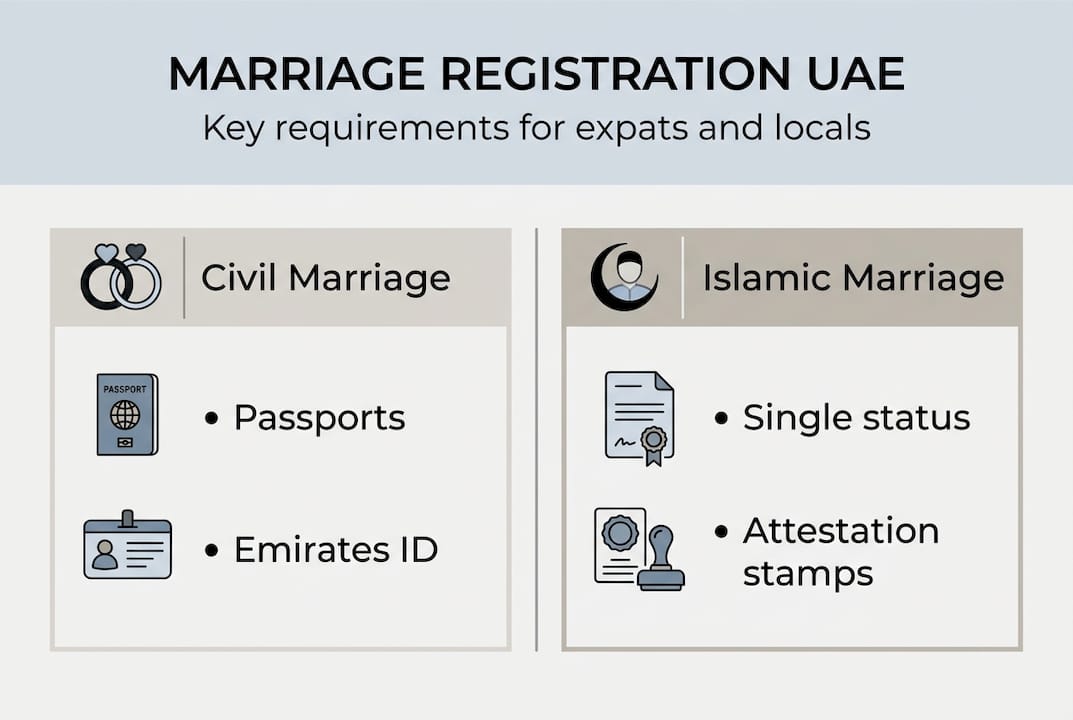
Here is a side-by-side look at the core document differences:
Document | Civil marriage | Islamic marriage (sharia) |
Valid passports | Required | Required\ |
Emirates ID or residency visa | Required | Required\ |
Certificate of single status | Required (attested) | Required (attested)\ |
Medical fitness certificate | Not always required | Required (mandatory)\ |
Two Muslim male witnesses | Not required | Required\ |
No-objection letter (where applicable) | Sometimes required | Sometimes required\ |
translated and attested foreign documents | Required if applicable | Required if applicable |
For expats, foreign documents need a full attestation chain ending at the UAE Ministry of Foreign Affairs and International cooperation (called “mofaic”). That means your home country’s documents must be notarized, then authenticated by your home foreign ministry, then attested by the UAE embassy in your country, and finally stamped by mofaic here in the UAE. Missing even one step in that chain guarantees rejection.
Key documents to have ready, regardless of ceremony type:
Original passports and certified copies
Emirates IDs or valid UAE residency visas
UAE legal union steps documentation like divorce certificates or death certificates if previously married (fully attested and translated)
Official translations of all foreign-language documents into Arabic
Pro tip: Do not wait until your appointment to check attestation stamps. Go through every document the week before and verify each stamp or seal is complete and legible. A minor ink smudge on a notary stamp has caused real rejections.
Step-by-step marriage registration process in the UAE
With your documents ready, here is how the actual registration process works. Both civil and Islamic tracks share some steps but diverge significantly at the submission stage.
For civil marriage (non-Muslim expats):
Visit the personal status court or designated civil marriage authority in your emirate. Abu dhabi’s civil marriage framework under the personal status affairs law is the most widely used for expats.
Submit your completed application along with all original documents and certified translations.
A marriage officer reviews documents on the spot. If everything is in order, both parties sign the marriage contract.
Pay the applicable registration fees (these vary by emirate).
The certificate is processed and issued, either digitally through UAE pass or available for in-person pickup.
For Islamic marriage (sharia):
Book an appointment through the eZawaj platform or visit your local sharia court.
Both parties appear in person, along with the wali and two Muslim male witnesses.
Submit all required documents. The mazoon (licensed marriage officer) verifies everything.
The marriage contract is read and signed. For a checklist on hassle-free UAE weddings, see our full guide.
The official certificate is issued and registered in the national database.
Here is a quick comparison of key process differences:
| Step | Civil marriage | Islamic marriage |—|—|— | Application portal | UAE pass, emirate portals | eZawaj, sharia courts | Physical presence needed | Yes | Yes | Religious witnesses required | No | Yes (two Muslim males) | Medical certificate needed | Usually no | Always yes | Certificate format | Civil/personal status court | Court/mazoon fee-based
For marriage registration for expats, the digital portal route is strongly recommended because incomplete applications get rejected automatically without any human review. The civil vs Islamic marriage differences page goes deeper on how to choose the right track for your situation.
Pro tip: Submit applications early in the week, ideally on Sunday or Monday morning. Mid-week and Thursday submission slots tend to see higher portal traffic, which increases the risk of session timeouts and lost form data.
troubleshooting and common mistakes to avoid
With each step laid out, it is critical to know how to steer clear of the most common and costly mistakes.
The number one reason applications fail is incomplete or incorrectly attested documentation. As noted in the detailed UAE marriage registration guide, incomplete applications are rejected instantly, with no grace period for corrections at the counter.
“applicants with even a single translation error or missing stamp see instant rejection at submission.”
Here are the most frequent mistakes couples make and how to avoid them:
Missing or expired documents. Check expiry dates on every document. An Emirates ID that expired three weeks ago will invalidate your entire application.
Wrong type of single-status certificate. Some countries issue multiple versions of this document. The UAE requires the full, notarized, apostilled, or attested version, not a simple printout from a civil registry website.
Translation by a non-certified translator. The UAE only accepts translations from translators approved by the Ministry of Justice. Using a bilingual friend or an uncertified online service will result in rejection.
Missing witness credentials. For Islamic marriages, witnesses must be Muslim males of legal age. They must also bring their own identification. A witness showing up without ID causes immediate delays.
Portal errors treated as submissions. If a UAE pass or eZawaj portal session times out mid-submission, the application may not actually be saved. Always screenshot or download the confirmation page.
For legal steps for expats, the attestation chain is the most common stumbling block. If your home country is a signatory to the hague convention, an apostille replaces most of the chain. If not, you need the full multi-step process. Check your country’s status before assuming which route applies to you.
If your application is rejected, do not panic. Request the written rejection reason from the authority, correct the specific issue noted, and resubmit. Most rejections are fixable within a few business days if you act quickly. See our marriage certificate guide for details on resubmission.
What happens after submission: verification and official certificate
Once your application is submitted, understanding the verification and certificate issuance process is crucial to complete your legal marriage.
Here is what the post-submission timeline typically looks like:
Initial document review (day 1). The authority performs a primary check on your submission. If anything is missing, you will receive an immediate notification digitally or in person.
Administrative verification (days 1 to 3). Staff verify identities, cross-check records, and confirm no legal impediments to the marriage (prior marriages, prohibited relationships, and so on).
Certificate generation (days 3 to 5). Once verified, the marriage certificate is generated and registered in the national system.
Collection or delivery. For civil marriages, many emirates now offer digital certificates via UAE pass. For Islamic marriages registered through courts, in-person pickup may still be required.
For expats, the process does not end with receiving the UAE certificate. If you need recognition in your home country, the certificate itself needs a full attestation chain going through mofaic and your home country’s embassy in the UAE. See the certificate application steps for a complete breakdown.
If your application is rejected after the verification stage, you will receive a formal notice explaining the reason. You can appeal through the same authority that issued the rejection, typically within 30 days. Appeals require you to address the specific grounds stated, not just resubmit the same package.
One practical reality: the entire process from first document submission to receiving your official certificate typically runs 2 to 5 business days when documents are complete and accurate. Factor in extra time if your documents require mofaic attestation, which can add 3 to 7 additional business days depending on volume.

Why most couples get tripped up—and how to actually succeed
Here is something worth saying plainly: the UAE marriage registration system is not actually that complicated. The confusion nearly every couple experiences comes from one place, which is assuming their paperwork is already correct before verifying it.
We see this constantly. A couple spends months planning every detail of their wedding day, then discovers a week before their registration appointment that a document is missing a notary stamp. The ceremony proceeds beautifully, but the legal registration gets delayed by three weeks.
The contrarian truth is that knowing every step of the legal process matters far less than spending one focused afternoon checking every single document against the official list. Digital tools like eZawaj and UAE pass exist precisely to flag errors before they become rejections. Most couples underuse them.
Our honest advice: treat documentation the same way you treat your wedding venue booking. Plan early, confirm every detail, and get it in writing. Check our marriage eligibility guide to start that review before you even open an application form.
Get expert help for a stress-free marriage registration
If reading through every attestation rule and portal workaround sounds exhausting, you are not alone. Many couples prefer to hand the documentation and coordination off to people who do this every day.

At Harris & charms, we specialize in guiding couples through both civil marriage packages and Islamic registration processes from start to finish. Our team handles document verification, attestation coordination, and submission support so that rejections and delays become someone else’s problem. Whether you want full-service support or just need a second set of eyes on your paperwork, our UAE marriage services are built for exactly this. Contact Harris & charms today to get a clear plan tailored to your specific situation.
frequently asked questions
What documents are mandatory for marriage registration in the UAE?
You need passports, Emirates IDs, and proof of single status fully attested and translated. Islamic marriages additionally require a medical fitness certificate and documentation confirming your two Muslim male witnesses.
How long does marriage registration take in the UAE?
With complete, correctly attested documents, most couples receive their certificate within 2 to 5 business days. However, incomplete applications are rejected immediately, which resets the clock entirely.
Can expats get married in the UAE without a medical fitness certificate?
Expats using the civil marriage track, particularly in Abu dhabi, often do not need a medical fitness certificate. For sharia marriages, it is always mandatory regardless of nationality.
What is the role of attestation for foreign documents in UAE marriage registration?
Foreign documents must be translated into Arabic and carry a full attestation chain that ends at mofaic. A document missing even one step in that chain will be rejected at submission.
Recommended
Comments