
Why register marriage legally in UAE: Benefits and process

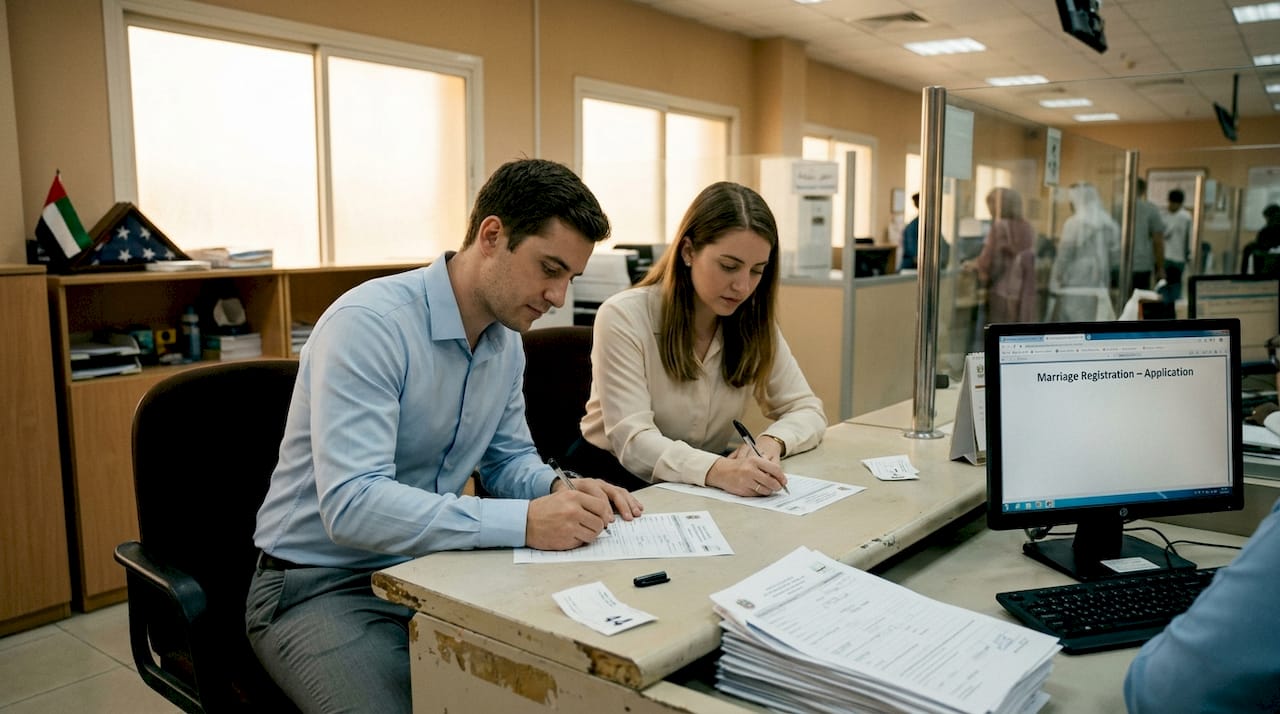
Many couples assume that exchanging vows in a beautiful ceremony is all it takes for their marriage to be recognized. In the UAE, however, a wedding celebration alone does not grant you legal status as a married couple. Without official registration through the proper authorities, you lack essential rights related to visas, inheritance, child custody, and international recognition. This article walks you through the practical reasons why legal marriage registration matters in the UAE and the exact steps you need to take to secure your union officially.
Table of Contents
Key Takeaways
Point | Details |
Legal status is essential | Only registered marriages provide legal rights and protections for couples in the UAE. |
Civil vs. Islamic options | Couples, especially expats, can choose between civil and Islamic registrations based on their needs. |
Documentation and process | Accurate paperwork and proper procedures are crucial for successful, stress-free registration. |
Risk of non-registration | Unregistered marriages can jeopardize visas, inheritance, and international recognition. |
Understanding legal marriage registration in the UAE
Now that you understand why the ceremony is not enough, let us clarify what it means to register your marriage legally in the UAE. Legal marriage registration is a civil process that confers official status, rights, and documentation on your union. It is distinct from a religious ceremony and involves submitting paperwork to government authorities who issue a marriage certificate recognized by law.
In the UAE, you can choose between civil and Islamic marriage registration. Islamic marriage is the traditional route for Muslim residents and involves religious procedures overseen by a Sharia court. Civil marriage, introduced more widely for expats in recent years, does not require religious affiliation and is increasingly popular among non-Muslim couples. Expats prioritize civil for international recognition, and over 5,000 civil marriages were registered in Abu Dhabi in the first year after the 2021 law change.
Legal marriage is required for critical life events. You need it to sponsor family members for residency visas, to establish inheritance and property rights, and to secure child custody and legitimacy. Without legal registration, your marriage holds no weight in the eyes of UAE law, leaving you vulnerable in disputes and unable to access benefits tied to marital status.
“A marriage certificate is your legal proof of union. Without it, you are considered single under UAE law, regardless of any ceremony you held.”
Key reasons to register include:
Official recognition for visa sponsorship and residency
Legal protection in inheritance and property matters
International acceptance of your marriage for travel and documentation
Rights concerning children’s legitimacy and custody
Understanding marriage registration impact helps you see why this step is non-negotiable for couples planning a future in the UAE.
Key reasons to register your marriage legally
Once you understand what constitutes legal registration, it becomes clear why this process is crucial for your life and stability in the UAE. Legal registration provides a safety net that protects both spouses in case of disputes, separation, or death. Without a marriage certificate, you have no legal claim to your partner’s assets, and inheritance laws will not recognize you as a spouse.
Family visa sponsorship is another major reason to register. If you want to bring your spouse or children to live with you in the UAE, you must present a legally recognized marriage certificate. Immigration authorities will not process family visas without this document, leaving couples in limbo if they skip registration.
International recognition is essential for expats who travel frequently or plan to return to their home countries. A UAE-registered marriage is accepted globally, making it easier to update passports, apply for joint bank accounts, and handle legal matters abroad. This is especially important for couples from different countries who need their union recognized in multiple jurisdictions.
Children born to legally married couples automatically receive legitimacy and citizenship rights based on their parents’ status. Without legal registration, proving parentage and securing custody can become complicated and require court intervention. Legal marriage also simplifies access to joint banking, insurance, healthcare, and property ownership.
Pro Tip: Keep multiple certified copies of your marriage certificate. You will need them for visa applications, bank accounts, insurance policies, and legal proceedings throughout your time in the UAE.
The legal marriage benefits extend beyond paperwork. They provide peace of mind and stability, knowing that your relationship is protected under UAE law. Registering marriage advantages include faster processing for family matters and smoother interactions with government agencies.
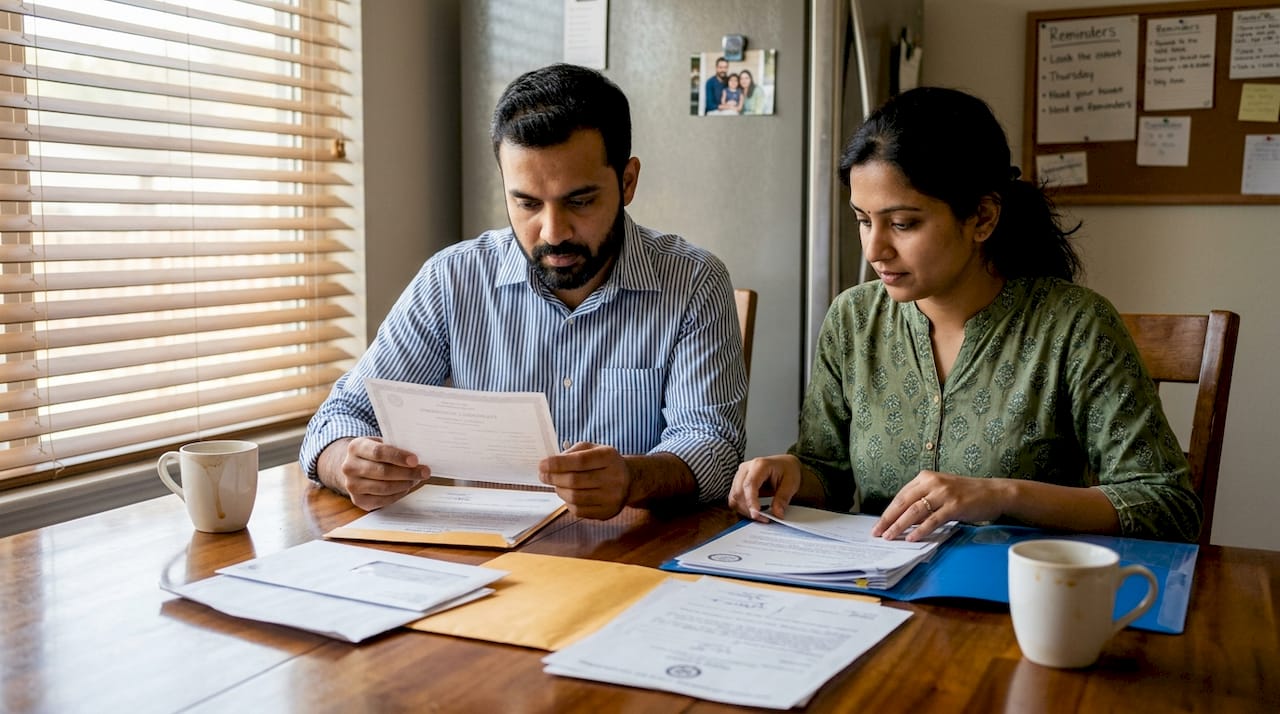
Required documents include passports, Emirates ID, residency visa, birth certificates, proof of single status, and a premarital medical certificate for Islamic marriages. Expats must have these documents attested by their home country and the UAE Ministry of Foreign Affairs.
Risks of skipping legal marriage registration
Understanding these advantages brings into focus what you risk losing by neglecting official registration. Couples who skip legal registration face serious consequences that can disrupt their lives and leave them without legal recourse.
No legal protection for spouse or children. If your partner passes away or you separate, you have no claim to assets, custody, or inheritance without a marriage certificate.
Visa sponsorship difficulties. You cannot sponsor your spouse or children for residency visas, forcing families to live apart or rely on employer sponsorship.
Potential criminal liability. While recent reforms have relaxed cohabitation laws for expats, unmarried couples still face legal gray areas and potential fines.
No inheritance or property rights. Without legal marriage, your partner is not recognized as your heir, and property disputes require lengthy court battles.
Marriage not recognized internationally. Your union will not be accepted for travel, banking, or legal matters outside the UAE, creating complications for expats.
“Skipping legal registration is like building a house without a foundation. It may stand for a while, but the first storm will reveal the cracks.”
Required documents are essential for recognition, and attestation is mandatory for expats. Without proper documentation, your marriage application will be rejected, and you will need to start the process over.
The legal marriage steps are straightforward when you know what to expect. Avoiding them creates unnecessary risk and stress for couples who could easily secure their union with a few weeks of paperwork.
What documents and steps are required to register marriage in the UAE?
So what does the process of registering a marriage in the UAE actually look like for you? The steps vary slightly depending on whether you choose civil or Islamic marriage, but the core requirements are similar.
Step 1: Gather required documents. You need passports, Emirates ID, residency visa, birth certificates, proof of single status, and a premarital medical certificate for Islamic marriages. Expats must have documents attested by their home country and the UAE Ministry of Foreign Affairs.
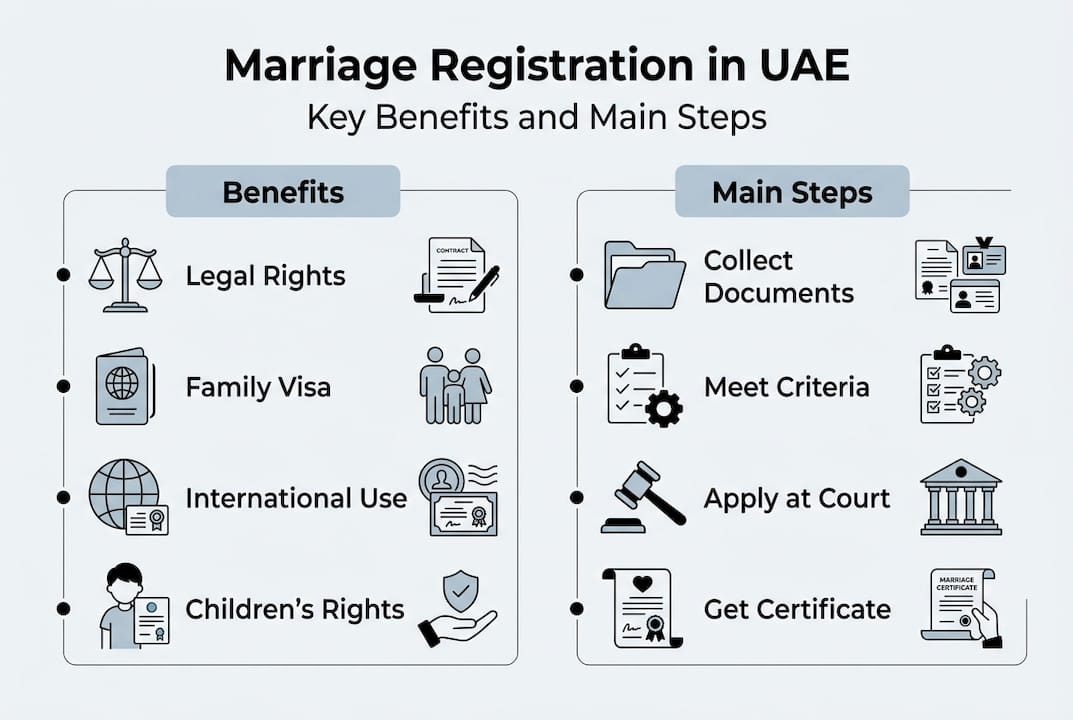
Step 2: Meet eligibility criteria. For civil marriage, both parties must be non-Muslim or one party must be non-Muslim. For Islamic marriage, at least one party must be Muslim, and the marriage must follow Sharia law.
Step 3: Apply at the proper court. Submit your application to the family court in your emirate. Dubai and Abu Dhabi have dedicated civil marriage courts for expats.
Step 4: Pay fees and attend appointments. Fees range from AED 1,000 to AED 3,000 depending on the emirate and type of marriage. You may need to attend a brief interview or counseling session.
Step 5: Receive your marriage certificate. Processing takes 2 to 6 weeks. Once approved, you will receive an official marriage certificate that you can use for visa sponsorship and legal matters.
Document | Civil Marriage | Islamic Marriage |
Passport copies | Required | Required |
Emirates ID | Required | Required |
Residency visa | Required | Required |
Birth certificates | Required | Required |
Proof of single status | Required | Required |
Premarital medical certificate | Not required | Required |
Attestation | Required for expats | Required for expats |
Pro Tip: Start the attestation process early. It can take several weeks to get documents certified by your home country and the UAE Ministry of Foreign Affairs.
Required documents include passports, Emirates ID, residency visa, birth certificates, proof of single status, and a premarital medical certificate for Islamic marriages. Expats must have these documents attested to ensure recognition.
The civil marriage requirements are designed to be accessible for expats, while the civil marriage process is streamlined to reduce waiting times and bureaucracy.
Civil vs. Islamic marriage registration: Which is right for you?
Choosing the correct registration pathway is as important as knowing the paperwork involved. Civil and Islamic marriage registrations serve different communities and have distinct requirements, benefits, and processes.
Eligibility criteria: Civil marriage is open to non-Muslim expats and mixed-faith couples. Islamic marriage is required for Muslim residents and follows Sharia law, including requirements for witnesses and a marriage contract.
Required documents: Both types require passports, Emirates ID, residency visa, birth certificates, and proof of single status. Islamic marriage also requires a premarital medical certificate to screen for genetic and infectious diseases.
Processing and recognition: Civil marriage is faster and simpler for expats, with processing times of 2 to 4 weeks. Islamic marriage involves religious procedures and may take longer, but it is the only option for Muslim couples seeking Sharia-compliant unions.
Aspect | Civil Marriage | Islamic Marriage |
Eligibility | Non-Muslim or mixed-faith couples | Muslim couples |
Religious requirements | None | Sharia law, witnesses, marriage contract |
Premarital medical certificate | Not required | Required |
Processing time | 2-4 weeks | 3-6 weeks |
International recognition | High | High |
Cost | AED 1,000-2,000 | AED 1,500-3,000 |
Expats prioritize civil for international recognition, and the premarital certificate is mandatory for Islamic marriages. Civil marriage is often chosen for its simplicity and global acceptance, while Islamic marriage is essential for Muslim residents who want their union to comply with religious law.
Key differences include:
Civil marriage does not require religious affiliation or ceremonies
Islamic marriage involves a marriage contract and witnesses
Civil marriage is processed through civil courts, Islamic through Sharia courts
Both types are legally binding and recognized internationally
The civil marriage process UAE is designed to accommodate expats from diverse backgrounds, making it a popular choice for couples who want a straightforward, legally recognized union.
Recent trends in marriage registration for UAE expats
Now, let us see how real couples are adapting to these new laws and just how common legal registration has become. Legal reforms introduced in 2021 expanded options for expats, leading to a significant rise in civil marriages across the UAE.
Dubai registered 4,636 non-Emirati marriages in 2024, reflecting the growing demand for legal marriage services among expats. Over 5,000 civil marriages were registered in Abu Dhabi in the first year after the new law, demonstrating how quickly couples embraced the option.
Dubai and Abu Dhabi have become leading destinations for civil marriages, offering dedicated courts and streamlined processes for expats. The reforms have made it easier for couples from different countries and religions to marry legally without navigating complex religious requirements.
Year | Dubai Non-Emirati Marriages | Abu Dhabi Civil Marriages |
2022 | 4,200 | 3,800 |
2023 | 4,400 | 4,500 |
2024 | 4,636 | 5,200 |
Key trends:
Increasing preference for civil marriage among expats
Faster processing times and reduced bureaucracy
Greater awareness of legal marriage benefits
More couples seeking international recognition
The UAE marriage trends show that legal registration is becoming the norm for expats who want to secure their unions and access the full range of legal protections available in the UAE.
Get expert help with marriage registration in the UAE
If you want your marriage journey to be smooth, expert support is available. Navigating the documentation, attestation, and application process can be overwhelming, especially for expats unfamiliar with UAE legal requirements. Professional services can handle the paperwork, translations, and submissions, saving you time and reducing stress.

At Harris & Charms, we specialize in helping couples register their marriages legally in the UAE. Whether you are planning a civil or Islamic wedding, we provide personalized assistance at every step. From gathering and attesting documents to submitting applications and coordinating with courts, we make the process hassle-free. Our team understands the unique challenges expats face and works to ensure your marriage is recognized legally and internationally. We also offer comprehensive wedding services, including venue management, photoshoots, and event planning, so you can focus on celebrating your union while we handle the details. Explore our UAE marriage services or speak with an expert to get started today.
Frequently asked questions
Is a religious wedding ceremony enough for legal recognition in the UAE?
No, only a marriage registered with UAE authorities is recognized legally, regardless of a religious ceremony. Expats prioritize civil for international recognition, and without official registration, your union has no legal standing.
What documents do expats need to register marriage in the UAE?
Required documents include your passport, Emirates ID, residency visa, birth certificates, proof of single status, and, for Islamic marriages, a premarital medical certificate. Expats must have these documents attested by their home country and the UAE Ministry of Foreign Affairs.
How long does the marriage registration process take?
Marriage registration in the UAE typically takes 2 to 6 weeks, depending on documentation and court processing. Civil marriages are usually faster than Islamic marriages.
Are civil marriages in the UAE recognized internationally?
Yes, civil marriages registered in the UAE are recognized globally, which is why many expats favor this method. The marriage certificate is accepted for visa applications, banking, and legal matters worldwide.
Recommended
Comments