
Islamic Marriage Registration in the UAE: Your U.S. Recognition Guide

Updated: Sep 1

A valid nikah can be legally recognized in the United States through two clear routes: perform a civil-legal marriage on U.S. soil (marriage license, authorized officiant, filed certificate), or properly document and authenticate a UAE-registered nikah for submission to U.S. agencies including USCIS. Three institutions anchor both paths: USCIS (for immigration and benefits), your county clerk or state vital records office (for domestic licensure and recording), and the UAE Sharia court or Ministry of Justice (for UAE registration and attestation).
Marrying in the U.S.: Get your marriage license from the county clerk, have a recognized officiant perform the ceremony, and file the signed certificate with the county.
Married in the UAE: Obtain the Sharia court marriage certificate, get a certified English translation, complete the UAE attestation chain (Ministry of Foreign Affairs, embassy legalization where required), and submit to USCIS or your state authority.
Next step: If you married in the UAE, collect the court-issued marriage certificate and start the UAE attestation process before you leave the country. If you’re marrying in the U.S., book your county clerk appointment first.
Pro Tip: Keep at least three certified copies of your marriage certificate the moment it is issued. Attestation, USCIS filings, and state vital records offices each want an original or certified copy, and getting extras later costs time and money.
Key Takeaways for Islamic marriage registration in the UAE
A valid nikah becomes legally recognized in the United States only when the civil requirements of the relevant jurisdiction are met, whether through a domestic U.S. marriage license and filing or through a properly attested and translated UAE Sharia court certificate submitted to USCIS or a state authority.
Point | Details |
Two routes to U.S. recognition | Domestic civil marriage (license, officiant, filing) or authenticated foreign nikah (UAE certificate, translation, attestation, USCIS submission). |
UAE attestation before departure | Complete MOFAIC attestation and U.S. Embassy legalization in the UAE before leaving; retrospective processing adds months. |
Certified translation required | USCIS requires a certified English translation with a signed translator competency statement, not just a notarized one. |
Officiant authorization matters | Confirm in writing that your imam or officiant is legally authorized in your specific state and county before the ceremony. |
Harrisandcharms for complex cases | Harrisandcharms manages UAE Sharia court filings, MOFAIC attestation, embassy legalization, and USCIS-ready bundles for couples navigating both systems. |
Table of Contents
1. How U.S. law treats a nikah: what actually makes a marriage legal here
2. Step-by-step checklist to register an Islamic marriage inside the United States
3. If you married in the UAE: how to get your nikah recognized in the United States
4. Documents you’ll need for both domestic and foreign marriages
5. Who can officiate a nikah so it counts legally in the United States
7. When should you handle registration yourself, and when should you hire help?
8. How Harrisandcharms helps couples marrying in the UAE prepare for U.S. recognition
What couples consistently get wrong about nikah registration
Harrisandcharms handles UAE registration and U.S. recognition from start to finish
1. How U.S. law treats a nikah: what actually makes a marriage legal here
U.S. law does not recognize a purely religious ceremony on its own. Recognition depends on satisfying three civil requirements: a valid marriage license, a ceremony performed by an authorized officiant, and a properly filed marriage certificate with the county or state.
The three core elements:
Marriage license: Issued by the county clerk before the ceremony. Both parties must appear in person, present valid government-issued photo ID, and pay the applicable fee.
Authorized officiant: The person who solemnizes the marriage must be legally recognized in that state. Most states accept ordained clergy (including imams), judges, and designated civil officiants. Some states require the officiant to register with the county; others do not.
Filed certificate: After the ceremony, the signed marriage certificate must be returned to the county clerk or state vital records office within the timeframe the state specifies, typically within a few days to a few weeks.
State variation is real and consequential. California, New York, and Texas each have different rules on who qualifies as an authorized officiant, how many witnesses are required (usually two, but some states require none), and whether a waiting period applies between license issuance and the ceremony. A few states still list blood-test requirements on the books, though most have repealed them.
A nikah performed without a civil license is ceremonially valid under Islamic law but carries no automatic legal weight in the U.S. system. The practical fix is straightforward: perform the civil ceremony alongside the religious rite, using the same officiant if they are state-authorized, or with a separate civil officiant if not.
Pro Tip: Call your county clerk’s office directly and ask: “Is an imam ordained through [specific organization] authorized to solemnize a marriage in this county?” Get the answer in writing. Verbal confirmation is not enough if USCIS later questions the ceremony’s validity. You can also check officiant registration requirements for your state before booking anyone.
2. Step-by-step checklist to register an Islamic marriage inside the United States
Start at the county clerk’s office, not the mosque. The civil paperwork must precede the ceremony.
Ordered steps
Apply for a marriage license. Both partners visit the county clerk in person. Bring valid government-issued photo ID (passport or driver’s license), proof of age (birth certificate or passport), and any required documentation of prior marriage termination.
Choose an authorized officiant. Confirm the imam, clergy member, judge, or civil officiant is recognized in your state and county. Collect their full legal name, title, and contact information for the marriage certificate.
Observe any waiting period. Some states impose a waiting period between license issuance and the ceremony (commonly 24–72 hours). Others allow same-day ceremonies. Check your county’s specific rule.
Perform the ceremony with witnesses. Most states require at least one witness; many require two. Witnesses must be adults and typically sign the marriage certificate at the ceremony.
Complete and sign the marriage certificate. The officiant, both spouses, and witnesses sign the certificate immediately after the ceremony. Do not leave the venue without signed copies.
File the certificate with the county clerk or vital records office. The officiant is usually responsible for returning the signed certificate within the state’s deadline. Confirm this with them before the ceremony.
Obtain certified copies. Once recorded, order at least three certified copies from the vital records office. These are the documents USCIS, employers, and foreign authorities will accept.
Documents to bring to the county clerk
Valid government-issued photo ID (passport preferred for non-citizens)
Birth certificate or passport showing date of birth
Divorce decree (if previously married) or death certificate of former spouse
Social Security number (required in most states; visa documentation for non-citizens)
Any state-specific forms the county clerk requires (check their website in advance)
A ceremonial-only nikah can be made legally binding in the U.S. by following these exact steps. Many couples perform the religious rite first and then complete the civil formalities the same day or the following morning.
3. If you married in the UAE: how to get your nikah recognized in the United States
To use a UAE nikah in the U.S., you need the original court-issued marriage certificate and a completed UAE-to-U.S. authentication chain. Skipping any link in that chain means the document may be rejected by USCIS or a state vital records office.
Step-by-step authentication process
Obtain the certified Sharia court marriage certificate in Arabic. This is issued by the Dubai Courts Family/Personal Status Court or the relevant emirate’s court. Request at least three certified copies at the time of issuance.
Get a certified English translation. The translation must be done by a certified translator. For USCIS purposes, the translator must certify in writing that they are competent in both languages and that the translation is accurate and complete.
Complete UAE attestation through the Ministry of Foreign Affairs and International Cooperation (MOFAIC). This step authenticates the document for international use. Some documents also require prior attestation by the Ministry of Justice.
Embassy legalization (where required). For U.S. purposes, the document may need to be legalized at the U.S. Embassy or Consulate in Abu Dhabi or Dubai. Check current U.S. Embassy requirements before submitting, as procedures can change.
Submit to USCIS or the relevant U.S. authority. USCIS accepts foreign marriage certificates as evidence of a valid marriage for immigration benefits, provided the certificate is accompanied by a certified translation and any required attestation or legalization.
Attestation vs. apostille: what applies to UAE documents
The UAE is not a party to the Hague Apostille Convention for all document types, so the standard apostille process used in many countries may not apply. UAE documents typically go through the MOFAIC attestation chain and then embassy legalization for U.S. use. Some U.S. states will accept a MOFAIC-attested and embassy-legalized certificate without additional local filing; others want the couple to register the foreign marriage locally. Contact your county clerk after you return to the U.S. to confirm what they require.
What USCIS typically wants
Original or certified copy of the foreign marriage certificate
Certified English translation with translator’s certification statement
Proof of the marriage’s legitimacy: ceremony photos, invitation, evidence of shared life
Any supporting civil registration or attestation documents from the issuing country
Pro Tip: Before leaving the UAE, verify that your Sharia court certificate has been attested by MOFAIC. Embassy appointments in Abu Dhabi and Dubai book out weeks in advance. Schedule the embassy legalization step before your travel date, not after you land in the U.S.
The Islamic marriage for expats in the UAE guide covers additional considerations for U.S. residents marrying in the UAE, including residency conditions and cross-border document handling.
4. Documents you’ll need for both domestic and foreign marriages
The specific documents required depend on whether you’re registering in the U.S. or authenticating a UAE marriage for U.S. use. Here is what each path typically demands.
For a U.S. domestic marriage registration:
Government-issued photo ID or passport for both parties
Birth certificates (or passports showing date of birth)
Divorce decree or death certificate if either party was previously married
Social Security numbers or visa/immigration documentation for non-citizens
Completed marriage license application (county-specific form)
Signed marriage certificate (completed at the ceremony)
For authenticating a UAE Islamic marriage certificate:
UAE Sharia court marriage certificate (Arabic original, certified copies)
Emirates ID (required at the time of UAE registration per Ministry of Justice requirements)
Premarital medical screening certificate from an accredited UAE facility (mandatory for Islamic marriages in the UAE)
Witness identification documents (used during UAE registration)
Certified English translation of the Arabic marriage certificate
MOFAIC attestation stamp on the original certificate
U.S. Embassy legalization endorsement (where required)
Translator’s written certification statement (for USCIS submissions)
A note on certified translations: USCIS does not maintain a list of approved translators, but the translator must provide a signed statement certifying their competence and the accuracy of the translation. Notarized translations are not the same as certified translations, though some state vital records offices request notarization in addition to certification. Confirm the exact requirement with the receiving authority before commissioning the translation.
For a detailed breakdown of acceptable document formats, the UAE marriage documents guide covers what each UAE authority accepts and how to prepare documents for international use.
5. Who can officiate a nikah so it counts legally in the United States
The officiant question is where many couples run into trouble. An imam who is spiritually qualified to perform a nikah is not automatically authorized to solemnize a marriage under state law.
How to confirm your officiant qualifies:
Call the county clerk in the county where the ceremony will take place and ask specifically whether your officiant’s ordination or title qualifies under state law.
Ask the officiant directly: Are you registered with this state or county? Will you sign the marriage license? Can you provide written confirmation of your authorization?
Request a letter from the officiant confirming their legal name, title, the organization through which they are ordained or authorized, and their willingness to sign the marriage certificate.
Collect witnesses’ full legal names and government ID numbers in advance so the certificate can be completed accurately at the ceremony.
State differences in brief:
Most states accept ordained clergy (including imams ordained through recognized Islamic organizations), judges, magistrates, and civil officiants. The number of required witnesses varies: some states require two adult witnesses, others require one, and a handful require none. A few states require the officiant to file a registration form with the county before performing ceremonies. New York, for instance, requires officiants to register with the city clerk in New York City, while the rest of the state has no such requirement.
Numbered checks before the ceremony:
Confirm the officiant’s legal authorization in writing from the county clerk.
Verify the officiant will personally return the signed certificate to the county clerk within the required timeframe.
Confirm witness requirements (number, age, ID needed) with the county clerk.
Have a backup civil officiant identified in case the primary officiant’s authorization is questioned.
6. What does it actually cost, and how long does it take?
Costs vary widely depending on whether you’re registering domestically or authenticating a foreign marriage. A U.S. county marriage license is modest; attesting a UAE marriage certificate for U.S. use adds government fees, translation costs, and potentially embassy fees.
Typical fee ranges:
U.S. county marriage license fees generally range from around $25 to $115, depending on the state and county.
Certified English translation of an Arabic marriage certificate typically costs $75–$200 depending on document length and the translator’s rates.
UAE Ministry of Foreign Affairs attestation carries government fees; the exact amount depends on the document type and processing speed.
U.S. Embassy legalization fees in the UAE are set by the State Department and are subject to change; check the current fee schedule on the U.S. Embassy Abu Dhabi website before submitting.
USCIS filing fees depend on the specific benefit form being submitted (I-130, I-485, etc.) and are listed on the USCIS website.
Typical timelines:
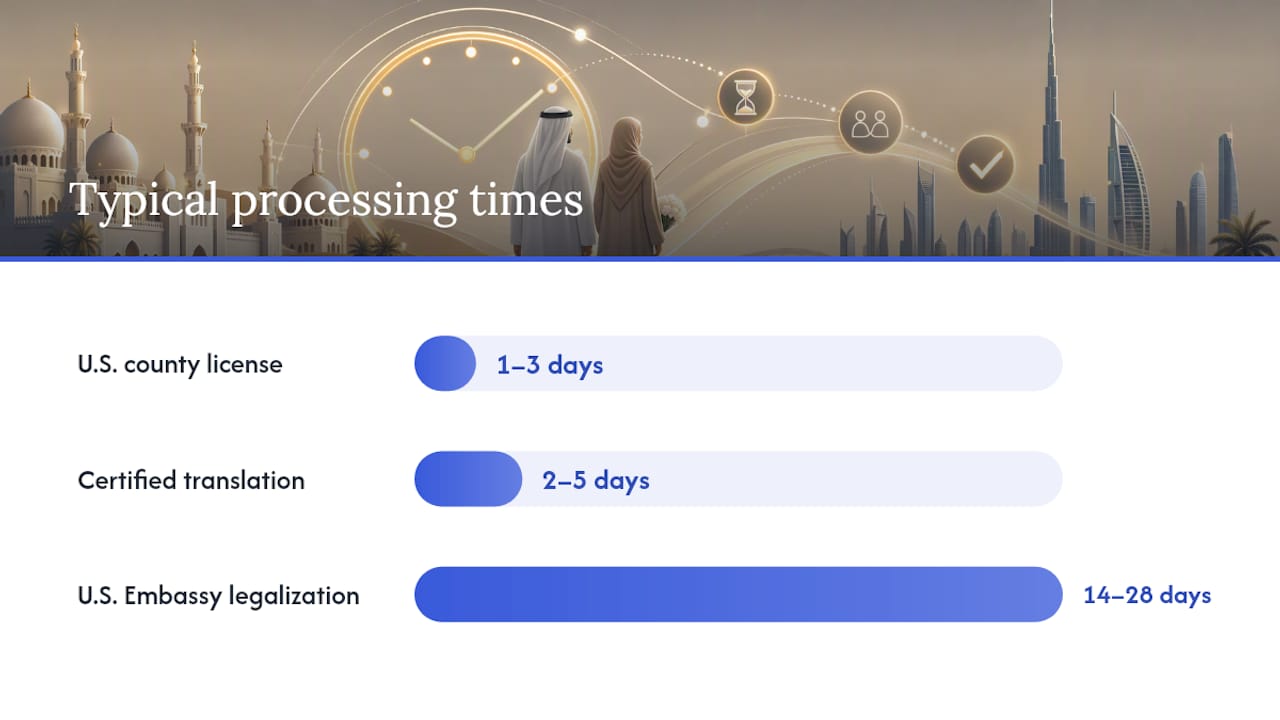
U.S. county marriage license: issued same day or within a few days; waiting periods of 24–72 hours apply in some states.
UAE Sharia court marriage certificate: issued at the time of registration if all documents are in order.
MOFAIC attestation: typically a few business days for standard processing; expedited options may be available.
U.S. Embassy legalization: appointment availability varies; allow at least two to four weeks.
USCIS processing: varies significantly by form and service center; check current processing times on the USCIS website.
Step | Typical fee range | Typical processing time |
U.S. county marriage license | $25–$115 | Same day to a few days |
Certified English translation | $75–$200 | 2–5 business days |
UAE MOFAIC attestation | Government fee (varies) | A few business days |
U.S. Embassy legalization (UAE) | State Dept. schedule | 2–4 weeks (appointment-dependent) |
USCIS filing (benefit-dependent) | Per USCIS fee schedule | Varies by form and center |
For halal-conscious budgeting across the full wedding and registration process, the Muslim wedding budget guide offers a practical framework for planning costs without compromising on what matters.
7. When should you handle registration yourself, and when should you hire help?
If your paperwork is straightforward and you can visit the county clerk in person, the domestic U.S. route is manageable on your own. Hire a professional when foreign attestation, embassy legalization, language barriers, or immigration stakes are involved.
Decision checklist:
Document complexity: Are all your documents in English and issued by a U.S. authority? DIY is viable. Are documents in Arabic, requiring attestation and translation? Professional help saves significant time.
Language barriers: Can you communicate confidently with UAE government offices and the U.S. Embassy in Arabic and English? If not, a professional reduces the risk of errors.
Embassy legalization: Do you need to schedule and attend a U.S. Embassy appointment in the UAE? A professional familiar with current embassy procedures can manage this on your behalf.
Immigration stakes: Is the marriage certificate needed for a USCIS petition, visa application, or green card? Errors in this context have serious consequences. Professional handling is worth it.
Time pressure: Do you have a visa expiry, travel deadline, or immigration interview date approaching? A professional with established workflows moves faster.
Distance from UAE offices: Are you already back in the U.S. and need someone on the ground in Dubai or Abu Dhabi? Remote handling requires a trusted local representative.
Questions to ask any provider:
Do you handle Sharia court filings directly in the UAE?
Will you manage MOFAIC attestation and U.S. Embassy legalization end to end?
Do you provide certified translations with the required translator certification statement?
How do you handle original documents, and do you use insured courier services?
Will you provide a written scope of work and a timeline before we begin?
Red flags to watch for:
Vague timelines with no specific milestones
No clear explanation of who handles the embassy legalization step
Requests to hand over original documents without a secure handling protocol
No written agreement or scope of work before payment
8. How Harrisandcharms helps couples marrying in the UAE prepare for U.S. recognition
Harrisandcharms offers on-the-ground UAE marriage registration support, certified document handling, and U.S.-readiness packages for couples navigating both the UAE Sharia court process and the U.S. authentication chain.
Core service areas:
Direct filings with UAE Sharia courts and Dubai Courts Family/Personal Status Court
Coordination of premarital medical screening requirements
Certified English translations with compliant translator certification statements
MOFAIC attestation and Ministry of Justice document handling
U.S. Embassy legalization coordination in Abu Dhabi and Dubai
Secure, insured courier delivery of certified copies to U.S. addresses
USCIS-ready documentation bundles including translated certificates, attestation records, and supporting evidence
The step-by-step Islamic marriage registration guide on the Harrisandcharms site walks through the official UAE process in detail, and the 2026 Islamic wedding registration guide reflects current procedural requirements and document checklists.
One scenario the team handles regularly: a U.S. resident couple completes their nikah in Dubai, then realizes after returning to the U.S. that their certificate lacks MOFAIC attestation and the translation does not include the required certification statement. Harrisandcharms coordinates the retrospective attestation from the U.S. side, managing UAE office filings and embassy scheduling remotely so the couple can meet their USCIS petition deadline without flying back to Dubai.
Harrisandcharms brings together UAE Sharia court expertise and U.S. documentation requirements under one service, so couples do not have to coordinate between two legal systems on their own. The team’s familiarity with Dubai Courts, MOFAIC procedures, and USCIS evidence standards means fewer errors, faster turnaround, and originals handled securely from start to finish.
[Author bio: Harris, founder of Harrisandcharms, has guided hundreds of couples through UAE marriage registration and cross-border document authentication. Full professional background and credentials available on the Harrisandcharms about page.]
What couples consistently get wrong about nikah registration
The most common mistake is treating the nikah as the finish line when it is actually the starting point of a documentation process. Couples who marry in the UAE often leave the country with a beautiful ceremony and a Sharia court certificate that has not been attested, translated, or legalized. By the time USCIS requests proof of marriage, the UAE offices they need are thousands of miles away and embassy appointments are weeks out.
The second mistake is assuming that because a marriage is valid under Islamic law, it is automatically valid under U.S. law. These are two separate legal systems with different requirements. A nikah that satisfies every condition of Sharia does not satisfy the county clerk’s requirements unless the civil formalities are also completed.
What actually works: treat the civil and religious processes as parallel tracks, not sequential ones. In the UAE, register with the Sharia court and begin attestation the same week. In the U.S., book the county clerk appointment before you book the venue. The couples who avoid problems are the ones who start the paperwork early, keep multiple certified copies, and confirm every step in writing with the relevant authority.
One case worth noting: a couple who completed their nikah in Abu Dhabi and returned to the U.S. within two weeks had their USCIS petition delayed by four months because the translation they submitted was notarized but not certified. The fix was straightforward once identified, but the delay had real consequences for a pending visa renewal. Starting attestation before departure and using a provider who knows the difference between notarization and certification would have prevented it entirely.
Harrisandcharms handles UAE registration and U.S. recognition from start to finish
Couples who marry in the UAE and need their nikah recognized in the U.S. face a two-country documentation process that most people have never navigated before. Harrisandcharms removes that friction by handling both sides: UAE Sharia court filings, MOFAIC attestation, U.S. Embassy legalization, certified translations, and USCIS-ready document bundles, all under one service agreement with a clear timeline and secure handling of your originals.

The service is designed for couples who are already managing a move, a visa application, or a new life together and do not have time to coordinate between Dubai Courts, the Ministry of Foreign Affairs, and a U.S. Embassy appointment simultaneously. Whether you need full end-to-end support or just the attestation and translation steps, the team builds the scope around what you actually need.
To get started with UAE marriage registration or U.S. recognition support, visit the Islamic marriage services page or explore the full range of UAE marriage packages to find the right fit for your situation.
Authoritative sources and where to verify requirements
Use these resources to confirm current requirements for your specific situation. Procedures and fees change; always verify directly with the issuing authority before submitting documents.
UAE government and Sharia court sources:
UAE Ministry of Justice official portal: use to request a marriage contract, confirm required documents (Emirates ID, medical report, witness identification), and check current fee schedules.
UAE official government platform (marriage under Sharia law): explains registration requirements, premarital counseling, and e-services for Islamic marriages.
Dubai Courts online application portal: used for submitting marriage contract applications and tracking status; one party must hold UAE residency.
MOFAIC (Ministry of Foreign Affairs and International Cooperation): the attestation authority for UAE documents intended for international use.
Harrisandcharms guides:
Islamic marriage registration step-by-step guide: process flow and timelines for UAE registration.
Required documents for UAE marriage registration: full document checklist with format and verification details.
Muslim marriage registration steps and tips: client-facing overview of services and on-the-ground support.
Advantages of Islamic marriage registration in the UAE: explains the legal protections formal registration provides.
U.S. authorities to contact:
County clerk or state vital records office: the first call for any domestic marriage license or foreign marriage registration question. Requirements differ by county; call before visiting.
USCIS (uscis.gov): for current guidance on proving a valid marriage for immigration benefits, acceptable document formats, and certified translation requirements. Check current processing times directly on the site.
U.S. Embassy Abu Dhabi or U.S. Consulate Dubai: for current legalization fees, appointment availability, and document submission requirements for UAE-issued certificates.
How to use these sources:
Use the UAE Ministry of Justice portal to request your marriage contract and confirm current document requirements. Use MOFAIC for attestation of the issued certificate. Schedule the U.S. Embassy legalization appointment while still in the UAE. Contact your county clerk by phone to confirm whether a foreign marriage certificate requires local registration after you return to the U.S. Check USCIS directly for the current evidence standard for your specific petition type.
Recommended
Comments