
What You Need to Get Married by Court in the UAE

Updated: Sep 3

To get legally married by court in the UAE, you need valid ID (passport or Emirates ID), a signed declaration of consent, proof that any prior marriage has ended, a medical fitness certificate, and properly translated and attested foreign documents. Here is the short version: passport, Emirates ID (if resident), signed disclosure form, divorce or death certificate if applicable, medical report, certified Arabic translations, and MOFA attestation for foreign-issued papers. Most couples with clean, consistent paperwork can navigate the process themselves. Expats with U.S.-issued documents, prior marriages, or tight timelines typically hire a specialist like Harrisandcharms to avoid the attestation errors that cause the most delays.
Key Takeaways
Getting married by court in the UAE requires valid ID, a signed consent declaration, certified translations, and proper attestation for all foreign documents, with the full process typically taking three to eight weeks.
Point | Details |
Core documents | Passport, signed disclosure, medical certificate, and dissolution proof for any prior marriage |
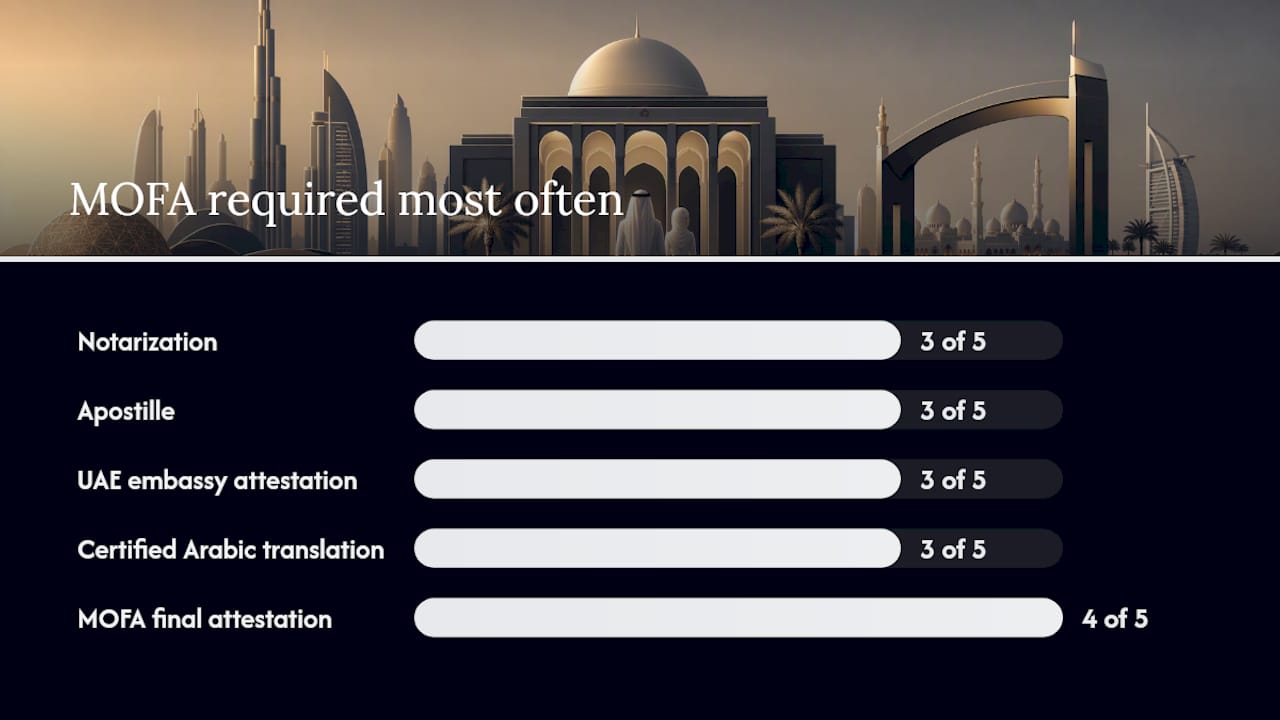
Attestation order | Notarize → apostille → UAE embassy → certified translation → MOFA attestation |
Eligibility | Open to all non-Muslim couples regardless of nationality; tourists may apply without UAE residency |
Common delay cause | Inconsistent name spellings or missing apostille on foreign-issued documents |
Harrisandcharms | Provides end-to-end document checks, translations, court filing, and MOFA attestation support |
Table of Contents
What documents do you need to get married by court in the UAE?
The Abu Dhabi Civil Family Court requires both spouses to present primary ID, a signed consent declaration, and dissolution proof for any prior marriage. The UAE Ministry of Justice also lists a medical report and Emirates ID among required items for non-Muslim marriage contract requests. Carry originals and at least two certified copies of every document to the court.
For a full breakdown of documents required for court marriage in the UAE, the Harrisandcharms guide covers each document type with current 2026 requirements.
Pro Tip: Always verify that the name spelling on your passport matches your birth certificate and divorce papers exactly. Courts regularly reject applications over a single letter difference in transliteration.
How the civil court marriage application process works, step by step
The Abu Dhabi Civil Family Court allows both residents and non-residents to apply online; tourists must travel to Abu Dhabi for the ceremony itself.
Submit your application online or in person. Create an account on the Abu Dhabi Judicial Department (ADJD) portal or visit the court directly. Upload scanned copies of all required documents.
Document review stage. Court staff verify that all papers are complete, translations are certified, and attestations are in order. Incomplete files are returned at this stage.
Schedule the ceremony date. Once approved, both spouses receive a ceremony appointment. Both must appear in person; no proxy marriages are permitted.
Appear before the judge. The judge reviews the bilingual marriage contract, confirms consent from both parties, and certifies the agreement. Both spouses sign the contract in the judge’s presence.
Witnesses sign. Two witnesses (each with valid ID) sign the contract at the same appointment.
Court registers the marriage. The signed contract is entered into the court register and a marriage certificate is issued.
MOFA attestation (post-ceremony). The Abu Dhabi Civil Family Court recommends having the marriage certificate attested by the Ministry of Foreign Affairs after the ceremony. This step is required if you plan to use the certificate outside the UAE.
Embassy registration (if needed). U.S. nationals should register the marriage at their nearest U.S. embassy or consulate for it to be recognized in their home country.
The civil marriage application guide on Harrisandcharms walks through each court interaction in detail.
How to legalize, translate, and attest U.S. documents for a UAE court marriage
All foreign civil documents need certified Arabic translation and UAE attestation before a court will accept them. For U.S.-issued documents, follow this sequence without skipping steps:
Notarization → Apostille → UAE Embassy attestation → Certified Arabic translation → MOFA final attestation in the UAE
Document Type | Translation to Arabic | Apostille Needed | UAE Embassy Attestation | MOFA Final Attestation |
U.S. birth certificate | Yes | Yes | Yes | Yes |
U.S. divorce decree | Yes | Yes | Yes | Yes |
U.S. death certificate | Yes | Yes | Yes | Yes |
UAE-issued documents | No (bilingual) | No | No | Yes (QR/reference required) |
Medical fitness certificate | No | No | No | No |
The UAE Ministry of Foreign Affairs attestation service specifies that documents must be originals or legally translated copies, and that UAE-issued digital documents must include a QR code or reference number for verification.
Pro Tip: The most common rejection cause for U.S. documents is submitting a notarized copy without an apostille. The apostille must come from the Secretary of State in the state where the document was issued, before it goes to the UAE embassy.
For practical guidance on document legalization steps, the ViaUAE blog covers embassy interactions and apostille workflows for expats in detail.
Who can use the civil court marriage route in the UAE?
Civil court marriage under Federal Decree Law No. 41 of 2022 is available to non-Muslim couples regardless of nationality. The Abu Dhabi Civil Family Court confirms that civil marriage is open to all nationalities and religions except Muslim UAE nationals, who follow a separate process.
Standard eligibility requirements:
Both parties must meet the minimum legal age for marriage as specified by the court
Neither party may be in an existing marriage
The couple must not be related within prohibited degrees of kinship
Both must provide valid ID and sign a declaration of consent
Special-case documents:
Previously married (divorced): Certified divorce decree with apostille and Arabic translation
Previously married (widowed): Certified death certificate of prior spouse with apostille and Arabic translation
Tourists and non-residents: Passport only (no Emirates ID required); must travel to Abu Dhabi for the ceremony
Golden Visa holders: Same civil court route applies; present your valid Golden Visa residency document alongside your passport where requested
Mixed-faith or non-religious couples: Civil marriage functions as a secular contract under UAE law, so faith is not a condition for eligibility
Red flags that cause delays:
Name spellings that differ across passport, birth certificate, and divorce papers
Missing original dissolution documents for a prior marriage
Divorce decrees without apostille or without certified Arabic translation
Witnesses who arrive without valid ID
For non-Muslim couples specifically, the non-Muslim marriage UAE guide on Harrisandcharms covers legal pathways and rights in detail.
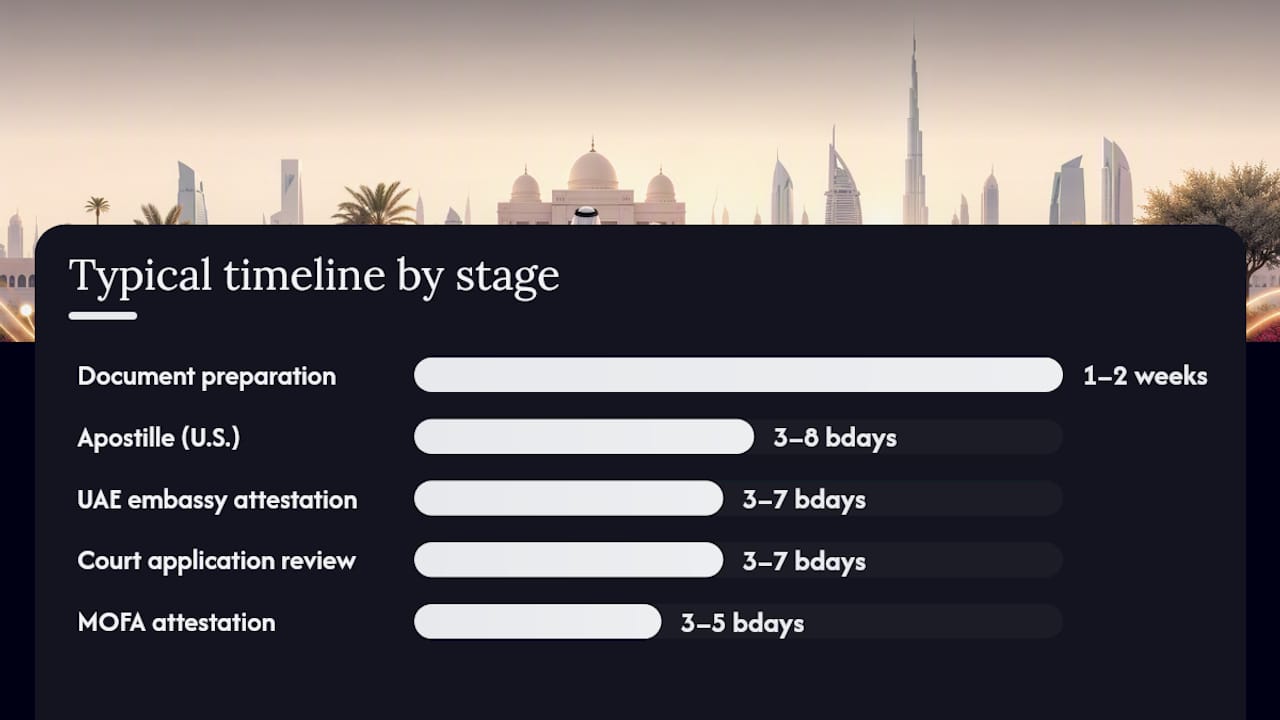
Realistic timeline and costs for a UAE civil court marriage
The entire process from preparing documents to receiving an attested marriage certificate typically takes several weeks, with timing depending on individual circumstances. Couples with clean, locally issued documents can move faster; those with U.S.-issued papers needing apostilles and embassy attestation typically need the longer end of that range.
Stage | Typical Time | Approximate Cost Category |
Document preparation (translations, notarization) | 1–2 weeks | Moderate (translation + notary fees) |
Apostille (U.S. Secretary of State) | 3 to 8 business days | Low to moderate (state fee) |
UAE Embassy attestation | 3–7 business days | Moderate (consular fee) |
Court application review | 3–7 business days | Low (court filing fee) |
Ceremony scheduling and appointment | 1–5 business days | Included in court fee |
MOFA attestation (post-ceremony) | 3–5 business days | Low (government fee) |
Common causes of rejection or delay:
Incomplete or unstamped translations
Missing apostille on foreign documents
Inconsistent name spellings across documents
No proof of prior marriage dissolution
Witnesses without valid ID at the ceremony
Build at least two weeks of buffer time if you have wedding vendors, flights, or visa applications tied to the marriage date. Rushing the apostille or embassy step is where most timelines break down.
How Harrisandcharms handles your court marriage from start to finish
Getting every document right, in the right order, with the right stamps, is where most couples lose time. Harrisandcharms provides end-to-end civil court marriage support: document checklist review, certified Arabic translation coordination, apostille and UAE embassy liaison, court filing, in-person ceremony logistics, and post-ceremony MOFA attestation.

The service removes the guesswork from a process where a single missing stamp can push your ceremony date back by weeks. Harrisandcharms works with a network of certified translators and attestation partners, and the team handles court scheduling so you arrive prepared. For couples who also want document legalization and visa support, the partner network covers those steps too.
The founders built Harrisandcharms after navigating the UAE marriage process firsthand. That experience shapes how the team approaches every file: check the documents before the court does, not after. Explore the civil marriage packages or the full wedding and registration services to request a consultation and get a document checklist tailored to your situation.
What I see couples get wrong most often
The single most avoidable cause of delay is submitting documents with inconsistent name spellings. A passport that spells a name one way and a divorce decree that spells it slightly differently will stop your application cold. Before you submit anything, lay every document side by side and check that names, dates, and document numbers match exactly across all of them. If you have a U.S. divorce decree, confirm the apostille is attached before you pay for the Arabic translation. Translating a document that still needs an apostille means paying twice. Schedule a document check with Harrisandcharms before you file, and we will catch these issues before the court does.
Useful official sources
Abu Dhabi Judicial Department (ADJD) Civil Family Court: — The primary court for non-Muslim civil marriages; covers eligibility conditions, online application, and ceremony scheduling. Check the ADJD portal for current appointment availability.
UAE Ministry of Foreign Affairs (MOFA) Attestation Service: — Lists accepted document types, attestation requirements, and the digital-document verification criteria (QR code/reference number). Use this page to confirm current fees and processing times before submitting.
UAE Ministry of Justice Marriage Contract Service: — The official gateway for marriage contract requests; lists required documents for non-Muslims including Emirates ID and medical report.
Always bring original documents to the court and keep certified copies separate. Official requirements can update; verify directly with the relevant authority before your appointment.
This article is general information, not a substitute for advice from a qualified lawyer. Consult a qualified legal professional about your own circumstances before acting on anything here.
Recommended
Comments