
Complete Procedures for Register Marriage in UAE: 2026 Guide

Updated: Sep 3

Registering a marriage in the UAE means choosing between two legal routes: the civil family court (Abu Dhabi) or the Sharia personal-status court, and the right path depends on your religion and nationality. Your single next step is to gather your passports and single-status evidence, then either book through the Abu Dhabi Judicial Department (ADJD) online portal or contact Harris & Charms for end-to-end handling.
The two primary routes at a glance:
Civil route (Abu Dhabi Civil Family Court): Open to non-Muslim couples, interfaith couples, and most Muslim expatriates regardless of residency. Tourists can apply online and travel to Abu Dhabi for the ceremony. Governed by Law No. 14 of 2021 and administered by the ADJD.
Sharia/Personal Status route: Required for Emirati Muslim nationals and available to Muslim expatriates who prefer an Islamic contract. Administered through Personal Status courts and the federal eZawaj system, with UAE Ministry of Foreign Affairs (MOFA) attestation for international use.
Pro Tip: Contact Harris & Charms before you book anything. A 15-minute document gap check can save weeks of back-and-forth with the court.
Key Takeaways
Registering a marriage in the UAE requires choosing the correct legal route, preparing a complete attested document set, and planning the MOFA attestation chain before your travel dates.
Point | Details |
Choose your route first | Civil court suits non-Muslims and most expats; Sharia court is required for Emirati Muslim nationals. |
Attestation chain is non-negotiable | The UAE does not accept the Hague Apostille; every foreign document needs the full four-step attestation sequence. |
Medical screening takes time | Sharia route couples must book premarital screening early — it is a prerequisite, not an afterthought. |
Plan attestation before travel | Embassy legalisation for overseas use can add weeks; build that into your schedule from the start. |
Harris & Charms handles it end-to-end | From document gap check to MOFA attestation, Harris & Charms manages every step for civil and Islamic registrations. |
Table of Contents for procedures for register marriage in UAE
Civil vs. Islamic route: which one fits your situation?
The civil route under Law No. 14 of 2021 is deliberately broad. Non-Muslim couples, interfaith couples, and Muslim expatriates who want a secular contract can all use it. The Sharia route is mandatory for Emirati Muslim nationals and is the natural choice for Muslim couples who want their marriage recognized under Islamic law.
Three quick decision rules:
Nationality and religion: Emirati Muslim nationals must use the Sharia court. Non-Muslims and most expatriates use the civil court.
Prior foreign marriage: If you married abroad, you may need attestation of that certificate rather than a new registration.
Speed and flexibility: The civil route offers a regular and an express option, and the court uses a standardized template contract that simplifies cross-national and interfaith cases.
Pro Tip: Even if you live in Dubai or Sharjah, you can use the Abu Dhabi Civil Family Court. Tourists and non-residents are explicitly accepted, which makes it the most accessible option for couples visiting the UAE.
Who can register a marriage in the UAE?
Eligibility rules differ by route, but several conditions apply across both:
Minimum age of 18 (with court approval required for younger applicants in exceptional cases under Sharia rules).
Both parties must be legally free to marry: prior marriages must be ended by divorce or death, with supporting certificates.
Marriage between first- and second-degree relatives is prohibited.
For the civil route, there is no residency requirement. Tourists can apply online and attend the ceremony in Abu Dhabi.
For the Sharia route, Muslim brides typically need a guardian (wali). A Mazoon or court-appointed official can substitute in structured circumstances.
Important: Emirati Muslim nationals cannot use the Abu Dhabi Civil Family Court. They must register through the Sharia/Personal Status court system. Attempting to use the civil route will result in an automatic rejection, regardless of how complete your documents are.
How to register a civil marriage step by step
The civil marriage registration process follows a clear sequence. Work through it in order. Procedures for Marriage
Check eligibility. Confirm neither party is an Emirati Muslim national and that all prior marriages are legally dissolved.
Gather your documents. See the checklist below.
Apply via the ADJD online portal. Residents and tourists both apply online. Upload scanned copies of all required documents.
Choose regular or express service. Regular processing gives you a scheduled date within the court’s standard queue. Express lets you select a specific date and time, useful if you have travel constraints, but carries a premium fee.
Pay fees and confirm your ceremony date. Payment is completed online through the portal.
Attend the ceremony at the ADJD main court building in Abu Dhabi. Both parties must be physically present. Bring original documents.
Sign the marriage certificate and collect it.
Obtain MOFA authentication if you need the certificate recognized abroad, then proceed to your home country’s embassy or consulate for legalisation.
Documents checklist for civil marriage:
Valid passports (both parties)
Emirates ID (for UAE residents)
Single-status certificate or sworn affidavit of no impediment
Divorce decree or death certificate of former spouse (if applicable)
Certified Arabic translation of any foreign-language documents
Pro Tip: Submit PDFs at the online application stage, but bring originals plus two sets of photocopies to the ceremony. If your documents are in English, have certified Arabic translations ready before your court date, not after.
Stage | What happens | Who does it |
Online application | Upload documents, choose service type | Applicant (or Harris & Charms) |
Fee payment | Court and service fees paid online | Applicant |
Ceremony | Both parties sign before court official | Both parties, in person |
MOFA attestation | Authentication stamp for overseas use | MOFA office or service provider |
How to register an Islamic marriage step by step
The Sharia route has a few extra requirements compared to the civil process, most notably the medical screening and the presence of a guardian.
Complete premarital medical screening. Both parties must obtain a medical fitness certificate from an approved UAE health facility. Couples often underestimate the time this takes; book early.
Prepare your documents (see list below).
Book through the Personal Status court or the federal eZawaj system. The Ministry of Justice’s electronic marriage contracts system allows online submission, fee payment via UAE Pass, and digital receipt of the contract.
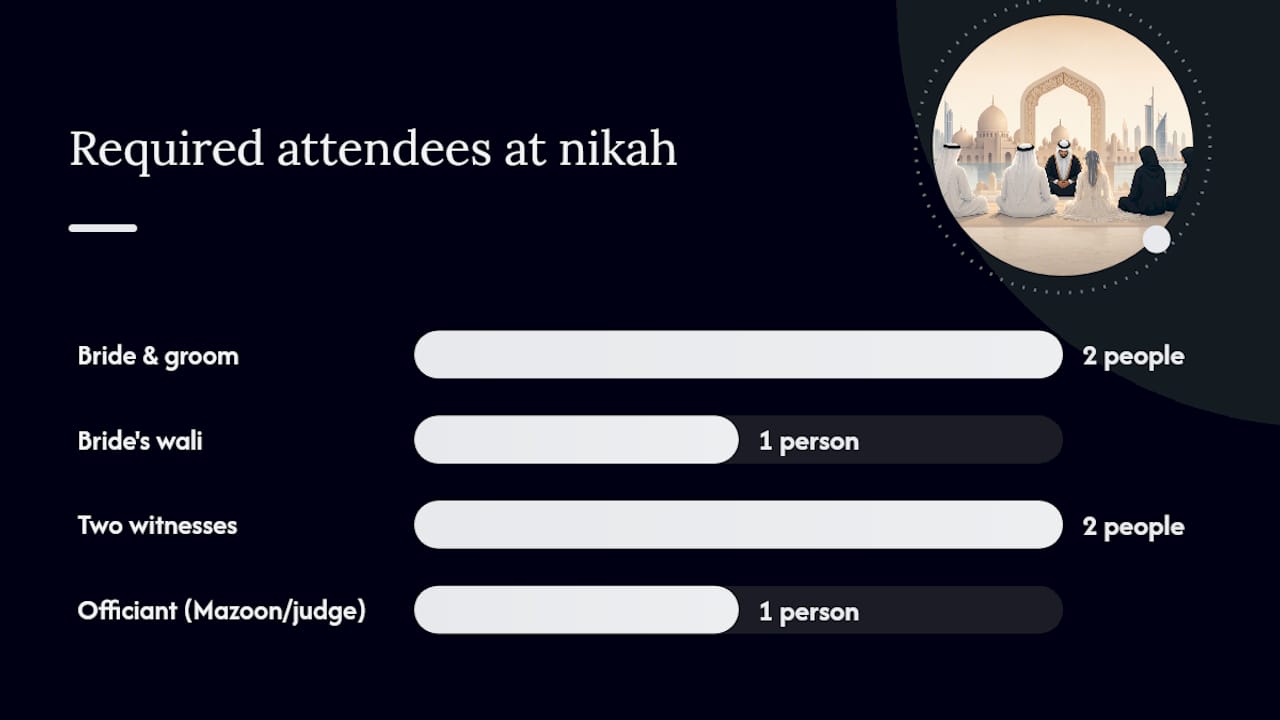
Attend with the bride’s wali (guardian) and two male witnesses. The Mazoon or court judge officiates the nikah.
Sign and register the contract. The court issues the official marriage certificate.
Obtain MOFA attestation for any overseas use.
Documents specific to Islamic marriage:
Valid passports and Emirates ID (where applicable)
Premarital medical fitness certificates (both parties)
Bride’s guardian’s passport and ID
Two witnesses’ passports or IDs
Divorce or death certificates if either party was previously married
Certified Arabic translations of foreign documents
Pro Tip: If the bride’s guardian is abroad or unwilling to attend, consult an authorized Mazoon or a Personal Status court lawyer before you book. The court can appoint a substitute wali, but the paperwork adds time.
Complete documents checklist and attestation for overseas use
Getting the right documents for marriage registration is where most delays originate. Here is the full picture.
Identity and status documents:
Passports (valid, not expiring within six months of the ceremony date)
Emirates ID (residents only)
Single-status certificate or Certificate of No Impediment from your home country
Divorce decree or death certificate (if previously married)
Birth certificates (required by some courts or embassies)
Premarital medical screening certificate (Sharia route)
Translation and notarization rules:
All foreign-language documents must be translated into Arabic by a UAE-licensed certified translator.
Foreign documents must be attested in your home country before the UAE will accept them.
Attestation chain for foreign-issued documents:
Origin-country authentication (notary or relevant authority)
Home country’s Ministry of Foreign Affairs stamp
UAE embassy or consulate attestation in your home country
MOFA stamp in the UAE
The UAE does not accept the Hague Apostille as a substitute for this full chain. Every link matters.
For the UAE marriage certificate used abroad:
MOFA authentication in the UAE
Your home country’s embassy or consulate in the UAE
Home-country legalisation (if required by that country)
Pro Tip: Harris & Charms bundles certified translation, notarization coordination, and MOFA attestation into a single workflow. That reduces the chance of submitting documents in the wrong sequence, which is the most common reason for rejection.
What timelines and fees should you expect?
Planning around realistic windows prevents missed flights and expired visas.
Typical timelines:
Civil regular service: application processing plus a scheduled ceremony date within the court’s standard queue (allow several business days to a few weeks depending on demand).
Civil express service: faster scheduling with a specific date and time of your choosing; tighter document preparation window required.
Sharia/eZawaj route: online submission is fast, but medical screening and guardian coordination add days or weeks before you can book.
MOFA attestation: typically a few business days once documents are submitted.
Full attestation chain for overseas use (including embassy legalisation): allow several additional weeks, especially if your home country’s embassy has a backlog.
Typical fee categories to budget for:
Court registration fee (civil or Sharia)
Express processing premium (civil route, if selected)
Certified Arabic translation fees
Notarization and attestation fees
MOFA attestation fee
Embassy or consulate legalisation fee (home country)
Plan attestation before you book flights. Couples who need the certificate for a visa or immigration application often discover their embassy requires a specific local step before accepting the MOFA stamp. That step can add weeks.
Common rejections and delays, and how to prevent them
Most application failures come down to the same short list of mistakes.
Common causes of rejection or delay:
Missing or incomplete attestation on foreign documents (wrong sequence or a skipped step)
Translations not certified by a UAE-licensed translator
Expired passports at the time of application or ceremony
Single-status certificate that is too old or in the wrong format
Witness documentation that does not meet court requirements
Embassy-specific no-objection certificate formats not followed
Prevention steps:
Verify your passport expiry before applying. Courts check validity at the ceremony date, not the application date.
Use only UAE-licensed certified translators. A translation from an overseas agency will be rejected.
Contact your home country’s embassy in the UAE before submitting to confirm their specific no-objection format.
Book medical screening as soon as you decide on the Sharia route.
Pro Tip: Build your attestation timeline into your travel plan, not around it. If you are flying in for the ceremony, add a buffer of at least three to five business days for any last-minute document corrections.
Do not wait until the week before your travel or visa deadline to start the attestation process. A single missing stamp can delay your certificate by weeks, and no court or embassy will expedite on short notice.
How Harris & Charms supports every step
Harris & Charms handles the parts of marriage registration that couples most often get wrong: document sequencing, translation quality, and attestation timing. The full service scope covers both civil and Islamic routes.
Core services:
Document preparation, verification, and gap check before submission
Certified Arabic translation and notarization coordination
Court application filing and ceremony booking (civil and Sharia)
MOFA attestation and embassy legalisation support
Venue and event planning
Photography and yacht wedding packages as add-ons
Visa and residency documentation support through partner network
Service flow:
Stage | What Harris & Charms does |
Inquiry | Document gap check and route recommendation |
Preparation | Translation, notarization, attestation sequencing |
Filing | Online portal submission and ceremony booking |
Ceremony | On-site coordination and document handling |
Post-ceremony | MOFA attestation and embassy legalisation |
Why document precision matters more than most couples expect
Most couples who come to us after a rejection share the same story: they submitted everything they thought was required and still got turned back because one document was attested in the wrong order or translated by an uncertified agency. The paperwork for UAE marriage registration is not complicated, but it is unforgiving. One skipped step in the attestation chain means starting over.
If you are unsure whether your documents are in order, a short consultation before you apply costs far less than a rejected application and a rescheduled flight. Reach out to Harris & Charms for a document check before you submit anything.
Harris & Charms packages: what’s included and how to book
Harris & Charms offers the fastest path from “we want to get married in the UAE” to a legally registered certificate in hand, without the back-and-forth of managing courts, translators, and embassies separately.

Package options:
Civil Marriage Package: Document handling, certified translation, court application, ceremony booking, and MOFA attestation. Ideal for non-Muslim couples, interfaith couples, and tourists.
Islamic Marriage Package: Document preparation, Mazoon or Personal Status court coordination, medical screening guidance, and MOFA attestation.
Premium Package: Express civil filing, venue coordination, photography, and full attestation chain. Built for couples who want a ceremony and a legally recognized certificate in one trip.
Add-ons: Yacht wedding packages, professional makeup services, and visa/residency documentation.
Which package fits you:
Tourist or non-resident couple: Civil Marriage Package or Premium Package with express filing.
UAE resident: Civil or Islamic package depending on religion and preference.
Golden Visa holder needing certified documentation: Premium Package with full attestation.
Start with a civil marriage package inquiry or browse the full range of wedding and registration services. Request a document gap check as your first step.
Useful official sources for forms and verification
These are the primary government pages to check for the latest forms, templates, and official guidance:
Abu Dhabi Civil Family Court (ADJD): — The official portal for civil marriage applications under Law No. 14 of 2021, including eligibility rules, service types, and the online application system. Start here for civil route applications.
This article is general information, not a substitute for advice from a qualified lawyer. Consult a qualified legal professional about your own circumstances before acting on anything here.
Recommended
Comments