
Civil marriage in the UAE: A complete guide for expats


TL;DR:
Many expat couples in the UAE assume marriage requires a religious ceremony, but civil marriage is a legally valid alternative for non-Muslims. The process involves specific documentation, authentication, and compliance with local rules, which vary by emirate and require early preparation. Proper understanding, timely planning, and expert guidance ensure recognition both locally and internationally for your marriage.
Many expat couples arrive in the UAE assuming their only legal path to marriage involves a religious ceremony. That assumption is wrong, and it catches people off guard at exactly the wrong moment. The UAE now offers a well-structured civil marriage route specifically designed for non-Muslim residents and foreign nationals, but the process comes with specific documentation requirements, eligibility rules, and post-marriage steps that vary by emirate. This guide walks you through everything you need to know before you start filling out a single form.
Table of Contents
Key Takeaways
Point | Details |
Civil marriage is secular | Civil marriage in the UAE provides a non-religious legal route for non-Muslim expats and foreigners. |
Legal routes differ | Eligibility and rules can vary by emirate and by the couple’s religion or nationality. |
Documentation is critical | Passports, ID, and authenticated status proof are required; prepare for translation and attestation. |
International use needs extra steps | For use abroad, civil marriage certificates must be properly attested and translated as per the destination country’s rules. |
Plan early and get support | Advance document work and expert advice help avoid delays or legal surprises in your UAE civil marriage process. |
Understanding civil marriage in the UAE
Civil marriage in the UAE is not a watered-down or informal alternative to a religious ceremony. It is a legally recognized contract governed by a specific legal framework, and it carries the same legal weight as any other form of marriage registration in the country.
In the UAE context, “civil marriage” refers to a marriage conducted as a civil contract under UAE civil personal status rules, rather than under Sharia religious rules. That distinction matters enormously for expat couples. It means your marriage is recorded through a civil authority, not a religious court, and the legal standards that govern it are entirely different from those applied to Muslim nationals.
The legal foundation for this route expanded significantly with recent reforms. The UAE federal decree-law framework allows non-Muslim residents an option regarding personal status matters, including marriage, divorce, inheritance, and child custody. This was a deliberate move by the UAE government to attract and support its large international community. Roughly 90% of the UAE’s population is made up of expatriates and foreign nationals, so creating a civil legal pathway was a practical and important step.
Feature | Civil marriage | Sharia-based marriage |
Governing law | UAE Civil Personal Status Law | Islamic Sharia law |
Eligible parties | Non-Muslim expats, foreign nationals | Muslim parties (by default) |
Jurisdiction authority | Civil courts or dedicated personal status courts | Sharia courts |
Ceremony style | Civil contract signing | Religious ceremony |
Recognition abroad | Requires attestation | Requires attestation |
“The UAE’s civil personal status framework represents a significant policy shift aimed at making the country more accessible for the millions of expats who call it home — without requiring them to navigate religious legal systems that may not reflect their own beliefs or circumstances.”
Understanding this difference upfront helps you choose the right process from the start. Mixing up the two systems wastes time, money, and energy. For a deeper breakdown of the similarities and differences, the civil vs Islamic marriage comparison is worth reading before you proceed.
Key eligibility and legal routes for civil marriage
Now that you understand what civil marriage means, let’s examine if you and your partner qualify under UAE law and which route fits your situation.
Eligibility is where a lot of couples get tripped up. For civil marriage arrangements used by many expats in the UAE, especially in Abu Dhabi, eligibility commonly requires both partners to be at least 18 years old, not currently married, not closely related, and in some channels, not UAE nationals or not Muslim.
Here is a quick breakdown of common eligibility requirements:
Age: Both partners must typically be at least 18 years old
Marital status: Neither partner can be currently married to someone else
Relationship: Partners cannot be closely related by blood (consanguinity rules apply)
Religion: In many civil routes, at least one or both partners must be non-Muslim
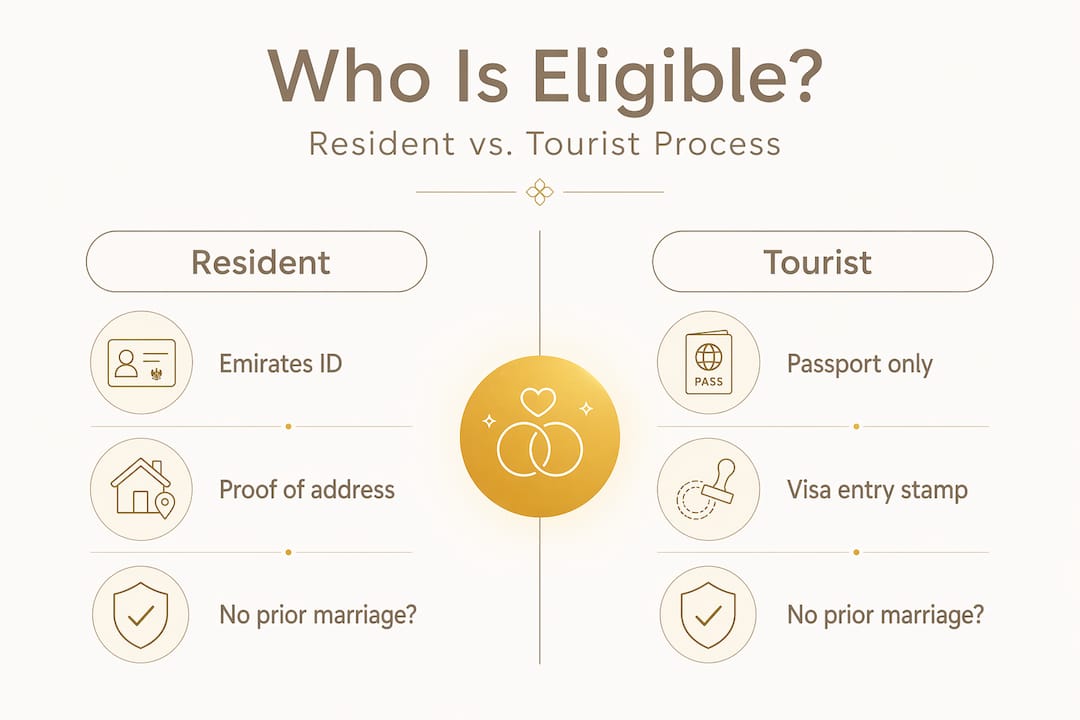
Residency: Some channels require UAE residency; others are open to tourists
The tourist-friendly angle is genuinely important. Abu Dhabi, in particular, has developed a civil marriage process that does not require both parties to hold UAE residency visas. This makes the UAE an appealing destination for couples from countries with more restrictive marriage laws, or those who simply want to legalize their relationship while visiting.
Scenario | Likely eligible for civil marriage? | Key condition to check |
Two non-Muslim expat residents | Yes | Both must be single and over 18 |
Non-Muslim tourists visiting UAE | Yes (Abu Dhabi route) | No residency needed in some cases |
One Muslim, one non-Muslim | Depends on emirate | Check local channel rules |
Two Muslim non-nationals | May need Sharia court | Check emirate-specific guidance |
UAE nationals (either partner) | Generally restricted | Civil route typically for non-nationals |
Pro Tip: Eligibility rules are not identical across all seven emirates. Dubai, Abu Dhabi, and Ras Al Khaimah each have slightly different procedures and channels. Always verify the rules for the specific emirate where you plan to register your marriage.
If you want a clear eligibility walkthrough before booking appointments or collecting documents, reviewing civil marriage eligibility can save you a lot of back and forth. You can also check the full requirements for civil marriage to avoid gaps in your preparation.
Documentation and legal process: What you’ll need
Once you’ve confirmed eligibility, the next hurdle is preparing the right paperwork. This is where most couples face the most friction, especially when one or both partners hold documents issued outside the UAE.

Typical documentation for UAE civil marriage for expats includes identity documents such as passports and often Emirates IDs for residents, as well as proof that any prior marriages have been legally dissolved. Foreign documents generally must be legally authenticated and attested, and translated as required by the court.
Standard documents required:
Valid passport copies for both partners (original passports usually required at the appointment)
Emirates IDs if either partner is a UAE resident
Proof of single status or dissolution of any prior marriage (divorce decree or death certificate if widowed)
Birth certificates (required in some emirate-specific processes)
Completed application forms issued by the relevant court or authority
Passport-sized photographs
Payment of registration fees (these vary by emirate)
For foreign-issued documents, the authentication process adds complexity. Here is what it typically involves:
Notarization: Your document is notarized in the country where it was issued
Ministry of Foreign Affairs stamp: The notarizing authority’s signature is then certified by the Ministry of Foreign Affairs in that country
UAE Embassy attestation: The document is then stamped by the UAE Embassy or consulate in your home country
UAE Ministry of Foreign Affairs: Final attestation in the UAE itself
Certified translation: Documents not in Arabic must be translated by a certified legal translator
Pro Tip: Start gathering and authenticating your documents at least two to three months before your planned marriage date. Delays at the UAE Embassy or Ministry of Foreign Affairs in your home country are common, especially during public holidays or high-demand periods. Always request at least two certified copies of every attested document.
The civil marriage application process covers the step-by-step procedure in detail. You can also use the UAE civil wedding document checklist to make sure nothing slips through before your appointment.
Why documentation and legal recognition matter after marriage
You’ve gathered your papers and completed the ceremony, but civil marriage doesn’t end there. Here’s what to know about your documents and their legal value beyond the UAE.
Getting married in the UAE is only part of the story. If you eventually want to use your marriage certificate to apply for a spouse visa in another country, update your marital status at a foreign government office, or access joint financial or legal rights abroad, your UAE civil marriage certificate will need to meet that country’s recognition standards. That is rarely automatic.
When using a civil marriage certificate abroad, acceptance is not guaranteed; attestation and notarization, as well as compliance with the destination country’s recognition rules, can be a separate step entirely. Some countries have very specific requirements. Others may not recognize certain foreign civil marriages at all without additional legal proceedings.
Common post-marriage documentation issues expats face:
Home country non-recognition: Some countries require the marriage to be re-registered or verified through their own consular system
Visa applications: Spouse visa applications in other countries often require an attested, translated marriage certificate with an apostille (a form of international document authentication)
Bank and financial accounts: Joint accounts or inheritance claims may require a legally recognized marriage certificate
Name change documents: Updating passports or identity documents after marriage depends on your home country recognizing the UAE certificate
Document legalization is a common bottleneck for foreign nationals, because even when the marriage ceremony itself is straightforward, foreign-issued status documents often require authentication, attestation, and translation before court acceptance, and the same applies in reverse when taking your UAE certificate home.
“A UAE civil marriage certificate is a powerful legal document, but its reach beyond UAE borders depends entirely on how well it has been authenticated and whether your home country’s legal system accepts it.”
The legal benefits for expats that come with a properly documented civil marriage are significant. For a complete picture of the end-to-end journey, the full civil marriage process article walks through each stage in sequence.
Our take: The real-world pitfalls and practical solutions for expats
After working extensively with expat couples going through civil marriage in the UAE, the single most consistent pattern we see is this: people underestimate how long the paperwork will take.
The ceremony itself can be quick, sometimes completed in a single appointment. But the document trail that has to be in place before that appointment, and the follow-up attestation needed afterward, can stretch across weeks or months. Couples who start the process in January expecting a March wedding sometimes discover their attested divorce decree from a foreign court won’t be ready until April.
The other major blind spot is international recognition. Many couples think once they have the UAE certificate, they’re done. They aren’t. If you plan to use that certificate in your home country, whether for a visa, a name change, or simply updating your official marital status, you need to take additional steps immediately after the ceremony. Wait too long and you may find yourself untangling bureaucratic delays when you least have energy for it.
Here is what we consistently recommend to couples we work with:
Start early. Give yourself a minimum of three months for document preparation if either partner has foreign-issued documents. Six months is safer if you’re dealing with countries known for slow embassy processing or complex authentication chains.
Keep multiple certified copies. Every attested document you receive, whether it’s a divorce decree, a birth certificate, or your final marriage certificate, get at least two or three certified copies made immediately. Courts and embassies sometimes retain originals, and replacing an authenticated document from scratch is expensive and time-consuming.
Know your home country’s rules before you marry. Spend thirty minutes researching what your home country requires to recognize a foreign marriage. Some countries require a specific apostille. Others require consular registration within a set time after the ceremony. Find this out in advance, not after.
Consider specialist support for the paperwork. The process is manageable, but it is genuinely complex, especially for couples handling it in a second or third language. Having a knowledgeable team guide you through attestation, translation, and court requirements removes a significant amount of stress and significantly reduces the chance of errors.
You can review the step-by-step civil requirements to build your personal preparation checklist based on your specific circumstances.
Need expert guidance for your UAE civil marriage?
Getting through a UAE civil marriage successfully is absolutely possible, and it can be a genuinely smooth experience when you have the right support in place from the beginning.

At Harris & Charms, we specialize in helping expat couples and foreign nationals navigate every part of the civil marriage process in the UAE, from confirming your eligibility and organizing your documentation to managing attestation requirements and connecting you with trusted legal partners. We understand that your time and peace of mind matter as much as legal compliance does. Whether you need full end-to-end support or just a clear roadmap, our team is ready to help. Explore our marriage services in UAE to see how we can support you, or contact our team directly to start a conversation about your specific situation.
Frequently asked questions
Do both partners need to be UAE residents for a civil marriage?
No, in many emirates like Abu Dhabi, tourists can apply for civil marriage without UAE residency, making the UAE an accessible destination for couples visiting from abroad.
Does a UAE civil marriage certificate work abroad?
A civil marriage certificate may be recognized abroad, but acceptance is not automatic; attestation, notarization, and compliance with your destination country’s rules are usually required.
What documents do expat couples need for civil marriage in the UAE?
You typically need both passports, Emirates IDs if you are resident, and proof of dissolved prior marriage if applicable; foreign documents require legal authentication, attestation, and certified translation before court acceptance.
Is there a waiting period or witnesses needed for a UAE civil marriage?
In many UAE emirates, no witnesses are required, and the process can sometimes be completed in a single visit, though you should always confirm the specific rules for the emirate where you’re registering.
Recommended
Comments