
Legal marriage options in Dubai: a complete 2026 guide

Updated: Jul 9

TL;DR:
Getting married in Dubai as a foreigner involves complex pathways determined by religion, residency, and nationality, not just walking into court. Couples must carefully select the appropriate route—such as Sharia, civil, embassy, or religious institution—based on their specific circumstances, including prior marital status. Thorough documentation, translation, and early verification with authorities are essential for a smooth process, as Dubai’s laws are continually evolving.
Getting legally married in Dubai as an expatriate or foreign national is far more nuanced than most couples expect. Many arrive assuming they simply walk into Dubai Courts, sign some papers, and leave as a married couple. Reality is more layered: residency constraints affect eligibility for certain legal marriage routes, and your religion, nationality, and visa status all shape which pathway is actually available to you. This guide maps out every major option, shows you how to identify the right route for your specific circumstances, and highlights the documentation pitfalls that cause delays so you can avoid them entirely.
Table of Contents
Key Takeaways of Legal Marriage Options Dubai
Point | Details |
Pathway depends on profile | The right marriage route in Dubai depends on your religion, residency, and nationality. |
Residency is crucial | Some legal options are only open to residents, while others—like Abu Dhabi’s civil route—accommodate tourists. |
Documentation matters | Missing or incorrect documents are the main cause of delays or denials. |
Civil vs Islamic explained | Civil marriage suits non-Muslims; Islamic (Sharia) marriage is for Muslims and eligible interfaith couples. |
Get expert help | Consult legal experts to ensure compliance, speed, and validity for your Dubai marriage. |
Understanding marriage pathways in Dubai
Dubai offers more than one legal road to marriage, but not every road is open to everyone. The four main pathways are Sharia court marriage, civil marriage through UAE courts, embassy or consular marriage, and marriage through a licensed religious institution. Foreigners can marry through Sharia, civil courts, embassies, or licensed religious institutions depending on their religion, residency, and eligibility. Understanding the boundaries of each route before you start saves weeks of wasted effort.
The four main legal marriage pathways at a glance:
Pathway | Who it serves | Residency required? | Authority involved |
Sharia court marriage | Muslim couples, some interfaith | At least one UAE resident (typically) | Dubai Personal Status Court |
Civil marriage | Non-Muslim expats | UAE residency preferred; varies by emirate | Dubai or Abu Dhabi Courts |
Embassy/consular marriage | Nationals of eligible countries | No UAE residency needed | Your home country’s embassy |
Licensed religious institution | Christians and other faith groups | Residency or tourist visa | Approved church or institution |
Here is what determines your pathway most directly:
Religion: Muslim couples are directed to Sharia court; non-Muslims use civil or consular routes.
Residency status: UAE residents have broader access than tourists or visitors.
Nationality: Some embassies only conduct marriages for their own nationals; others have stopped the service entirely.
Marital history: Previous divorce or widowhood adds document requirements regardless of the route.
Pro Tip: Before booking any venue or starting any paperwork, confirm with the specific authority whether both partners must hold UAE residency visas. This single question can save you weeks of preparation for the wrong pathway.
For couples who are non-Muslim, the civil marriage overview is usually the clearest starting point. If you are visiting rather than living in the UAE, the rules around marriage law for tourists are especially important to review before you make any assumptions.
The embassy route is underutilized but genuinely useful for couples from countries like the UK, France, Germany, or the US, where consular marriages abroad carry full legal weight at home. However, processing time at many embassies runs four to eight weeks, so it is not the right choice if you need to marry quickly.
Decision framework: how to select your legal marriage route
Having listed the different pathways, let’s walk through how you actually determine which one fits your circumstances. The process is not complicated once you know the decision tree, but many couples skip it and end up halfway through the wrong process before realizing their mistake.
Step-by-step route selection:
Identify both partners’ religions. Are both Muslim? Both non-Muslim? Is one Muslim and one not? This single factor narrows your options dramatically.
Check UAE residency status. Does at least one partner hold a valid UAE residency visa? Or are you both on tourist or visit visas?
Check your home country’s embassy. Does your country’s embassy in the UAE conduct legal marriages? If yes, this is often the least complex option for tourists.
Identify prior marital history. Either partner divorced or widowed? You will need original documentation in Arabic or with certified Arabic translation.
Confirm the route with the relevant authority. Rules shift. The correct route is largely driven by religion and residency and eligibility, not just personal preference.
Comparing the most common scenarios:
Scenario | Best route | Key constraint |
Two non-Muslim UAE residents | Civil marriage, Dubai Courts | Both hold valid residency visas |
Non-Muslim tourists/visitors | Civil marriage, Abu Dhabi OR embassy | Dubai Courts typically requires residency |
Both Muslim, one UAE resident | Sharia court, Dubai | At least one resident partner usually needed |
Interfaith (Muslim + non-Muslim) | Sharia court (specific conditions apply) | Complex; legal and religious requirements intersect |
Christian couple with eligible embassy | Embassy/consular marriage | Embassy processing times vary widely |
A real-world example makes this clearer. A British couple visiting Dubai on tourist visas cannot simply walk into Dubai Courts for a civil marriage. Dubai’s civil pathway typically requires at least one UAE resident partner. Their fastest legal options are either the British Embassy (if services are available) or traveling to Abu Dhabi, where the civil marriage pathway for non-residents is more accessible.
An interfaith couple where one partner is Muslim and the other is a non-Muslim Christian woman follows a very different path, governed by conditions under UAE personal status law. Comparing civil vs Islamic options side by side helps you see these distinctions clearly. For a deeper explanation of what Sharia courts actually require, the Sharia courts explained guide walks through it in detail.
Pro Tip: The most common mistake couples make is assuming that because a friend married in Dubai, the same process will work for them. Even a small difference in religion, residency, or nationality changes everything. Always verify your own scenario independently.
Residency and documentation: what every couple must know
Once you have seen which route fits you, it is important to understand residency, document, and eligibility nuances for each pathway. This is where many otherwise prepared couples hit an unexpected wall.
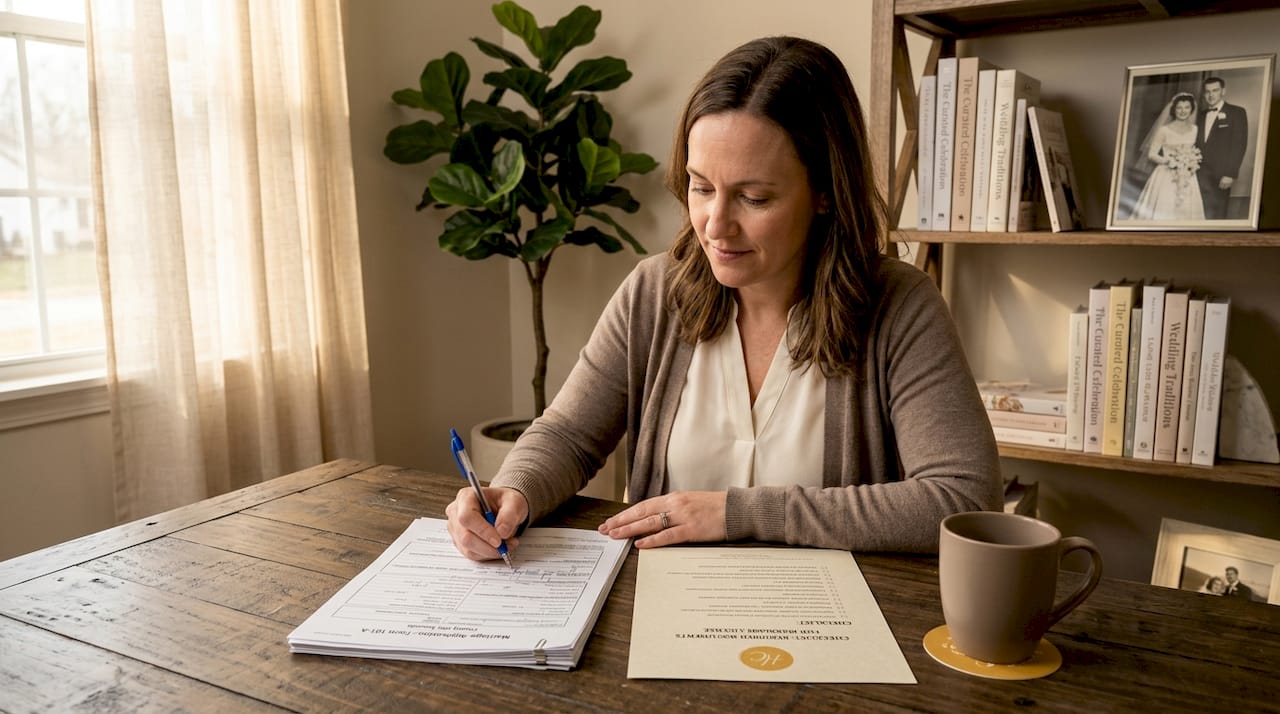
Dubai Courts civil service eligibility generally requires residency; Abu Dhabi’s civil pathway is far more accessible for non-residents and tourists than Dubai’s. This difference is significant enough that many couples who are visiting the UAE specifically to marry choose Abu Dhabi as their destination rather than Dubai.
Core documents required across most marriage pathways:
Valid passports for both partners (with copies)
Original birth certificates (apostilled or embassy-certified)
UAE residency visas (where the route requires residency)
Divorce decree or death certificate if either partner was previously married
Certificate of no objection or single status certificate from your home country
Passport-size photos, usually with a white background
Important: All non-Arabic documents must be translated into Arabic by a UAE-certified translator. An uncertified translation, even a very accurate one, will be rejected at court. Budget time for this step; it often takes three to five working days.
The single status or no-objection certificate is the document that surprises couples most. Some countries issue this document through their embassy; others require you to obtain it in your home country before traveling. Confirming this requirement early for both partners’ nationalities avoids a last-minute international trip.
Mixed-nationality couples carry an added layer of complexity because documentation standards differ by country of origin. A certificate that is perfectly acceptable from one country may need additional authentication from another. For a detailed breakdown of where to start, the guide on expat marriage steps is one of the most practical resources available. You can also cross-check your specific situation using the marriage eligibility guide before approaching any authority.
The tourist pathway is worth addressing specifically. Abu Dhabi’s civil marriage service, introduced under UAE personal status law changes, does allow non-residents to marry civilly under certain conditions. This has become a popular option for couples flying into the UAE for their wedding. The process requires advance scheduling, all documents prepared and translated before arrival, and in some cases a local guarantor or contact. Trying to do this on arrival without preparation rarely works.
Civil versus Islamic marriage: practical and legal considerations
Now, let’s compare the most common legal marriage options for expats in Dubai: civil and Islamic marriages, and who should pick which.
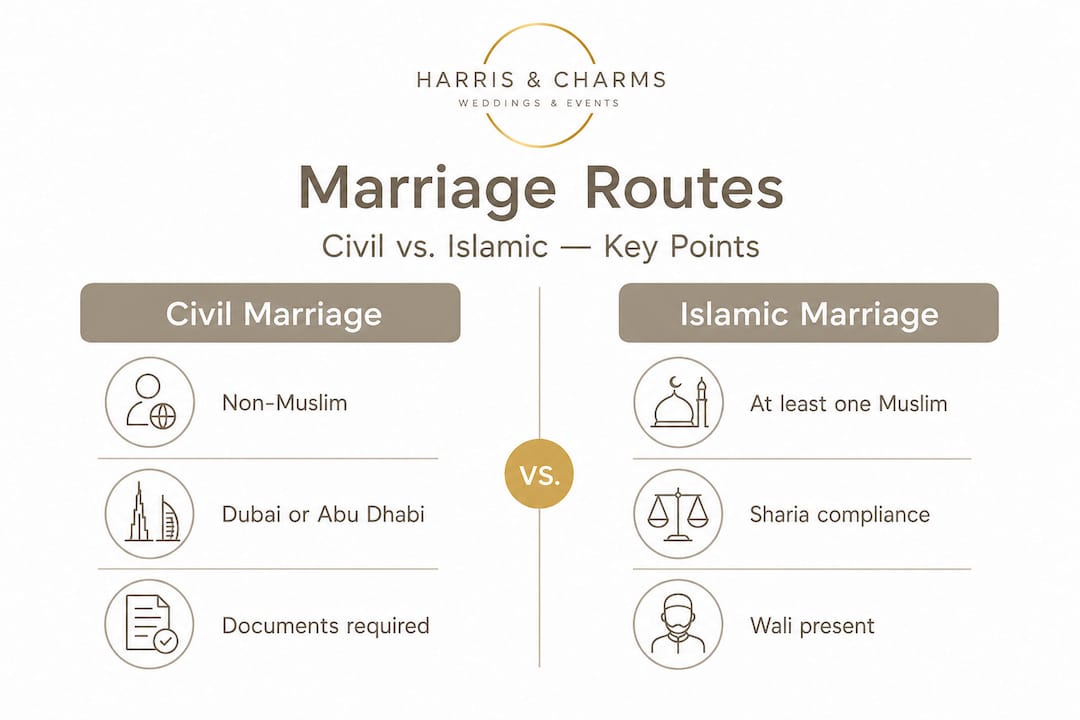
Civil marriage generally serves non-Muslims, while Islamic (Sharia) marriage applies to Muslims and permitted interfaith combinations. The process, the authorities involved, and the documentation are different enough that confusing one for the other creates real problems.
Civil marriage in Dubai:
Conducted through Dubai Courts or Abu Dhabi Courts under UAE civil law
Requires both parties to be non-Muslim (or one non-Muslim under specific limited scenarios)
Witnesses are required, usually two adult witnesses per partner
A UAE-licensed marriage officer presides over the ceremony
Timeline from document submission to marriage certificate: typically one to three weeks
Certificate is issued in Arabic with English translation available on request
Islamic (Sharia) marriage:
Conducted at Dubai Personal Status Court
Requires the groom to be Muslim; the bride may be Muslim or a person of the book (Christian or Jewish) under traditional interpretations
A wali (guardian) for the bride is required in most cases
Mehr (a gift from the groom to the bride) must be agreed and documented
The nikah contract is registered with the court after the ceremony
Timeline is typically faster than civil marriage when documents are in order
Key differences at a glance:
Authority: Civil uses civil courts; Islamic uses Sharia/Personal Status Court
Witnesses: Both require witnesses, but witness specifications differ
Documentation: Islamic marriage requires additional Islamic documents; civil requires standard civil documents
International recognition: Both are widely recognized internationally, but some countries require additional legalization
Pro Tip: If you are a non-Muslim couple planning to use your UAE marriage certificate in your home country, confirm whether apostille (Hague Convention) legalization is sufficient or whether you need full embassy legalization. The UAE joined the Apostille Convention in January 2021, which simplified this for many nationalities.
Mismatching your route to your background is a real risk. A non-Muslim couple who attempts to register through a Sharia court will face rejection. A Muslim groom who tries to proceed through civil courts without understanding the process will encounter delays. The civil marriage explained guide covers the civil process step by step for anyone still uncertain about which lane they belong in.
Our take: what couples really need to consider when marrying in Dubai
Here is the part that most legal guides skip: knowing the official pathways is necessary, but it is not the thing that will make or break your experience.
The couples who have the smoothest marriages in Dubai are not necessarily the best-prepared on paper. They are the ones who stay flexible, plan ahead by at least six to eight weeks, and verify their specific scenario with someone who works with these processes daily. Official rules and real-world processing at specific courts are sometimes different things. A court officer’s interpretation of a document requirement, an embassy’s current service status, a change in a specific emirate’s policy: these are the things that create last-minute panic for couples who relied solely on information they read six months ago.
Dubai’s marriage pathways have genuinely evolved. Significant changes to UAE personal status law came into effect in 2021 and have continued to develop since. What worked two years ago may now have a different process, a different form, or a different fee. The in-depth marriage process guide is regularly updated and reflects current requirements rather than outdated information you might find elsewhere.
The other thing we see consistently is couples underestimating the international recognition step. Getting married in Dubai is one thing. Making sure your marriage is legally recognized in your home country for visa, tax, inheritance, and benefit purposes is another. These steps are not automatic, and they require additional legalization and translation that should be built into your planning timeline from the start.
Our honest advice: treat the choice of legal marriage route as a decision that deserves the same attention as your venue or your guest list. Get it right the first time.
Need support? Let Harris N Charms guide your Dubai marriage
Navigating Dubai’s marriage pathways alone is possible, but the margin for error is slim and the cost of a mistake is significant in time, money, and stress.

At Harris & Charms, we have supported hundreds of couples through every major marriage pathway in the UAE, from civil ceremonies to Islamic marriages to full event experiences. We know which documents each authority currently requires, which pathways are open to tourists right now, and how to prevent the delays that catch unprepared couples off guard. Whether you are a resident couple planning a civil ceremony or a tourist couple flying in for your wedding day, our team handles the details so you do not have to.
Explore our Civil Marriage Packages for a clear overview of what we offer. If you are specifically planning in Dubai, our Marriage Services Dubai page covers the local process in detail. For couples looking at the broader picture across the UAE, our Marriage Services in UAE page is the best starting point. Reach out and let us map the right route for your specific situation.
Frequently asked questions
Can tourists legally marry in Dubai?
Tourists face residency constraints for Dubai civil marriage, but Abu Dhabi offers a civil marriage pathway that is more accessible to non-residents and visitors under the right conditions.
Is a marriage in Dubai recognized internationally?
Civil and Islamic Dubai marriages are widely recognized internationally, but you may need to apostille or legalize the certificate and provide a certified translation for some jurisdictions.
What documents are needed for civil marriage in Dubai?
Key documents include passports, birth certificates, valid UAE visas where required, and any prior divorce or death certificates, all translated into Arabic by a UAE-certified translator.
Can Muslim and non-Muslim couples marry in Dubai?
Yes, but the route depends on both religion and residency of both partners, and interfaith marriages typically proceed through Sharia court under specific eligibility conditions rather than through civil pathways.
Recommended
Relocating in Dubai often brings together practical concerns like choosing reliable movers and packers alongside bigger life decisions such as legal marriage procedures, since both involve careful planning, documentation, and timing. In the same way that a smooth move depends on organized handling of belongings, legal marriage in Dubai also requires proper paperwork, approvals, and step by step coordination to avoid delays. This connection shows how services like Dubai Marina movers and packers can reflect the broader importance of structured processes when navigating life transitions in the UAE.