
Civil wedding in the Philippines: requirements and guide

TL;DR:
Getting married in the Philippines requires strict adherence to documentation procedures and timelines, especially for Filipino expats in the UAE. Civil weddings are simpler and less expensive but involve important prerequisites like certificates, IDs, and legal capacities that must be meticulously prepared. Proper planning, timely submission, and expert assistance can help couples avoid delays and ensure their marriage is legally recognized both locally and internationally.
Getting married in the Philippines sounds refreshingly straightforward on paper. Show up, sign a few documents, say your vows. For Filipino expats living in the UAE, though, the reality is far more demanding. Civil weddings are simpler and cheaper than church weddings but come with strict documentation rules and firm timelines that catch many couples off guard. Miss one document, file at the wrong office, or misjudge your travel window, and you could find yourself starting over. This guide breaks down every requirement, every step, and every pitfall so you can walk into that civil registry with confidence.
Table of Contents
Key Takeaways
Point | Details |
Strict legal requirements | Missing documentation or timeline steps can delay or void your marriage registration. |
Marriage license is essential | You must secure a marriage license from the Local Civil Registrar before the ceremony. |
Foreigners have extra steps | Foreign nationals need authenticated documents and must coordinate with their embassies. |
Registration ensures validity | Official registration with the LCR and PSA is necessary for legal recognition in and outside the Philippines. |
Overview of civil wedding requirements in the Philippines
With this perspective on common challenges, let’s clarify what the law actually requires for a civil wedding in the Philippines.
Philippine law does not leave much room for improvisation. The Family Code sets out five core requirements that every valid civil marriage must satisfy. According to essential requisites for valid civil marriage, these are: legal capacity of both contracting parties (both must be at least 18 years old), freely given consent, authority of the solemnizing officer, a valid marriage license (except in specific exempted circumstances), and a ceremony witnessed by at least two people. If even one of these elements is absent, the marriage can be declared void or voidable under Philippine law. That is not a technicality. That is your entire legal union at stake.
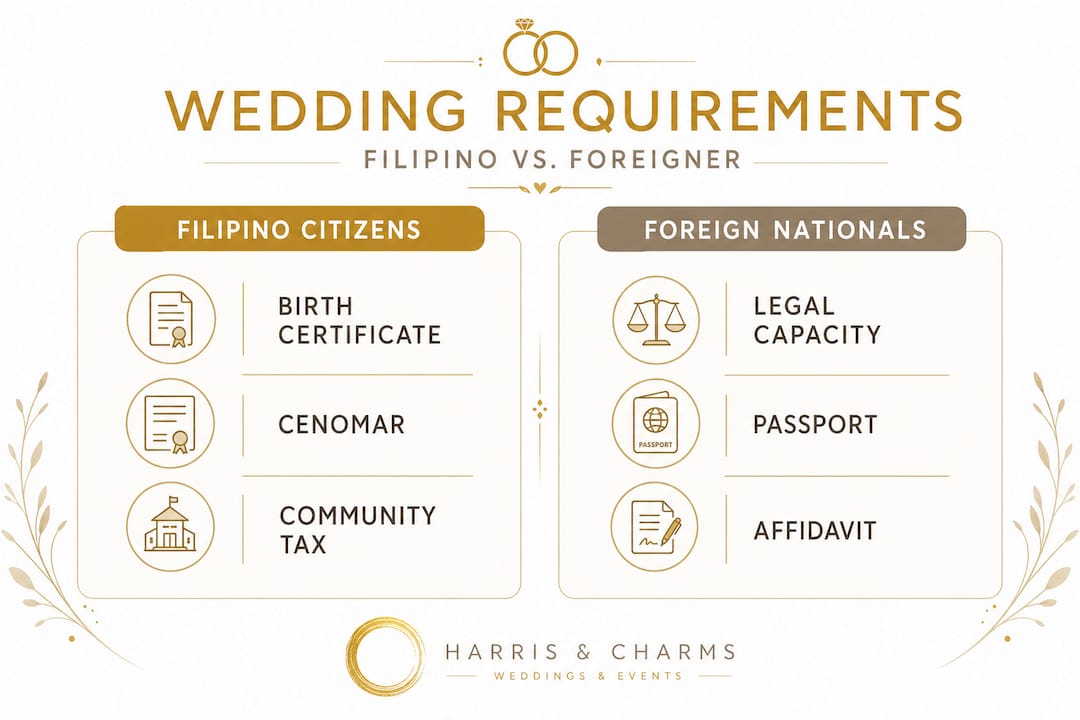
Here is a quick summary of the core documents required, depending on your citizenship status:
Requirement | Filipino citizen | Foreign national |
Birth certificate (PSA-issued) | Required | Not always required; passport accepted |
Certificate of No Marriage (CENOMAR) | Required | Not applicable; use Certificate of Legal Capacity |
Valid government-issued ID | Required | Passport required |
Parental consent (if 18 to 21) | Required | Required |
Parental advice (if 22 to 25) | Required | Depends on home country rules |
Certificate of Legal Capacity | Not applicable | Required from home country embassy |
Pre-marriage counseling certificate | Required | Required |
Community tax certificate (cedula) | Required | Not always required |
The documents a Filipino citizen needs are different in key ways from what a foreign national must provide. Filipino couples often underestimate how long PSA documents take to process, especially if they are living abroad. CENOMAR requests through the PSA Serbilis portal can take 10 to 20 business days for delivery to a UAE address. Plan accordingly.
One thing couples often overlook: the marriage license is not just a formality. If you plan a civil ceremony in the Philippines but also need to comply with UAE civil wedding requirements, the Philippine marriage certificate you obtain must meet international documentation standards to be recognized abroad.
Step-by-step process: How to secure a marriage license
Once you know the critical requirements, the next logical step is understanding how to actually start the process and what you will need in hand.
Securing a marriage license in the Philippines involves more steps than most couples anticipate, and for UAE-based expats, the timing is particularly unforgiving. Here is how the process works:
Choose the correct Local Civil Registrar (LCR). The marriage license must be obtained from the LCR in the city or municipality where either party permanently resides. You cannot just walk into any LCR office.
Gather all required documents before your visit. The core documents for a marriage license include PSA birth certificates for both parties, a PSA-issued CENOMAR for the Filipino partner, valid government IDs, parental consent if either party is between 18 and 21, parental advice if either party is between 22 and 25, a pre-marriage counseling certificate, and a community tax certificate.
Submit your application in person. Both parties typically need to appear at the LCR together to file the application and sign the required forms.
Wait through the 10-day posting period. This is the step that surprises most people. Philippine law requires that the marriage license application be posted for 10 consecutive days before the license is issued. This is not negotiable and cannot be expedited.
Collect your marriage license. After the posting period, the LCR issues the license. It is valid for 120 days from the date of issue and is valid nationwide.
Schedule your ceremony within the 120-day window. Book your solemnizing officer and confirm the venue before the license expires. If it lapses, you must start the entire application process again.
Here is a breakdown of age-specific document requirements:
Age range | Additional requirement | Who provides it |
18 to 21 years old | Written parental consent | Parent or legal guardian, notarized |
22 to 25 years old | Parental advice | Parent or legal guardian, written |
26 years and above | No parental document needed | N/A |
Pro Tip: If you are based in the UAE, plan your Philippines trip to cover both the application date and the ceremony date within a single visit. This means staying in the Philippines for at least 12 to 15 days: 10 for the posting period plus a few buffer days for document collection and ceremony scheduling. Book annual leave accordingly.
For those navigating online marriage application steps from abroad, note that the physical presence requirement at the LCR generally means at least one trip back to the Philippines is unavoidable. After your wedding, do not forget the report of marriage process, which is an important step for having your marriage officially acknowledged by Philippine authorities if the ceremony happened overseas or involves a foreign spouse.
Special requirements for foreigners and mixed-nationality couples
While core requirements apply to all, mixed-nationality couples and foreigners face additional steps and challenges. Let us break those down.
If you are a foreign national marrying a Filipino citizen, the document list is longer and more complex. Philippine law requires that foreigners provide a Certificate of Legal Capacity to Contract Marriage from their home country’s embassy or consulate in the Philippines. This document confirms that the foreign national is legally free to marry under the laws of their own country. It must be obtained before the marriage license application is submitted.
Here is a checklist of what foreign nationals typically need:
Valid passport (unexpired)
Certificate of Legal Capacity issued by their embassy or consulate
Proof of legal termination of any prior marriage (if applicable)
All foreign documents must be authenticated or apostilled
The authentication step trips up many couples. Documents issued outside the Philippines must be properly authenticated before Philippine authorities will accept them. Since the Philippines joined the Hague Apostille Convention in 2019, many foreign documents only need an apostille stamp rather than full consular authentication. However, this depends entirely on which country issued the document.
“For previously married individuals, proof of the dissolution of the prior marriage is required. For Filipinos, this means a PSA-annotated marriage certificate showing the annulment or, in cases involving a foreign spouse’s divorce, a judicial recognition of that divorce by a Philippine court.”
This last point is crucial and frequently misunderstood. The Philippines does not recognize divorce for Filipino citizens except in limited circumstances involving a foreign spouse. If a Filipino was previously married and the foreign spouse obtained a divorce abroad, the Filipino must file a Petition for Recognition of Foreign Divorce in a Philippine court before they are legally free to remarry. This process can take months or even years. Start early.
For UAE-based couples, there is another layer: the Philippine embassy marriage requirements in Dubai or Abu Dhabi add consular steps that must be completed before traveling to the Philippines. Some documents need to be authenticated or notarized at the Philippine Overseas Labor Office or the Philippine Consulate General before they are valid for use at the LCR back home.
If you are navigating the report of marriage for dual-national couples or trying to understand the legal marriage abroad complexities, working with a professional service that understands both UAE and Philippine requirements can save you weeks of back-and-forth.
Pro Tip: Contact your home country’s embassy in Manila at least four to six weeks before your planned wedding date to request the Certificate of Legal Capacity. Appointment slots fill quickly, and processing times vary significantly by nationality.
Civil wedding day and post-ceremony registration
After all documents are ready and requirements are met, here is what happens on your wedding day and how to make the union legally binding.
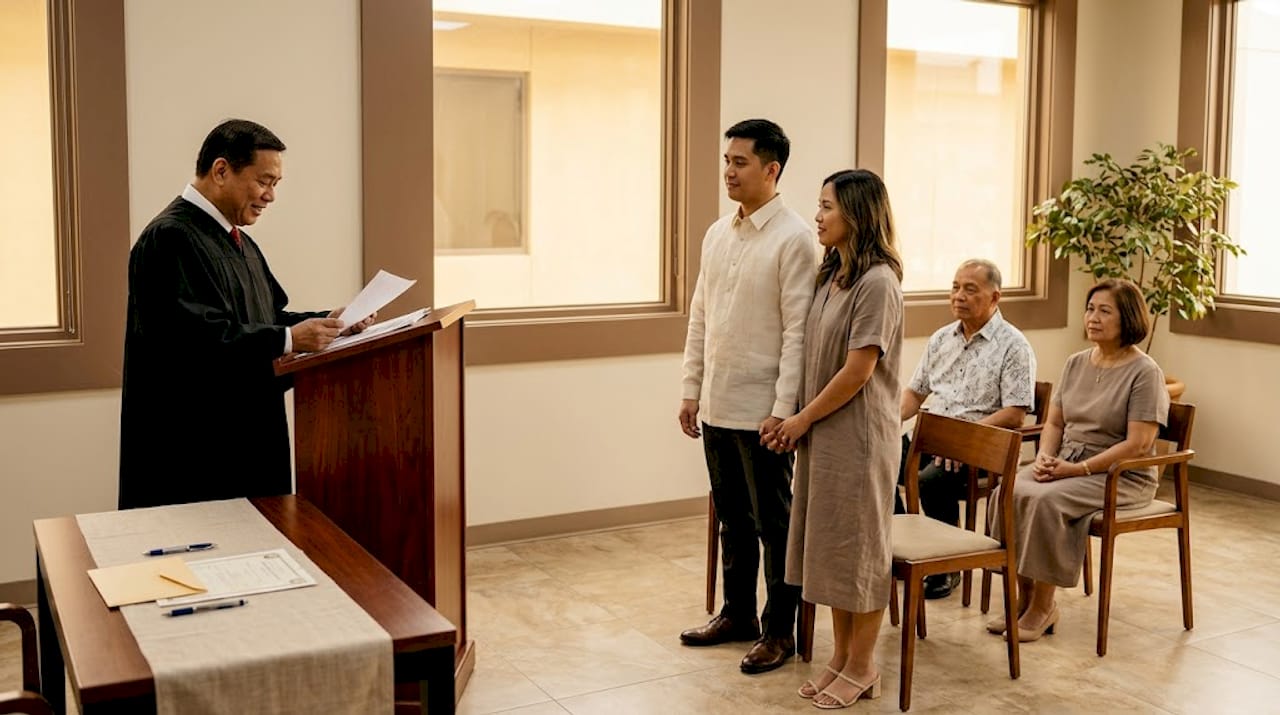
The ceremony itself is relatively brief compared to everything that led up to it. A civil wedding in the Philippines must be performed by an authorized solemnizing officer, which includes judges, mayors, or other municipal officials within their jurisdictions. The ceremony requires at least two witnesses, both of whom must be of legal age.
Here is the post-ceremony sequence:
Sign the marriage contract immediately after the ceremony. Both parties, the two witnesses, and the solemnizing officer must sign the contract on the same day.
The solemnizing officer registers the marriage. After the ceremony, the officer registers the marriage contract with the LCR within 15 days. This is a legal obligation, not optional.
The LCR forwards the record to the Philippine Statistics Authority (PSA). Once the LCR receives and processes the contract, it forwards the document to the PSA, which issues the official marriage certificate.
Request your PSA marriage certificate. After registration, you can request a PSA-authenticated copy. This typically takes four to six weeks after the ceremony for the record to become available in the PSA database.
Have the certificate authenticated for use abroad. If you need your Philippine marriage recognized in the UAE, the PSA marriage certificate will need to go through apostille or authentication at the DFA (Department of Foreign Affairs).
Understanding the importance of marriage registration is especially critical for expats. An unregistered or unauthenticated marriage creates problems with spousal visas, joint property rights, and family-related legal matters in the UAE. Getting the marriage certificate process in the UAE right from the start avoids expensive legal complications later.
Pro Tip: If your ceremony takes place in the Philippines but you live in the UAE, you will also need to file a Report of Marriage at the Philippine Consulate. This guide to reporting a marriage abroad explains the specific steps for UAE-based Filipinos.
Why couples underestimate civil weddings in the Philippines
Now that we have covered the process, let’s challenge some popular perceptions and share insights often missed by guides.
Here is the honest truth we have seen over and over again: couples treat civil weddings like a shortcut. They assume that because there is no church, no elaborate religious ceremony, and no years-long annulment process involved, things will just fall into place. They book flights, tell family to gather, and then realize four days before the ceremony that a document is missing or that the LCR posting period has not even started yet.
The label “civil wedding” creates a false sense of simplicity. Civil weddings are indeed simpler and cheaper than religious ones, but they are not loose. The documentation requirements are just as binding, and the timelines are just as firm.
For UAE-based expats, the challenges multiply. You are not just managing paperwork. You are coordinating between two countries with different bureaucratic systems, managing flight schedules that must align with a 10-day posting period, and hoping that embassy appointment slots are available when you need them. One delay in getting your Certificate of Legal Capacity from your embassy in Dubai can push your entire timeline back by three weeks.
The most common mistakes we see are: applying at the wrong LCR (you must apply in the area where you or your partner actually resides), forgetting to get documents apostilled before traveling, not allowing time for the Report of Marriage filing after returning to the UAE, and underestimating how long PSA documents take to reach them by mail.
What actually works is simple: verify every single requirement directly with the LCR you plan to use, because local offices sometimes have additional requirements. Start the embassy steps at least six weeks out. And treat the 10-day posting period as your minimum, not your entire timeline. Build a buffer of at least five additional days for unexpected delays.
When you understand the process deeply, the marrying abroad pitfalls become avoidable. The couples who glide through a civil wedding in the Philippines are not the ones who got lucky. They are the ones who planned meticulously and verified everything twice.
Get expert assistance for your wedding journey
Navigating Philippine civil wedding requirements from the UAE is genuinely complex, and no guide, however thorough, replaces personalized support for your specific situation.

At Harris & Charms, we work with Filipino expats, foreign nationals, and mixed-nationality couples every day to handle exactly these kinds of documentation challenges. Whether you need help coordinating your paperwork between two countries, managing embassy appointments, or processing your marriage certificate for use in the UAE, our team understands the full picture. You can explore our comprehensive marriage services to see the full range of support we offer, or simply get in touch with a quick message to tell us about your situation. We will help you figure out the clearest path forward without the guesswork.
Frequently asked questions
How long does it take to get a marriage license in the Philippines?
The marriage license application is posted for 10 days before it is issued, and once issued, it is valid for 120 days nationwide. Build in additional buffer days for document processing and LCR scheduling.
Do both parties need to be in the Philippines before a civil wedding?
At least one party typically must apply in person at the LCR, and both parties must be present at the actual ceremony for the marriage to be legally valid.
What documents do foreigners need to marry in the Philippines?
Foreigners need a Certificate of Legal Capacity, a valid passport, and proof of dissolution of any prior marriage, with all foreign-issued documents properly authenticated or apostilled.
Can I get married in the Philippines if I was previously married?
Yes, but you must provide proof of your prior marriage’s legal dissolution. Previously married individuals need a PSA-annotated certificate or court-recognized proof of divorce before a new marriage license will be issued.
Who can officiate a civil wedding in the Philippines?
Judges, mayors, and municipal officials within their respective jurisdictions are authorized to perform civil weddings in the Philippines.
Recommended
Comments