
UAE wedding ceremony guide: Legalities and real choices


TL;DR:
Choosing between civil and Islamic weddings in the UAE impacts legal recognition, process duration, and ceremony style. Civil marriages are quick and secular, mainly for non-Muslims, while Islamic marriages are mandatory for Muslims, involving religious rituals and guardianship. Proper documentation, early attestation, and understanding legal consequences are crucial for a smooth wedding experience and international recognition.
Your UAE wedding ceremony could be over in 15 minutes with minimal paperwork, or it could take weeks of document gathering and legal preparation. That gap surprises almost every couple who starts planning. Many expats assume a UAE wedding automatically means a formal religious ceremony, while others think civil marriage is a quick formality with no real legal weight. Both assumptions can lead to costly mistakes. Whether you are a non-Muslim expat, a Muslim resident, or an interfaith couple navigating unfamiliar ground, understanding your legal options from the start is the single most important step you can take.
Table of Contents
Key Takeaways
Point | Details |
Two main ceremony types | UAE offers civil (secular) and Islamic (Sharia) weddings, each with different requirements and legal effects. |
Document preparation is crucial | Missing or improperly attested documents can delay or block your wedding approval. |
Legal outcomes differ | Civil and Sharia marriages have different rules for divorce, inheritance, and recognition abroad—plan ahead. |
Ceremony experience varies | Civil weddings are fast and minimal, while Islamic ceremonies involve more steps and religious traditions. |
Expert help smooths the process | Professional guidance helps avoid pitfalls and ensures your marriage is valid in the UAE and abroad. |
Understanding UAE wedding ceremony options: Civil vs. Islamic
The UAE offers two primary pathways to a legally recognized marriage: civil and Islamic (Sharia). Each operates under a completely different legal framework, serves a different population, and carries distinct long-term consequences. Choosing without fully understanding the difference is where many couples go wrong.
Civil marriage is secular, relatively fast, and designed primarily for non-Muslim expatriates. It does not involve religious rituals. Civil marriages in UAE are available primarily for non-Muslims under Federal Decree Law No. 41 of 2022, which was a landmark reform that created a modern, neutral legal framework for resident foreigners. This was a major shift. Before this law, many non-Muslim couples had to rely on their home country’s embassy or consulate to formalize their union in the UAE.
Islamic (Sharia) marriage is mandatory for all Muslims, including UAE nationals and Muslim expatriates. It is conducted by a licensed religious official called a Ma’athoun and follows Islamic law on everything from the marriage contract (Aqd al-Nikah) to the role of a guardian (Wali) for the bride.
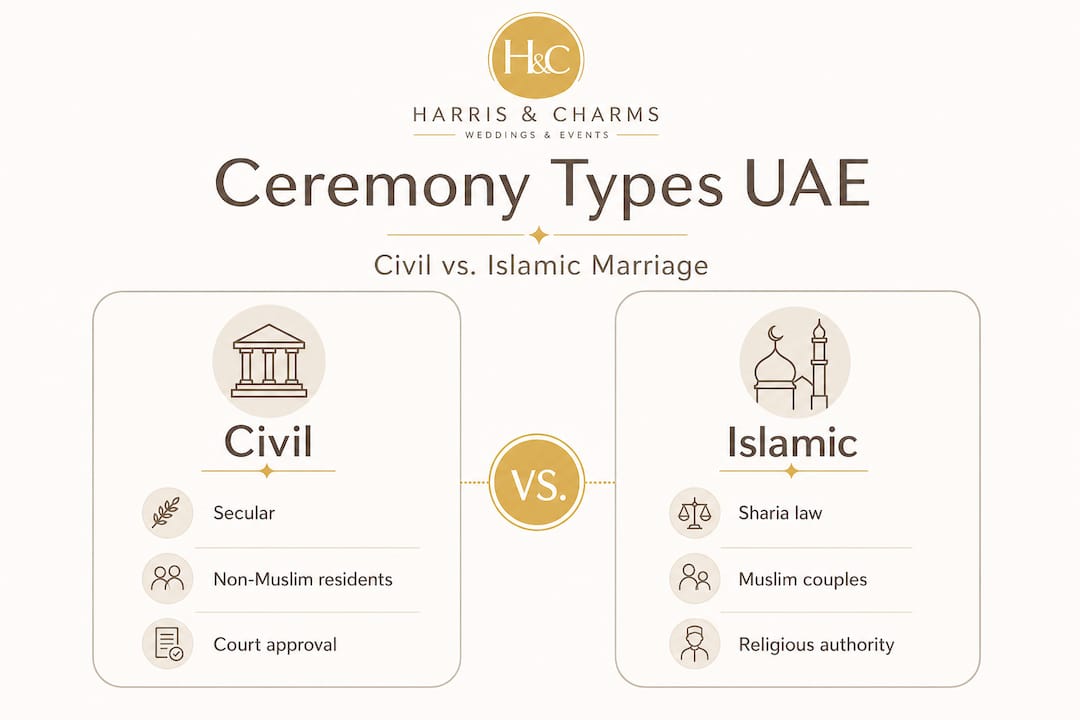
Here is how the two compare side by side:
Feature | Civil marriage | Islamic (Sharia) marriage |
Who it applies to | Non-Muslims (primarily) | Muslims (mandatory) |
Legal authority | UAE Courts | Sharia Court / Ma’athoun |
Guardian (Wali) required | No | Yes (for the bride) |
Witnesses required | No (new rules) | Yes (two male witnesses) |
Religious rituals | None | Yes |
Processing time | 1 to 10 days | Varies, typically 1 to 4 weeks |
Primary governing law | Federal Decree Law No. 41 of 2022 | Islamic law |
One important edge case: Muslim expats can opt for civil marriage in Abu Dhabi under specific conditions, although the standard route for Muslims remains Sharia. Interfaith marriage follows specific rules too: a Muslim man may marry a Christian or Jewish woman, but a Muslim woman cannot legally marry a non-Muslim man in the UAE without conversion.
“Your ceremony type is not just a wedding day decision. It is a legal framework you will live inside for years.”
Understanding the civil vs. Islamic marriage differences early gives you and your partner the clarity to plan everything else around a solid foundation. If you are uncertain about which category applies to you, reviewing the non-Muslim marriage legal process is a smart first move.
Document and eligibility checklist for civil and Islamic weddings
After choosing your preferred ceremony type, the next hurdle is proving your eligibility and getting your paperwork right. This is where the process becomes very granular, and where delays most commonly happen. Missing even one document can push your date back by weeks.
For a civil wedding in Dubai or Abu Dhabi:
Valid passport (both parties)
UAE residence visa (at least one partner must be a UAE resident)
Proof of marital status (divorce certificate or death certificate of former spouse, if applicable)
Age verification showing both parties are 21 or older
Application submitted through the Dubai Courts portal or Abu Dhabi Family Court
Dubai civil marriage for non-Muslims requires at least one UAE resident, a minimum age of 21, and proof of current marital status submitted through the designated court portal. It is worth noting that the age requirement is stricter here than in many home countries, so younger couples should factor that into their planning.
For an Islamic (Sharia) wedding:
Valid passports for both parties
UAE residence visas
Birth certificates (translated into Arabic)
Medical fitness certificate (blood test for genetic compatibility)
Proof of marital status (officially attested)
Guardian (Wali) consent documentation for the bride
Two male witnesses
All foreign documents for Sharia marriage must be translated into Arabic and legally attested. Attestation means your documents are verified at multiple levels: notarized in your home country, authenticated by the UAE embassy there, and then attested again by the UAE Ministry of Foreign Affairs. This chain of verification is non-negotiable.
Pro Tip: Start the attestation process at least 8 to 12 weeks before your intended wedding date. Embassies in some countries work on very slow timelines, and any error in the chain means starting over from that step.
Common reasons applications get delayed or rejected include missing birth certificate translations, expired medical certificates (they are usually valid for only 3 months), and guardianship documentation that does not meet the Sharia Court’s specific format requirements.
The marriage attestation process is detailed and varies based on your home country, so research it specific to your nationality. For a clear overview of the full journey, the legal marriage steps for expats and the Muslim court marriage guide are both practical starting points.
The ceremony experience: From process to personalization
Once documents and eligibility are confirmed, it’s time to envision how your wedding day will feel and run in real time. The contrast between civil and Islamic ceremonies is striking, and knowing what to expect eliminates the anxiety that comes from uncertainty.
Civil ceremony experience:
Abu Dhabi’s Civil Family Court offers two service tiers: an express option for AED 2,500 processed in one business day, and a standard option for AED 300 that takes up to 10 days
The ceremony itself lasts 15 to 30 minutes, with pre-recorded vows available in multiple languages
No witnesses or guardian are required under the current rules
The atmosphere is formal but efficient, similar to a government office proceeding
Islamic ceremony experience:
The Aqd al-Nikah (marriage contract) is recited by a licensed Ma’athoun
The bride’s Wali (guardian, typically her father or a male relative) must be physically present or legally represented
Two male witnesses must be present and sign the marriage contract
The Mahr (a gift from groom to bride, mandated by Islamic law) must be agreed upon and documented
Religious supplications and blessings are a standard part of the ceremony
Both ceremony types are legally valid in the UAE, but the personal experience is completely different. A civil ceremony is clinical and quick. An Islamic ceremony carries spiritual weight, family tradition, and religious ritual.
Pro Tip: If you want a more personal touch on a civil ceremony day, nothing stops you from celebrating with a separate reception event that includes décor, speeches, and catering. Many couples do both: the legal ceremony in the morning, a private celebration in the evening.

For couples considering the express route, see the full breakdown of civil marriage steps in Abu Dhabi to understand exactly what happens from arrival to exit.
Legal effects, aftercare, and cross-border recognition
Finishing your ceremony is just the beginning. Here’s what these choices mean for your life, rights, and travel plans going forward.
Civil marriage legal effects:
Governed by a neutral, secular framework
Designed to offer equal rights to both parties
Allows no-fault divorce proceedings in UAE courts
Property and financial settlements follow civil law principles
Islamic marriage legal effects:
Maintenance (Nafaqah) is the husband’s financial obligation
Inheritance follows Islamic law (Fara’id), which allocates specific shares
Divorce proceedings (Talaq or Khul’) are governed by Sharia principles
Child custody default rules differ from civil law
Civil offers equal rights and no-fault divorce options, while Sharia marriage enforces maintenance and inheritance per Islamic rules. Choosing based on your future legal preferences, not just your ceremony day, is critical.
“Your marriage certificate is a legal document that will be tested by banks, immigration authorities, and courts. Make sure it is ready for that test.”
After your ceremony, these are the practical aftercare steps you should not skip:
Obtain your official marriage certificate from the court (Arabic original)
Have it attested by the UAE Ministry of Foreign Affairs
Get an official translation if your home country requires English or another language
Update your residency status or family visa if applicable
Inform your employer, bank, and insurance provider of your new marital status
Cross-border recognition is a real concern, especially for couples who plan to relocate or need to use their marriage certificate for visa applications in third countries. Most countries require attested documentation for international recognition, and some specifically require an Apostille stamp if the UAE has bilateral agreements with that country.
If you are still unsure which legal path suits your long-term life plans, the guide on choosing the right legal option lays out the decision framework clearly.
What most guides miss: Matching legal choices with your wedding vision
Here is the honest talk that most informational articles skip. The legal ceremony type you choose is not just a bureaucratic checkbox. It shapes your wedding experience, your family dynamics, and your legal life in ways that a five-minute decision can lock in for decades.
We have seen couples rush toward the express civil option because it sounds effortless, only to discover that their home country does not recognize UAE civil marriages without additional attestation steps that they did not budget time or money for. That “15-minute wedding” turns into a months-long post-ceremony paperwork scramble. Speed is attractive, but it requires planning.
We have also seen the opposite. Couples who assumed civil marriage was “just for tourists” dismissed it without understanding that it could actually serve them better as long-term UAE residents, especially in cases where families are from different religious backgrounds or where future residency applications require a neutral legal certificate.
The family conversation is one couples consistently underestimate. For Islamic marriages, the Wali’s documentation requirements mean you need to involve the bride’s family well before any official date is set. Missing a signature or discovering that a guardian is abroad just days before your ceremony can derail everything. Involve both families early, communicate the specific documentation needs, and get written confirmations.
For guidance on navigating the family and legal coordination together, the Abu Dhabi marriage step-by-step advice is one of the most practical resources available.
One final insight worth carrying into your planning: the peace of mind that comes from choosing the right ceremony type, not just the fastest or cheapest one, is something couples feel on their wedding day and every legal encounter afterward.
How Harris N Charms helps you navigate UAE wedding ceremonies
Now that you know what’s possible, here’s how experienced professionals can make your wedding journey effortless.

Planning a UAE wedding involves legal research, document gathering, translation, attestation, and ceremony logistics, all running in parallel. At Harris & Charms, we handle every piece of that process for you. From confirming your eligibility and preparing your paperwork to coordinating your ceremony and organizing your celebration, we offer tailored support for both civil marriage packages and Islamic ceremonies. Whether you need a fully managed documentation service or a personalized event experience, our team works alongside you at every step. Explore our complete range of full wedding services and reach out to us to start your personalized consultation today.
Frequently asked questions
Can non-Muslims get married in the UAE without converting?
Yes, non-Muslims can marry through civil wedding ceremonies in the UAE without any religious conversion requirement under Federal Decree Law No. 41 of 2022.
How long does a UAE civil wedding ceremony take?
A civil ceremony at Abu Dhabi Family Court lasts 15 to 30 minutes, and an express service option processes your application in as little as one business day for AED 2,500.
What documents must be attested for an Islamic marriage?
All foreign documents for Sharia marriage including birth certificates and proof of marital status must be officially translated into Arabic and legally attested through your home country and UAE authorities.
Will my UAE marriage certificate be recognized internationally?
Most countries require your UAE marriage certificate attested by the Ministry of Foreign Affairs before recognizing it, and some require an additional Apostille or embassy legalization step.
Is parental consent required for a civil marriage in Dubai?
No, civil ceremonies in Abu Dhabi do not require witnesses or guardian consent for non-Muslims under the current legal framework, making the process considerably simpler for eligible couples.
Recommended
Comments