
Document Legalization Process for UAE Marriages: Essential Guide by Harris & Charms


Many couples assume their marriage certificate is ready to use the moment they leave the ceremony. In the UAE, that assumption can cost you weeks of delays, rejected applications, or worse, a document that no government office will accept. The process must follow a strict sequence, and skipping even one step invalidates the entire chain. Whether you married in Dubai, Abu Dhabi, or abroad, this guide walks you through every official requirement, explains the terminology, and helps you avoid the most common and costly mistakes.
Table of Contents
Key Takeaways
Point | Details |
Legalization is mandatory | Marriage certificates must be legalized for official recognition in the UAE or abroad. |
Follow the sequence | Skipping any attestation or legalization step can cause costly delays or rejections. |
Preparation avoids problems | Common mistakes like mismatched names or missing translations are the biggest reasons for rejection. |
Professional help reduces stress | Using service agencies or PROs can save time and ensure your process is error-free. |
Timelines can vary widely | UAE-linked attestation often takes days, while complex foreign cases may require weeks. |
What document legalization means in the UAE
Legalization, attestation, and notarization are three terms that get mixed up constantly, and that confusion leads to real problems. Let’s separate them clearly.
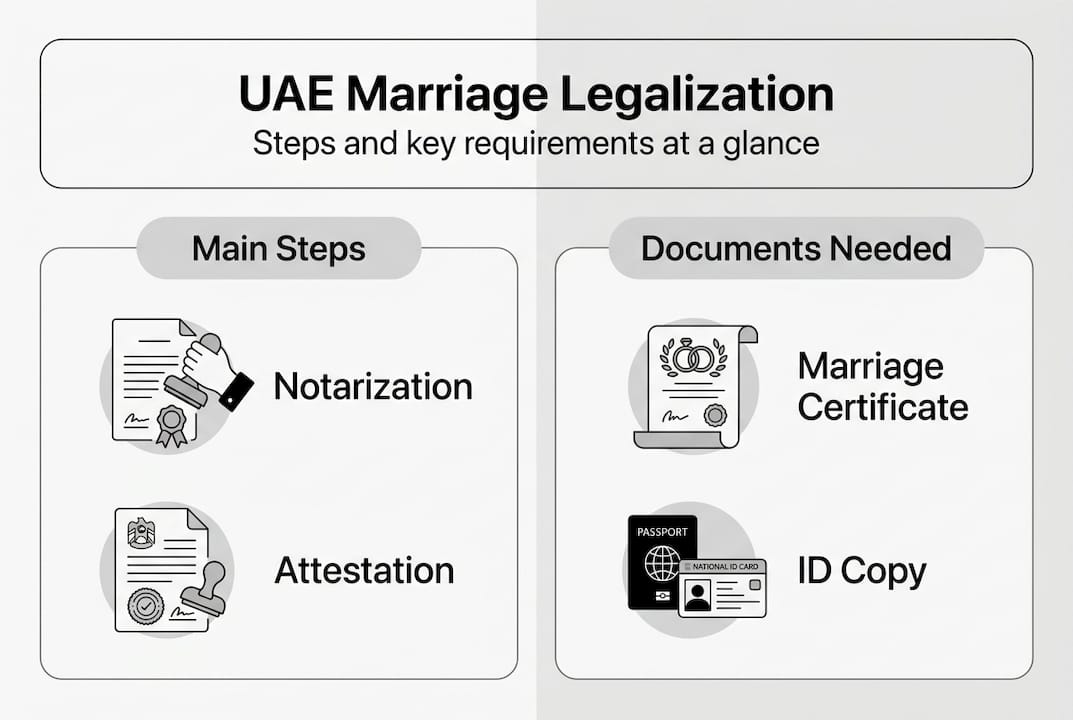
Legalization is the broader process that makes a document officially valid for use in another country. Attestation is the UAE-specific chain of verifying and stamping documents through a sequence of authorities. Notarization is a separate, preliminary step where a notary public certifies the authenticity of a document, and it is often required before attestation can even begin.
The UAE’s requirements are stricter than most countries. You are not dealing with a single stamp from one office. You are working through a layered system involving multiple government bodies, and the role of a marriage certificate in this system is central to everything from visa applications to property ownership.
Important: The attestation chain for marriage certificates in the UAE is sequential. Each authority verifies the stamp of the previous one. A missing link means the entire document is rejected, not just that step.
Understanding the difference between legalization and notarization is the first practical step before you submit anything. Legalization ensures your marriage is recognized by legal and government bodies both inside the UAE and internationally.
UAE marriage types and when legalization is required
Not every marriage certificate goes through the same process. The type of marriage you had, and where it took place, determines exactly what legalization steps apply to you.
Civil marriages in Abu Dhabi are available to non-Muslim expats and foreign nationals, and they come with their own certificate and legalization requirements. Islamic marriages follow a different registration path through the relevant religious authority. Foreign marriages, meaning those conducted outside the UAE, require the most extensive legalization chain before they are recognized here.

Here is a quick comparison to help you identify your situation:
Marriage type | Conducted in | Legalization needed for UAE use | Legalization needed for international use |
Civil (Abu Dhabi) | UAE | Basic attestation | Full MOFAIC legalization |
Islamic | UAE | Basic attestation | Full MOFAIC legalization |
Foreign (any religion) | Outside UAE | Full chain from home country | Full chain plus MOFAIC |
Expat Muslim | UAE | Basic attestation | Full MOFAIC legalization |
Key scenarios to know:
Non-Muslim expats can marry civilly in Abu Dhabi and receive a recognized certificate.
Muslim expats can also opt for civil marriage in the UAE, but UAE nationals cannot.
UAE nationals must follow Islamic marriage registration procedures.
For any international or legal use, full legalization through MOFAIC (Ministry of Foreign Affairs and International Cooperation) is mandatory, regardless of marriage type.
Choosing the right path from the start matters. Read more about choosing the right type of marriage certificate and the full civil marriage application guide before you begin.
Step-by-step legalization process for marriage documents
The exact steps depend on whether your certificate was issued inside or outside the UAE. Here is how each path works.
For foreign-issued marriage certificates:
Notarization in the country of issue (if required by that country).
Home country Ministry of Foreign Affairs attestation.
UAE embassy in the issuing country stamps the document.
UAE MOFAIC (Ministry of Foreign Affairs and International Cooperation) final attestation inside the UAE.
For UAE-issued marriage certificates:
Ministry of Justice attestation (if applicable to your document type).
UAE MOFAIC final attestation for international use.
The UAE MOFAIC attestation process is now handled online through UAE Pass. You submit your application, upload prior attestations, pay the AED 150 fee, and typically receive your attested document within 1 to 3 working days. For UAE-issued marriage certificates, the process starts with the Ministry of Justice if needed, then moves to MOFAIC for international recognition.
Here is a summary of fees and timelines:
Step | Fee | Processing time |
MOFAIC attestation (standard) | AED 150 | 1 to 3 working days |
Civil marriage certificate (Abu Dhabi, standard) | AED 300 | Varies |
Civil marriage certificate (Abu Dhabi, express) | AED 2,500 | Faster turnaround |
Full foreign legalization chain | Varies by country | 7 to 15 days, up to 8 weeks |
For a detailed breakdown of Dubai attestation steps, or to understand the full UAE certificate legalizing guide, those resources cover emirate-specific nuances. You can also find guidance on getting your UAE certificate if you have not yet obtained the original.
Pro Tip: Use a typing center or a professional PRO (Public Relations Officer) service to prepare and submit your documents. Even a small formatting error in your online application can trigger a rejection and restart the clock entirely.
Common challenges and mistakes: Avoiding rejection or delays
Rejections are more common than most couples expect, and the reasons are almost always avoidable.
Name mismatches and damaged documents are the top causes of outright rejection. If your passport spells your name differently than your marriage certificate, even by one letter, the document will not pass. Physical damage, torn edges, faded seals, or smudged stamps also trigger automatic rejection.
Here are the most frequent pitfalls:
Spelling errors between your certificate and your passport or Emirates ID.
Untranslated documents: Any certificate not in English or Arabic must be translated to Arabic by a certified legal translator before submission.
Out-of-sequence attestation: Submitting to MOFAIC before completing the home country chain is one of the most common and costly mistakes.
Non-Hague countries: If your home country is not part of the Hague Apostille Convention, the full legalization chain applies and can take up to 8 weeks.
Assuming domestic use skips steps: Even for UAE-based legal matters, incomplete attestation can cause problems.
Understanding the legal marriage steps for expats and the full legal UAE marriage guide helps you map out exactly what applies to your nationality and situation. The difference between legalization and notarization also becomes critical here, since confusing the two leads to submitting incomplete chains.
Pro Tip: Before you mail or upload anything to MOFAIC, lay every document side by side and check that every name, date, and seal matches perfectly across all of them.
Practical tips for a smooth marriage document legalization
Knowing the process is one thing. Executing it without stress is another. These steps will help you stay organized and avoid the delays that catch most couples off guard.
Build a document checklist early. List every certificate, translation, and notarization you need before you start. Do not rely on memory.
Confirm the sequence before you submit anything. Every authority in the chain must stamp in order. Strict sequence compliance is non-negotiable, and using a PRO or typing center significantly reduces the risk of errors.
Use experienced attestation professionals. For expats especially, a PRO service or attestation agency that knows the UAE system saves time and prevents the kind of delays from errors that routinely exceed official processing times.
Add buffer time for non-Hague countries. If your home country requires the full legalization chain, plan for up to 8 weeks. Do not schedule visa applications or property transactions around an optimistic timeline.
Inspect every document physically. Check for damaged seals, faded ink, torn corners, or any physical defect before mailing originals or uploading scans.
Start early, not after the wedding. Legalization is not a quick errand. Treating it as an afterthought is the single biggest mistake couples make.
For more structured guidance, the step-by-step registration tips and the civil marriage requirements guide are practical starting points depending on your marriage type.
Need help with UAE marriage document legalization?
Legalization paperwork is detailed, sequential, and unforgiving of small errors. For couples managing jobs, relocations, or tight timelines, handling it alone adds unnecessary stress to what should be an exciting time.

At Harris & Charms, we work with couples every day who came to us after a rejection or a delay they did not see coming. Our team understands the full legalization chain for both civil and Islamic marriages, and we handle the process so you do not have to second-guess every step. Explore our full range of marriage services in UAE or speak to our consultants directly to get started with a clear, personalized plan for your documents.
Frequently asked questions
How long does marriage certificate legalization in the UAE take?
UAE MOFAIC attestation typically takes 1 to 3 working days, but a complete foreign legalization chain can take 7 to 15 working days or up to 8 weeks for complex cases involving non-Hague countries.
What documents must be translated for UAE marriage certificate attestation?
Any certificate not already in English or Arabic must be translated into Arabic by a certified legal translator before it will be accepted for UAE attestation.
Can UAE nationals have civil marriages and are they recognized?
Civil marriage in the UAE is available to non-Muslim expats and foreign nationals, but it is not permitted for UAE nationals, who must follow Islamic marriage registration procedures.
Do I need to get my marriage certificate attested if I only need it inside the UAE?
For most domestic uses, basic attestation is sufficient, but any official international or government purpose requires full MOFAIC legalization regardless of where the marriage took place.
What is the cost of legalizing a marriage certificate in the UAE?
The standard MOFAIC attestation fee is AED 150, while civil marriage certificates in Abu Dhabi cost AED 300 for standard processing and AED 2,500 for express service, with additional fees depending on your specific chain of authorities.
Recommended
Comments