
Marriage Apostille UAE: Why It Matters for Expats


For many Canadian, American, British, and other expatriates preparing for marriage in the UAE, sorting legal marriage documents is a challenge with real consequences. Whether your wedding is civil or Islamic, apostille authentication is now the recognized path for validating marriage certificates since the UAE joined the Hague Convention in 2022. Getting this step right means smoother visa approvals, stress-free bank dealings, and hassle-free government recognition for your union. This guide gives you clear answers on what apostille means, why it matters, and how to safeguard your rights as a foreign national in the UAE.
Table of Contents
Key Takeaways
Point | Details |
Apostille Definition | An apostille is a certificate that verifies the authenticity of documents like marriage certificates for use within the UAE. |
Importance of Apostille | Obtaining an apostille ensures your marriage certificate is immediately recognized by UAE authorities, avoiding delays and complications. |
Hague Convention Impact | The UAE’s adoption of the Hague Convention standardizes the apostille process, making it easier for expats to authenticate documents. |
Steps for Apostille | Expats should ensure proper notarization and authentication processes are followed to avoid common pitfalls in document submissions. |
What Is Marriage Apostille in UAE?
An apostille is a certificate of authenticity issued by an authorized government official that verifies the signature, seal, and official capacity of the person who signed a document. Think of it as an official stamp of approval that confirms your marriage certificate is genuine and legally recognized. The UAE adopted the Hague Convention of 1961 in 2022, which means apostilles became the standard method for authenticating documents like marriage certificates for use within the country. Before this adoption, expats had to go through more complex attestation processes. Now, the apostille streamlines everything, making it easier for your marriage documents to be recognized by UAE authorities without unnecessary delays or complications.
What makes an apostille different from other forms of authentication is its universal recognition. Countries that are part of the Hague Convention accept apostilles without requiring additional verification steps. The apostille certifies three critical elements: the authenticity of your document’s signature, the official capacity of the person who signed it, and any seals or stamps attached to it. For marriage certificates, this means when you present your document to UAE government agencies, banks, employers, or immigration officials, they immediately recognize it as legitimate. You won’t face the frustration of being told your paperwork isn’t valid or having to provide extra documentation to prove your marriage is real.
However, understanding the difference between an apostille and marriage attestation through UAE authorities is crucial for expats. While an apostille authenticates your document in its country of origin, UAE Ministry of Foreign Affairs (MOFA) attestation confirms that your foreign marriage certificate is recognized within the UAE legal system. For documents originating from non-Hague countries, MOFA attestation remains the critical step to ensure your marriage certificate holds legal weight in the UAE. Some documents may require both processes to ensure complete recognition across different contexts and institutions.
The practical value of having a proper apostille cannot be overstated. Whether you are sponsoring a spouse for a visa, opening a joint bank account, registering property, or establishing legal rights in inheritance matters, your marriage certificate needs this authentication. Without it, you face potential rejection from government departments, financial institutions, and employers. The apostille eliminates these obstacles and protects your legal interests as an expat building a life in the UAE.
Here’s how apostille and embassy attestation compare for marriage certificates in the UAE:
Feature | Apostille (Hague Countries) | Embassy Attestation (Non-Hague) |
Processing Time | 1–7 business days | 3–8 weeks or longer |
Countries Covered | Hague Convention members | Non-Hague Convention countries |
Additional UAE Steps Needed | Usually only MOFA attestation | MOFA and embassy required |
Cost Range | Moderate (AED 150–300) | Higher (multiple fees, $50–$400+) |
Legal Recognition in UAE | Immediate upon completion | Only after full attestation |
Pro tip: Request your apostille from the authority that issued your original marriage certificate in your home country before traveling to or immediately upon arriving in the UAE, as processing times vary by country and can take anywhere from a few days to several weeks.
Types of Marriage Certificates Apostilled
Not all marriage certificates are created equal, and the type you need to apostille depends on where your marriage took place and what you plan to use it for in the UAE. Government-issued original marriage certificates are the most common documents that require apostille. These are the official certificates issued by civil authorities in your home country after your marriage was registered. If you have a certified copy instead of the original, that document also qualifies for apostille, though some jurisdictions may have specific requirements about which copies can be certified. The apostille process works the same way regardless of whether you are submitting the original or a certified duplicate.
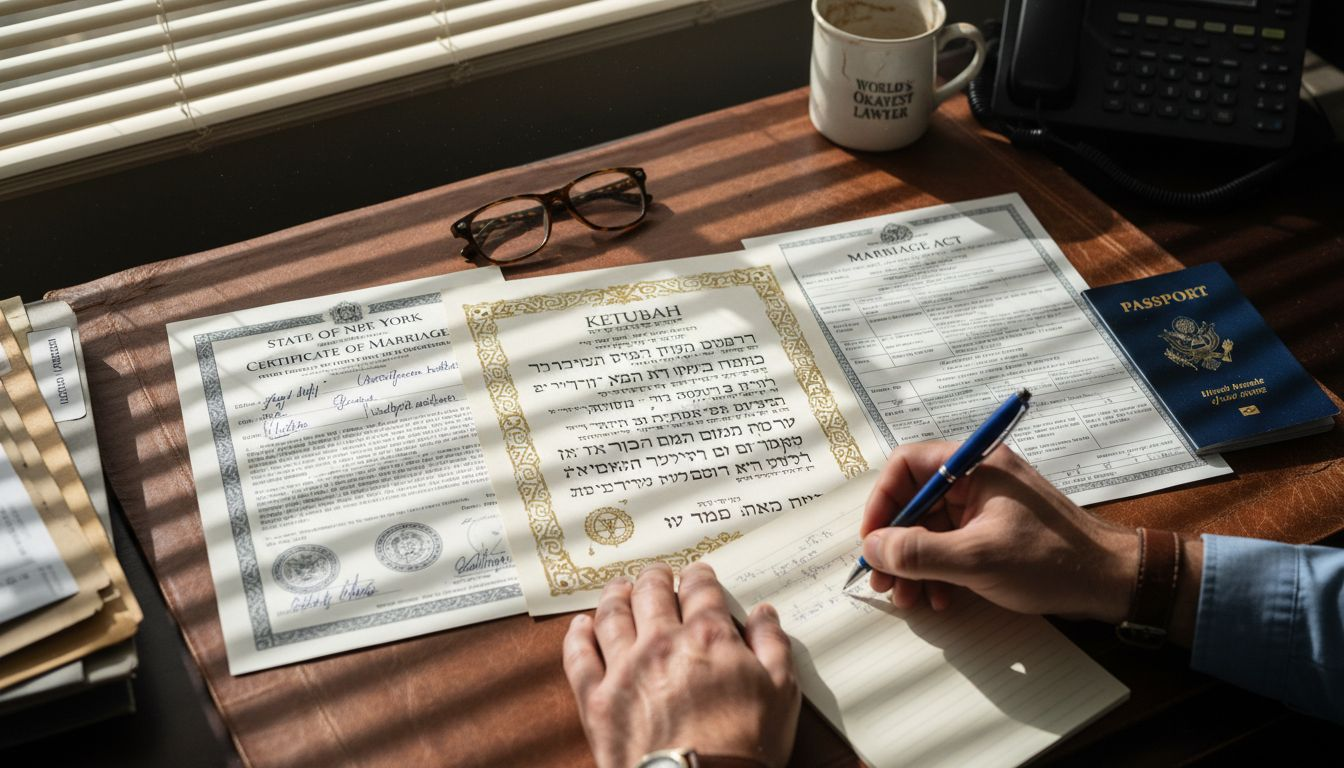
Religious marriage certificates present a different scenario that many expats encounter. If your marriage was performed according to Islamic, Christian, Jewish, or other religious traditions and that certificate is recognized by your home country’s authorities, it can be apostilled. The key requirement is that the religious institution or authority issuing the certificate must be officially recognized by your government. This matters because the apostille only verifies documents that have official standing in their country of origin. Some countries recognize religious marriages with full legal status, while others require both a religious ceremony and a civil registration. Understanding your home country’s rules prevents delays when you attempt to apostille your certificate.
Translation requirements add another layer to consider. Marriage certificates requiring translation to Arabic or English for UAE legal processing typically need apostille on the original document first, then the translated version may require separate authentication depending on the translator’s credentials. Many expats discover too late that they need both the apostille on the original certificate and additional attestation on the translation. The sequence matters: always apostille your original certificate before having it translated, not after. This ensures the UAE authorities recognize both your original document and any translated version you submit for official purposes like visa sponsorships or property transactions.
Understanding the different types of marriage certificates UAE couples need helps you determine exactly which documents require apostille. Whether your certificate is from a civil registry, religious institution, or a country that recognizes both equally, the apostille process authenticates that specific document as genuine. Some jurisdictions may also require endorsements from local government offices or ministries before the apostille can be applied, so checking with the issuing authority in your home country prevents unnecessary back and forth.
Pro tip: Before requesting an apostille, contact the specific government agency or religious institution that issued your marriage certificate to confirm whether your document type requires any pre-apostille endorsements or translations, as this varies significantly by country and can save you weeks of processing delays.
Legal Steps and Required Documentation
The process of getting your marriage certificate apostilled involves multiple steps, each designed to verify your document’s authenticity at different levels of government authority. Start by obtaining a notarized copy of your original marriage certificate from the civil authority that issued it in your home country. This notarization confirms that the copy matches the original. Next, you need to submit this notarized certificate to your home country’s Ministry of Foreign Affairs or equivalent government body for authentication. This step verifies that the notary’s signature and seal are legitimate. The authentication confirms the document is genuine before it ever reaches UAE authorities. Without this step, your apostille request will be rejected.
Once your home country completes its authentication, you must obtain attestation from the UAE Embassy or Consulate operating in your home country. This embassy attestation confirms that your document has been properly authenticated by your home country’s Ministry of Foreign Affairs. This step bridges the gap between your home country’s legal system and the UAE’s requirements. After receiving the embassy attestation, bring your document to the UAE Ministry of Foreign Affairs (MOFA) for final attestation. MOFA verifies all previous authentications and officially recognizes your marriage certificate for use within the UAE legal system. You can submit documents online through MOFA’s official portal or visit designated service centers in person.
The required documentation package includes your original marriage certificate, any certified copies you plan to use, valid identification documents, and translations into Arabic if your certificate is in another language. Understanding UAE marriage document requirements helps you gather everything needed before starting the attestation process. Keep copies of receipts and reference numbers from each stage, as you may need to prove completion of previous steps when moving forward. Processing times vary depending on your home country’s efficiency and MOFA’s current workload, but typically range from two to six weeks total. Some countries process faster than others, so confirm timelines with your home country’s Ministry of Foreign Affairs before submitting.
One critical detail many expats overlook: the document must meet specific formatting and condition standards. It cannot be damaged, altered, or have missing information. Pages must be clean and legible. If your certificate has any issues, contact the issuing authority about obtaining a replacement before attempting apostille. Also, confirm whether you need the apostille for your specific purpose, as some UAE institutions accept documents with only embassy attestation, while others require full MOFA attestation. Knowing this prevents unnecessary steps and delays.
Pro tip: Submit your apostille application online through MOFA’s portal if available, as it reduces processing time and provides you with a tracking reference number that allows you to monitor progress without making in-person visits.
Processing Costs, Timelines, and Common Issues
Processing timelines vary significantly depending on where your marriage certificate originated and whether your home country is a Hague Convention member. If your certificate comes from a Hague Convention country, expect apostille processing to take 1 to 7 business days once you submit to the appropriate authority. However, if your home country is not part of the Hague Convention, you are looking at a much longer timeline because your document must go through embassy attestation instead, which involves notarization, Ministry of Foreign Affairs approval, and embassy legalization. This multi-step process can stretch from three to eight weeks or longer depending on how efficiently your home country’s government processes documents. Planning ahead is critical because unexpected delays can derail visa applications, property purchases, or other time-sensitive matters.
Costs break down across multiple stages and can add up quickly if you are not strategic. UAE Ministry of Foreign Affairs attestation typically costs between AED 150 to AED 300 depending on the document type and whether you use expedited services. Embassy attestation fees vary widely by country and can range from USD 50 to USD 300 or more. If your home country is not a Hague Convention member, you will also pay for notarization, which usually costs USD 20 to USD 100. Translation services add another expense if your certificate needs Arabic versions, typically costing USD 30 to USD 150 depending on translator credentials. Using professional attestation services can simplify the process but increases costs significantly, sometimes doubling your total expenses. Budget accordingly and compare costs between handling it yourself and using a service provider.
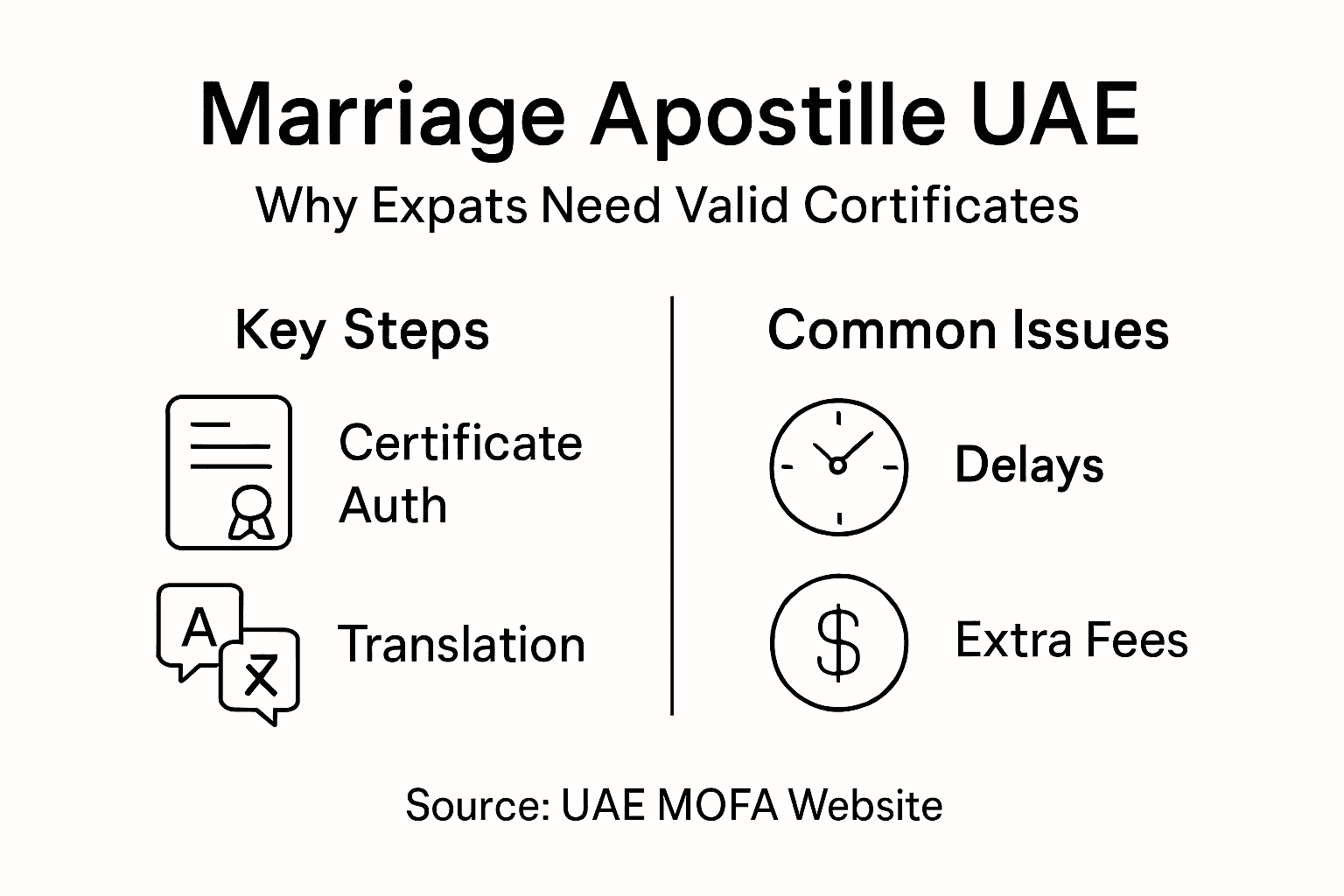
Common issues create unnecessary delays when expats do not understand the requirements upfront. Incomplete documentation is the number one reason applications get rejected. Missing notarization, forgotten translations, or invalid identification documents all send your application back to square one. Expats from non-Hague countries often discover too late that apostilles alone will not work and they need embassy attestation instead, requiring them to restart the entire process. Incorrectly completed paperwork with missing signatures, incomplete dates, or unclear information causes rejections. Coordination problems between countries also happen when documents are lost in transit or when one government office does not communicate properly with another. The confusion between apostille and embassy attestation methods leads many expats to submit their documents to the wrong authority, wasting weeks waiting for the wrong process to complete.
Anticipate these issues by confirming your home country’s Hague Convention status before starting any application. Verify exactly which documents your specific institution in the UAE requires, as not all require full attestation. Double check every form for completeness before submission. Keep detailed records of everything you submit, including photos of documents and confirmation receipts. Consider whether professional assistance makes sense for your situation, especially if your home country has complicated procedures or slow processing times.
Here’s a quick reference for common issues and ways to avoid them:
Issue | Typical Cause | How to Prevent |
Application Rejection | Missing notarization or ID | Double-check requirements |
Long Delays | Submitting to wrong authority | Confirm process with officials |
Translation Problems | Uncertified translators used | Hire certified translation only |
Document Damage | Old or illegible certificate | Replace before starting process |
Lost Documents | Poor tracking by authorities | Keep copies and submission proof |
Pro tip: Request expedited or rush processing from MOFA if your timeline is tight, as it typically costs an additional AED 100 to AED 150 but reduces processing from 7 business days to 1 to 2 business days, potentially saving you significant time if you have an urgent deadline.
Legal Validity, Risks, and Alternatives
Legal validity of your marriage certificate in the UAE depends entirely on proper attestation or apostille matching UAE government requirements. If your certificate originates from a Hague Convention member country, an apostille carries full legal weight and is recognized by UAE authorities without requiring additional steps. However, the UAE still maintains rigorous attestation processes for documents from non-member countries to guard against fraud and forgery. This means your document must pass through multiple validation layers before it becomes legally valid for official processes like visa sponsorships, property registration, or court proceedings. Submitting an improperly attested document creates serious complications that can derail your plans for months.
The risks of using invalid or improperly attested documents extend far beyond simple delays. Your visa application can be rejected outright, leaving you unable to sponsor your spouse or family members. Banks may refuse to open joint accounts or process loan applications. Property transactions can fall through if your ownership rights cannot be verified. Courts may refuse to hear cases involving your marriage if your certificate lacks proper authentication. In extreme cases, improper documentation can lead to legal disputes about the validity of your marriage itself within the UAE system. These consequences highlight why cutting corners on attestation is never worth the risk. One rejected application costs far less than months of legal battles or visa rejections.
If standard apostille or embassy attestation seems too complicated or time consuming for your situation, alternatives exist that can streamline the process. Registered attestation agencies and specialized notarization services understand both UAE requirements and your home country’s procedures, allowing them to navigate the system efficiently. These services cost more upfront but eliminate the confusion and back and forth between government offices. Seeking guidance directly from UAE Ministry of Foreign Affairs or certified attestation centers ensures you are following correct procedures and using the right document version. Some embassies also offer expedited processing or premium services that bypass standard queues. Harris and Charms offers professional assistance with marriage document attestation, helping expats avoid common pitfalls and ensuring their documents meet all UAE legal requirements.
Choosing the right approach depends on your timeline, budget, and comfort level with bureaucratic processes. If you have several months and enjoy managing paperwork, handling attestation yourself saves money. If your timeline is tight or your home country has complicated procedures, professional assistance becomes a worthwhile investment. Either way, confirm your home country’s Hague Convention status immediately and verify exactly which documents your specific UAE institution requires. This single step prevents most common mistakes and keeps your process moving forward.
Pro tip: Contact the specific UAE government institution or bank where you plan to use your marriage certificate before starting any attestation process, and ask them exactly which document version they require, as some accept apostilles alone while others demand MOFA attestation, saving you unnecessary steps if you get this detail right the first time.
Make Your Marriage Apostille Process Stress-Free with Harris & Charms
Navigating the complexities of marriage apostille and legal attestation in the UAE can be overwhelming, especially for expats facing different country requirements and strict timelines. You know the frustration of dealing with notarizations, embassy attestations, and Ministry of Foreign Affairs steps that demand absolute accuracy and patience. At Harris & Charms, we understand these challenges and provide a personalized, reliable solution to simplify your marriage documentation journey while preserving your peace of mind.
Take the stress out of the apostille process by partnering with experts who know exactly how to handle your specific document needs, whether from Hague Convention countries or not. Visit our main page to explore our full range of services including legal documentation assistance and wedding support designed for expats like you. Don’t wait until delays affect your visa sponsorship or property registration – reach out now to ensure your marriage certificate is recognized smoothly in the UAE. Begin your hassle-free journey today with Harris & Charms.
Frequently Asked Questions
What is a marriage apostille?
An apostille is an official certificate that authenticates the signature, seal, and official capacity of the individual who signed a marriage certificate, ensuring it is legally recognized.
How does an apostille differ from embassy attestation?
An apostille is used for documents from Hague Convention countries, offering universal recognition, while embassy attestation is required for documents from non-Hague countries, involving multiple validation steps to be recognized in the UAE.
What are the benefits of having my marriage certificate apostilled?
Having an apostille on your marriage certificate streamlines its acceptance by UAE authorities and avoids complications when dealing with government agencies, banks, and employers.
What documents are needed to obtain a marriage apostille?
You need the original marriage certificate or a certified copy, valid identification documents, and translations into Arabic if required. Additionally, you should ensure the document has been notarized and authenticated by your home country’s Ministry of Foreign Affairs.
Recommended
Comments