
Marriage registration explained: Your 2026 UAE legal guide


Marriage Registration Explained: Your wedding ceremony may feel like the moment you became married, but in the UAE, the legal reality is different. A ceremony alone—no matter how beautiful or traditional—does not create a legally recognized marriage. Official registration with UAE authorities is the only way to gain legal status, secure your rights, and ensure government recognition of your union.
Table of Contents
Key takeaways of Marriage Registration Explained
Point | Details |
Legal requirement | Marriage registration is mandatory for official recognition and protects spouses’ rights in the UAE. |
Two pathways | Civil marriages register through civil courts; Islamic marriages require Sharia court registration with wali consent. |
Essential documents | Valid passports, birth certificates, residency permits, and medical fitness certificates are required. |
Processing time | Registration typically takes 2 to 6 weeks, with fees ranging from AED 1,000 to AED 3,000 depending on emirate and marriage type. |
Legal benefits | Official registration grants inheritance rights, sponsorship privileges, and recognized legal status under UAE law. |
Foundation of marriage registration in UAE
Marriage registration is mandatory for legal recognition and protects spouses’ rights in the UAE. Without registration, you lack formal legal protections and benefits, even if you held a ceremony witnessed by hundreds of guests. The UAE government recognizes marriage only through official registration, not ceremonial vows or religious celebrations.
Both civil and Islamic marriages must complete registration procedures, though the processes differ significantly. Understanding which pathway applies to you is essential to avoid costly mistakes and delays. Many couples mistakenly assume their ceremony date is their legal marriage date, creating confusion when applying for spousal benefits or government services.
Official registration supports critical spousal rights:
Inheritance rights under UAE law
Visa sponsorship for your spouse and dependents
Child custody and guardianship recognition
Access to family health insurance and benefits
Legal standing in divorce or separation proceedings
Misunderstanding registration’s role creates serious legal risks. You may discover years later that your marriage holds no legal weight, leaving you without recourse during property disputes, medical emergencies, or custody battles.
“Registration transforms a personal commitment into a legal contract recognized by courts, government agencies, and financial institutions.”
Treating registration as optional or delaying it indefinitely jeopardizes your family’s legal security. Couples who prioritize registration early gain peace of mind and avoid scrambling to fix their status when urgency strikes.
Required documentation and process overview
Collecting proper documentation before starting registration saves weeks of frustration. Having all required documents including passports, birth certificates, and medical fitness certificates properly attested is critical to avoid registration delays.
Start with these essential documents:
Valid passports for both parties
Current UAE residency permits (if applicable)
Original birth certificates from your country of origin
Medical fitness certificates issued by approved UAE facilities
Divorce or death certificates if previously married
No objection certificate from your sponsor or employer
Pro Tip: Request multiple certified copies of your birth certificates before leaving your home country. Attestation and translation consume original documents, and replacing them from abroad takes months.
Medical fitness certificates verify freedom from communicable diseases and must come from government-approved clinics. This step takes 3 to 5 days and costs around AED 200 to AED 300 per person. Schedule these tests early, as results expire after a set period.

Documents require attestation and Arabic translation when issued in other languages. Attestation follows a chain: notarization in your home country, authentication by your foreign ministry, then verification by the UAE embassy in that country. Finally, UAE’s Ministry of Foreign Affairs stamps the documents upon arrival.
Submit your complete application with all documentation and fees to the relevant authority. Processing involves document review, possible interviews for Islamic marriages, and certificate issuance. Incomplete submissions get rejected immediately, resetting your timeline to zero.
Differences between civil and Islamic marriage registration
Civil marriages register through civil courts or government departments, while Islamic marriages require Sharia court registration with wali consent. This fundamental difference shapes every aspect of your registration journey, from paperwork to legal consequences.
Aspect | Civil Marriage | Islamic Marriage |
Registration authority | Civil courts or government departments | Sharia courts |
Wali requirement | Not required | Mandatory for bride |
Witnesses | Two witnesses | Two male witnesses or four female witnesses |
Pre-marriage counseling | Optional | Often required |
Religious restrictions | None | Both parties typically Muslim |
Islamic marriage registration requires a wali (guardian) for the bride, usually her father or closest male relative. The wali must attend the registration in person or provide notarized authorization. This requirement confuses many modern couples who view marriage as a personal choice between two adults.
Civil marriage procedures focus on legal compliance without religious elements. You complete forms, submit documents, pay fees, and receive your certificate after approval. The process resembles other government transactions, making it straightforward for expatriates familiar with bureaucratic systems.
Documentation largely overlaps between both types, but procedures and legal weight differ. Islamic marriages invoke religious law principles regarding dowry, maintenance, and divorce. Civil marriages operate entirely under secular legal frameworks, though UAE law still governs dissolution and custody.
Pro Tip: If you’re unsure which type suits your situation, consult both a civil law attorney and an Islamic law expert. Some couples choose to complete both registrations for comprehensive legal coverage and family acceptance.
Understanding these differences prevents procedural errors and legal complications. Couples confused about whether their ceremony qualifies as Islamic or civil often submit applications to the wrong authority, wasting weeks before discovering the mistake.
Timeline and fees
Marriage registration typically takes between 2 and 6 weeks, with fees ranging from AED 1,000 to AED 3,000 depending on emirate and marriage type. Processing time depends heavily on document completeness and authority workload during peak wedding seasons.
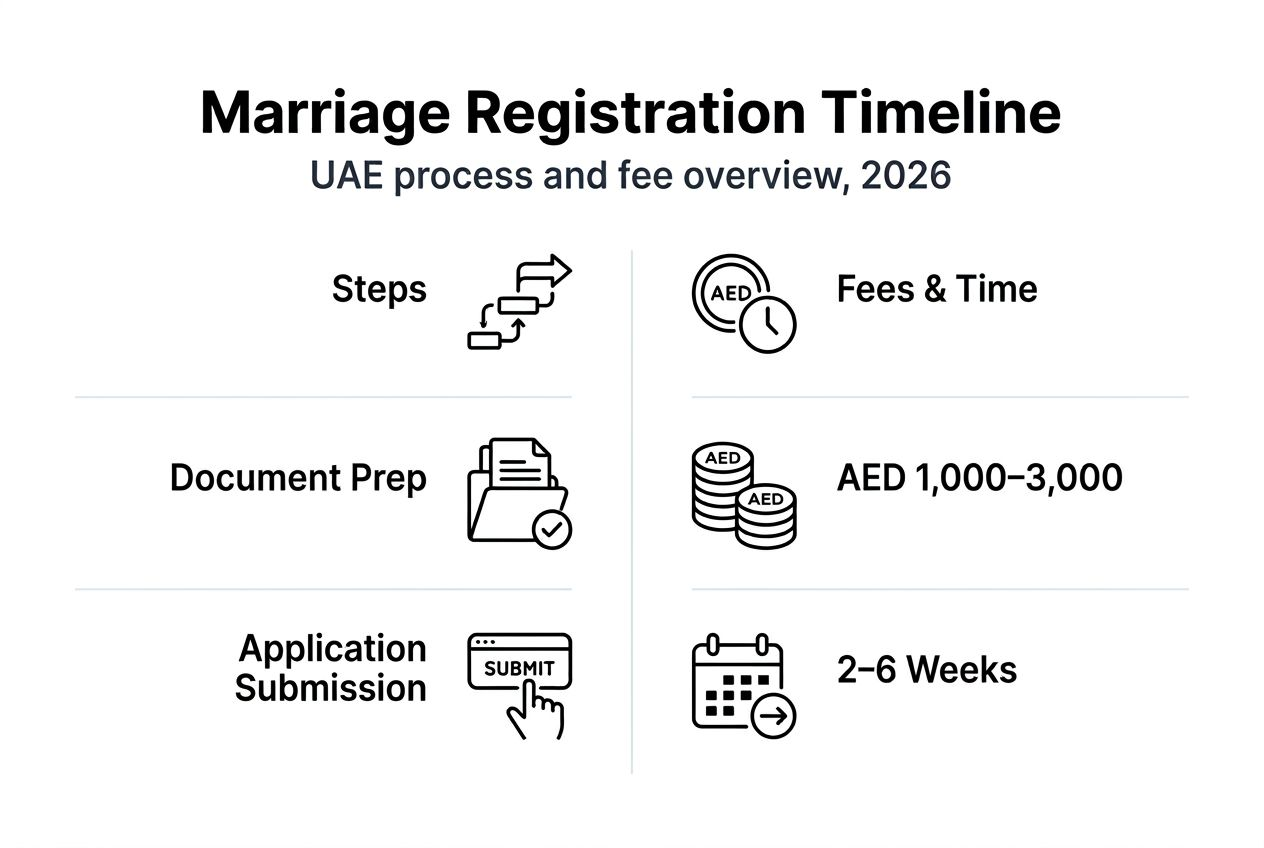
Fees vary significantly by location and marriage pathway:
Emirate | Civil Marriage Fee | Islamic Marriage Fee | Processing Time |
Dubai | AED 1,500 to AED 2,500 | AED 1,000 to AED 1,800 | 2 to 4 weeks |
Abu Dhabi | AED 2,000 to AED 3,000 | AED 1,200 to AED 2,000 | 3 to 5 weeks |
Sharjah | AED 1,200 to AED 2,000 | AED 900 to AED 1,500 | 2 to 6 weeks |
Other Emirates | AED 1,000 to AED 2,500 | AED 800 to AED 1,800 | 3 to 6 weeks |
Delays most often result from incomplete or un-attested paperwork. A single missing stamp on your birth certificate sends your application back to square one. Double-checking every requirement before submission prevents these frustrating setbacks.
Planning for 4 to 6 weeks creates realistic expectations and reduces stress. Peak periods like December through February see higher application volumes, extending processing times. Submit during off-peak months if your timeline allows flexibility.
Budgeting should include hidden costs:
Medical fitness certificates (AED 400 to AED 600 for both)
Document attestation (AED 500 to AED 2,000 depending on origin country)
Translation services (AED 100 to AED 300 per document)
Courier fees for international document shipping (AED 200 to AED 500)
These additional expenses often double your initial fee estimate. Couples who budget only for registration fees face unpleasant surprises when attestation costs arrive.
Common pitfalls and misconceptions
Confusing your ceremony date with your legal registration date is a critical mistake. Your anniversary may feel personal, but government systems recognize only your registration date for calculating benefits, visa eligibility, and legal standing.
Over 30% of delays result from submitting incomplete or incorrect documents, or misunderstanding legal requirements. Most rejections stem from avoidable errors that proper preparation eliminates.
Frequent mistakes include:
Assuming ceremony completion equals legal marriage
Submitting un-attested foreign documents
Using expired medical fitness certificates
Providing translations from non-approved translators
Missing witness requirements for Islamic marriages
Applying to the wrong authority for your marriage type
Ignoring differences between civil and Islamic marriage procedures leads to rejected applications and wasted fees. You cannot simply choose your preferred process; your religious status and nationality determine which pathway you must follow.
Rushing submission without proper document verification prolongs the process significantly. Spending an extra week organizing paperwork saves a month of resubmission cycles. Review every document against official checklists before paying fees.
Pro Tip: Create a checklist spreadsheet tracking each document’s attestation status, translation completion, and expiry date. This simple tool prevents overlooking critical steps and identifies problems before submission.
Planning ahead and consulting experts avoids these common issues entirely. Couples who invest in professional guidance complete registration faster and with less stress than those attempting to navigate requirements alone.
Legal implications and benefits
Official registration grants spouses inheritance rights, sponsorship privileges, and recognized legal status under UAE law. Legal recognition begins only when registration completes, not when you exchange vows or celebrate your union.
Registered spouses gain immediate access to:
Inheritance rights according to UAE law or religious principles
Ability to sponsor spouse for residency visa
Joint property ownership and mortgage applications
Family health insurance coverage
Custody rights over children born in the marriage
Legal standing in divorce or separation proceedings
Unregistered marriages offer no official protections or government recognition, regardless of how long you’ve lived together or how many children you share. Courts cannot enforce spousal support, property division, or custody arrangements without a registered marriage.
Registration enables lawful access to social and financial benefits reserved for married couples. Banks require marriage certificates for joint accounts and loans. Employers verify registration before extending family benefits. Schools need proof of legal marriage for dependent enrollment.
The difference becomes painfully clear during crises. Medical facilities require marriage certificates to grant spousal visitation rights or authorize treatment decisions. Without registration, you may be barred from your partner’s hospital room during emergencies.
Knowing these benefits motivates proper and timely registration. The effort invested in gathering documents and completing procedures pays dividends throughout your married life, protecting your family during both routine matters and unexpected challenges.
Special considerations for expatriates
Expatriates must ensure foreign documents are attested by their home country authorities and translated into Arabic for UAE registration. This extra layer of bureaucracy catches many expat couples off guard, extending timelines and inflating costs beyond initial estimates.
Foreign birth certificates and identity documents need attestation following a specific chain of custody. Start in your home country with notarization, proceed to your foreign ministry, then to the UAE embassy or consulate there. Finally, submit to UAE’s Ministry of Foreign Affairs upon arrival.
Arabic translations must come from approved translation services recognized by UAE courts. Google Translate or personal bilingual friends cannot substitute for certified legal translations. Each translated document requires the translator’s stamp, signature, and registration number.
Attestation delays often extend registration timelines by weeks or months:
Home country notarization: 1 to 2 weeks
Foreign ministry authentication: 2 to 4 weeks
UAE embassy verification: 1 to 3 weeks
UAE MOFA stamping: 3 to 7 days
Arabic translation: 3 to 5 days
Pro Tip: Begin attestation while still in your home country if possible. Completing early steps before moving to the UAE eliminates international shipping delays and simplifies coordination with authorities.
Expatriates should plan extra time and budget generously for attestation costs. Fees vary dramatically by country of origin, with some nations charging AED 1,000 or more per document. Factor these expenses into your wedding budget from the start.
Consult official checklists and legal experts to comply fully with requirements. Each nationality faces slightly different rules, and regulations update periodically. Professional guidance prevents costly mistakes and ensures you follow current procedures.
Make your UAE marriage registration easy and stress-free with Harris & Charms
Navigating UAE marriage registration requirements feels overwhelming when you’re simultaneously planning a wedding and managing work commitments. Harris & Charms transforms this complex process into a smooth, guided experience.

Our expert team handles civil marriage packages and Islamic marriage registration with personalized attention to your unique situation. We manage document preparation, attestation coordination, translation services, and submission to the correct authorities. Our civil wedding services in Dubai combine legal expertise with event planning support, letting you focus on celebrating while we ensure compliance.
With comprehensive marriage services covering everything from initial consultation through certificate delivery, we minimize delays and eliminate the stress of navigating unfamiliar bureaucratic systems. Contact Harris & Charms today to start your hassle-free marriage registration journey with confidence.
FAQ
What is the difference between marriage ceremony date and legal registration date in UAE?
The ceremony is cultural and symbolic; legal status begins on your official registration date only. Government agencies, banks, and courts recognize your registration date for calculating benefits, visa eligibility, and legal standing. Your ceremony date holds personal significance but carries no legal weight.
How long does it typically take to complete marriage registration in the UAE?
Registration usually takes between 2 to 6 weeks from submission to certificate issuance. Delays depend on document completeness, attestation status, and the type of marriage you’re registering. Peak wedding seasons from December through February may extend processing times by several weeks.
What documents are required to register a marriage in the UAE?
Passports, birth certificates, and residency permits are essential for both parties. Medical fitness certificates from approved UAE clinics and Arabic translations of foreign documents are required. Previously married individuals must provide divorce or death certificates, and some sponsors require no objection letters.
Are there different registration processes for Islamic and civil marriages in UAE?
Islamic marriages register at Sharia courts requiring wali consent and religious compliance. Civil marriages register through civil authorities or government departments without wali consent or religious requirements. The pathways differ significantly in procedures, documentation, and legal frameworks applied to the marriage.
Recommended
Comments