
Islamic marriage steps in the UAE: your full Nikah guide

Planning an Islamic marriage in the UAE can feel overwhelming when every source gives you a different answer. Some say you need a wali, others say it depends on your nationality. Some say register within 30 days, others say 60. The truth is, the UAE has a clear, structured process for Nikah, and missing even one step can create serious legal problems down the road. This guide walks you through every stage, from eligibility and documents to the ceremony and post-registration, so you can move forward with confidence and zero guesswork.
Table of Contents
Key Takeaways of Islamic Marriage Steps
Point | Details |
Complete legal paperwork | Gather and attest all required documents before starting the Nikah process. |
Follow court registration | Book and attend the Nikah via Sharia court to ensure legal recognition. |
Register promptly | Register your marriage within 30 days to avoid legal and residency issues. |
Understand special cases | Special rules apply for polygamy, Misyar, expats, and large age differences. |
Essential prerequisites for Islamic marriage in the UAE
Before you book any appointments, you need to confirm that both parties meet the basic Sharia and legal requirements. The UAE follows Islamic law for Muslim marriages, which means certain conditions must be satisfied for the Nikah to be valid.
Here are the core requirements:
Minimum age: Both parties must be at least 18 years old. Marriages involving anyone under 18 require special court approval.
Mutual consent: Both the bride and groom must agree freely. Forced marriages are illegal and void.
Wali (guardian): The bride must have a male guardian, typically her father or another close male relative, present or represented.
Witnesses: At least two adult Muslim male witnesses must be present during the ceremony.
Mahr (dowry): A gift from the groom to the bride, agreed upon before the ceremony, is a mandatory Sharia element.
Medical screening: Both parties must complete a mandatory medical fitness screening for communicable diseases before the marriage is approved.
The medical test is not just a formality. It checks for conditions like HIV, hepatitis, and genetic disorders that could affect the couple or future children. Results are confidential between the couple, but the certificate is required for court submission.
Comparison: Islamic vs. civil marriage basics in the UAE
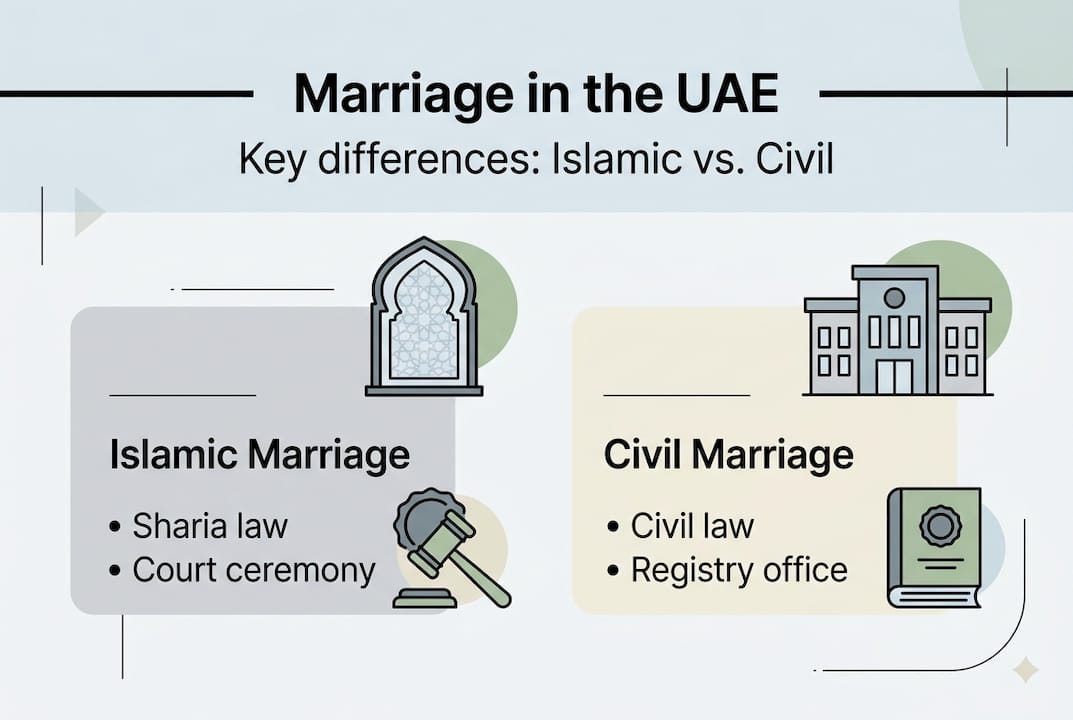
Feature | Islamic (Sharia) marriage | Civil marriage |
Governing law | Sharia courts | Civil courts (non-Muslims) |
Wali required | Yes | No |
Mahr required | Yes | No |
Medical test | Yes | Yes |
Witnesses | 2 Muslim males | 2 witnesses |
Registration | Sharia court | Civil court |
Pro Tip: If there is a large age gap (over 30 years) between the couple, or if either party is under 18, you will need prior approval from the court before proceeding. Check the full Islamic marriage requirements to avoid surprises.
For a broader overview of what the UAE officially requires, the official Sharia marriage summary is a reliable starting point. Once you’ve confirmed you meet the basic requirements, you’ll need to prepare your documents and appointments.
Preparing required documents for Nikah
Documentation is where most couples hit delays. Getting this right the first time saves weeks of back-and-forth. The exact list varies slightly by emirate, but here is what most couples need.
Standard documents for both parties:
Original passport and valid UAE visa (for expats)
Emirates ID (for UAE residents)
Birth certificate (attested if issued abroad)
Proof of single status: a certificate of no impediment or bachelor certificate, attested by the home country and UAE Ministry of Foreign Affairs
Medical fitness certificate from an approved UAE health center
Divorce or death certificate if previously married (attested)
No-objection letter from employer or sponsor in some cases
For expats and tourists, proper attestation of foreign documents is critical. A document that is not attested by both the issuing country and the UAE Ministry of Foreign Affairs will be rejected at the court.

Pro Tip: Start the attestation process at least 4 to 6 weeks before your planned Nikah date. Some countries take longer than others to process apostilles and embassy stamps. Review the full UAE marriage documents checklist to make sure nothing is missing.
Document requirements by situation:
Situation | Extra documents needed |
First marriage, both locals | Emirates ID, medical cert, family book |
Expat marrying in UAE | Attested passport, single status cert, visa |
Previously married | Attested divorce or death certificate |
Age gap over 30 years | Court approval letter |
Polygamy | Proof of financial ability, first wife’s acknowledgment |
Emirate-specific rules do exist. Dubai, Abu Dhabi, and Sharjah each have their own court portals and may require slightly different supporting documents. The court marriage process in Dubai, for example, has its own online booking system and fee structure. With all necessary documents in hand, you’re ready to set up your official ceremony.
Scheduling your Nikah: Court appointments and ceremony details
The actual Nikah ceremony in the UAE takes place at a Sharia court or through an authorized marriage officer. Here is how the process works step by step.
Create a UAE PASS account or log into the relevant emirate’s court portal.
Book your appointment online. Most courts offer slots within 1 to 2 weeks if documents are ready.
Submit documents for pre-review. Some courts allow digital submission; others require originals on the day.
Attend the ceremony with the groom, bride, wali, and two witnesses. All must bring original IDs.
Ijab and Qubul: The marriage offer (Ijab) is made by the wali or bride, and the groom accepts (Qubul). This verbal exchange, witnessed and recorded, is the legal and religious core of the Nikah.
Mahr is declared and recorded in the contract.
Sign the marriage contract. All parties sign, and the court issues a receipt.
The Nikah ceremony sequence is straightforward once everyone is present, but delays happen when a witness is missing or a document is not in order. Arrive early and bring extra copies of everything.
“The validity of a Nikah in the UAE depends on the presence of the wali, two witnesses, declared mahr, and mutual verbal consent. Missing any one of these elements can invalidate the contract.”
Pro Tip: If one party cannot attend in person, proxy or remote Nikah options exist but require special court permission in advance. This is not automatic and must be applied for separately. Review the legal steps for Nikah if your situation involves remote attendance.
Typical court fees range from AED 1,000 to AED 3,000 depending on the emirate and whether you use additional services. The court marriage rules in Dubai outline the current fee schedule clearly. After the Nikah is performed, registering your marriage is a critical step for legal protection.
Post-Nikah: Registration, certificates, and legal recognition
The Nikah ceremony alone is not enough. You must register the marriage with the Sharia court to receive a legally recognized marriage certificate. Here is how to complete that process.
Submit the signed Nikah contract to the court registry immediately after the ceremony or within the allowed window.
Pay the registration fee and receive a reference number.
Collect the official marriage certificate. This is usually ready within a few days.
Verify the certificate through the court’s online portal or official app to confirm authenticity.
Attest the certificate if you need it recognized abroad, through the UAE Ministry of Foreign Affairs.
Registration must happen within 30 days of the Nikah in most emirates. Missing this window can complicate the process significantly.
An unregistered Nikah carries serious risks. Without legal registration, the marriage has no standing in UAE courts. This means:
Divorce proceedings cannot be filed
Child custody claims become legally complicated
The wife cannot be sponsored on a residency visa
Inheritance rights may not be enforceable
These are not minor inconveniences. They are life-altering legal gaps. The difference between a Sharia court marriage and a civil court marriage matters here too. Sharia courts handle Muslim marriages and apply Islamic family law. Civil courts handle non-Muslim marriages under different rules. For Muslim couples, the Sharia court is the correct venue. Review the civil vs Islamic marriage differences if you are unsure which applies to your situation. Understanding common pitfalls and unique scenarios adds an extra layer of confidence as you complete the process.
Special cases: Polygamy, Misyar, and expat/tourist considerations
Not every marriage follows the standard path. The UAE has specific rules for several edge cases that couples need to understand before proceeding.
Polygamy is permitted under UAE law for Muslim men, but it comes with strict conditions. According to UAE marriage contract requirements, a man seeking a second marriage must:
Prove financial ability to support multiple households
Disclose the existing marriage to the new bride
Obtain court approval
Have no more than four wives at any time
Meet visa and residency criteria for sponsoring additional spouses
For more detail, the polygamy rules UAE page covers the legal framework thoroughly.
Misyar marriage is a form of Islamic marriage where the wife waives certain rights, such as shared housing or financial support. It is legally recognized in the UAE but remains controversial. The Misyar marriage UAE legal status is clear: it must still be registered at the Sharia court to have any legal standing.
“Misyar marriages that are not registered carry the same legal risks as any unregistered Nikah, including no protection in divorce or custody disputes.”
For expats and tourists, the process is largely the same but with additional paperwork. You will need attested documents from your home country, and some nationalities may need a no-objection letter from their embassy. The expat marriage guide breaks down country-specific requirements in detail.
Pro Tip: If you are a tourist planning to marry in the UAE, confirm with the court in advance whether your visa type allows marriage registration. Some visa categories require additional approvals.
Get support for a smooth Islamic marriage process
Going through the Islamic marriage process in the UAE on your own is possible, but one missed document or wrong appointment can set you back weeks. Paperwork errors, attestation gaps, and court scheduling conflicts are the most common reasons couples face delays.

At Harris & Charms, we specialize in making this process straightforward for couples at every stage, whether you are locals navigating court bookings or expats dealing with international attestations. Our team handles document verification, court appointments, and certificate processing so you can focus on your relationship, not the paperwork. Explore our Islamic wedding services or reach out directly through our contact for Nikah help page to get personalized guidance for your specific situation.
Frequently asked questions
How long does the Islamic marriage process take in the UAE?
The process typically takes 1 to 6 weeks, depending on how quickly documents are ready and court appointment slots are available.
Can expats or tourists have an Islamic marriage in the UAE?
Yes, but expats and tourists must provide fully attested documents and may face additional steps compared to UAE nationals.
Is the Nikah valid if not registered at the court?
No. An unregistered Nikah has no legal recognition in the UAE, which creates serious problems in divorce, child custody, and residency sponsorship situations.
What are the costs involved with Islamic marriage in the UAE?
Fees typically range from AED 1,000 to AED 3,000, with variation depending on the emirate and the specific services required.
Recommended
Comments