
UAE Marriage Registration Workflow: Your 2026 Guide


TL;DR:
Getting married in the UAE requires navigating multiple government portals, document attestations, and procedures tailored to religion and nationality. Proper sequence of attestation, translation, and submission is crucial to avoid delays, with all documents needing full authentication before applying online via UAE PASS. After receiving the marriage certificate, additional steps like MOFA attestation and visa applications are necessary for legal recognition and residency purposes.
Getting legally married in the UAE sounds straightforward until you realize the UAE marriage registration workflow involves multiple government portals, document authentication chains, and procedures that differ depending on your religion and nationality. Couples who skip a single step often find themselves restarting the process from scratch, sometimes weeks later. This guide breaks down every stage clearly, from the documents you need before you apply to what you do with your certificate after it arrives, so you walk into the process knowing exactly what to expect.
Table of Contents
Key takeaways
Point | Details |
Documents must be attested first | Foreign-issued documents require MOFA attestation before they are valid for UAE marriage registration. |
The process differs by religion | Muslims follow a different registration path than non-Muslims, involving different officials and contracts. |
UAE PASS is your starting point | Online applications for marriage contracts require a UAE PASS account to access government services. |
Sequence matters in attestation | Confusing attestation order with translation steps is the most common cause of registration delays. |
Your certificate needs further steps | After receiving your marriage contract, MOFA attestation is still needed for spouse visa and residency applications. |
The UAE marriage registration workflow: prerequisites and documents
Before you touch a single government portal, your paperwork needs to be in order. This is where most couples lose time, and it is almost always because they did not know what “attested” actually means in the UAE context.
Here is what you will need regardless of your religion or nationality:
Valid passports for both parties
UAE residency visas (for expats residing in the UAE)
Birth certificates, attested from the country of origin
Premarital screening certificates (a mandatory blood test conducted in the UAE)
No-objection letters from employers or sponsors, in some cases
Proof of divorce or death certificate if either party was previously married, attested accordingly
For non-Muslims, Federal Decree Law No. 41 of 2022 governs the civil marriage framework, and it gives expats a clear and legally protected path to register their union. Muslim couples follow Sharia-based procedures handled through different officials.
One requirement that catches many expats off guard is document attestation. Any document issued abroad must go through a chain of authentication before UAE authorities will accept it. That chain typically includes notarization in the home country, attestation by the home country’s Ministry of Foreign Affairs, UAE embassy attestation, and finally MOFA attestation inside the UAE.
Document | Who issues it | Attestation required? |
Passport | Home government | No |
Birth certificate | Home government | Yes, full attestation chain |
Premarital screening certificate | UAE health authority | No |
Divorce or death certificate | Home government or UAE court | Yes, full attestation chain |
No-objection letter | Employer or sponsor | No |
Both parties must also meet the legal eligibility requirements: both must be at least 18 years old, must provide free and informed consent, and must not be closely related to each other. These conditions are strictly enforced without exception.
Pro Tip: Get your attested documents apostilled or notarized at least six to eight weeks before your planned registration date. Translation into Arabic is often required after attestation, not before. Doing it in the wrong order means you may need to re-attest translated copies.
Step-by-step registration workflow
Once your documents are ready and attested, the actual registration process is more manageable than most couples expect. Here is how it works in sequence.
Create or access your UAE PASS account. UAE PASS is required to log into the Ministry of Justice portal and begin your marriage contract application. Both parties need verified accounts.
Submit your application online. Upload your attested documents through the Ministry of Justice portal. The system will prompt you for each document type depending on whether you are registering as a Muslim or non-Muslim couple.
Pay the applicable fees. Fees are paid online through the portal and vary based on service type and emirate. Credit cards and digital payment methods are accepted through the UAE PASS payment gateway.
Schedule your appointment. For Muslim couples, this step involves confirming availability with the marriage official who will conduct the ceremony. For non-Muslim couples, you schedule a meeting with the notarial judge.
Attend the ceremony or contract session. Muslims communicate with an official and conduct the marriage in accordance with Islamic proceedings. Non-Muslims meet with the notarial judge, who verifies consent and formalizes the civil contract.
Receive the electronic marriage contract. After the ceremony or signing session, the electronic marriage contract is issued through the system. You can download and print it from your UAE PASS account.
Step | Muslim couples | Non-Muslim couples |
Governing law | Sharia-based | Federal Decree Law No. 41 of 2022 |
Key official | Marriage official | Notarial judge |
Ceremony required | Yes | Contract signing session |
Contract type | Islamic marriage contract | Civil marriage contract |
Document issued | Marriage certificate | Marriage contract |
Pro Tip: Book your appointment slot as soon as your documents are approved. Peak windows around public holidays can push wait times back by two to three weeks. Morning slots tend to move faster than afternoon ones at most offices.
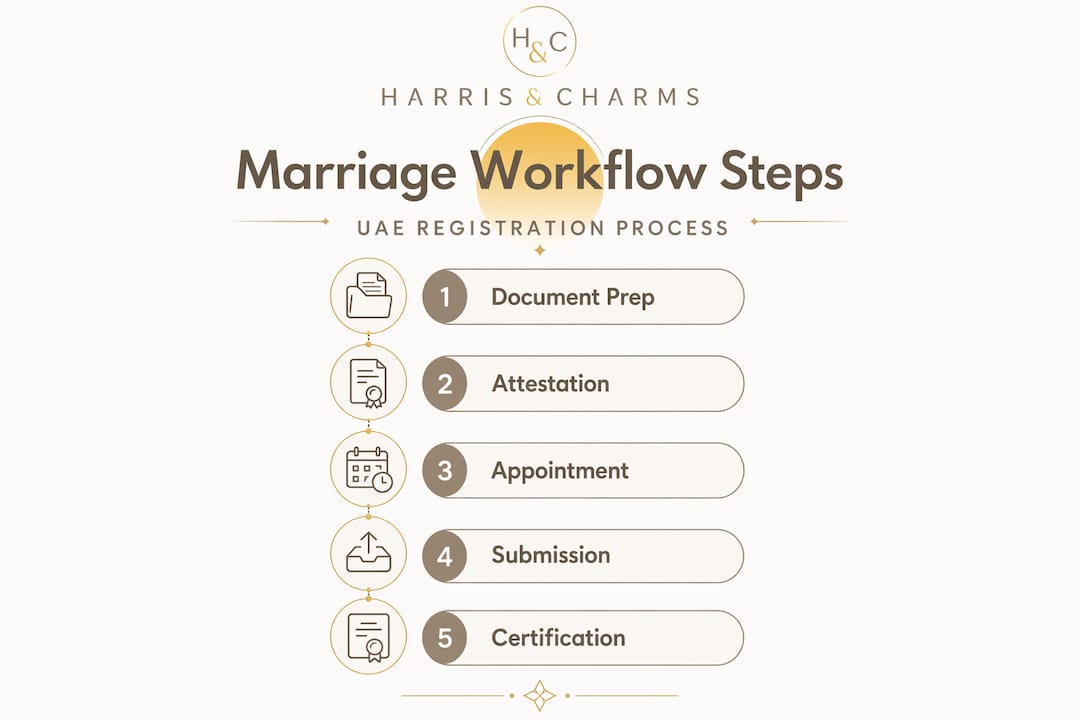
A useful starting point for understanding how the legal steps connect is reviewing what happens between document submission and certificate issuance. Knowing this prevents surprises on the day of your appointment.
Common challenges and how to handle them
Even well-prepared couples run into problems. The good news is that most issues are predictable and fixable before they derail your timeline.
Missing attestation steps. The most frequent cause of rejection is a document that skipped one link in the authentication chain. If your birth certificate was notarized at home but never sent to the UAE embassy before arriving in the UAE, it will not be accepted. Review your full attestation chain before submission.
Confusing attestation with translation. A common expat mistake is getting documents translated first and then trying to attest the translated copy. UAE authorities require attestation of the original document. Translation comes after attestation.
Residency status mismatches. If one partner is on a tourist visa or between residency statuses, the process can stall. Registering with valid residency for both parties is strongly advised before initiating the process.
Previously married applicants. If you were married before, you must provide an attested divorce decree or death certificate. A simple stamped copy from a foreign court is not enough.
The Ministry of Justice customer service center and the MOFA helpline are your two most useful contacts when a document issue comes up mid-process. Do not rely solely on information from third-party sources. Go directly to the issuing authority.
Pro Tip: If your documents originate from multiple countries because you or your partner relocated several times, make a country-by-country checklist. Each country’s documents need their own attestation chain, regardless of whether those documents are the same type.
What to do after you receive the certificate
Getting your marriage contract in hand is a milestone, not the finish line. Several important steps follow, especially if you plan to apply for a spouse visa or update legal records.
Apply for MOFA attestation of your UAE-issued contract if you need the document recognized outside the UAE. Even a UAE-issued certificate requires MOFA attestation to be valid for international use or for spouse sponsorship in some scenarios.
Initiate your spouse visa application. Your marriage contract is the foundation for sponsoring your partner for UAE residency. Submit it through the Federal Authority for Identity, Citizenship, Customs and Ports Security portal along with supporting documents.
Update family records. If either party is a UAE national, the marriage should be recorded in the family book through the relevant emirate authority.
Secure additional certified copies. The Ministry of Justice portal allows you to download your electronic contract, but many banks, embassies, and employers require a certified physical copy. Request these early.
Next step | Where to do it | Why it matters |
MOFA attestation of contract | MOFA service centers or online portal | Required for international recognition and visa processes |
Spouse visa application | ICP portal | Legal residency for your partner in the UAE |
Family book update | Emirate-level authority | Required for UAE nationals to formalize records |
Certified copy request | Ministry of Justice portal | Needed for banks, embassies, and employers |
For couples dealing with a marriage originally conducted abroad, the attestation process involves bringing foreign certificates through the full chain before any UAE authority will treat the marriage as legally recognized here.

My honest take on UAE marriage registration
I have worked with hundreds of couples navigating this process, and what I keep seeing is the same pattern. Couples come in having done their research online, they feel prepared, and then they get tripped up not by the big things but by sequence. Attestation before translation. Embassy stamp before MOFA. That ordering matters more than people realize.
What I have also noticed is that the process has become meaningfully better since Federal Decree Law No. 41 of 2022 gave non-Muslim couples a clear legal framework. Before that, many expat couples either registered abroad or struggled to find a recognized path. Today, civil marriage for non-Muslims is a defined, accessible procedure with real legal protection.
My strongest advice is this: do not treat document preparation as a box to check on a weekend. It often takes six to eight weeks when foreign documents are involved. Start that process the moment you know your wedding date. And if anything feels unclear about the attestation steps, talk to someone who has done it before rather than guessing and resubmitting.
The couples who glide through this process are the ones who treated the paperwork as seriously as the ceremony itself.
— Harris
Let Harrisandcharms handle the complexity
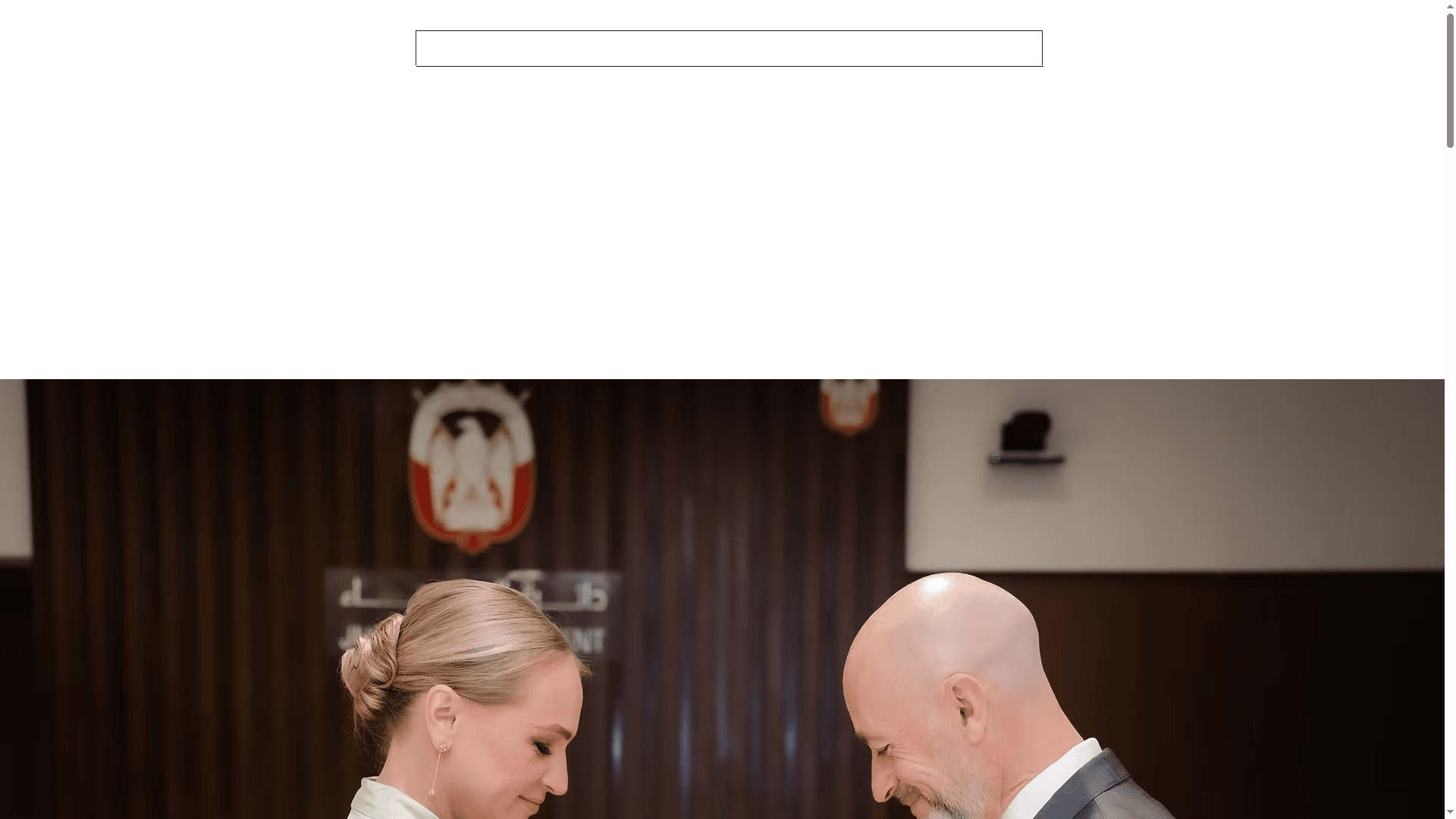
If reading through attestation chains and government portals already sounds like a full-time job, that is exactly the problem Harrisandcharms was built to solve. The team has guided expat and resident couples through the UAE marriage registration workflow dozens of times, handling documentation review, attestation coordination, and ceremony logistics so you can focus on the celebration itself.
Whether you are looking for a tailor-made experience through our civil wedding packages in Dubai or need end-to-end support including legal documentation through our marriage services in Dubai, Harrisandcharms offers 2026-ready packages built specifically for expats and UAE residents. Reach out through the contact page to start a conversation about what your registration and celebration can look like.
FAQ
What documents do I need for UAE marriage registration?
You need valid passports, UAE residency visas, birth certificates, a premarital screening certificate, and any divorce or death certificates from previous marriages. Foreign-issued documents must be fully attested before submission.
How does the process differ for Muslims and non-Muslims?
Muslim couples work with a marriage official and follow Islamic proceedings, while non-Muslim couples meet with a notarial judge for a civil contract under Federal Decree Law No. 41 of 2022. Both use the UAE PASS portal to start the application.
Do I need MOFA attestation after getting my marriage certificate?
Yes, if you plan to use the certificate for a spouse visa application, international recognition, or legal record updates. MOFA attestation is the final step that makes the document officially recognized for these purposes.
What is the most common reason for registration delays?
Missing or incorrectly sequenced document attestation causes the majority of delays. Getting documents translated before attesting the original, or skipping the UAE embassy step, are the two most frequent errors expats make.
Can I register my marriage in the UAE if one partner is on a tourist visa?
It is possible but significantly more complicated. Both parties having valid UAE residency visas makes the process much smoother. If one partner is on a short-term visa, consult with a marriage services professional before starting the application.
Recommended
Comments