
How to Choose a UAE Marriage Court: Expat Guide 2026


TL;DR:
Choosing the correct UAE marriage court depends on your religion and residency, as civil courts serve non-Muslims and Sharia courts handle Muslim marriages. Proper documentation, including attestation chains and premarital medical screening, is essential to avoid delays or rejection, especially for Islamic marriages. The civil route in Abu Dhabi offers a transparent process with internationally recognized certificates, making it the preferred choice for most expats.
Getting legally married in the UAE sounds straightforward until you realize there are multiple court systems, two entirely different legal frameworks, and eligibility rules that vary by emirate. Knowing how to choose a UAE marriage court correctly from the start saves you weeks of frustration, rejected documents, and rebooking fees. Whether you are a non-Muslim expat leaning toward Abu Dhabi’s civil family court or a Muslim couple planning an Islamic marriage through a Sharia court, the path you take depends on factors most couples do not research until it is too late.
Table of Contents
Key takeaways
Point | Details |
Court type follows religion | Non-Muslims typically use civil family courts; Muslims use Sharia courts with a Ma’zoon officiant. |
Emirate rules differ | Abu Dhabi allows civil marriage at age 18; Dubai requires age 21 with at least one Dubai resident. |
Documents need attestation | Foreign certificates require notarization, translation, and attestation before any UAE court will accept them. |
Medical screening is mandatory | Premarital screening is a legal requirement for Islamic marriages and must be completed before your court date. |
Certificates need attestation abroad | A UAE marriage certificate must be attested by MOFAIC and your home embassy for international legal recognition. |
How to choose a UAE marriage court: eligibility first
The official term courts and legal professionals use is “personal status court,” covering both civil family courts and Sharia courts operating under UAE personal status law. Understanding which system applies to you is the real starting point for choosing marriage court UAE options correctly.
Civil vs. Sharia: the core distinction
Civil family courts handle marriages for non-Muslim couples. Sharia courts handle marriages where at least one party is Muslim. This is not a preference. It is a legal distinction, and applying to the wrong court will result in rejection.
For civil marriages in Abu Dhabi, eligibility requires that both parties be at least 18 years old, give free and genuine consent, be non-Muslim, and have no close kinship relationship that would legally prohibit the marriage. Abu Dhabi was the first emirate to build a dedicated civil marriage system, and it remains the most popular route for expats because of its legal clarity and predictable processing times.
Dubai’s civil marriage route follows a slightly different standard. Dubai Courts require at least one partner to be a Dubai resident, and the minimum age is 21, not 18. If neither partner holds a Dubai residence visa, Abu Dhabi is likely your more accessible option.
Document requirements that catch couples off guard
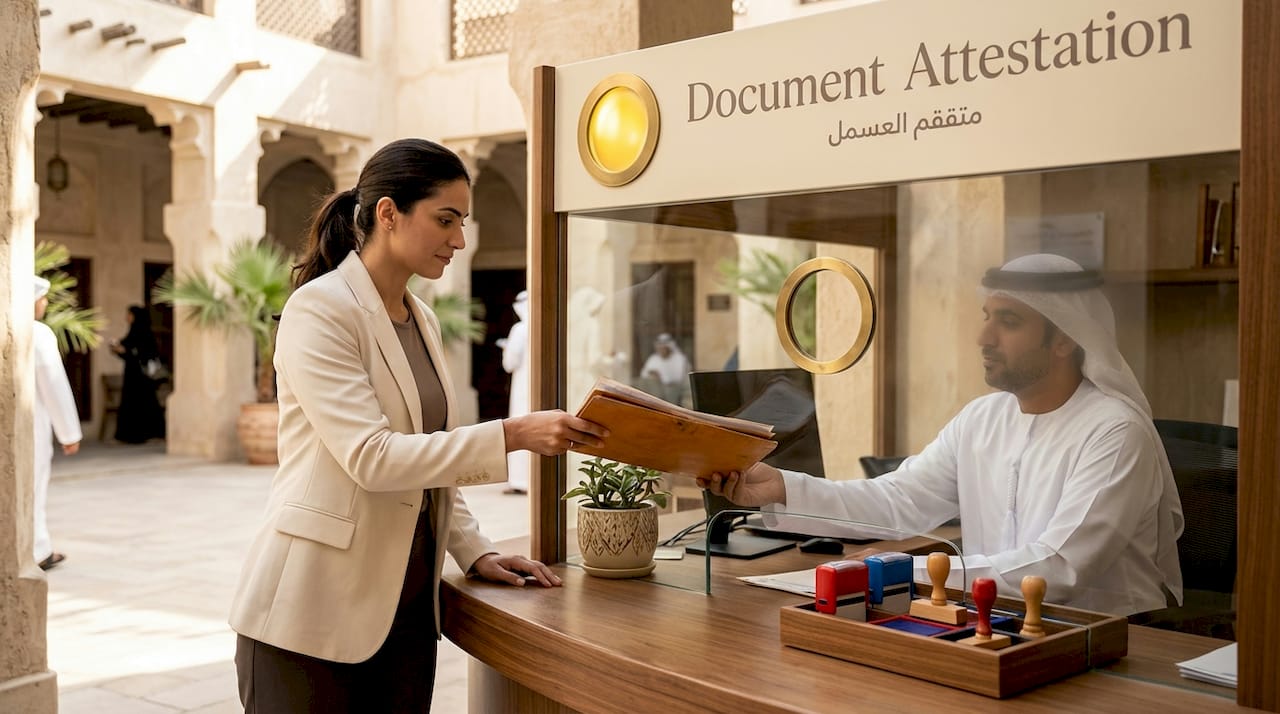
Regardless of which court system you are applying to, your foreign documents must go through a full attestation chain. This means notarization in the country of origin, attestation by that country’s Ministry of Foreign Affairs, and then attestation by the UAE embassy in that country before any document is useful here. Notarization, attestation, and legal translation are not quick steps. They can take several weeks, and you need to start before you book a court appointment.
For Islamic marriages, premarital medical screening is mandatory. The Ma’zoon (the authorized Islamic marriage registrar) cannot legally complete your marriage contract without seeing a valid screening certificate. Plan this step at least a month out.
Pro Tip: When gathering documents, request certified copies with apostilles from your home country at the same time. Ordering additional copies later adds weeks to your timeline.
The application process, step by step
Once you know which court system applies to you, the process becomes much more manageable. Here is how civil and Islamic court applications typically flow in practice.
Gather and authenticate all documents. For civil courts, you will typically need valid passports, birth certificates, proof of single status (a certificate of no impediment or equivalent), and proof of UAE residency where required. For Islamic courts, add the premarital medical screening certificate. All foreign documents need the full attestation chain described above, plus a certified Arabic translation.
Book your appointment. Abu Dhabi’s civil family court appointments can be booked through the Abu Dhabi Judicial Department’s online portal. Sharia courts in most emirates also offer online booking. Do not show up without an appointment. Walk-in availability is extremely limited.
Attend in person. Both parties must appear personally at the court. For civil marriages, you both sign the marriage contract in front of a court officer. For Islamic marriages, the Ma’zoon presides over the contract signing, and two male witnesses are required under Sharia rules.
Pay the applicable fees. Abu Dhabi civil marriage fees start at AED 300 for regular processing (up to 10 working days) and AED 2,500 for express processing (as fast as one working day). Islamic court fees vary by emirate but are generally lower.
Receive your marriage certificate. After the registration is complete, the court issues an official marriage certificate. Keep multiple certified copies. You will need them for visa applications, name changes, and future legal processes.
Pro Tip: If you are a tourist rather than a UAE resident, Abu Dhabi’s civil court can still register your marriage if one partner has a valid UAE entry stamp. Check the expat marriage options available to visitors before assuming you need residency.
Common pitfalls and how to avoid them
Choosing the wrong court or submitting incomplete paperwork are the two most common reasons couples face delays. Here is what to watch for.
Incomplete attestation chains. A document notarized in your home country but not attested by the UAE embassy there will be rejected. Courts do not accept partial attestation.
Expired medical screening certificates. For Islamic court marriages, the premarital screening certificate has a validity window. Scheduling your screening too early means it may expire before your court date.
Wrong court for your religion status. A non-Muslim applying to a Sharia court, or a Muslim applying to a civil family court, will have the application rejected. This delays the process significantly.
Misinformation about eligibility. UAE courts take false declarations seriously. A 2026 Abu Dhabi case resulted in imprisonment and a Dh5 million fine for providing false information related to marriage legality. This is not a formality. Accuracy matters.
“Medical screening certificates are gating criteria that can stall Islamic court registration, so plan this step early to avoid delays.” — HHS Lawyers
If your application stalls, contact the court registry directly rather than waiting. Courts will usually tell you exactly what is missing, and you can resubmit without losing your place in the queue entirely.
Certificate validity and international recognition
Getting married is only half the process. Making your certificate usable, whether for a spouse visa, international residency application, or legal name change back home, requires additional steps that many couples overlook.
Use case | Required attestation steps | Who handles it |
Use within UAE | No extra attestation needed | Court issues directly |
Spouse or family visa in UAE | Copy submitted to UAE immigration | GDRFA or ICP |
Use in home country | MOFAIC attestation + home embassy attestation | Couple arranges independently |
Use in third country | MOFAIC attestation + relevant embassy attestation | Couple arranges independently |
Golden Visa application | Attested copy submitted with residency application | Relevant UAE authority |
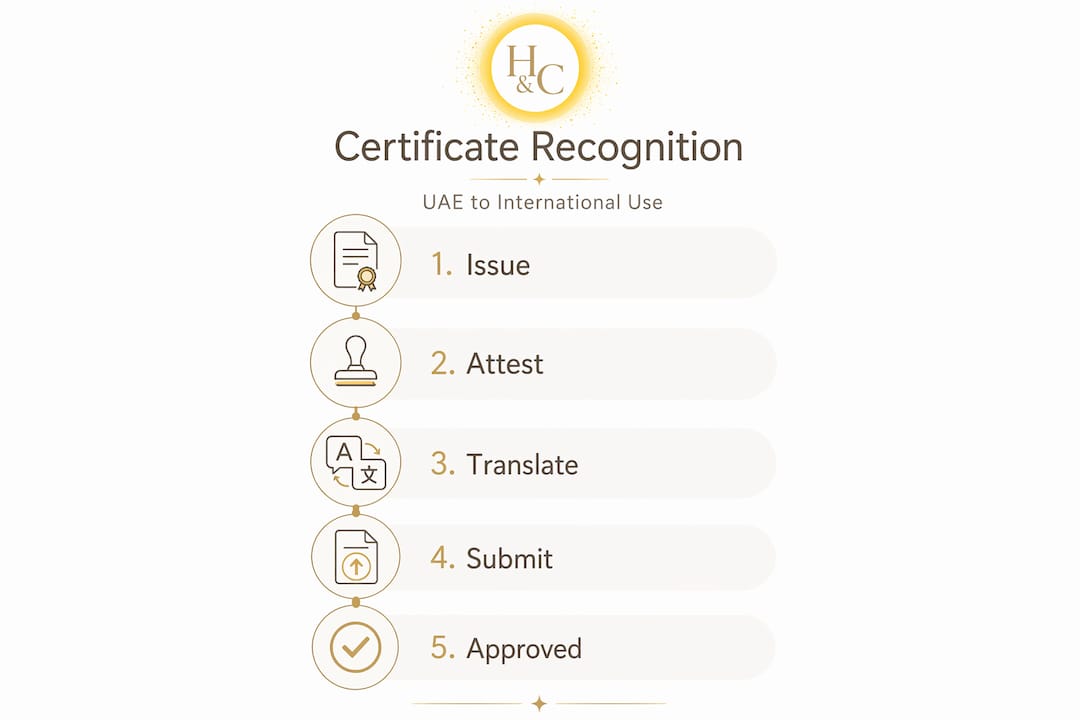
Abu Dhabi Civil Family Court certificates are legally recognized across all UAE emirates and internationally, once they have gone through the Ministry of Foreign Affairs and International Cooperation (MOFAIC) attestation process. Islamic court certificates follow the same attestation pathway for international use, though some countries may have additional requirements around translated copies.
For couples holding or applying for a UAE Golden Visa, marriage registration is directly tied to your eligibility to sponsor a spouse. The certificate must be properly attested before it can be submitted as supporting documentation. If you are planning marriage registration specifically in connection with Golden Visa sponsorship, review the court marriage legal guide to understand which documents need to be in order before you apply for residency.
The civil route generally produces cleaner documentation for international use. Islamic marriage certificates are equally valid, but some countries request additional religious court verification, which adds a step for couples using those certificates abroad.
My honest take on choosing the right court
I have seen hundreds of couples go through this process, and the single biggest mistake people make is treating court selection as a checklist item rather than a strategic decision. You are not just picking a venue. You are choosing a legal framework that affects your visa, your taxes, your inheritance rights, and your ability to use that certificate in every country you might live in.
For most non-Muslim expats, Abu Dhabi’s civil court is the clearest path. The eligibility rules are well-defined, the processing fees are transparent, and the certificate holds up internationally without complications. Dubai’s civil option is excellent if you have the residency requirement covered, but the higher age minimum catches some younger couples off guard.
What I have learned from working with couples at Harrisandcharms is that document preparation is where people consistently underestimate the timeline. Most couples assume two to three weeks. The reality, especially for nationals from countries with slower apostille or foreign ministry processes, is often six weeks or more. Starting documents the same week you decide to get married is not overly cautious. It is the right call.
On the Islamic court side, the Ma’zoon process is actually quite personal and well-organized in most emirates. The complication is almost always the medical screening certificate. Plan that appointment early, and the rest of the process tends to go smoothly.
My honest advice? If you are an expat without a strong preference for a religious ceremony, go civil, go Abu Dhabi, and get your documents moving before you book any dates. If you are looking for guidance specific to your nationality and situation, a brief consultation saves far more time than trying to piece together regulations from three different sources.
— Harris
Let Harrisandcharms handle the complexity for you
Planning a marriage in the UAE involves more moving parts than most couples expect, from court selection and document attestation to appointment booking and certificate processing. Harrisandcharms was built specifically for this.

Whether you are planning a civil marriage in Abu Dhabi, an Islamic ceremony through a Sharia court, or something that combines both legal registration and a full celebration, the team at Harrisandcharms covers it all. Their civil and Islamic marriage packages include document preparation support, court liaison, attestation coordination, and personalized planning for residents and tourists alike. Reach out through the Harrisandcharms contact page to get a clear plan built around your timeline and circumstances.
FAQ
What is the difference between a civil and Sharia marriage court in the UAE?
Civil family courts handle non-Muslim marriages under civil personal status law, while Sharia courts handle marriages where at least one party is Muslim. The documents, fees, and witnesses required differ between the two systems.
Can tourists get married in a UAE civil court?
Yes. Abu Dhabi’s civil family court can register marriages for non-resident couples if the eligibility criteria are met, including age requirements and proper document attestation. Check current entry and residency conditions before applying.
How long does UAE civil marriage registration take?
Abu Dhabi civil marriage processing takes between one and ten working days depending on whether you choose standard (AED 300) or express (AED 2,500) processing.
Is premarital medical screening required for all UAE marriages?
Premarital medical screening is legally mandatory for Islamic marriages and must be presented to the Ma’zoon before the marriage contract can be executed. It is not currently required for civil court marriages.
How do I get my UAE marriage certificate recognized abroad?
You need to obtain MOFAIC attestation on your certificate first, then have it attested by your home country’s embassy in the UAE. Some countries may also require a certified Arabic-to-English translation from a licensed translator.
Recommended
Comments