
Filipino Civil Wedding: A Complete Guide for UAE Couples

TL;DR:
Planning a Filipino civil wedding from the UAE requires careful coordination of documents, legal requirements, and ceremony options.
The process involves securing a valid marriage license within 120 days, choosing an authorized officiant, and understanding cultural considerations.
Planning a filipino civil wedding from the UAE is one of those situations where the logistics can easily overshadow the romance. You are dealing with two governments, a stack of documents that need authentication, a marriage license with a ticking clock, and cultural expectations from both your family in the Philippines and your life here in the UAE. Most couples get tripped up not because the process is impossible, but because nobody gave them a clear picture of how all the pieces fit together. This guide does exactly that.
Table of Contents
Key Takeaways
Point | Details |
Marriage license validity | Your Philippine marriage license is valid for only 120 days from issuance, so time your ceremony carefully. |
Documents needed | PSA birth certificates, CENOMAR, valid IDs, and pre-marriage counseling certificates are non-negotiable. |
Officiant authority matters | Marrying before an unauthorized person makes your marriage legally void under Philippine Family Code Art. 7. |
UAE-based embassy option | Filipino couples in the UAE can arrange a civil wedding through the Philippine Embassy in Dubai. |
Cost comparison | A civil wedding ceremony costs roughly ₱5,000 to ₱10,000, compared to ₱50,000 or more for a traditional religious wedding. |
Filipino civil wedding requirements you need to know first
The legal foundation of any Filipino civil wedding rests on the Philippine Family Code, specifically Executive Order 209. Under this law, a valid marriage requires a marriage license, a duly authorized solemnizing officer, the free consent of both parties who are at least 18 years old, and two adult witnesses present at the ceremony. Get any of these wrong and you risk a marriage that is void from the start.
Here is the full document checklist you will need when applying at the Local Civil Registrar (LCR):
PSA birth certificates for both parties (processing takes 5 to 10 business days through the Philippine Statistics Authority)
CENOMAR (Certificate of No Marriage Record), also from PSA, confirming neither party is currently married
Valid government-issued IDs for both applicants
Pre-marriage counseling certificate from a licensed counselor, family planning instructor, or parish-recognized program
Community Tax Certificates (Cedula)
Barangay clearances in some LCR offices
Age matters significantly here. Applicants aged 18 to 20 must have written parental consent. Applicants aged 21 to 24 need parental advice. If you are in that 21 to 24 bracket and your parents refuse to give written advice, the LCR will impose a mandatory three-month waiting period before issuing the license. Many couples miss this distinction entirely and show up at the registrar confused about why they are being delayed.
After you submit your documents, the LCR posts a notice of your application for 10 days to allow any objections. Once cleared, the license is issued. From that issuance date, you have 120 days to hold your ceremony. The clock does not start at application. It starts the moment the license is officially issued.
For couples where one partner is a foreign national, passport and proof of legal stay plus a Certificate of Legal Capacity to Marry from their embassy are also required. This is a detail that catches many Filipino-foreigner couples completely off guard.
Pro Tip: Request multiple certified copies of your PSA documents before traveling or shipping them. Authentication processes can damage or delay original submissions, and having backups saves weeks of backtracking.
There are limited exemptions to the marriage license requirement. These include couples who have lived together as husband and wife for at least five years with no legal impediment during that entire period, as well as Muslim or indigenous customary marriages. These exemptions are narrow and heavily documented, so do not assume you qualify without consulting a civil registrar directly.
Ceremony options and what they actually cost
Who can legally solemnize your Filipino civil ceremony is not optional information. Under Article 7 of the Philippine Family Code, officiants without authority render the marriage void. Your options are judges of courts, mayors, priests or ministers of registered religious organizations, ship captains in specific circumstances, and military commanders under certain conditions. For a purely civil ceremony, judges and mayors are the standard choice.
Here is a comparison of your main options:
Officiant type | Venue | Typical cost | Best for |
City hall judge or mayor | City/municipal hall | ₱500 to ₱3,000 | Budget-conscious couples |
Private licensed officer | Any agreed venue | Up to ₱30,000 | Couples wanting venue flexibility |
Philippine Embassy consul | Embassy premises (Dubai) | Consular fee applies | UAE-based couples |
Municipal mayor (remote town) | Town hall | ₱500 to ₱1,500 | Quick, low-key ceremonies |
The total civil wedding cost in the Philippines typically falls between ₱5,000 and ₱10,000 for the full ceremony. That is a fraction of what a church wedding costs, which routinely runs ₱50,000 and above when you factor in venue, church fees, and related expenses.
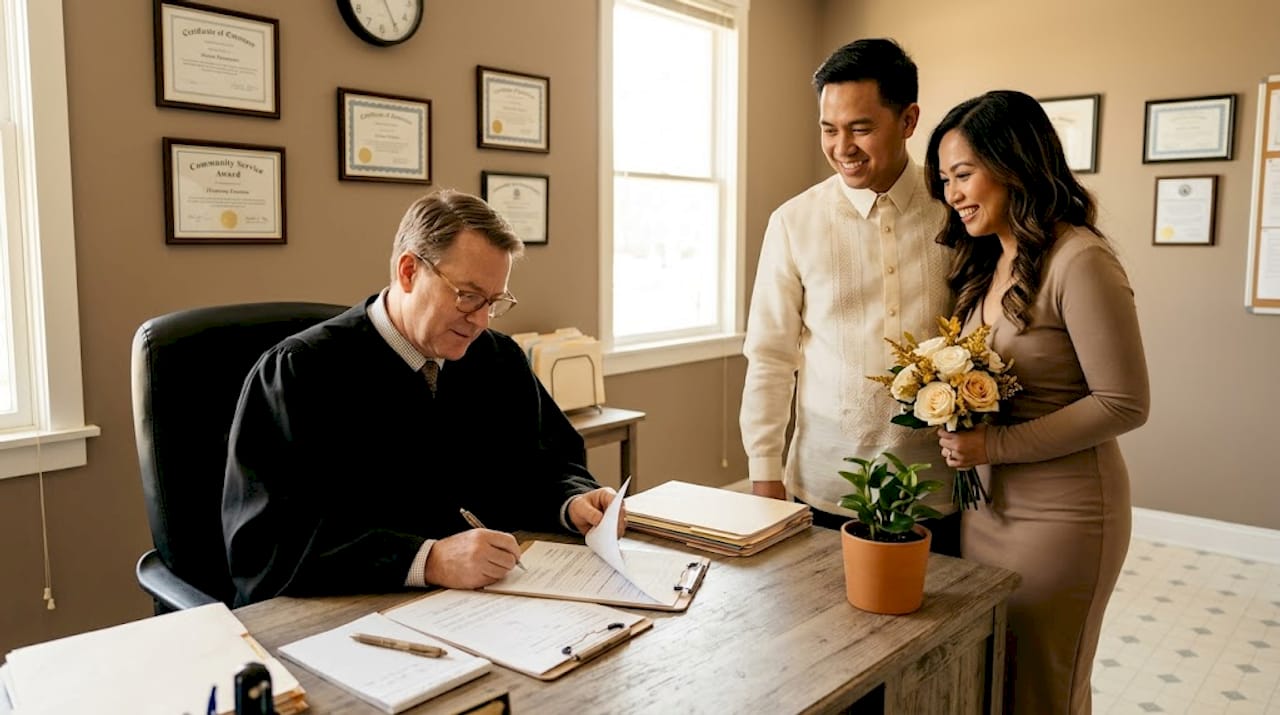
For Filipino couples based in the UAE, the Philippine Embassy in Dubai is a legitimate and practical option. The embassy’s consul general is an authorized solemnizing officer. You will need to book an appointment well in advance, bring all your documents, and comply with the same marriage license requirements as you would in the Philippines. Read the complete embassy wedding guide before you book anything, as requirements and appointment slots can change.
Pro Tip: Always bring at least three extra signed copies of your marriage contract to the ceremony. Some local registries ask for more than the standard two, and you do not want to delay registration because you are short one copy.
Cultural considerations for Filipinos getting married in the UAE
Filipino civil weddings occupy a complicated space culturally. For many Filipino families, a civil ceremony has historically been seen as less significant than a church wedding. That perception is changing, especially among younger couples and OFWs who prioritize legal efficiency without diminishing the meaning of their commitment. Understanding where your family stands on this before you finalize your plans will save you a lot of friction later.
That said, there are meaningful ways to honor Filipino heritage within a civil ceremony:
Traditional attire: Many couples choose the Barong Tagalog and a formal Filipiniana gown for the civil ceremony, giving it the same visual weight as a church wedding
Family blessing rituals: A brief blessing from parents or grandparents before or after the legal ceremony can be incorporated without compromising the civil format
Filipino prayers: While a civil ceremony is not religious, couples can privately include a moment of prayer before or after the legal proceedings
Pamanhikan traditions: Families who observed the formal courtship ritual of pamanhikan often expect to be prominently involved in any wedding celebration, civil or religious
Post-ceremony gatherings: A salu-salo or small reception with pancit, lechon, and local Filipino food is practically a cultural requirement, regardless of where the legal ceremony takes place
For Filipino couples in the UAE, blending cultures is part of daily life. Some couples hold the legal civil ceremony in Dubai or at the Philippine Embassy, then fly home to the Philippines for a symbolic celebration or second celebration with extended family. Others organize a small ceremony in the UAE and stream it live for relatives back home.
One thing worth naming directly: the civil wedding vs. church wedding tension in Filipino culture is real. Some parents will push hard for a church wedding on top of, or instead of, a civil ceremony. Having a clear and early conversation about which ceremony carries the legal weight, and what role the other plays, prevents misunderstandings about your actual marital status. The civil ceremony is the legally binding one. Full stop.
Step-by-step planning for UAE-based Filipino couples
Here is the order of operations that gives you the smoothest path from planning to registered marriage:
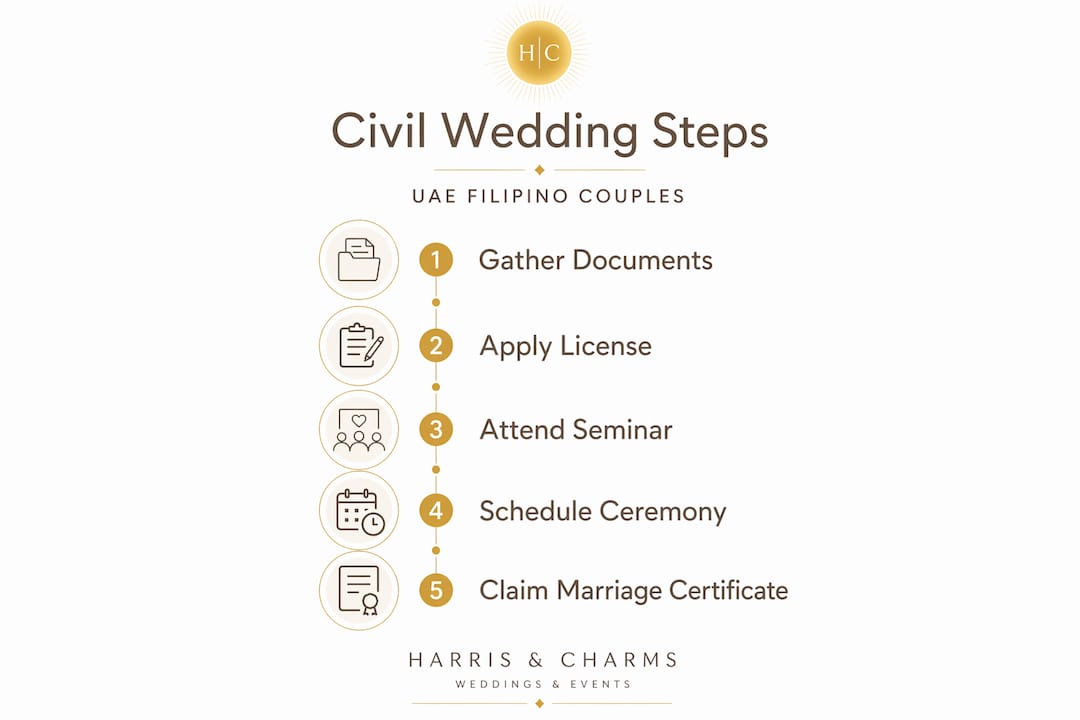
Gather your documents early. Order PSA birth certificates and CENOMAR at least one month before your target wedding date. Factor in the 5 to 10 business day processing time and any mail or courier delays if you are having them sent to the UAE.
Determine your marriage license route. If you plan to hold your ceremony in the Philippines, apply at the LCR of either party’s city of residence. If you plan to marry at the Philippine Embassy in Dubai, contact the embassy directly for their specific intake process, which includes an expat civil marriage checklist that differs slightly from local Philippines applications.
Wait out the 10-day posting period. This is not negotiable. Build it into your timeline from the start.
Schedule your ceremony within the 120-day window. The 120-day validity period requires careful coordination, particularly for couples abroad who need embassy appointment slots, which can book out weeks in advance.
Conduct the ceremony with your authorized officiant and two witnesses aged 21 or older. Both witnesses must sign the marriage contract on the day of the ceremony.
Register the marriage. The solemnizing officer submits the marriage contract to the Local Civil Registrar within 15 days after the ceremony. If you married at the Philippine Embassy in Dubai, they handle this differently. Check their specific post-ceremony reporting protocol.
Report your marriage in the Philippines. For Filipinos who married abroad, a Report of Marriage must be filed with the Philippine Statistics Authority through the Philippine Embassy or Consulate. This officially updates your civil status records in the Philippines.
Update your records in the UAE. Depending on your visa type and employer, you may need to update your marital status with UAE authorities and your company’s HR department.
Pro Tip: Do not schedule your ceremony for the last week of your 120-day window. If anything goes wrong with the officiant, venue, or a witness, you will have no buffer. Aim for a ceremony date at least three weeks before the license expires.
My honest perspective on planning a Filipino civil wedding from the UAE
I’ve worked with enough Filipino couples navigating this process to say this clearly: the legal part is not actually the hardest part. Most couples can handle the paperwork once they know what they need. What actually derails people is the gap between what they thought they knew and what the law actually requires.
The parental advice versus parental consent distinction catches more couples off guard than any other single requirement. I’ve seen couples in their early twenties arrive at the LCR expecting a smooth application, only to be told they need written parental advice that nobody told them about. If either of you is between 21 and 24, handle that piece before anything else.
The other thing I genuinely believe, having seen both approaches, is that a civil wedding done with intention is every bit as meaningful as any church ceremony. The couples I’ve worked with who treated their civil ceremony as the real thing, with flowers, their best outfits, family on video call, and a proper celebration afterward, walked away feeling completely married. The ones who treated it as a formality to get through before the “real” church ceremony often felt oddly underwhelmed by both.
You do not need to spend ₱50,000 or more to feel married. You need the right documents, the right officiant, and people who love you in the room. Everything else is optional.
— Harris
Let Harrisandcharms handle the complexity for you
Planning a Filipino civil wedding from the UAE involves more moving parts than most couples expect, and that is exactly where Harrisandcharms comes in. The team specializes in complete wedding services tailored specifically for Filipino expats in the UAE, covering everything from document processing and marriage license coordination to ceremony arrangement with authorized solemnizing officers and post-wedding registration support.

Whether you want a quiet embassy ceremony or a fully coordinated event, Harrisandcharms removes the guesswork and the back-and-forth with government offices. The team understands both the Philippine and UAE requirements inside out, and they handle the coordination so you can focus on what actually matters: getting married. Reach out through the contact page to start your inquiry today.
FAQ
What documents are required for a Filipino civil wedding?
You need PSA birth certificates, a CENOMAR, valid IDs, a pre-marriage counseling certificate, and community tax certificates for both parties. Two witnesses aged 21 or older must also be present at the ceremony.
How long is a Philippine marriage license valid?
A Philippine marriage license is valid for 120 days from the date it is issued by the Local Civil Registrar, not from the date of application.
Can Filipino couples in the UAE get civilly married without going back to the Philippines?
Yes. Filipino couples in the UAE can arrange a civil wedding through the Philippine Embassy in Dubai, where the consul general serves as an authorized solemnizing officer under Philippine law.
How much does a Filipino civil wedding ceremony cost?
A civil wedding ceremony in the Philippines typically costs between ₱5,000 and ₱10,000 in total, significantly lower than traditional religious weddings which often exceed ₱50,000.
What happens if the officiant is not legally authorized?
Under Philippine Family Code Art. 7, a marriage solemnized by an unauthorized person is void from the beginning. Always verify your officiant’s legal authority before the ceremony.
Recommended
Comments