
Navigate UAE Court Marriage Process: Step-by-Step Expat Guide by Harris & Charms


TL;DR:
Legal reform and digital workflows have simplified UAE civil marriage for non-Muslim expats, making it faster and more straightforward.
Preparation of attested, translated documents is the main bottleneck, requiring early attention and expert support.
Most expats assume that getting legally married in the UAE involves mountains of paperwork, weeks of waiting, and a labyrinth of government offices. That assumption is outdated. Thanks to recent legal reforms, including Federal Decree Law No. 41 of 2022, and digital workflows now available in Abu Dhabi and Dubai, non-Muslim couples can complete a civil court marriage faster than they might expect. The real challenge isn’t the court itself. It’s getting your documents in order before you ever submit an application.
Table of Contents
Key Takeaways
Point | Details |
Expats can marry legally | UAE courts provide accessible civil marriage routes for non-Muslim expats. |
Abu Dhabi offers express service | Marriage can be completed in as little as 15 minutes with streamlined digital workflow. |
Translation and attestation critical | Properly prepared and legalized documents prevent most delays in the court marriage process. |
Residency affects eligibility | Dubai generally requires residency status, while Abu Dhabi is more flexible and digital. |
Expert help simplifies process | Legal consultants provide support for paperwork, translation, and attestation to ensure smooth completion. |
Understanding the UAE court marriage framework
Before you book anything or gather a single document, you need to understand what type of marriage you’re actually pursuing. In the UAE, there are two primary paths: religious (Sharia-based) marriage and civil marriage. For non-Muslim expats, civil marriage is the relevant route, and it operates under a clearly defined legal framework.
Federal Decree Law No. 41 of 2022 governs personal status matters for non-Muslims in the UAE. This law gives non-Muslim residents the option to choose civil personal status for marriage, divorce, and inheritance, separate from Islamic law. It’s a significant shift that opened the door for a straightforward, contract-based marriage process that doesn’t require religious oversight.
Here’s what makes civil marriage fundamentally different from a Sharia marriage:
No religious ceremony is required
No wali (male guardian) is needed for either party
The marriage is treated as a legal contract between two consenting adults
Couples have flexibility in selecting applicable personal status law
As a complete guide for expats on this subject confirms, civil marriage in the UAE is strictly contract-based and does not involve any religious ceremony or a guardian requirement, unlike the Sharia route.
Civil marriage in the UAE treats your union as a legal agreement between two adults. This is especially important for mixed-nationality couples and those from countries where religious ceremonies are not the norm.
To be eligible, you generally need to meet these conditions:
At least one partner should hold UAE residency (requirements vary by emirate)
Both partners must be non-Muslim or legally able to marry under civil law
Both must have legal capacity to enter a contract (sound mind, of legal age)
Required documents must be valid and properly attested
Understanding the civil marriage requirements from the start saves you from surprises later. The framework is more flexible than many couples realize, but eligibility still needs to be confirmed before you begin.
Step-by-step guide to the UAE court marriage process
Now that you understand the legal context, let’s walk through the actual steps. The process varies slightly between Abu Dhabi and Dubai, but the core workflow follows a consistent pattern.
General process overview:
Confirm eligibility based on residency, religion, and legal capacity
Gather all required documents (passport copies, birth certificates, single status certificates, visa copies)
Get all non-Arabic documents translated by a certified legal translator
Attest and legalize foreign documents through the relevant embassy and UAE Ministry of Foreign Affairs (MOFAIC)
Submit your online marriage application through the relevant emirate’s portal (TAMM for Abu Dhabi, Dubai Courts for Dubai)
Upload supporting documents and pay applicable fees
Book your appointment for the contract signing ceremony
Attend the appointment, sign the marriage contract in front of an authorized judge
Receive your digitally attested marriage certificate
Abu Dhabi uses the TAMM platform and the Abu Dhabi Judicial Department (ADJD) system. As Gulf News reports, this workflow includes document upload, fee payment, appointment booking, and delivery of a digitally attested contract. The process is genuinely digital from start to finish.
Dubai’s route runs through the Dubai Courts portal. According to marriage registration guidance for the UAE, eligibility in Dubai often hinges more strictly on residency status, and the workflow involves more in-person elements. Document attestation and legalization remain a significant friction point in both cities.
Pro Tip: Prepare certified Arabic translations of all non-Arabic documents before you even start the application. Translation errors or missing certifications are the single most common reason applications get delayed or rejected outright.
Here’s a comparison of what each emirate offers at a glance:
Feature | Abu Dhabi | Dubai |
Digital application | Fully online via TAMM | Partially online via Dubai Courts |
Express option | Yes, as fast as 15 minutes | Limited express options |
Residency requirement | More flexible | Stricter, usually requires residency |
Contract delivery | Digital attestation available | In-person collection common |
Processing time | 1 to 10 working days | Varies, often longer |
End-to-end legal support for expat couples, including translation, attestation, and certificate preparation, is widely available from specialized firms and can significantly reduce the stress of navigating this process alone.
Abu Dhabi vs. Dubai: Fast-track and eligibility options
If you’re choosing between the two emirates for your civil court marriage, this decision matters more than most couples realize. The differences go beyond geography.
Abu Dhabi stands out for one key reason: speed. The emirate offers an express civil marriage service that can be completed in as little as 15 minutes, with the full contract process wrapped up within one working day for the express option. Standard processing takes up to 10 working days, but even that timeline is competitive by regional standards.
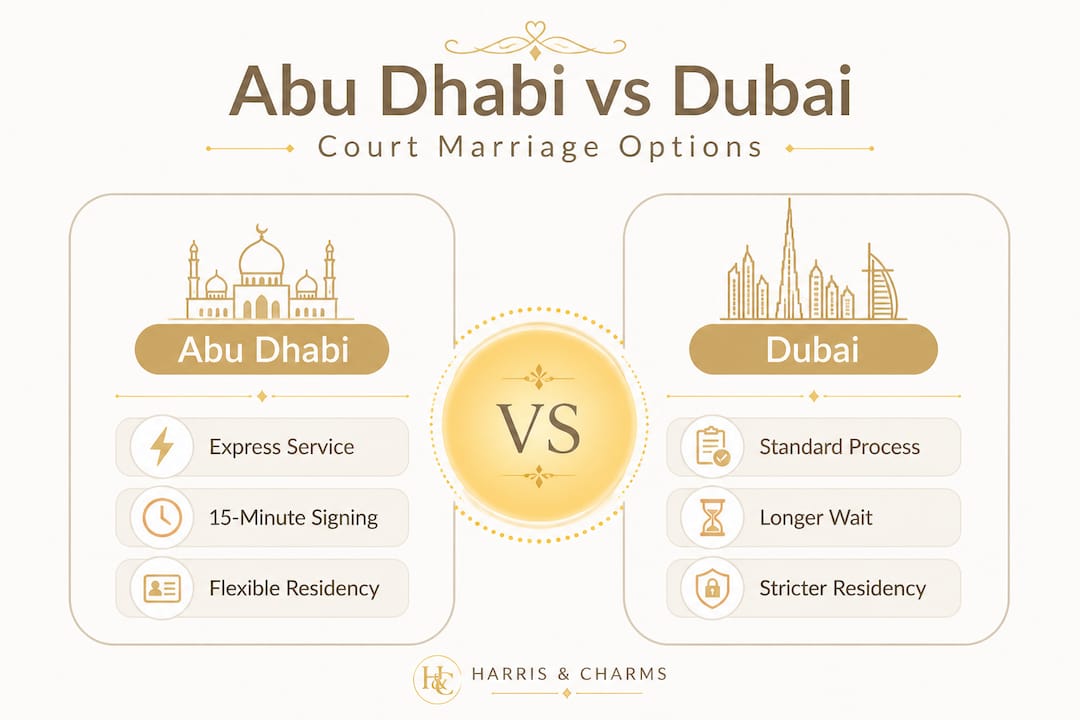
Dubai’s system is functional but slower for most expat couples. Residency requirements are often stricter, commonly requiring at least one partner to hold a valid UAE residence visa. The workflow involves more in-person steps, which can add days or even weeks depending on appointment availability and document status.
Here’s a more detailed comparison to help you decide:
Criteria | Abu Dhabi | Dubai |
Express service | Yes (15 minutes) | No equivalent |
Residency flexibility | Broader eligibility | At least one resident typically required |
Fully digital workflow | Yes | Partial |
Document attestation friction | Moderate | High |
Typical timeline | 1 to 10 working days | 10 or more working days |
Suitable for tourists | Sometimes | Rarely |
Key considerations when choosing your emirate:
If neither of you holds UAE residency, Abu Dhabi is almost always the better option
If speed is your priority, Abu Dhabi’s express service is unmatched
If you’re both Dubai residents, Dubai Courts may still be the more practical choice for follow-up documentation and legal continuity
If you need your marriage certificate recognized internationally, the attestation process is similar in both emirates but should be planned carefully
Statistic to note: Abu Dhabi’s express civil marriage completes the contract signing in approximately 15 minutes, compared to processes in other countries that can take weeks of waiting periods and pre-ceremony requirements.
The Abu Dhabi civil marriage advantages are real, particularly for foreign nationals without long-term UAE residency. Knowing which route fits your situation lets you avoid applying in the wrong place and dealing with rejections that cost you time and fees.
Document translation and attestation: The expat’s friction point
Here’s the uncomfortable truth: for most expat couples, the court itself is easy. Documents are where things fall apart.

Every document you submit that isn’t in Arabic needs a certified legal translation. This isn’t optional, and informal translations won’t be accepted. You need a UAE-licensed legal translator, and the translation must accompany the original or attested copy. The marriage attestation UAE process has strict requirements that trip up couples who try to do it all at the last minute.
Foreign certificates, things like your birth certificate, divorce decree if applicable, or single status certificate, need to go through a multi-step attestation chain:
Notarization in your home country
Attestation by your home country’s foreign affairs ministry
Attestation by the UAE embassy in your home country
Final attestation by UAE MOFAIC (Ministry of Foreign Affairs and International Cooperation) after arriving in the UAE
That’s four steps, each with its own processing time and fees. As Gulf News confirms, most process delays for foreign nationals come directly from this translation and legalization chain.
After your marriage, if you want the certificate to be internationally recognized, you’ll need an additional layer of attestation. This is especially important for couples who plan to use the certificate for visa applications, inheritance, or property purposes in another country. Full document legalization guidance helps you plan for this in advance rather than scrambling afterward.
Pro Tip: Start your attestation process as soon as you decide to get married in the UAE. Even if your court appointment is weeks away, the attestation chain for some countries takes 3 to 6 weeks. Begin immediately to avoid delays.
The attestation steps for 2026 have been updated to reflect current MOFAIC requirements. Working with a specialist who knows the current chain for your specific nationality removes guesswork from this part of the process. Many couples also find that certificate attestation in Dubai requires additional coordination if the marriage was performed in Abu Dhabi but you’re based in Dubai for practical follow-up.
End-to-end specialist support for translation, attestation, and certificate preparation is the most efficient way to handle the document side, especially for couples with complex nationality combinations or documents from multiple countries.
Making your UAE court marriage a hassle-free reality
Getting through the process smoothly comes down to preparation and sequencing. Couples who run into problems almost always do so because they tackled steps out of order or assumed certain requirements didn’t apply to them.
Here’s what actually helps:
Confirm your eligibility before spending money on translations or attestations
Start the document chain at least 4 to 8 weeks before your target marriage date
Use official portals (TAMM or Dubai Courts) and verify fee structures directly before paying any third party
Consult a legal specialist if either partner has a complex situation (previous marriage, multiple nationalities, or documents from a country with a slow attestation process)
As Gulf News notes, when legal capacity or identity verification is incomplete for an online Abu Dhabi application, the submission may need to be handled by a legal guardian or an authorized representative. This is a practical edge case worth knowing about if you’re supporting a partner with documentation challenges.
Pro Tip: If your documentation situation is complex, appoint an authorized legal representative early. They can submit applications, follow up on status, and act on your behalf without requiring you to be physically present for every step.
The expat marriage guide covers many of these practical decision points. Knowing where the real hurdles are before you start makes the difference between a smooth application and one that takes months longer than expected.
Why the hardest part of UAE court marriage isn’t the court
Here’s a perspective you won’t find in most guides: couples spend hours researching court rules, eligibility criteria, and appointment systems. Then they walk into their application with an unattested birth certificate and wonder why things stalled.
The actual court step, signing the contract in front of a judge, takes minutes. Abu Dhabi’s express service makes that literally true. The digital workflow is clean, the officials are experienced with expat couples, and the process is far more standardized than most people expect.
What isn’t fast or simple is the document preparation chain. And this is where the real timeline lives. A couple from different countries, say one from the Philippines and one from Germany, is looking at two completely different attestation chains, each with its own government steps and processing delays. Add in a previous marriage for one partner, and the complexity doubles.
The insight most guides miss is this: legal readiness is the bottleneck, not procedural complexity. If your documents are ready, attested, translated, and organized before you ever log into the TAMM portal, your court marriage process will feel almost instant. If they aren’t, it doesn’t matter how efficient the digital system is.
We’ve seen couples who planned their wedding day before confirming their document status. They had venues, photographers, and guest lists sorted, but their certificates weren’t attested. That’s a painful situation. Start with documents. Everything else follows.
The document attestation process isn’t glamorous, but it’s the foundation of a successful court marriage. Treat it as the first step, not the last.
Get expert help for your UAE court marriage
Navigating UAE civil marriage as an expat is genuinely manageable when you have the right support structure in place. But the document chain, translation requirements, and emirate-specific workflows take time to understand when you’re doing it alone for the first time.

Harris & Charms specializes in exactly this. We handle the legal documentation, certified translations, attestation coordination, and digital application process so that you can focus on what actually matters: your marriage. Whether you’re exploring Dubai court marriage packages, need specialized Dubai marriage services, or want a full view of UAE wedding services including venue coordination and photography, we’ve got a path for you. Our team works with non-Muslim expat couples from every nationality and background, and we understand the nuances of multi-country document situations. Reach out to us and let’s map out your specific path forward.
Frequently asked questions
Can expats get legally married in the UAE via a civil/court process?
Yes, non-Muslim expats can legally marry in UAE courts through the civil marriage framework, which operates separately from religious ceremony requirements.
How fast is the express court marriage in Abu Dhabi?
Abu Dhabi’s express civil marriage option can complete the contract signing in about 15 minutes, with the full process wrapped up within one working day under the express route.
What documents do I need for UAE court marriage as an expat?
You’ll need valid identity documents, certified Arabic translations for any non-Arabic records, and properly attested certificates for any foreign-issued documents, including birth certificates and single status declarations.
Do UAE courts require a religious ceremony for civil marriage?
No, civil marriage requires no religious ceremony or a guardian. It is treated purely as a legal contract between two consenting adults.
What if one applicant lacks legal capacity for the contract?
If either partner cannot meet the legal capacity requirements, a legal guardian or authorized representative must submit the application on their behalf through the official court process.
Recommended
Comments