
Marriage nullification in UAE: legal meaning, grounds, and process


TL;DR:
Marriage nullification in the UAE treats a marriage as if it never legally existed.
Grounds for nullification include lack of guardian, witnesses, fraud, coercion, or prohibited relations.
Nullification removes marital rights, affects residency, but children’s legitimacy remains protected.
Some marriages in the UAE don’t end with divorce. They are erased entirely. Under UAE law, a court can declare a marriage contract invalid from the start, treating the union as if it never legally existed. This is called marriage nullification, also known as annulment, and it carries very different consequences than a standard divorce. For couples planning a wedding or facing relationship difficulties, understanding this distinction is not just academic. It can affect your residency, your assets, your children, and your future. This guide breaks down what nullification means, when it applies, and what you should do about it.
Table of Contents
Key Takeaways
Point | Details |
Nullification erases the marriage | In the UAE, nullification means the marriage is treated as if it never existed in law. |
Strict legal grounds | Annulment is possible only for specific reasons like fraud, coercion, or missing contract elements. |
Children’s rights are protected | Nullification does not affect the legitimacy or rights of children from the union. |
Clean record for new marriage | After nullification, both parties are free to remarry without residual legal burdens. |
Expert help recommended | Professional guidance is essential for navigating complex marriage or nullification cases in the UAE. |
What is marriage nullification in the UAE?
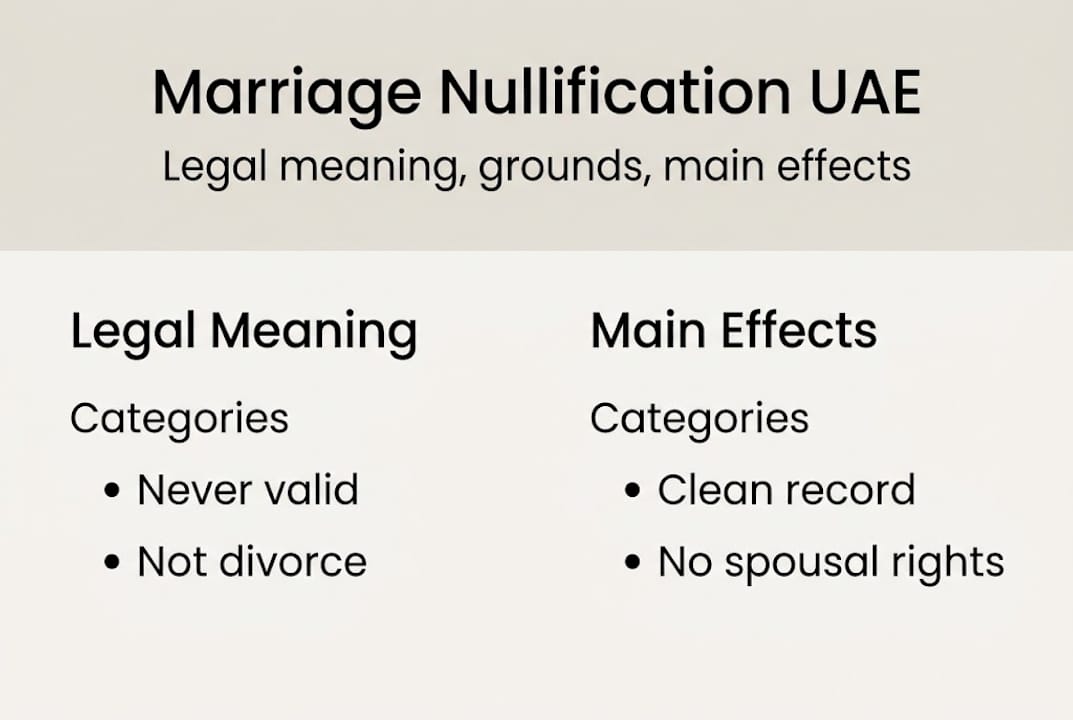
Marriage nullification is a legal declaration that a marriage contract was never valid in the first place. It is not the same as divorce. Divorce ends a marriage that was once legally sound. Nullification says the marriage should never have happened at all.
As UAE legislation confirms, marriage nullification declares a marriage contract invalid from the outset, as if it never existed legally, unlike divorce which ends a valid marriage. That distinction matters enormously for how your legal status, finances, and personal records are treated afterward.
Understanding marriage contracts in the UAE is the first step to understanding why nullification exists. A marriage contract in the UAE must meet specific legal requirements to be valid. If those requirements were never met, the contract itself is flawed, and the court can void it entirely.
Nullification is relatively rare in the UAE, especially for Muslim marriages governed by Sharia. Courts apply strict standards and do not grant annulments lightly. The current framework for Muslims is Federal Decree-Law No. 41 of 2024, which classifies marriages as valid, void, or Al-Fased (a voidable or tainted contract). Non-Muslim residents follow a separate civil track, though the courts still apply UAE personal status principles.
“A nullified marriage leaves no legal trace of a valid union, while a divorced couple carries a record of a marriage that once existed and was formally dissolved.”
Here is a side-by-side comparison to make this clearer:
Feature | Nullification | Divorce |
Legal outcome | Marriage treated as never existing | Marriage legally dissolved |
Marital record | Clean, no prior marriage recorded | Divorce recorded in personal status file |
Financial rights | Generally no spousal entitlements | Alimony and asset division may apply |
Children’s status | Legitimacy protected by law | Legitimacy unaffected |
Frequency in UAE | Rare, courts apply strict criteria | Common, multiple legal pathways |
Applicable law | Personal Status Law, Sharia for Muslims | Personal Status Law, civil law for non-Muslims |
The legal framing matters because it shapes every practical outcome that follows.
Grounds for declaring a marriage null or voidable
With the legal foundation set, let’s examine the specific reasons a court may declare a marriage invalid in the UAE.
Under Federal Decree-Law No. 41 of 2024, Muslim marriage contracts are classified as valid, void, or Al-Fased (voidable). Article 37 covers void marriages, meaning those that carry a fundamental defect from the beginning. Article 39 covers Al-Fased marriages, which are tainted by a correctable or procedural flaw.
For non-Muslims, UAE courts apply their home country’s law in some cases, but UAE public policy and local statutes still set the outer limits of what is permissible.
The grounds for nullity recognized by UAE courts include a wide range of circumstances:
No guardian (Wali): For Muslim marriages, the absence of a legally recognized male guardian renders the contract void in most cases.
Missing witnesses: A Muslim marriage without two adult male witnesses is invalid from the start.
Prohibited degree of relation: Marriage between close blood relatives or those connected by fosterage (milk kinship) is absolutely void.
Underage marriage without court approval: Marrying below the legal minimum age (18 Hijri years) without prior judicial authorization is a ground for nullification.
Fraud or misrepresentation: If one party concealed a critical fact (such as a prior marriage, a serious illness, or false identity), the deceived party may seek annulment.
Coercion: A marriage entered under duress or threats is voidable at the request of the coerced party.
Bigamy: A second marriage while a valid first marriage is still in place is void by default.
Non-consummation combined with other defects: In some circumstances, a marriage that was never consummated and carries another legal flaw may be easier to nullify.
Mental incapacity: If either party lacked the mental capacity to consent at the time of the contract, the marriage may be declared void.
Knowing Muslim marriage rules in UAE and Islamic marriage requirements before signing any contract is not just good practice. It is your first line of protection against a marriage that could later be challenged in court.
“Prevention is always easier than annulment. A properly drafted and registered marriage contract eliminates most grounds for nullification before they arise.”
For non-Muslim couples, fraud and coercion remain the most common grounds. Civil marriages registered in the UAE must still meet the basic requirements of free and informed consent.
Legal effects and implications of nullification
Once a marriage is nullified, the couple’s situation changes in several important ways. Let’s break down the main legal effects.

The most significant consequence is that nullification removes marital rights and duties, affects child legitimacy protections, and gives both parties a clean marital record. But the details matter.
Assets and property: Because the marriage is treated as never having existed, neither party typically has a legal claim to the other’s assets under marital property rules. There is no automatic division of shared property the way there might be in a divorce. Any financial entanglements must be resolved through separate civil claims.
Children: This is where UAE law is notably protective. Even if a marriage is nullified, children born during that union retain their legal legitimacy. Their lineage, inheritance rights, and parental support obligations are preserved. The court does not punish children for a contract that was flawed between adults.
Marital record: Nullification gives both parties a clean record. There is no divorce entry in your personal status file. For some individuals, particularly those whose culture or religion treats divorce as a social stigma, this can be a meaningful distinction.
Residency and work permits: This is where things get complicated. If your UAE residency was tied to your spouse’s visa, nullification can affect your legal status in the country. You may need to apply for an independent visa or leave the UAE while sorting out your documentation.
Legal area | Effect of nullification |
Spousal financial rights | Generally not applicable |
Children’s legitimacy | Fully protected |
Personal status record | Clean, no divorce entry |
Residency/visa status | May be affected if tied to spouse |
Inheritance rights | No spousal inheritance claim |
Remarriage eligibility | Immediate, no waiting period typically required |
Pro Tip: If your residency depends on your spouse’s sponsorship, consult an immigration specialist the moment nullification becomes a possibility. Do not wait for the court ruling to start planning your next steps.
For couples navigating the non-Muslim marriage pathway in UAE, understanding these implications before the wedding is far less stressful than dealing with them after.
Practical steps: What couples should do before and after nullification
For couples worried about nullification or seeking a way forward after one, here is an action plan.
The good news is that most nullification risks are entirely preventable with the right preparation. The UAE legislation on marriage makes clear that courts are strict on Sharia requirements for Muslims, and that a valid contract requires proper registration, minimum age of 18 Hijri years, and no legal impediments.
Before your wedding, verify the following:
Confirm marriage eligibility: Both parties must meet the legal age requirement and have no existing marriages that would create a bigamy situation. Check marriage eligibility in UAE to understand the full criteria.
Appoint a qualified guardian (Wali): For Muslim marriages, ensure the Wali is legally recognized and present at the contract signing.
Arrange proper witnesses: Two adult male Muslim witnesses are required for Islamic marriages. Confirm their eligibility before the ceremony.
Disclose all relevant information: Both parties should be transparent about prior marriages, health conditions, and any other facts that could later be cited as grounds for fraud-based annulment.
Register the contract officially: Unregistered marriages are extremely vulnerable to nullification. Use official UAE channels and follow the Islamic marriage process guide step by step.
Seek legal advice for complex situations: Mixed nationality couples, those with prior marriages, or couples with significant age gaps should consult a UAE family lawyer before proceeding.
If you are already facing nullification:
Gather all marriage documents, including the original contract, registration certificates, and any communication that may be relevant.
Protect your children’s interests immediately. Document custody arrangements and ensure their residency status is secure.
Address your visa situation before the court ruling is finalized if possible.
Consult a UAE-licensed family lawyer who specializes in personal status law.
Contact the relevant government authority, such as the Personal Affairs Court or the Abu Dhabi Judicial Department, depending on your emirate.
Pro Tip: Keep certified copies of your marriage contract in a separate, secure location from the original. If a dispute arises, having your own verified copy speeds up the legal process significantly.
Hard truths: What most UAE couples miss about nullification
Here is the part most couples never realize until it is too late.
Nullification is not about whether your relationship broke down. It is about whether your marriage contract was legally sound from day one. Two people can be deeply in love and still have a void marriage if the paperwork was wrong, a guardian was absent, or a disclosure was missed.
The UAE’s blend of Sharia and civil law means there is no single rulebook that applies to everyone. A Muslim Emirati couple, an expat Christian couple, and a mixed-nationality pair each face different legal standards. Generic advice from friends or online forums is genuinely dangerous here.
We have seen couples who assumed their informal or overseas ceremony was automatically recognized in the UAE. It often is not. And we have seen others who rushed into registration without understanding Muslim marriage rules, only to face challenges later.
The uncomfortable truth is that most nullification cases are preventable. The stress, the legal costs, and the personal disruption all trace back to a gap in knowledge or preparation before the wedding. Investing in proper legal guidance before you sign anything is not pessimistic. It is the most romantic thing you can do for your future together.
Get expert help with marriage contracts and rights in the UAE
Navigating marriage nullification risks on your own is stressful, and the stakes are too high to guess. Whether you are planning a wedding or trying to understand your legal position, getting the right support from the start makes all the difference.

At Harris & Charms, we help couples build marriages that are legally secure from day one. From tailor-made civil marriage packages to dedicated marriage services in Dubai, we handle the documentation, registration, and planning so nothing falls through the cracks. Explore our full range of comprehensive marriage services and take the first step toward a marriage that is as solid legally as it is personally. Reach out to our team today and let us help you get it right.
Frequently asked questions
How is marriage nullification different from divorce in the UAE?
Marriage nullification means the marriage never legally existed, while divorce legally ends a valid marriage. The two outcomes carry entirely different legal, financial, and personal consequences.
What are common grounds for marriage nullification in the UAE?
Common grounds include fraud, coercion, missing legal requirements, prohibited relationships, and underage marriage without approval. Courts also recognize bigamy and mental incapacity as valid grounds.
Does marriage nullification erase all legal records of the union?
Yes, nullification means the marriage is treated as if it never existed, giving both parties a clean marital record with no divorce entry in their personal status file.
What happens to children after a marriage is nullified?
Children remain fully protected and legitimate under UAE law. Their rights to lineage, parental support, and inheritance are preserved regardless of the annulment.
Recommended
Comments