
Islamic Wedding Registration Steps in the UAE: 2026 Guide


TL;DR:
Getting your Islamic marriage legally registered in the UAE requires thorough preparation of documents, including consent, witnesses, and certification. The process involves multiple structured steps from application submission to certificate issuance, with delays often caused by incomplete paperwork or scheduling issues. Proper early planning, authentic documentation, and professional assistance can ensure a smooth registration, safeguarding your legal rights in the UAE.
Getting your Islamic marriage legally recognized in the UAE involves more than exchanging vows. Many couples arrive at government offices missing a document, unsure which authority to approach first, or unaware that certain steps must happen in a specific sequence. The islamic wedding registration steps are formally governed by Sharia law as codified in UAE civil regulations, and skipping even one stage can delay your certificate by weeks. This guide walks you through every requirement, every document, and every procedural stage so you go in prepared, not guessing.
Key takeaways
Point | Details |
Start with documents first | Gather all original IDs, single status certificates, and wali consent before booking any appointment. |
Wali consent is non-negotiable | Missing the bride’s guardian consent can legally invalidate the entire registration process. |
Witnesses must be qualified | Two adult Muslim witnesses with valid ID must be physically present at the ceremony. |
Book appointments early | Solemnization slots at Islamic centers fill quickly, especially during peak seasons in the UAE. |
Your certificate unlocks legal rights | The official marriage certificate is required for residency sponsorship, visa applications, and inheritance claims. |
Islamic wedding registration steps: what you need first
Before you schedule anything or show up at any authority, you need to have your paperwork in order. Marriage under Sharia law in the UAE requires a structured set of documents covering both parties, their families, and their legal standing. Think of this phase as building the foundation. Everything else depends on it.
Here is what you and your partner need to prepare:
Document | Who It Applies To | Key Notes |
Valid passport (original + copy) | Both parties | Must be current, not expired |
Emirates ID | Residents in UAE | Original required at appointment |
Single status certificate | Both parties | Must be attested and sometimes translated |
Marriage application form | Both parties | Obtained from the registering authority |
Wali’s consent letter or presence | Bride’s guardian | Verbal or written, depending on jurisdiction |
Witness identification | Two male Muslim witnesses | Valid passport or Emirates ID |
Premarital counseling certificate | Both parties | Required in certain UAE emirates |
Medical fitness certificate | Both parties | Required in some registration offices |
Mandatory documentation includes passports, Emirates IDs, single status certificates, and the marriage application form. If either party is a foreign national, their home country documents must go through translation and authentication before any UAE authority will accept them. Foreign documents require attestation by the relevant embassy and the UAE Ministry of Foreign Affairs.
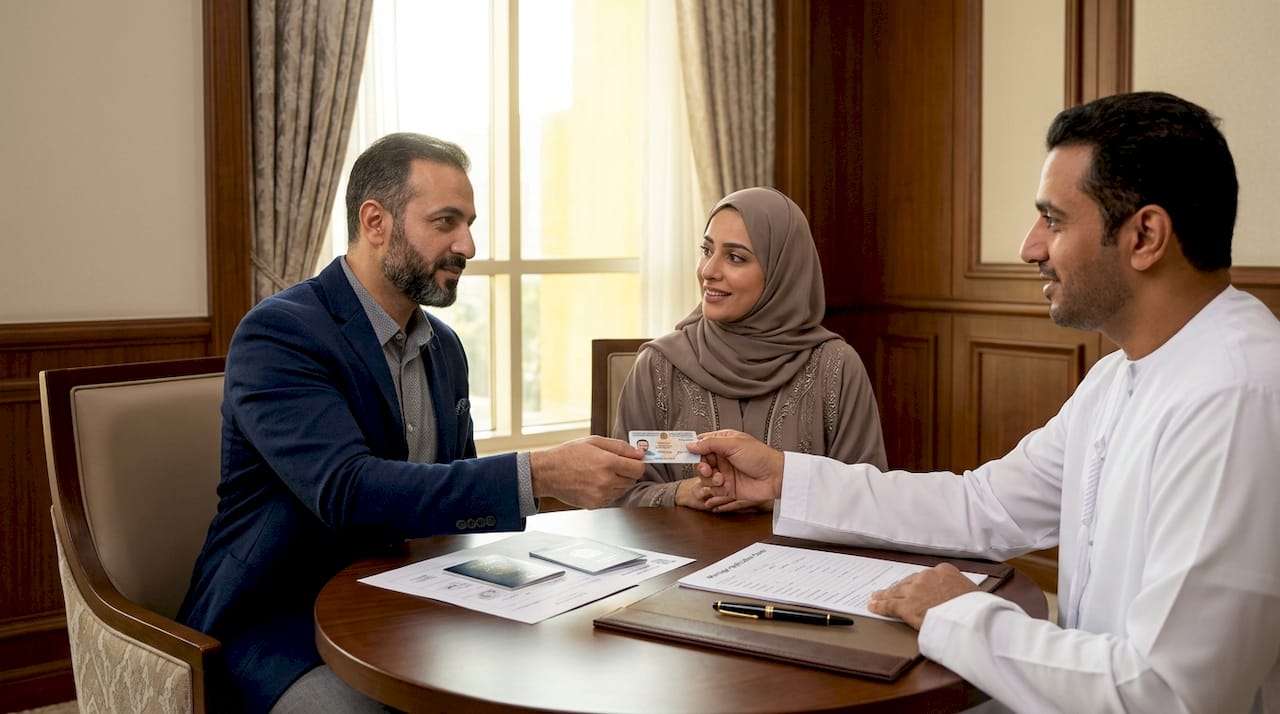
The wali, the bride’s male guardian, plays a legally significant role. Wali consent is a mandatory prerequisite, and if the wali cannot be present, a court-appointed representative may be arranged through the local Islamic affairs authority. Do not assume this step can be skipped or handled informally.
Premarital counseling certificates are required or strongly recommended depending on the emirate. In Abu Dhabi and Dubai, premarital screening programs are tied to the registration process. Check with your local Islamic Affairs and Charitable Activities Department (IACAD) or the equivalent authority in your emirate well before your scheduled date.
Pro Tip: Bring both originals and certified copies of every document. Many offices keep the copy and return the original, but some authorities do the reverse. Walking in with both eliminates any last-minute scramble.
The actual registration process, step by step
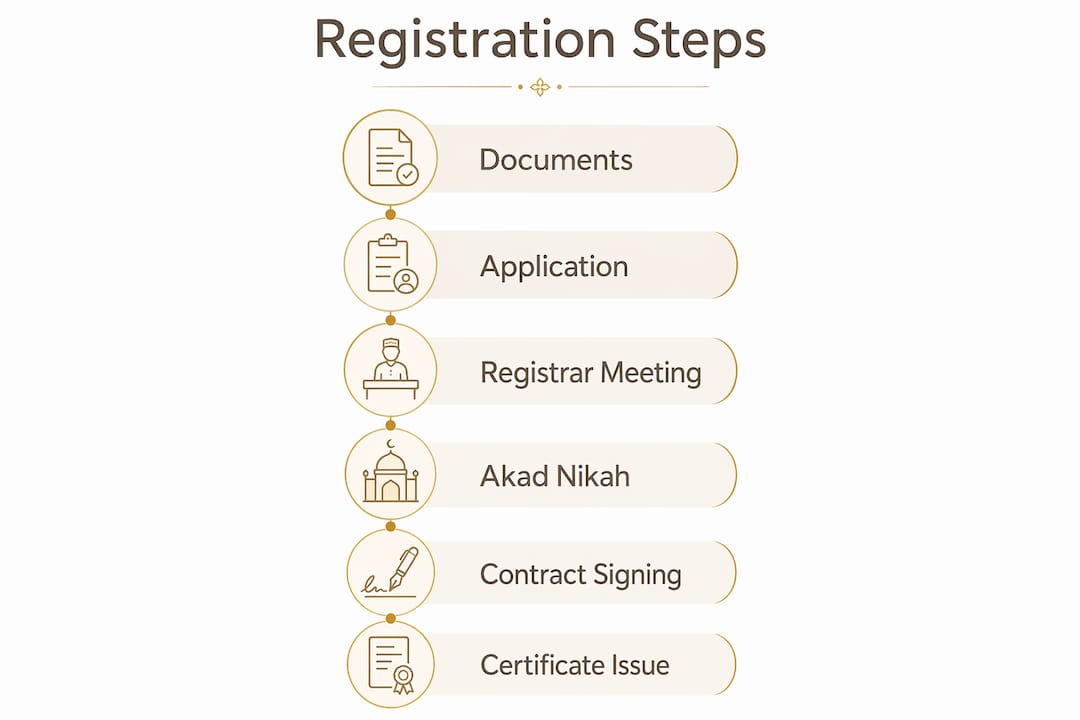
Now that your documents are ready, here is how the legal process of getting married in Islam unfolds in the UAE. The sequence matters. Going out of order is one of the most common reasons couples face delays.
Step 1: Submit your marriage application
You submit your completed application form along with all supporting documents to the relevant authority. In Dubai, this is typically through IACAD. In Abu Dhabi, couples go through the Abu Dhabi Department of Community Development or a licensed mosque registrar. The office reviews your submission and either approves it for the next stage or requests additional documents.
Step 2: Face-to-face session with the registrar
Once your application is accepted, both parties attend a scheduled meeting with the authorized marriage registrar, often referred to as the Kadi or marriage officer. This face-to-face session confirms that both parties are consenting freely, that the wali is present or represented, and that all documentary requirements are met. This is not optional, and both parties must appear in person.
Step 3: The Akad Nikah ceremony
The Akad Nikah is the formal solemnization. The groom makes the marriage declaration (Ijab), and the bride’s wali accepts it (Qabul) on her behalf. Two adult Muslim witnesses with valid identification must be physically present throughout the ceremony. The registrar officiates and formally records the union.
Step 4: Execution of the Nikah contract
The marriage contract is signed by the groom, the wali, and the witnesses. This document outlines the mahr (dower) agreed upon, which is a mandatory gift from the groom to the bride in Islamic law. The registrar countersigns as the legal witness on behalf of the state.
Step 5: Issuance of the marriage certificate
After all signatures are in place and the registration is logged in the system, the official marriage certificate is processed and issued. Timelines vary by emirate but typically range from a few days to two weeks.
Step | Action Required | Responsible Party | Estimated Duration |
Application submission | Submit forms and documents | Couple | 1 to 3 days processing |
Face-to-face session | Attend interview with registrar | Couple and wali | 1 appointment |
Akad Nikah ceremony | Solemnization with witnesses | Registrar, couple, wali | Same day as session |
Nikah contract signing | Sign official marriage contract | Groom, wali, witnesses | Immediate |
Certificate issuance | Receive official marriage certificate | Registrar’s office | 3 to 14 days |
Pro Tip: Book your appointment at least four to six weeks before your intended date. Islamic centers in Dubai and Abu Dhabi often have limited slots, and popular months like Ramadan or the period following Eid tend to fill up fast.
Common mistakes that delay or derail registration
Couples make these errors more often than you would expect, and most of them are entirely avoidable with a little upfront awareness.
Submitting photocopies without certified attestation. Uncertified copies are rejected on the spot. Every foreign document needs embassy attestation followed by UAE Ministry of Foreign Affairs verification.
Not securing the wali before booking the ceremony. If your wali lives abroad or is unavailable, arranging a court-appointed representative takes time. This step should be sorted weeks before any appointment.
Booking the venue before completing the legal steps. Some couples lock in wedding dates before their application is even approved. If your documents are incomplete, you may have to postpone at significant cost.
Using witnesses who do not qualify. Witnesses must be adult Muslim males of sound mind, fluent in the language of the ceremony. Bringing family members who do not meet these criteria creates problems at the ceremony itself.
Ignoring translation requirements. Incomplete documentation and missing wali consent are the most cited reasons for registration rejection. Foreign nationals who skip document translation face the same outcome.
If you need to make changes after registration, such as correcting a name or updating the mahr amount, contact the registering authority directly. Amendments after the fact require a formal request and supporting evidence, and the sooner you flag errors, the faster they get resolved.
What happens after your registration is complete
Receiving your marriage certificate is not the finish line. It is the starting point for a series of legal and administrative updates that protect your rights as a married couple in the UAE.
Official marriage certificates are required for spousal residency visa applications, changes to your family book (Khulasat Al Qaid for UAE nationals), and any future inheritance or property claims. If your spouse is on a separate visa, your marriage certificate is the document that initiates the sponsorship process.
Make certified copies immediately upon receiving the original. Keep the original in a secure location and use the certified copies for all ongoing legal purposes. You will need copies for your employer’s HR records, the General Directorate of Residency and Foreigners Affairs (GDRFA), and potentially your home country’s embassy if you plan to have your marriage recognized internationally.
Failing to register your marriage properly does not just create administrative headaches. Under UAE law, an unregistered marriage lacks legal standing, which means your spouse has no automatic right to residency sponsorship, inheritance, or shared legal guardianship of children. The consequences are serious, and they compound over time.
If you hold a Golden Visa, your spouse’s residency under your sponsorship still requires the formally registered marriage certificate. There is no shortcut around this requirement.
My honest take on getting this right
From my experience working with couples through this process, I’ve noticed that the couples who struggle the most are the ones who treat the legal registration as an afterthought to the celebration. They spend months planning the reception and then try to rush through the paperwork in two weeks.
I’ve seen situations where families flew in from three countries for a ceremony that had to be postponed because a single document hadn’t been attested. That kind of situation is entirely preventable. The legal process is predictable. It follows a defined sequence. What trips people up is underestimating how much lead time the bureaucratic parts require.
What I genuinely recommend is starting the document preparation at least two to three months before your planned date. Build the legal steps into your wedding timeline the same way you plan catering or photography. When you give yourself room, everything moves smoothly. When you rush, you hand control of your timeline over to paperwork backlogs and appointment availability.
Working with a trusted service provider who knows the local registration system is not a luxury. For many couples, especially expats dealing with foreign document authentication, it is the most practical decision you can make.
— Harris
Let Harrisandcharms handle the hard parts
Planning an Islamic wedding in the UAE is meaningful work. The legal side of it does not have to be stressful.

Harrisandcharms offers marriage service packages specifically designed for Islamic weddings in the UAE, covering document preparation, appointment scheduling, wali coordination, and ceremony facilitation. Whether you are a UAE national, a resident expat, or a Golden Visa holder, the team handles the procedural complexity so you can focus on what actually matters. From the first document checklist to the moment your certificate is in your hands, Harrisandcharms takes the uncertainty out of the process. Get in touch today to start your consultation and find out which package fits your situation.
FAQ
What documents are required for Islamic wedding registration in the UAE?
Both parties need valid passports, Emirates IDs, single status certificates, and a completed marriage application form. Foreign documents must be translated and attested before submission.
Is wali consent legally required for Islamic marriage in the UAE?
Yes. The bride’s wali must either be present at the ceremony or formally represented through a court-appointed guardian. Missing this step can invalidate the registration.
How long does the Islamic marriage registration process take in the UAE?
The process typically takes two to four weeks from document submission to certificate issuance, depending on the emirate and how quickly appointments are available.
Can non-Muslim foreigners marry a Muslim under Islamic law in the UAE?
Islamic marriage in the UAE generally requires both parties to be Muslim. Non-Muslim parties may need to convert and provide documentation of that conversion before registration.
Do I need my Islamic marriage certificate for a UAE spousal visa?
Yes. The official marriage certificate issued after registration is a mandatory document for any spousal residency visa application through the GDRFA.
Recommended
Comments