
Your guide to notarized marriage certificates in the UAE

TL;DR:
Notarization verifies the authenticity of signatures and document execution, not the marriage validity.
UAE couples must follow a specific attestation chain, including notarization, MOJ, MOFA, and embassy steps.
Proper planning and early document preparation prevent delays, rejections, and legal issues.
Couples across the UAE have had visa applications stalled, property transactions frozen, and family reunification plans derailed because their marriage certificate skipped one critical step: proper notarization. It happens more often than you’d think, and the frustration is real. Whether you’re planning a civil ceremony or an Islamic marriage, understanding what a notarized marriage certificate actually is and when you need it can save you weeks of back-and-forth with government offices. This guide walks you through everything, from the definition of notarization to the full attestation chain, common mistakes, and how to protect yourself from costly rejections.
Table of Contents
Key Takeaways
Point | Details |
Notarization is just step one | Notarization confirms certificate authenticity but does not complete the legal chain needed for UAE use. |
Requirements differ by certificate type | Civil, Islamic, foreign, and UAE-issued certificates follow different notarization and attestation processes. |
Mistakes can lead to lengthy delays | Missing a step or document can cause weeks-long processing setbacks, so early preparation is essential. |
Professional help prevents rejections | Specialist support helps ensure proper notarization, translation, and attestation for worry-free legal recognition. |
What is a notarized marriage certificate?
Notarization is one of those terms that gets thrown around constantly but rarely explained clearly. Let’s fix that.
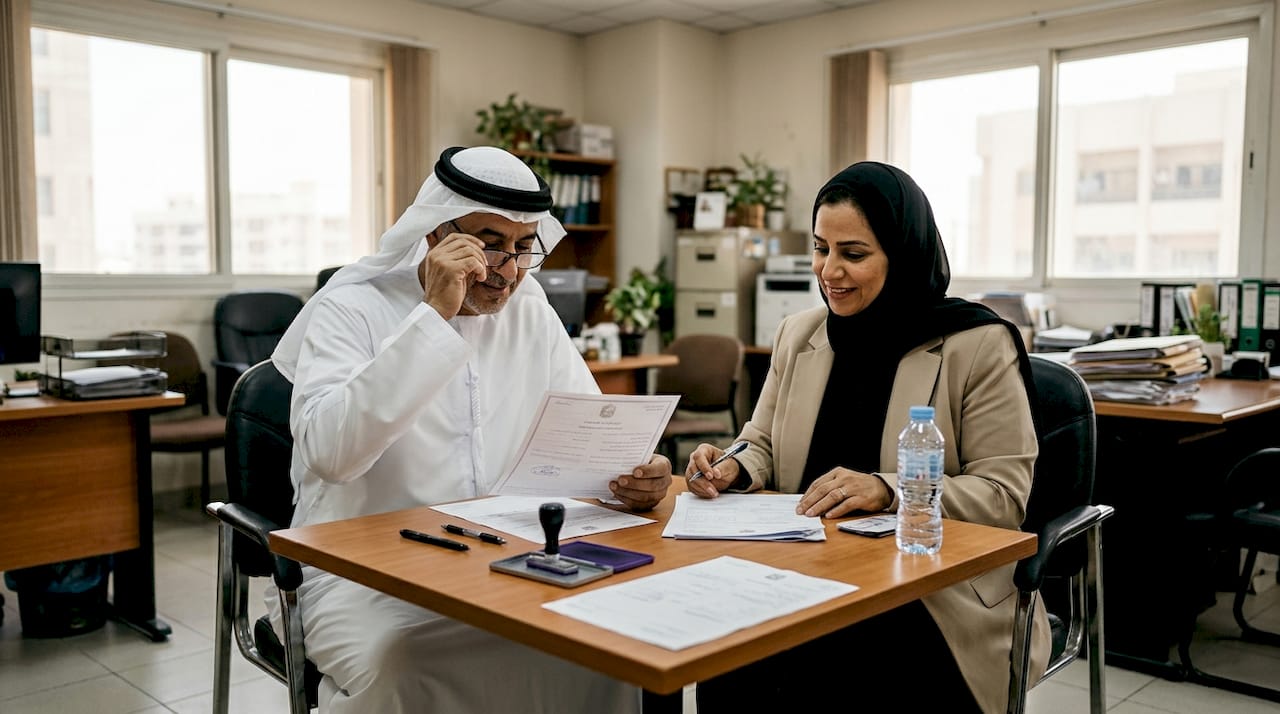
A notarized marriage certificate is a marriage certificate that has undergone notarization, where a notary public verifies the authenticity of signatures, seals, and document execution to prevent fraud. The notary is not confirming that your marriage is valid under UAE law. They are confirming that the document itself is genuine and was properly signed and executed.
This distinction matters enormously. Many couples assume notarization and attestation are the same thing. They are not.
Notarization vs. attestation: what’s the difference?
Notarization is the first step. It confirms the document’s authenticity at the source. Attestation is the broader process that follows, involving multiple government bodies validating the document for use in a specific country. Think of notarization as the foundation and attestation as the building on top of it. Skipping the foundation means the whole structure collapses.
Here’s what a notary public actually checks and confirms:
The identity of the signatories on the document
The authenticity of official seals and stamps
That the document was signed voluntarily and in the correct legal format
That signatures match official identification documents
That no visible alterations or tampering has occurred
Notarization comes first in the legal chain because every subsequent step (Ministry of Justice, MOFA, embassy) depends on the document having been verified at source. Authorities further up the chain will not process a document that hasn’t been notarized correctly.
Important: Notarization confirms signatures and document execution. The full attestation chain is what validates a certificate for UAE legal use, such as visa applications or property transactions. Many couples confuse the two, submitting notarized documents to MOFA and expecting immediate acceptance, only to discover that additional attestation steps were required. This confusion is one of the most common reasons for rejection. You can read more about the full marriage certificate attestation steps to see how each stage connects.
Where and when is notarization required for UAE marriage certificates?
Not every couple in the UAE needs to notarize their marriage certificate for the same reasons. The requirements depend on whether your certificate was issued in the UAE or abroad, and what you plan to use it for.
UAE-issued civil marriage certificates are valid domestically post-registration without initial notarization, but MOFA notarization is recommended for international use. Islamic marriage certificates follow a slightly different path depending on the emirate where the marriage was registered.

Here’s a quick comparison to help you see where you stand:
Certificate type | Issued in UAE | Issued abroad | Notarization needed? | Special steps |
Civil marriage | Yes | No | Recommended for international use | MOFA attestation for overseas use |
Islamic marriage | Yes | No | Sometimes required by receiving country | Sharia court authentication first |
Foreign civil marriage | No | Yes | Yes, in issuing country first | Home MFA, UAE embassy, then UAE MOFA |
Foreign Islamic marriage | No | Yes | Yes, in issuing country first | Certified translation often required |
For foreign certificates, the sequence is non-negotiable:
Notarize the certificate in the country where it was issued
Get it authenticated by the Ministry of Foreign Affairs (MFA) in that country
Submit it to the UAE embassy or consulate in that country
Upon arrival in the UAE, complete MOFA attestation
This sequence applies whether you’re using the certificate for a family visa, a property purchase, or school enrollment for children. Each use case may also require additional supporting documents, so confirm requirements early with the relevant authority.
The UAE marriage certificate process and civil marriage requirements vary by emirate, so always verify the specific rules for Abu Dhabi or Dubai before starting.
Pro Tip: Confirm your certificate’s language and format before anything else. If it’s not in Arabic or English, you’ll need a certified translation before notarization, and arranging this late in the process can add weeks to your timeline.
The step-by-step UAE notarization and attestation pathway
Once you know you need notarization, the process itself follows a clear sequence. The problem is that most couples only discover the full chain after they’ve already made a mistake somewhere in it.
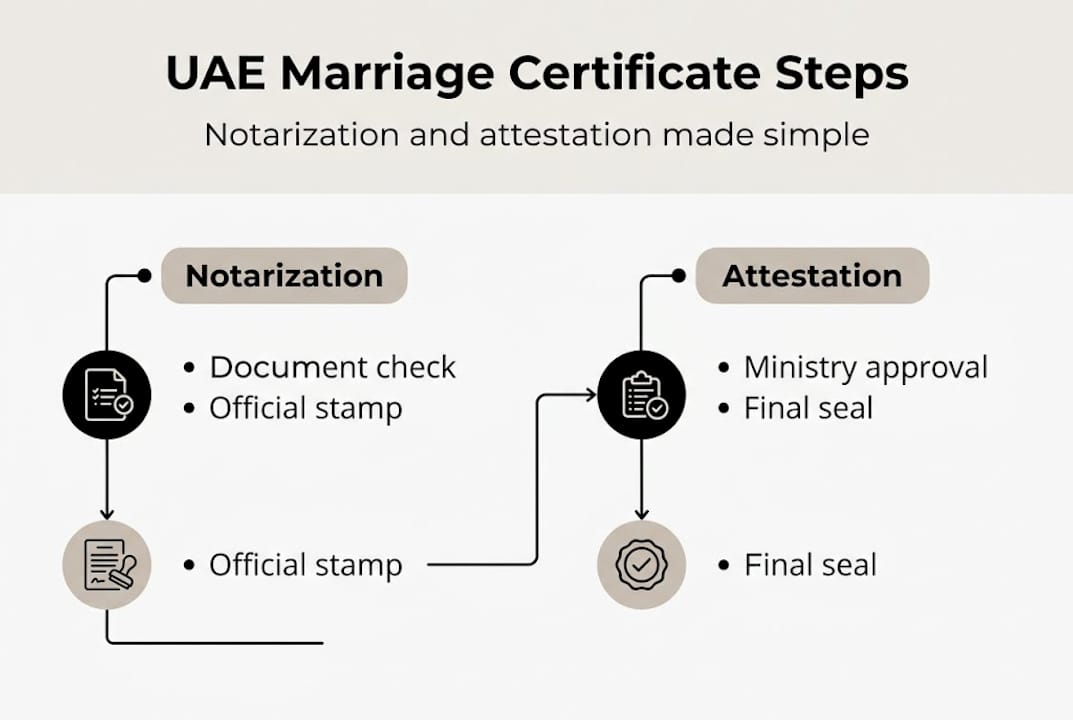
Notarization is the initial step in the UAE marriage certificate authentication process, typically followed by Ministry of Justice attestation, MOFA attestation, and sometimes embassy legalization for foreign certificates.
Here’s the full pathway:
Notarization at a licensed notary public (in the issuing country for foreign certificates)
Ministry of Justice (MOJ) attestation to confirm the notary’s credentials
Ministry of Foreign Affairs (MOFA) attestation for international recognition (fee: AED 150)
Embassy or consulate legalization if the certificate will be used in a third country
Here’s what you need at each stage:
Stage | Typical timeline | Fee (approx.) | Documents required |
Notarization | 1 to 3 days | Varies by notary | Original certificate, valid passport or Emirates ID |
MOJ attestation | 3 to 7 days | AED 100 to 150 | Notarized certificate, ID copies |
MOFA attestation | 3 to 5 days | AED 150 | MOJ-attested certificate, passport copy |
Embassy legalization | 5 to 15 days | Varies by country | MOFA-attested certificate, additional country-specific docs |
The most common mistakes at this stage include submitting documents out of sequence, presenting a certificate without a certified translation when one is needed, and assuming that a notarized document alone is sufficient for MOFA submission. It is not.
You can find a detailed breakdown of getting a UAE marriage certificate and a useful marriage certificate checklist to cross-reference your documents before submission.
Pro Tip: Using a professional attestation service can prevent up to 8 weeks of delay caused by sequence errors or incomplete documentation. For UAE expats juggling work and relocation timelines, this is rarely a risk worth taking alone.
Avoiding rejection: Common pitfalls and troubleshooting
Even couples who understand the process get tripped up by details. The difference between a smooth approval and a frustrating rejection often comes down to specifics that no one warned them about.
Here are the most common pitfalls to watch for:
Language and translation errors: Documents not in Arabic or English must be translated by a UAE-certified translator before submission. An uncertified translation will be rejected outright.
Skipping the notary step: Some couples go directly to MOFA with a foreign certificate, assuming registration is enough. It is not.
Damaged or altered documents: Certificates with tears, corrections, or faded text are routinely rejected. Always request a fresh certified copy from the issuing authority.
Relying on apostille alone: The UAE is not a member of the Hague Apostille Convention, so an apostille is invalid as a standalone authentication for use in the UAE.
Name mismatches: If your name appears differently on your marriage certificate versus your passport, even by a single letter, this triggers automatic rejection.
Name mismatches and altered certificates are among the most frequent causes of rejection. The UAE requires that all names match exactly across every document in your submission. A middle name included on one document but absent from another is enough to cause a problem.
Understanding the difference between attestation and notarization is also essential before you start, since mixing up these steps is a leading cause of rejected applications. For attestation for global use, the requirements become even more specific depending on the destination country.
Pro Tip: Before submitting anything, triple-check every name, date, and seal across all documents. Have a second person review them too. A fresh set of eyes catches errors that familiarity makes invisible.
A hard truth: Why proper notarization planning saves UAE couples time (and heartache)
Here’s something most guides won’t tell you: the couples who struggle most with notarization are not the ones who don’t understand the process. They’re the ones who understood it but thought they had more time.
Document preparation is almost always treated as the final item on the wedding checklist. Venue, catering, photography, then paperwork. But in the UAE, where attestation delays of 3 to 8 weeks from errors like sequence skips or mismatches are common, that mindset creates real hardship.
We’ve seen couples delay family visa applications by months because they started the notarization process after the wedding instead of alongside it. We’ve seen property transactions fall through because a certificate wasn’t attested in time for a closing deadline. These are not rare edge cases. They are the norm for couples who treat documentation as an afterthought.
The uncomfortable truth is that notarization is not bureaucratic box-ticking. It is a legal safeguard that determines whether your marriage is recognized for the purposes that matter most, such as residency, inheritance, and property rights. Starting UAE marriage registration steps early, ideally as soon as wedding planning begins, is the single most effective thing you can do to protect yourself from avoidable delays.
Get support with notarization and UAE marriage services
Navigating the notarization and attestation process on your own is possible, but it’s rarely straightforward. One missed step or mismatched document can set you back weeks.
At Harris & Charms, we handle the full range of UAE marriage services, from civil and Islamic wedding coordination to notarization support, certified translations, and complete attestation management. Whether your certificate was issued in the UAE or abroad, we know exactly what each authority requires and how to get it right the first time. If you’re unsure where to start or have already hit a snag, get guidance with documents from our team and we’ll map out the fastest, cleanest path forward for your specific situation.
Frequently asked questions
Can I use a notarized marriage certificate for UAE family visa applications?
Yes, but notarization alone is not enough. For family visa use, the certificate must also be attested by the Ministry of Foreign Affairs after notarization to be accepted by UAE immigration authorities.
Is notarization required for UAE-issued marriage certificates?
Not for domestic use. UAE-issued civil certificates are valid within the UAE after registration, but MOFA notarization is strongly recommended if you intend to use the certificate in another country.
What documents do I need for notarizing my marriage certificate?
You need the original marriage certificate, valid passports or Emirates IDs, certified translations if the document is not in Arabic or English, and visa copies if relevant to your application.
Does an apostille authentication work for marriage certificates in the UAE?
No. An apostille is not valid as standalone authentication in the UAE because the country is not a member of the Hague Apostille Convention. Full attestation through the correct UAE channels is required instead.
Recommended
Comments