
UAE Marriage Application Comparison: Expat Guide to Every Route

Updated: Aug 31

TL;DR:
Most UAE non-Muslim couples choose Abu Dhabi Civil Family Court for quick, accessible marriage processing, with an express option guaranteed within one working day. Dubai residents with all documents prepared can obtain a 24-hour civil license, but eligibility depends on residency status, and each route requires thorough attestation, especially for US recognition. Muslim couples must follow Sharia procedures, while marrying abroad then attesting documents remains a fallback option with a lengthy attestation chain.
If you’re a tourist in the UAE with a tight travel window, Abu Dhabi Civil Family Court’s express service offers a fast option processed within one working day. Dubai residents with all documents already in hand can use Dubai Courts’ 24-hour civil licence. Muslims and mixed-faith couples involving a Muslim partner follow Sharia personal-status procedures under separate rules. If none of those fit, marrying in your home country and attesting the certificate in the UAE is a legitimate fallback.
The three trade-offs that drive every decision in this UAE marriage application comparison:
Speed: Abu Dhabi express beats everything at one working day guaranteed; Dubai’s 24-hour option is faster on paper but depends entirely on document readiness.
Eligibility: Dubai civil marriage requires at least one party to be a Dubai resident; Abu Dhabi’s civil route is open to tourists and residents alike.
Downstream recognition: Every route requires MOFAIC attestation for the certificate to work internationally, including in the US. The UAE is not in the Hague Apostille Convention, so apostilles alone won’t cut it.
Before you book anything, confirm two things: your eligibility under the relevant emirate’s rules, and what attestation chain your home country (or the US) will require.
Table of Contents of UAE Marriage Application Comparison
What are the real UAE marriage options for expats?
Four distinct routes exist, and they don’t overlap cleanly. Understanding which legal framework governs each one saves a lot of wasted effort.
Abu Dhabi Civil Family Court
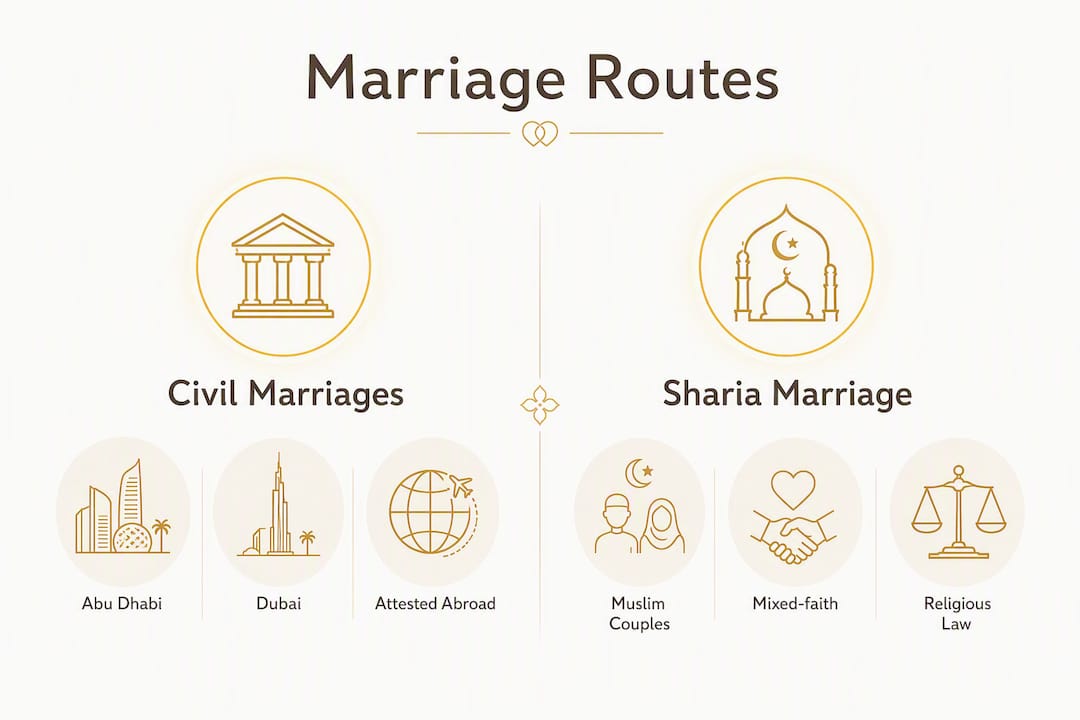
This is the most accessible civil route for non-Muslims, including tourists. The Abu Dhabi Judicial Department (ADJD) offers two service tiers: a regular service processed within approximately 10 working days, and an express service processed within one working day. Tourists can initiate the application remotely through the ADJD portal but must be physically present for the ceremony once approved. Federal Decree-Law No. 41 of 2022 governs civil personal-status matters for non-Muslims at the federal level, making Abu Dhabi’s civil court the primary venue for this framework.

Dubai civil marriage
Dubai Courts offers a civil marriage licence that can be issued within 24 hours for eligible couples. The catch: at least one party must be a Dubai resident, and minimum age requirements apply (21 in most Dubai guidance). If you’re both tourists or neither of you holds a Dubai residency visa, this route is closed to you. The speed advantage is real, but only when every required document is already certified, attested, and translated.

Sharia (Nikah) marriage
Muslim couples, and mixed-faith situations where one partner is Muslim, are directed to Sharia personal-status procedures. These operate under different rules entirely: a wali (guardian) and witnesses are required, mahr (dowry) is part of the contract, and the legal outcomes for divorce, custody, and inheritance follow Islamic law rather than civil frameworks. The Personal Status Law was updated in 2024 and applied from April 2025 for Sharia matters. Non-Muslims cannot use this route.
Marrying abroad, then attesting
Some couples marry in their home country or a third country and then attest the certificate for use in the UAE. This works, but the attestation chain is long: local authentication in the origin country, foreign ministry endorsement, UAE embassy attestation in the origin country, and finally MOFAIC attestation inside the UAE. It’s a reasonable option when neither party qualifies for a UAE civil route or when the home-country ceremony carries more personal significance.
Eligibility at a glance:
Non-Muslims (any nationality): Abu Dhabi civil or Dubai civil (residency rules apply)
Muslims: Sharia/Nikah procedure at a personal-status court
Tourists without Dubai residency: Abu Dhabi civil only (or marry abroad)
UAE nationals: subject to additional nationality-specific requirements
Minimum age: generally 18 for civil marriage; 21 cited in some Dubai guidance
Prior marriage: divorce or death certificate required and must be attested
The official UAE government portal, ADJD, Dubai Courts, and the Ministry of Justice are the governing sources for each route. Check them directly before acting on any third-party summary, including this one.
How do Abu Dhabi, Dubai, and marrying abroad compare?
Dimension | Abu Dhabi Civil (Regular) | Abu Dhabi Civil (Express) | Dubai Civil | Marry Abroad + Attest |
Processing speed | ~10 working days | 1 working day | 24-hour licence (if docs ready) | Depends on home-country timeline |
Eligibility / legal framework | Non-Muslims; tourists and residents | Non-Muslims; tourists and residents | Non-Muslims; one party must be Dubai resident | Any couple; UAE attestation required after |
Court / service fee | AED 300 | AED 2,500 | Not publicly listed; verify directly with Dubai Courts | Home-country fees vary |
Key pre-steps | Single-status cert, translation, attestation | Same as regular, expedited | Same docs; Dubai residency visa required | Full attestation chain post-ceremony |
Ceremony location | Abu Dhabi Family Court | Abu Dhabi Family Court | Dubai Courts | Home country / third country |
Using certificate in the US | MOFAIC attestation + certified translation | MOFAIC attestation + certified translation | MOFAIC attestation + certified translation | Origin-country auth + UAE embassy + MOFAIC |
Important: The UAE is not part of the Hague Apostille Convention. An apostille stamp from your home country does not replace the full attestation chain. Every foreign document used in a UAE court must pass through local authentication, foreign ministry endorsement, UAE embassy attestation, and MOFAIC attestation inside the UAE. Skipping any step renders the document invalid.
Abu Dhabi’s express service at AED 2,500 is the only route with a guaranteed one-working-day turnaround. Dubai’s 24-hour licence is faster on paper, but the practical bottleneck is document readiness. If your embassy single-status certificate takes two weeks to process, the “24-hour” label becomes misleading.
How do you actually apply? Step-by-step checklist
The workflow looks complex, but it follows a logical sequence. Work through it in order and you won’t miss anything critical.
Confirm eligibility. Check your religion, residency status, nationality, age, and prior-marriage status against the requirements for your chosen route (ADJD for Abu Dhabi, Dubai Courts for Dubai).
Obtain a single-status certificate. Contact your home country’s embassy or consulate in the UAE. This document confirms you are legally free to marry. Processing times vary widely by nationality.
Attest all foreign documents. Follow the full chain: local authentication in origin country → foreign ministry endorsement → UAE embassy attestation in origin country → MOFAIC attestation inside the UAE.
Translate and notarize. All documents not in Arabic must be translated by a UAE-certified legal translator and notarized. Keep certified copies; courts typically require originals plus copies.
Submit the application. For Abu Dhabi, use the ADJD online portal (tourists can apply remotely). For Dubai, submit in person at Dubai Courts. Select regular or express service at this stage.
Attend the ceremony. Both parties must be physically present. Bring two witnesses. For Abu Dhabi express, you can select your ceremony date when booking.
Collect the marriage certificate. Receive the official certificate from the court. If you need it for use outside the UAE, proceed to MOFAIC attestation of the issued certificate.
Document checklist
Document | Who issues it | Typical extra cost |
Valid passport (both parties) | Home-country government | None |
Emirates ID (if resident) | ICA / GDRFA | None |
Single-status certificate | Home-country embassy/consulate in UAE | AED 100–400 (varies by embassy) |
Birth certificate (attested) | Home-country authority + attestation chain | Attestation fees vary |
Divorce certificate (if previously married) | Court of origin + attestation chain | Attestation fees vary |
Death certificate of former spouse (if widowed) | Issuing authority + attestation chain | Attestation fees vary |
Certified Arabic translation of all foreign docs | UAE-licensed legal translator | AED 50–200 per document |
Medical report (required for Muslims per MOJ) | UAE-approved medical center | Varies |
Prenuptial agreement notarization (optional) | ADJD notary | AED 950 |
For the legal marriage steps in the UAE, the single-status certificate and attestation chain are consistently the longest lead-time items. Start them first, not last.
Regional notes: Dubai requires at least one party to hold a Dubai residency visa; a power of attorney (POA) is generally not accepted for the ceremony itself, though some pre-filing steps may allow a representative. Confirm POA rules directly with the relevant court before relying on one.
What do fees and timelines actually look like?
Published fees:
Abu Dhabi regular service: AED 300
Abu Dhabi express service: AED 2,500
Abu Dhabi prenuptial agreement notarization: AED 950 (if applicable)
Dubai Courts civil marriage fee: not publicly listed; verify directly with Dubai Courts before budgeting
Single-status certificate (embassy): AED 100–400 depending on your consulate
Certified Arabic translation: AED 50–200 per document
MOFAIC attestation of issued certificate: fees apply; check the MOFAIC portal for current rates
Realistic end-to-end timelines:
Abu Dhabi regular: approximately 10 working days from complete application, plus embassy and attestation lead time
Abu Dhabi express: 1 working day from complete application, plus embassy and attestation lead time
Dubai 24-hour licence: 24 hours from submission, but only if all documents are already fully attested and ready
Marrying abroad: depends entirely on home-country and embassy timelines, plus the UAE attestation chain afterward
The gap between the “official” processing time and the real-world timeline is almost always the embassy. A single-status certificate from some consulates takes two to four weeks. If you’re planning around a travel window, that’s the number to nail down first, not the court’s processing time.
Pro Tip: Book your embassy appointment for the single-status certificate before you book your court date. Embassy queues are the most common reason couples miss their planned ceremony window, and no amount of express-service upgrades will fix a document that hasn’t arrived yet.
For a full marriage checklist for expats, including document formats and timeline planning, review the detailed guide before you start gathering paperwork.
How is a UAE civil marriage recognized in the United States?
UAE civil and court-issued marriage certificates are recognized in the US once they are correctly attested and translated. The process has a specific sequence, and missing one step means starting over.
The attestation chain for UAE-issued certificates used in the US:
Obtain the original marriage certificate from the UAE court (ADJD or Dubai Courts).
Get MOFAIC attestation of the UAE-issued certificate inside the UAE.
Have the certificate translated into English by a certified translator (if not already bilingual).
Depending on the US state or federal agency, you may also need notarization of the translation.
Because the UAE is not in the Hague Apostille Convention, there is no shortcut here. The MOFAIC attestation step is what US agencies and immigration authorities accept as the equivalent of an apostille for UAE-origin documents.
Practical US uses and what each requires:
Social Security name change: Submit the attested, translated marriage certificate to your local SSA office along with your current ID.
US passport name change: File Form DS-5504 or DS-82 with the attested, translated certificate as supporting documentation.
US immigration (I-130/I-485 for spousal green card): USCIS requires the original or certified copy of the marriage certificate, a certified English translation, and evidence of a bona fide marriage. MOFAIC attestation strengthens the document’s credibility with adjudicators.
Home-state vital records: Some states require you to register a foreign marriage with the county clerk. Requirements vary; check your specific state.
Common pitfalls that cause US rejection:
Missing MOFAIC attestation (the most frequent error)
Name spellings that differ across the passport, marriage certificate, and translation
Incomplete attestation chain for documents originally issued outside the UAE
Certificates that list different dates or locations than supporting documents
Untranslated fields, even minor ones, on a bilingual certificate
For couples using the certificate for US immigration, the civil vs Islamic marriage impact on UAE expats matters beyond just the certificate itself. Civil marriage produces a secular legal record that US agencies handle more straightforwardly than a Nikah contract, which may require additional explanation or supporting documentation.
Pros, cons, and which route fits your situation
Abu Dhabi civil marriage
Pros: Open to tourists and residents; two clear service tiers; express option is the most reliable guaranteed fast route; ADJD portal allows remote pre-application.
Cons: Express fee (AED 2,500) is steep for budget-conscious couples; regular service takes up to 10 working days; both parties must be physically present for the ceremony.
Dubai civil marriage
Pros: 24-hour licence is the fastest option when documents are ready; well-suited for Dubai residents with established document files.
Cons: Requires at least one Dubai resident; tourists are excluded; the 24-hour timeline is only realistic when all attestations are already complete.
Sharia (Nikah) marriage
Pros: Legally required for Muslim couples; religiously recognized; well-established procedure with clear court processes.
Cons: Not available to non-Muslims; legal outcomes for divorce, custody, and inheritance follow Islamic law, which may not align with expat expectations; requires wali and witnesses.
Marrying abroad, then attesting
Pros: Ceremony in a meaningful location; useful when neither party qualifies for a UAE civil route; home-country legal framework may be more familiar.
Cons: Longest total timeline; full attestation chain required; more moving parts and higher total cost.
Scenario matching:
Tourist couple, tight travel window: Abu Dhabi express. Start the single-status certificate process at least three weeks before your planned ceremony date.
Dubai resident couple, all documents ready: Dubai Courts 24-hour licence. Confirm residency requirement and document checklist with Dubai Courts directly.
Mixed-faith couple (one Muslim): Sharia personal-status court. Consult a UAE family law specialist before proceeding, as the legal framework differs significantly from civil marriage.
Couple needing a US-recognized certificate for immigration: Abu Dhabi civil (regular or express) followed by MOFAIC attestation. The secular civil certificate is the cleanest document for USCIS purposes.
Special cases worth flagging: Applicants under 21 face additional restrictions in Dubai. UAE nationals are subject to nationality-specific requirements beyond what applies to expats. Mixed-citizenship couples with inheritance or estate planning concerns should get legal advice before choosing a route, since civil and Sharia frameworks produce materially different inheritance outcomes.
How do you choose the right route?
Work through these questions in order. The answer to the first one that eliminates a route narrows your decision immediately.
Are either of you Muslim? If yes, Sharia procedures apply. Stop here and consult a UAE personal-status court or a qualified family lawyer.
Does at least one of you hold a Dubai residency visa? If yes, Dubai Courts’ 24-hour option is available. If no, Abu Dhabi civil is your UAE option.
Do you have a firm travel window under two weeks? If yes, Abu Dhabi express (AED 2,500) is the only route with a guaranteed one-working-day turnaround. Budget for it.
Is the certificate going to be used for US immigration or a name change? If yes, confirm MOFAIC attestation is in your plan before you start. This step cannot be skipped.
Is budget the primary constraint? Abu Dhabi regular at AED 300 is the lowest-cost UAE civil option, but factor in embassy and translation costs before assuming it’s cheap.
Are your documents already fully attested and translated? If not, add two to four weeks minimum for embassy processing before any court date.
Questions to ask the court or your consulate before applying:
What is the current processing time for my specific nationality?
Does my country’s embassy in the UAE issue single-status certificates, or must I obtain one from my home country?
Is a power of attorney accepted for any pre-filing steps?
What translation format does the court require (certified, notarized, or both)?
Three quick profiles:
Speed-first (tourist, two-week window): Abu Dhabi express. Confirm embassy single-status certificate availability immediately. If the embassy queue exceeds your window, consider whether marrying abroad before arrival is more practical.
Cost-first (resident, flexible timeline): Abu Dhabi regular at AED 300, or Dubai Courts if you hold Dubai residency. The savings over express are real, but only if you can absorb a 10-working-day wait.
Legal-recognition-first (US immigration): Abu Dhabi civil, followed by MOFAIC attestation and certified English translation. The secular civil record is the most straightforward document for US federal agencies.
Practitioner tips that save time and money
Pro Tip: Start the attestation chain the moment you decide to marry in the UAE. The single-status certificate from your embassy is the longest lead-time item in the entire process. Book that appointment before you touch anything else.
Time-saving moves experienced applicants use:
Use the ADJD tourist portal for Abu Dhabi applications; it allows remote pre-submission and date selection for the express service.
Pre-translate and notarize all documents before submitting the application. Courts will not process incomplete files, and resubmitting costs time.
Have certified copies of every document ready. Courts typically require originals plus two or three copies; showing up with only originals causes delays.
Use the express service only when the timeline genuinely requires it. At AED 2,500 versus AED 300, the premium is significant. If your documents are ready and you have 10 working days, the regular service is the smarter spend.
Verify the MOFAIC attestation fee and current processing time before your court date. Attestation of the issued certificate is a post-ceremony step many couples forget to budget for.
Commonly overlooked items that cause rejections or delays:
Name mismatches across passport, birth certificate, and marriage certificate (even minor transliteration differences)
Incomplete attestation chains, particularly missing the UAE embassy attestation step in the origin country
Embassy processing delays for single-status certificates, especially from consulates with limited UAE staff
Expired documents submitted at the time of application
Assuming a Dubai residency visa from a family member (rather than your own) satisfies the residency requirement
When to hire a service versus doing it yourself: if your documents involve multiple countries, prior marriages, or you need the certificate for US immigration, the attestation chain has enough complexity that a professional document-clearing service pays for itself in avoided errors. For straightforward cases where both parties hold the same nationality and have clean document files, the DIY route through the ADJD portal is manageable.
What’s the verdict, and what should you do next?
For most non-Muslim expats and tourists, Abu Dhabi Civil Family Court is the most practical and accessible route. Tourists use the express service when speed matters; residents with more time use the regular service to save AED 2,200. Dubai residents with complete document files can use Dubai Courts’ 24-hour option, but only if the residency requirement is met. Sharia marriage is the correct path for Muslim couples and is not interchangeable with civil routes.
Three steps to take right now:
Check eligibility on the relevant court portal. ADJD for Abu Dhabi, Dubai Courts for Dubai. Confirm your nationality, residency status, and religion against current requirements before gathering a single document.
Start the attestation and translation chain. Contact your embassy for the single-status certificate today. Simultaneously identify a UAE-certified legal translator for your documents.
Book your application or contact a trusted service. Once documents are in motion, book your court date (or express slot) on the official portal. If the process feels complex, a professional service can handle the filing and attestation coordination.
Verify current fees and processing times directly on the official portals before making any payment. Fees and eligibility rules can change, and no third-party guide, including this one, replaces a direct check with ADJD, Dubai Courts, or MOFAIC.
Key Takeaways
Abu Dhabi civil marriage is the most accessible UAE route for non-Muslim expats and tourists, with a guaranteed one-working-day express option at AED 2,500 and a 10-working-day regular option at AED 300.
Point | Details |
Best route by situation | Tourists use Abu Dhabi civil; Dubai residents with full docs use Dubai Courts; Muslims use Sharia procedures. |
Express vs regular cost | Abu Dhabi express costs AED 2,500 (1 working day); regular costs AED 300 (~10 working days). |
Embassy is the real bottleneck | Single-status certificates take days to weeks; book the embassy appointment before the court date. |
US recognition requires MOFAIC | UAE is not in the Hague Apostille Convention; MOFAIC attestation is mandatory for US use. |
Harrisandcharms full-service option | Harrisandcharms handles civil marriage packages, attestation, and document clearing for Abu Dhabi and Dubai routes. |
What the case files actually teach you
Most couples who struggle with UAE marriage registration don’t fail on the court steps. They fail on the preparation steps, specifically the embassy queue and the attestation chain, that nobody warned them about clearly enough.
Tourists who book Abu Dhabi express slots without first confirming their embassy’s single-status certificate timeline often find themselves paying AED 2,500 for a one-working-day service they can’t actually use yet. Dubai residents who assume the 24-hour licence means 24 hours from the moment they decide to marry, rather than 24 hours from the moment every document is certified and in hand, end up scrambling.
The civil versus Sharia distinction also gets underestimated. It’s not just a procedural difference. Civil marriage under Federal Decree-Law No. 41 of 2022 produces a secular legal record with predictable outcomes for divorce, custody, and inheritance under civil law. Nikah produces outcomes governed by Islamic personal-status law. For expat couples with assets in multiple countries, or for anyone planning to use the certificate for US immigration, that distinction has real financial and legal consequences. Choosing a route because it seems faster or simpler, without thinking through what the certificate will need to do for you in five years, is the mistake worth avoiding.
The benefits of civil vs Islamic marriage for UAE couples go well beyond the ceremony itself. Think through the downstream legal framework before you choose.
How Harrisandcharms makes the process manageable
Navigating the UAE marriage application process alone means coordinating embassy appointments, attestation chains, certified translations, court bookings, and MOFAIC filings, often across multiple countries and time zones. Harrisandcharms exists to take that coordination off your plate.

For couples who want a complete solution, Harrisandcharms offers civil marriage packages in Dubai and Abu Dhabi that cover court application support, document attestation, certified translation coordination, and ceremony logistics. For those who want more than just paperwork, the full wedding services packages include venue management, event photography, prenup photoshoots, and yacht wedding options. Golden Visa holders with specific documentation requirements and couples needing premium express filing support for Abu Dhabi or Dubai courts can request bespoke packages. Every client’s documents are handled with full confidentiality through trusted embassy and MOFAIC workflows. To get started, contact Harrisandcharms directly to discuss your timeline, nationality, and which route fits your situation.
Official sources to verify before you act
Rules, fees, and eligibility requirements change. These are the primary sources to check directly:
UAE Government Portal (u.ae): official overview of civil marriage services, eligibility, and emirate-specific differences
Abu Dhabi Judicial Department (ADJD): civil family court services, regular and express service fees, online application portal for tourists and residents
Dubai Courts: civil marriage licence requirements, residency rules, and current fee schedule
Ministry of Justice (MOJ): marriage contract services, document requirements for Muslims and non-Muslims, medical report and age rules
MOFAIC (Ministry of Foreign Affairs and International Cooperation): attestation services for UAE-issued documents intended for international use
Your home-country embassy in the UAE: single-status certificate requirements, processing times, and fees specific to your nationality
Embassy rules vary significantly by nationality. A single-status certificate that takes three days for one nationality may take three weeks for another. Always confirm directly with your consulate, not with a general guide.
Recommended
Comments