
UAE Marriage Trends 2025 – What Expats Need to Know


Choosing when and how to marry in the UAE now means weighing not just romance, but education, career goals, and evolving legal rules. For expats and modern couples, marriage in 2025 is about marrying later, focusing on career growth first, and planning with intention. This shift, shown in recent UAE statistics, makes early financial preparation and clear communication more critical than ever. If you want your ceremony and paperwork to fit your priorities, knowing these trends and legal changes will guide every next step.
Table of Contents
Key Takeaways
Point | Details |
Later Marriages | Couples in the UAE are marrying at older ages, emphasizing professional and personal development before committing. |
Smaller Families | There is a growing preference for smaller family sizes as couples prioritize career and lifestyle aspirations. |
Legal Preparations | Understanding marriage registration processes and documentation requirements is essential for a smooth experience in the UAE. |
New Legal Reforms | Upcoming changes in 2025 law will provide clearer guidelines on marriage age and guardian requirements, impacting all marrying couples. |
Defining UAE Marriage Trends for 2025
UAE marriage patterns are shifting in ways that directly affect how expats approach relationships and legal commitments in 2025. The trends emerging from recent data reveal a clear picture: couples are marrying later, planning smaller families, and prioritizing personal and professional development before taking the plunge. This isn’t just a statistical shift; it reflects deeper cultural changes across both Emirati and expatriate communities that fundamentally reshape what marriage means in this region.
The average age at first marriage has risen significantly since the 1990s, reflecting a deliberate cultural preference for completing education and building careers before marriage. Young people in the UAE now view marriage as a milestone that comes after establishing independence, not before it. For expats, this trend matters because it means your peers and potential partners likely share similar priorities around career advancement and personal achievement. You’re no longer marrying into a system where early marriage was the norm; instead, you’re entering a landscape where intentional life planning precedes commitment.
Fertility rates and family size preferences have declined considerably, influenced by factors including female economic participation, education levels, and changing lifestyle expectations. Couples today express preferences for smaller families compared to previous generations, with professionals often delaying parenthood by several years after marriage. Consider what this means for your own expectations: conversations about family planning have become more open and individualized rather than following predetermined patterns.
Later marriage ages: Average age at first marriage continues climbing, especially among university-educated individuals
Smaller family sizes: Couples deliberately choose fewer children to balance career and personal goals
Educational priorities: Higher education completion is now expected before marriage discussions begin
Female economic independence: Women’s professional participation shapes relationship dynamics and decision-making power
Stable marriage rates: Official data from 2022-2024 shows consistent marriage volumes despite demographic shifts
Official statistics from Dubai’s 2022-2024 marriage and divorce data demonstrate that while marriage rates remain stable, the composition of those marriages reflects these broader changes. Divorce rates among Emiratis have shown modest declines, suggesting that the longer courtship periods and mature decision-making of older couples may contribute to more stable unions. When examining legal implications affecting marriage in the UAE, understanding these demographic trends provides context for why certain protections and documentation processes exist.
The cultural shift toward delaying marriage creates practical implications for expats. You’re entering a system where marriage is increasingly viewed as a partnership between two established individuals rather than a transition into adulthood. This means financial independence, career stability, and compatibility discussions happen before engagement. It also means legal documentation and marital agreements are taken more seriously because couples have more assets, clearer expectations, and defined professional commitments to protect.
The trend toward later marriage ages and smaller families reflects deliberate life planning—not hesitation about commitment itself. Couples are making more intentional choices about when and how to marry.
What makes 2025 particularly significant is that these trends have stabilized into expected norms rather than exceptions. A 35-year-old first-time bride or groom is no longer unusual in professional circles. Couples without immediate plans for children aren’t viewed as unusual. The expatriate community, drawn to the UAE for economic opportunity, naturally aligns with these values around career and education-first priorities.
For your planning purposes, recognize that the 2025 marriage landscape favors couples who’ve already established their professional and personal foundations. Whether you’re navigating civil marriage registration or planning an Islamic marriage ceremony, the expectation is that both parties enter with clarity about their lives, finances, and long-term goals. This cultural context shapes everything from how you approach pre-marital discussions to how legal authorities view your application.
Pro tip: Document and discuss your individual financial situations, career timelines, and family planning goals before approaching marriage registration—modern UAE trends show couples who’ve had these conversations experience smoother legal processes and stronger relationships.
Civil Versus Islamic Weddings Explained
The UAE operates under a dual legal system that recognizes two distinct types of marriages: civil marriages for non-Muslims and Islamic marriages governed by Sharia law. Understanding which path applies to you is fundamental because it determines your eligibility, the registration process, legal protections, and even how your marriage is recognized internationally. The UAE introduced civil marriage through Federal Decree Law No. 41 of 2022, making it the first Gulf Cooperation Council country to offer this option. This change reflects the nation’s commitment to accommodating its diverse expatriate population while maintaining Islamic legal principles for Muslim residents.
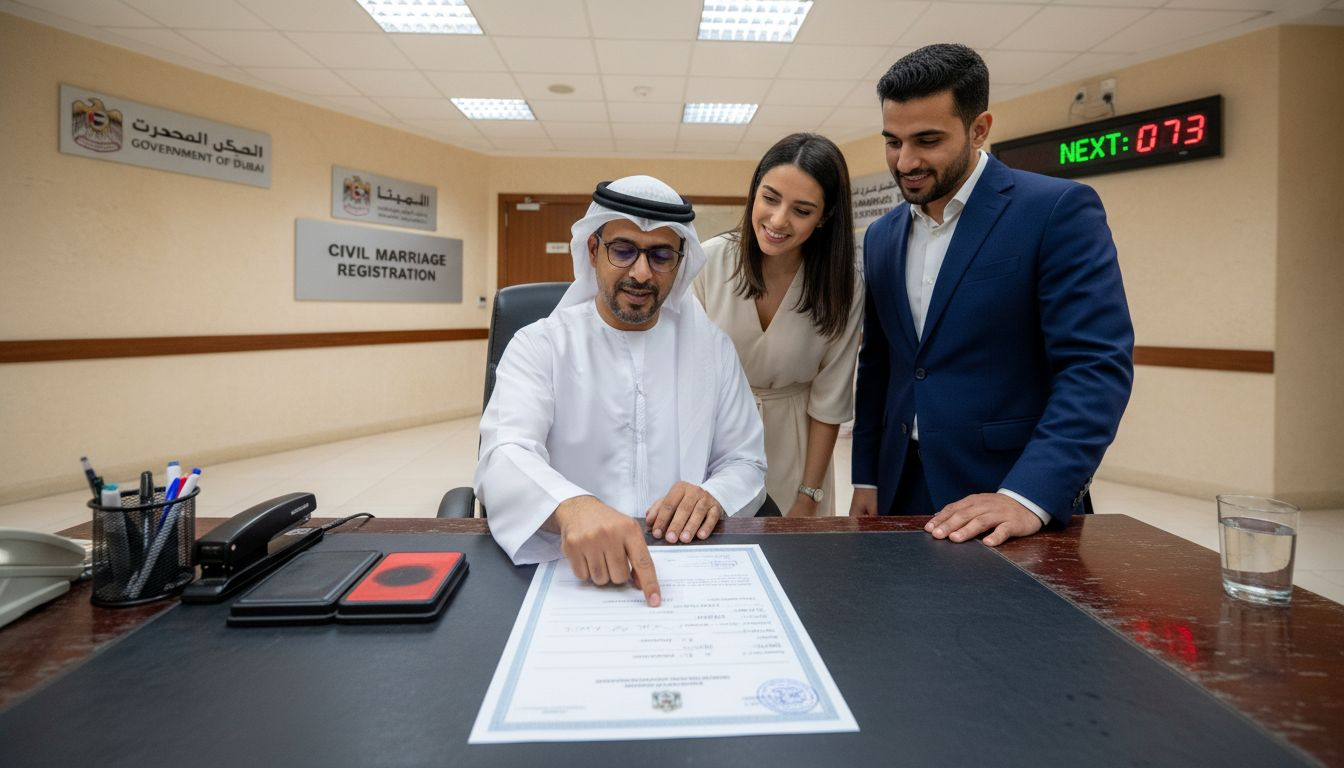
Civil marriage in the UAE is a secular contract registered without religious ceremonies or Islamic rites. It’s available to non-Muslim residents who want a legally recognized marriage within the UAE system. The process is straightforward: both parties sign a civil marriage contract before an official registrar, and the union is recorded in the civil registry. No religious officiant is required, and the ceremony itself can be as simple or elaborate as you choose—the legality depends on the registration, not the celebration. For expats, civil marriage means your union receives full legal recognition under UAE law for purposes like immigration sponsorship, inheritance rights, and property ownership.
Islamic marriage, by contrast, follows Sharia law principles and applies to Muslim couples. These marriages involve specific requirements rooted in Islamic jurisprudence, including the presence of witnesses, consent of both parties (and sometimes guardian involvement), and in many cases, a formal wedding ceremony conducted by an Islamic official. Islamic marriages are governed by personal status laws that address not just the marriage itself, but divorce, inheritance, and custody matters. The legal framework for Islamic marriages is more complex because it intertwines religious and civil law, with personal status affairs handled through specialized Islamic courts.
Key Differences at a Glance
Civil Marriage: Secular contract; non-Muslims; registered without religious rites; simpler documentation; full property and inheritance rights
Islamic Marriage: Religious and legal contract; Muslims; governed by Sharia law; witnesses and officiant required; personal status matters handled by Islamic courts
Eligibility: Civil marriages require at least one party to be non-Muslim; Islamic marriages require Muslim parties
Registration Process: Civil requires civil registry documentation; Islamic requires Islamic affairs office and religious witnesses
Legal Implications: Both are fully recognized by UAE law; differ in matters of divorce, custody, and inheritance procedures
The choice between civil and Islamic marriage isn’t always yours alone to make—it depends on your religion and the UAE’s legal classification of that status. If you’re a non-Muslim, you must use civil marriage. If you’re Muslim, Islamic marriage is the standard legal path, though some Muslim expats from countries with civil marriage systems may have specific options depending on their nationality and the UAE’s bilateral agreements. Understanding the differences between Islamic and civil marriage helps clarify what documentation you’ll need and which government departments handle your case.
The practical implications extend beyond just the ceremony. Civil marriages provide certain advantages for expats: they’re often faster to process, require fewer religious prerequisites, and align with how many Western countries recognize marriage. Islamic marriages, however, offer deep integration into UAE’s legal system and may be advantageous if you plan to live permanently in the UAE or if inheritance and family matters follow Islamic principles that match your values.
Civil marriage introduced in 2022 was designed specifically for the UAE’s non-Muslim expatriate population, making marriage registration accessible without requiring conversion or religious ceremonies.
Registration timelines differ significantly. Civil marriage registration can sometimes be completed within days to weeks once documentation is submitted. Islamic marriage registration involves coordinating with Islamic affairs offices and requires specific witnesses and documentation that may take longer to arrange. Both pathways require valid identification, proof of eligibility, and often attestation of documents from your home country.
For expats planning weddings in 2025, recognizing which legal framework applies to you shapes every decision—from where you submit paperwork to how you celebrate. Many couples opt for a religious ceremony that aligns with their personal values while simultaneously handling the legal registration that makes their marriage recognized by UAE authorities. The two aren’t mutually exclusive; they’re complementary processes that serve different purposes.
Here’s a summary of how civil and Islamic marriage processes compare in the UAE:
Factor | Civil Marriage | Islamic Marriage | Business/Legal Impact |
Eligibility | Only non-Muslims | Only Muslims | Determines pathway and requirements |
Registration Authority | Civil registry office | Islamic Affairs office | Affects legal recognition internationally |
Required Documentation | Single status & embassy authentication | Marriage contract & religious docs | Impacts time and complexity of registration |
Legal Areas Governed | Property, inheritance, sponsorship | Custody, divorce, inheritance, personal status | Influences dispute resolution procedures |
Ceremony Style | Secular, flexible | Religious, formal | May change venue and guest requirements |
Pro tip: Confirm your legal marriage category with the relevant UAE authority before booking venues or arranging ceremonies—your nationality, religion, and partner’s religion determine whether you register civilly or islamically, and this affects your entire timeline and documentation requirements.
Updated Legal Reforms and Key Requirements
The UAE’s marriage and personal status law landscape is undergoing the most significant transformation in decades. Effective April 15, 2025, Federal Decree Law No. 41 of 2024 introduces sweeping changes that directly impact how you marry, whom you can marry, and what protections exist for you and your family. These reforms aren’t marginal tweaks—they fundamentally reshape marriage eligibility, guardian requirements, age protections, and custody rights. For expats planning to marry in 2025, understanding these changes is non-negotiable because they affect your eligibility, documentation timeline, and legal protections.
The most transformative change is the establishment of a uniform marriage age of 18 years old, eliminating previous exceptions that allowed younger marriages under specific circumstances. This standardization provides clarity and protection across the board. Additionally, the reforms address guardian approval by allowing non-citizen Muslim women to marry without guardian consent if their home country laws permit it—a major shift toward individual autonomy. The UAE now recognizes that many Muslim women from Western countries or progressive nations operate under different family law systems, and the reforms accommodate this legal pluralism.
The reforms introduce judicial oversight for marriages with age gaps exceeding 30 years, requiring court approval before such unions can be registered. This protective measure addresses concerns about power imbalances and exploitation while respecting adult autonomy. Courts will evaluate whether the marriage is consensual and not exploitative before granting approval. For expats, this means if you’re significantly older or younger than your partner, expect additional documentation and possibly a brief court review—but the marriage isn’t prohibited, just scrutinized for legitimacy.
Major Changes Taking Effect April 2025
Uniform marriage age: 18 years minimum, no exceptions (previously had conditional exceptions)
Guardian consent flexibility: Non-citizen Muslim women can marry without guardian approval if their home law permits
Age gap protection: Marriages with 30+ year gaps require court approval
Expanded civil marriage: Non-Muslims gain broader options for civil marriage registration
Enhanced custody rights: Extended to age 18 with children’s preferences considered from age 15 onward
Engagement regulations: Clearer rules on engagement contracts and marital home rights
Polygamy clarification: Refined provisions ensuring transparency and consent
Custody provisions have expanded significantly. Previously, custody often transferred at age 11 or 13. Under the new framework, custody extends to age 18, and critically, courts must consider children’s preferences from age 15 onwards when determining custody arrangements. This protects children in 2025 by keeping them in stable situations longer and respecting their developing autonomy. For divorced or separating couples, this means custody disputes may be resolved differently than before.
Engagement rules have been clarified to prevent legal complications. The reforms define what constitutes a binding engagement versus a casual commitment, protecting both parties if circumstances change. Marital home regulations have also been refined to clarify rights and responsibilities regarding the family residence—important for couples managing property ownership and housing arrangements.
The April 2025 reforms represent the UAE’s commitment to modernizing family law while maintaining Islamic principles and cultural values. These changes provide more protection for vulnerable parties while expanding individual autonomy.
For expats specifically, the expansion of civil marriage options means more non-Muslims have clearer pathways to register marriages without navigating complex Islamic law provisions. The reforms also recognize diverse family structures and values among the UAE’s multinational population. If you’re planning to marry in 2025, these new requirements and protections apply to your case.
Polygamy provisions have been refined to ensure transparency. If a man intends to marry multiple women, he must disclose this to each spouse, and each spouse retains the right to include a clause in the marriage contract limiting his ability to take additional wives. This protects women from undisclosed polygamous arrangements and strengthens individual agency within marriage.
Documentation requirements may shift slightly as the new law takes full effect. Government agencies are still implementing procedures aligned with the April 2025 date, so timelines for registration may adjust. The safest approach is confirming current requirements with the relevant emirate’s marriage registration office, as different emirates sometimes have slightly different implementation timelines.
These reforms demonstrate that the UAE continues evolving its legal framework to balance tradition with modernization, religious principles with individual protection, and cultural values with practical reality for its diverse resident population. For 2025 couples, the reforms generally make marriage more accessible and protective.
Pro tip: Request an official English summary of the new marriage law requirements from your emirate’s marriage registration office before submitting documents—implementation details are still being finalized, and getting current guidance directly prevents processing delays and rejections.
Here’s a quick reference for UAE marriage legal reforms effective April 2025:
Reform Area | Previous Approach | 2025 Update | Practical Effect |
Minimum Marriage Age | Minimum 18 or younger with exceptions | Uniform minimum 18 | Clarifies eligibility, prevents child marriage |
Guardian Consent for Muslim Women | Mandatory for all Muslim women | Flexible for non-citizen Muslims | Eases process for non-citizen expats |
Age Gap Oversight | No judicial review | Court approval needed for gap >30 years | Protects against exploitation, adds scrutiny |
Custody Extension | Transfers at age 11 or 13 | Extends to age 18 | Greater child protection, autonomy |
Engagement Rules | Unclear definitions | Explicit and regulated | Reduces dispute risks, protects parties |
Marriage Documentation and Registration Procedures
Getting married in the UAE requires navigating a specific documentation process that varies slightly depending on whether you’re registering a civil or Islamic marriage. The good news: the process is systematic and predictable once you understand what documents you need and where to submit them. The UAE government requires all couples to demonstrate legal capacity, consent, age eligibility, and proof of eligibility before a marriage contract can be executed. For civil marriages, both spouses must be at least 21 years old; for Islamic marriages under the reformed 2025 law, the minimum age is now 18. Understanding these requirements upfront prevents delays and rejected applications.
The documentation process begins with gathering core identity and eligibility documents. You’ll need valid identification from both parties, typically your passport or UAE residence visa. Next, you’ll need proof of legal capacity and status, which means providing documents showing you’re not married elsewhere, not subject to marriage prohibitions, and legally able to consent to marriage. For non-Muslims registering civil marriages, this often requires a single status certificate or affidavit from your home country’s authorities, confirmed as authentic through your embassy or consulate.
Essential Documents for Marriage Registration
Valid identification: Passport or UAE residence visa for both spouses
Single status certificate: Proof you’re not married elsewhere (from home country or embassy)
Birth certificate: Original or certified copy showing age eligibility
Medical reports: Some emirates require health screening or blood tests
Attestation documents: Certificates notarized and authenticated by your home country’s embassy
Consent documentation: Written consent from both parties acknowledging the marriage
Residence proof: Proof of residency in the UAE (visa, tenancy contract, or residency document)
Translated documents: All non-English documents must be officially translated into Arabic or English
The process differs slightly between civil and Islamic marriages. For civil marriages, you submit your documents to the General Civil Court or Department of Civil Status in your emirate. The court reviews your documentation, confirms eligibility, and schedules a date for contract execution before a judge or authorized official. Once both parties sign the contract before witnesses, your marriage is legally registered. This typically takes 2-6 weeks depending on document completeness and emirate processing times.
For Islamic marriages, you work with Islamic Affairs offices and may involve a qazi (Islamic judge) to validate the marriage contract. The process includes similar documentation but adds Islamic marriage contract witnesses and may require specific religious documentation. Islamic marriage registration intersects with personal status law, so custody, inheritance, and divorce procedures flow through Islamic courts afterward.
Document authentication is critical and often causes delays. Any document issued outside the UAE must be authenticated by your home country’s embassy or consulate in the UAE. This means your single status certificate, birth certificate, and any other official documents need embassy confirmation before submission. Skip this step, and your application will be rejected. Plan for 1-3 weeks for embassy authentication, so start the process early.
Every non-UAE document requires embassy attestation—this is the most common reason applications get rejected, so submit authentication requests immediately when you begin gathering documents.
Translation requirements vary by emirate. Generally, all documents in languages other than English or Arabic must be officially translated by a certified translator recognized by the UAE. Google Translate doesn’t count. Hire a professional translator, and confirm they’re UAE-certified before submitting.
Medical requirements differ by emirate. Dubai and Abu Dhabi require blood tests or health screening to check for communicable diseases. Some emirates waive this if you provide recent medical certificates from accredited hospitals. Confirm requirements with your specific emirate’s civil court before scheduling medical appointments.
One often-overlooked requirement is proof of residence in the UAE. You’ll need to demonstrate you actually live here—a valid residence visa, tenancy contract, or utility bill typically suffices. Visitors can marry in the UAE, but residents have simpler processes.
The timeline varies significantly based on document completeness. With all documents ready and authenticated, civil marriage registration can complete in 2-4 weeks. Without proper authentication or missing documents, expect 6-8 weeks or outright rejection requiring resubmission. Islamic marriages sometimes move faster or slower depending on qazi availability and court scheduling.
Documents by Marriage Type
Civil Marriage (Non-Muslims): Single status certificate, birth certificate, identity documents, medical clearance, embassy authentication, translation
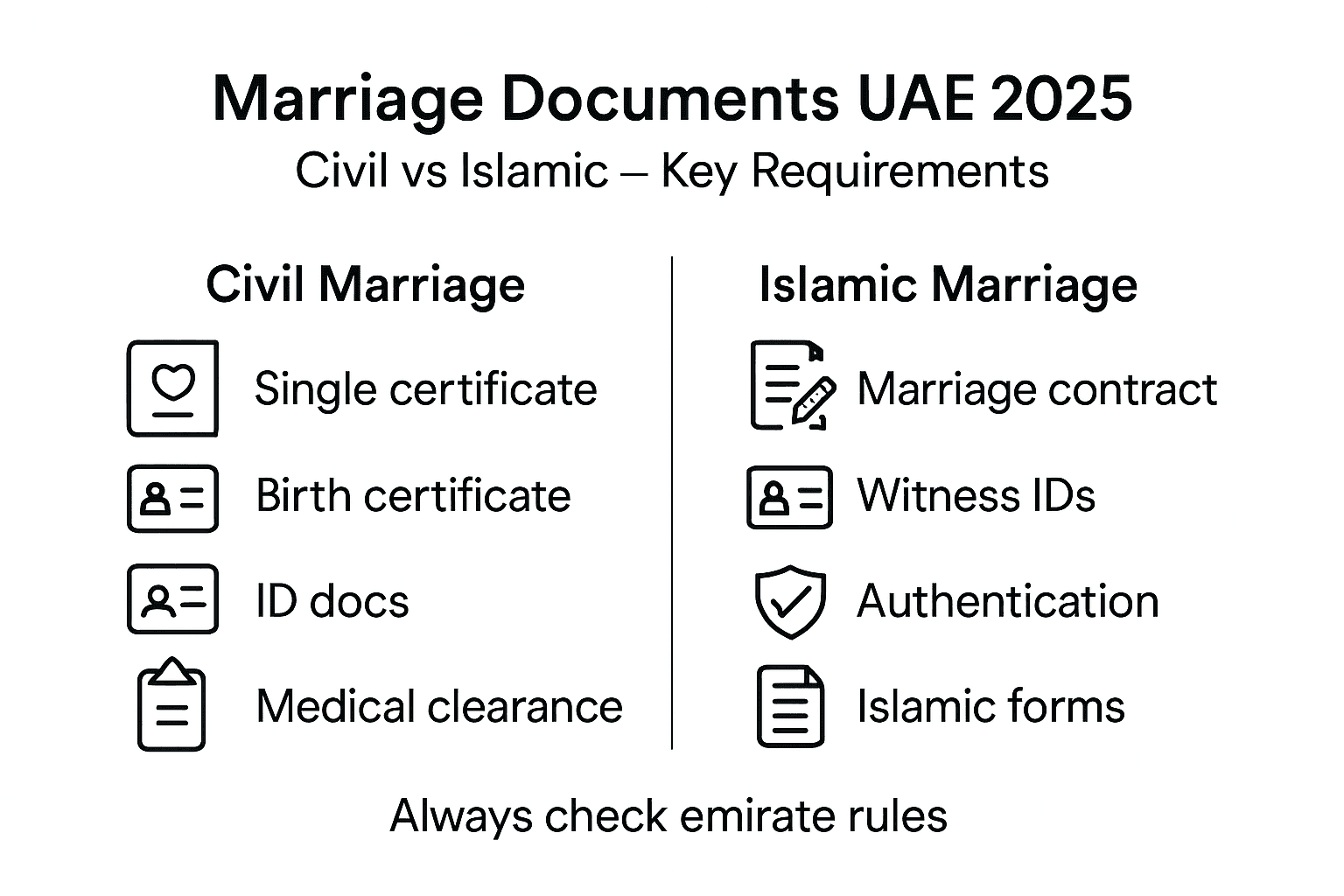
Islamic Marriage: Marriage contract, witnesses’ documentation, identity documents, authentication, Islamic Affairs forms
The registration procedure culminates in contract execution. For civil marriages, you appear before a judge or authorized registrar, confirm your consent, sign the contract, and receive your official marriage certificate. For Islamic marriages, the process involves the marriage contract signing with witnesses and Islamic official validation.
After registration, you receive an official marriage certificate in Arabic and English. This document becomes your proof of marriage for everything from sponsoring your spouse to immigration, property ownership, and legal matters. Keep multiple certified copies.
Pro tip: Start embassy authentication and document translation immediately when you begin planning—these steps take 3-6 weeks combined and are the primary cause of registration delays, so getting them done early prevents frustration and expedites your actual registration appointment.
Costs, Pitfalls, and Common Mistakes
Marriage in the UAE involves both financial and procedural costs that catch many expats off guard. The financial burden extends far beyond the wedding ceremony itself—you’re paying for registration, documentation, legal services, and potential delays that compound expenses. Civil marriage registration typically costs between AED 500-2,000 depending on your emirate, while Islamic marriage registration varies but generally falls in a similar range. However, the hidden costs multiply quickly. Embassy authentication fees (AED 100-300 per document), professional translation services (AED 50-150 per page), medical screening (AED 200-500), and legal consultation (AED 500-2,000) add up fast. A straightforward marriage registration can easily cost AED 3,000-5,000 by the time you’ve completed everything, and complicated cases can exceed AED 10,000.
For young Emirati couples, the UAE government offers marriage grants worth AED 70,000 each, with 3,000 grants allocated annually. However, these grants come with strict eligibility requirements and timeline conditions that create their own pitfalls. Young couples often miss eligibility windows, encounter delayed disbursement, or discover they don’t qualify due to age discrepancies or documentation issues. The grants don’t cover expat couples, and even for Emiratis, the application process adds 2-3 months to an already lengthy timeline.
Common Pitfalls and How to Avoid Them
Missing embassy authentication: Documents without embassy confirmation get rejected; authenticate all non-UAE documents immediately
Incomplete or incorrect documentation: Missing birth certificates, single status certificates, or medical clearance causes 4-8 week delays
Misunderstanding eligibility requirements: Not recognizing age changes, new 2025 law requirements, or guardianship rules leads to outright rejection
Neglecting translator certification: Using uncertified translators invalidates your application; hire only UAE-certified professionals
Failing to recognize emirate-specific requirements: Abu Dhabi, Dubai, and Sharjah have different procedural requirements; confirm with your specific emirate
Underestimating timeline: Many couples assume 1-2 weeks; realistic timelines are 4-8 weeks with complete documents
Ignoring new 2025 reforms: Couples unaware of Federal Decree Law No. 41 of 2024 changes encounter unexpected requirements or rejections
The most expensive pitfall is starting the process without legal guidance. Many expats attempt to navigate documentation independently, make mistakes, submit incomplete applications, and then pay legal professionals to fix the mess. Starting with proper legal consultation (AED 1,500-2,500) prevents costlier mistakes later. Think of it as preventive expense rather than optional cost.
Misunderstanding marriage law creates substantial problems. Couples often don’t realize that civil and Islamic marriages have different legal implications for property, custody, inheritance, and divorce. A marriage registered as civil means Islamic inheritance rules don’t automatically apply; an Islamic marriage means personal status courts handle custody disputes. Making this choice incorrectly, then attempting to change it later, requires legal action and additional costs.
Age eligibility mistakes happen frequently. Under the 2025 reforms, the minimum age is now 18 for Islamic marriages and 21 for civil marriages. Couples occasionally submit applications only to discover one party technically meets the old requirements but not the new ones. Verify current age requirements with your marriage registration office before submitting anything.
The most common expensive mistake is proceeding without proper legal consultation—professional guidance costs AED 1,500-2,500 but prevents rejections and complications that cost AED 5,000-15,000 to fix.
Gate-keeping documentation by emirate creates unexpected costs. If you’re registered in Dubai but your documents are from another country’s embassy in Abu Dhabi, you may need to get additional attestations. Each emirate has slightly different requirements about where documents must be authenticated. Confirm this before starting the authentication process to avoid duplicate fees.
Delayed processing creates hidden financial costs. Every week of delay potentially costs money if you’re sponsoring an employee, managing visa timelines, or paying for temporary accommodation. Budget-conscious couples sometimes skip steps to speed up the process, then face rejection and must restart entirely—actually costing more time and money.
A significant pitfall for expats is not updating documentation when laws change. The April 2025 reforms introduced new requirements, and many couples submitted applications based on 2024 rules, only to have them rejected. Confirm you’re using current procedural requirements, not outdated guides from 2023-2024.
Cost Breakdown for Civil Marriage Registration
Government registration fees: AED 500-1,500
Medical screening: AED 200-500
Embassy authentication (per document): AED 100-300 (typically 3-5 documents)
Professional translation (per page): AED 50-150 (typically 10-20 pages)
Legal consultation: AED 1,500-2,500
Certified copies and administrative fees: AED 200-400
Potential delays and expedited processing: AED 500-2,000
Total realistic cost: AED 3,500-7,500 with proper planning; AED 8,000-15,000+ if mistakes require resubmission.
Non-compliance with updated laws creates rejection. The 2025 reforms changed guardian consent requirements, custody age provisions, and age gap protections. Couples submitting applications based on old information face outright rejection. Check the UAE government’s official marriage information portal or consult a legal professional to confirm current requirements.
Failing to recognize that different emirates have different procedures multiplies costs. Abu Dhabi, Dubai, Sharjah, and other emirates each have their own court systems and slight procedural variations. What works in Dubai might not work in Abu Dhabi. Confirm your emirate’s specific requirements before gathering documents.
Pro tip: Invest AED 1,500-2,000 in a 1-hour legal consultation before gathering any documents—professionals identify eligibility issues, emirate-specific requirements, and documentation needs upfront, preventing costly mistakes and rejections that cost 3-5 times more to fix later.
Practical Challenges for Expats Planning Weddings
Planning a wedding as an expat in the UAE presents a unique set of challenges that go far beyond typical wedding logistics. You’re not just coordinating vendors and guest lists—you’re simultaneously navigating complex legal registration procedures, managing documentation from multiple countries, and complying with federal and emirate-level laws that operate under legal pluralism. The UAE recognizes both Islamic and civil marriage frameworks, each with distinct requirements, timelines, and legal consequences. For non-Muslims seeking civil marriage, the registration process alone adds 6-12 weeks to your planning timeline before you even schedule the actual celebration.
One of the most significant challenges is coordinating documentation across time zones and bureaucracies. Your birth certificate comes from one country, your single status certificate from another, and your employer’s attestation from yet another office. Each document requires embassy authentication in the UAE, which takes 2-3 weeks. Meanwhile, you’re trying to confirm venue availability, book photographers, and manage guest expectations—all while uncertainty hangs over whether your paperwork will be accepted. Many expats describe the feeling as juggling multiple projects simultaneously, with legal registration as the most stressful component.
The language barrier adds another layer of complexity. UAE government forms, court documents, and official communications are primarily in Arabic. Translation requirements mean hiring certified translators and waiting for approvals. If you don’t speak Arabic, coordinating with Islamic Affairs offices, civil courts, or marriage registrars requires translators or bilingual friends. This dependency on translation services creates delays and occasional miscommunication about requirements.
Key Practical Challenges for Expat Wedding Planning
Documentation from multiple countries: Coordinating birth certificates, single status certificates, and attestations from home country embassies takes 6-8 weeks
Legal uncertainty about eligibility: Not knowing until late in the process whether you meet all UAE requirements creates timeline anxiety
Language barriers: Most official communications are in Arabic; translation services add time and cost
Conflicting home and UAE laws: Your home country may recognize marriages differently than the UAE, creating legal ambiguity about marital status
Emirate-specific variations: Different emirates have different procedures, even for the same process
Medical clearance coordination: Scheduling medical screenings while managing work and social commitments takes planning
Witness and officiant availability: Finding qualified witnesses or Islamic officials who match your schedule creates coordination challenges
Visa and residency timing: If one partner is on a visit visa, marriage registration must happen before visa expiration
Visa timing creates real urgency for some expats. If your partner is visiting on a short-term visa and you want to marry, you must complete the entire registration process before the visa expires. This compresses your timeline dramatically and removes flexibility. You can’t extend the visa during marriage processing, so one partner may need to leave the UAE, then return as a spouse—requiring two separate visa processes.
Conflicting legal frameworks between your home country and the UAE create ongoing confusion. Your home country may not recognize a UAE civil marriage the same way, affecting citizenship, taxes, inheritance, or property rights back home. You may need to register the marriage again in your home country, or navigate situations where your marriage is recognized differently depending on which jurisdiction you’re in. This legal ambiguity stresses many couples throughout the process.
The biggest practical challenge isn’t the wedding itself—it’s managing legal registration while coordinating with multiple countries’ bureaucracies and UAE government offices operating on different timelines.
Finding qualified venues that can accommodate both legal requirements and your celebration preferences is harder than it sounds. Some venues don’t understand UAE marriage law and can’t accommodate certain requirements. Others are unfamiliar with civil marriage processes versus Islamic weddings. You may plan an elaborate venue celebration, then discover registration must happen at a courthouse first—meaning two separate events.
Guest management adds stress when your wedding timeline is uncertain. You want to send invitations, but the registration date isn’t finalized. Guests from your home country may book flights and accommodations only to have the timeline shift due to documentation delays. Communicating uncertainty to excited family members is emotionally exhausting.
Weather and seasonal challenges affect planning differently in the UAE. Wedding season typically runs October through April when temperatures are manageable. Summer weddings (May-September) are brutally hot, limiting outdoor options and guest comfort. If your registration timeline extends into peak heat, you may need to reschedule celebrations or accept uncomfortable conditions.
Coordinating with international guests adds logistical complexity. Guests need time to arrange visas, book flights, and request time off work. Yet you can’t confirm exact dates until your marriage registration is approved. This creates a catch-22 where you need guest commitments before you have certainty about dates.
Many expats recommend using professional marriage assistance services that understand the essential steps in a civil marriage checklist for expats. These services navigate the bureaucracy on your behalf, coordinate documentation, track timelines, and manage emirate-specific requirements. The service fee (typically AED 2,000-4,000) is offset by preventing costly mistakes and timeline extensions.
Pro tip: Start your marriage planning process 4-5 months before your desired wedding date, submit all documentation requests to embassies within the first month, and engage a professional marriage services provider by month two—this buffer allows for delays without compromising your celebration timeline.
Navigate UAE Marriage Trends Smoothly with Expert Guidance
Understanding that UAE marriage in 2025 requires clear knowledge of evolving legal reforms, age eligibility, and documentation challenges is essential for expats. Many couples face the stress of complex processes, embassy authentications, and navigating civil versus Islamic marriage options while balancing career and personal goals. Harris & Charms specializes in providing personalized support tailored to these exact challenges, helping you balance the trends of later marriages, smaller families, and updated legal requirements with ease and confidence. From securing all necessary paperwork and navigating emirate-specific rules to coordinating your ceremony and legal attestations, we simplify every step.

Experience a smoother journey toward your wedding day by partnering with experts who understand both the emotional and practical sides of marriage in the UAE. Visit Harris & Charms now to explore our comprehensive services including civil and Islamic marriage assistance, documentation support, and event planning. Begin your stress-free marriage process today with trusted guidance that aligns with your modern lifestyle and legal needs.
Frequently Asked Questions
What are the current marriage trends for expats in 2025?
Couples in the UAE are marrying later, planning smaller families, and prioritizing their personal and professional development before marriage. This trend indicates a cultural shift where marriage is seen as a milestone achieved after establishing independence.
What documentation is required for marriage registration in the UAE?
Essential documents for marriage registration include valid identification, proof of single status, birth certificate, medical reports (if required), and embassy attestation for non-UAE documents. Additionally, all documents in languages other than English or Arabic need to be officially translated.
How have the new legal reforms in 2025 impacted marriage eligibility?
The 2025 legal reforms introduce a uniform marriage age of 18, stipulate that non-citizen Muslim women can marry without guardian consent if permitted by their home laws, and require court approval for marriages with age gaps exceeding 30 years, enhancing protections against exploitation.
What is the difference between civil and Islamic marriages in the UAE?
Civil marriages are secular contracts for non-Muslims, while Islamic marriages follow Sharia law principles and apply to Muslims. Civil marriages typically require less documentation and allow more flexibility, while Islamic marriages involve specific religious requirements and must be managed through Islamic courts.
Recommended
Comments