
Role of Witnesses in Marriage: Civil & Islamic Rules in UAE Explained

Updated: Sep 11

TL;DR:
Civil marriages in the UAE do not require witnesses, while Islamic Nikah ceremonies need two Muslim male witnesses.
Witness requirements are legally binding; civil marriages rely on the officiant as the sole witness, but Islamic marriages require in-person male Muslim witnesses.
Proper understanding and preparation of witness rules based on ceremony type help prevent delays and legal issues.
Most couples planning a wedding in the UAE assume they need to bring witnesses, no matter what type of ceremony they choose. That assumption is only half right. The rules are actually split depending on whether you are having a civil marriage or an Islamic Nikah ceremony, and mixing up these two sets of rules is one of the most common sources of confusion we see. Understanding exactly what the law requires, and why, saves you from unnecessary stress, last-minute scrambling, and potential delays on one of the most important days of your life.
Table of Contents
Key Takeaways
Point | Details |
Civil marriage: no witnesses | In UAE civil weddings for non-Muslims, the notary acts as the sole official witness. |
Islamic marriage: two witnesses | Islamic weddings require two adult male Muslim witnesses to validate the Nikah contract. |
Check your ceremony type | Understanding which rules apply for your ceremony prevents mistakes and legal hassles. |
Expert help reduces stress | Professional support can simplify complex requirements and ensure a smooth process. |
Key differences: Civil vs. Islamic marriages and the role of witnesses
Before anything else, it helps to understand why these two ceremony types operate under completely different legal frameworks. Civil marriages in the UAE fall under federal and emirate-level legislation designed primarily for non-Muslim residents and expats. Islamic marriages, on the other hand, are governed by Sharia law and carry their own distinct requirements rooted in religious tradition.
The core difference when it comes to witnesses is straightforward. As Gulf News confirms, in civil marriages for non-Muslims under Federal Decree-Law No. 41/2022 and Abu Dhabi Law No. 14/2021, no witnesses are required because the notary or civil marriage officer serves as the official witness. For Islamic marriages, two adult Muslim male witnesses must be physically present at the ceremony for the marriage to be legally and religiously valid.
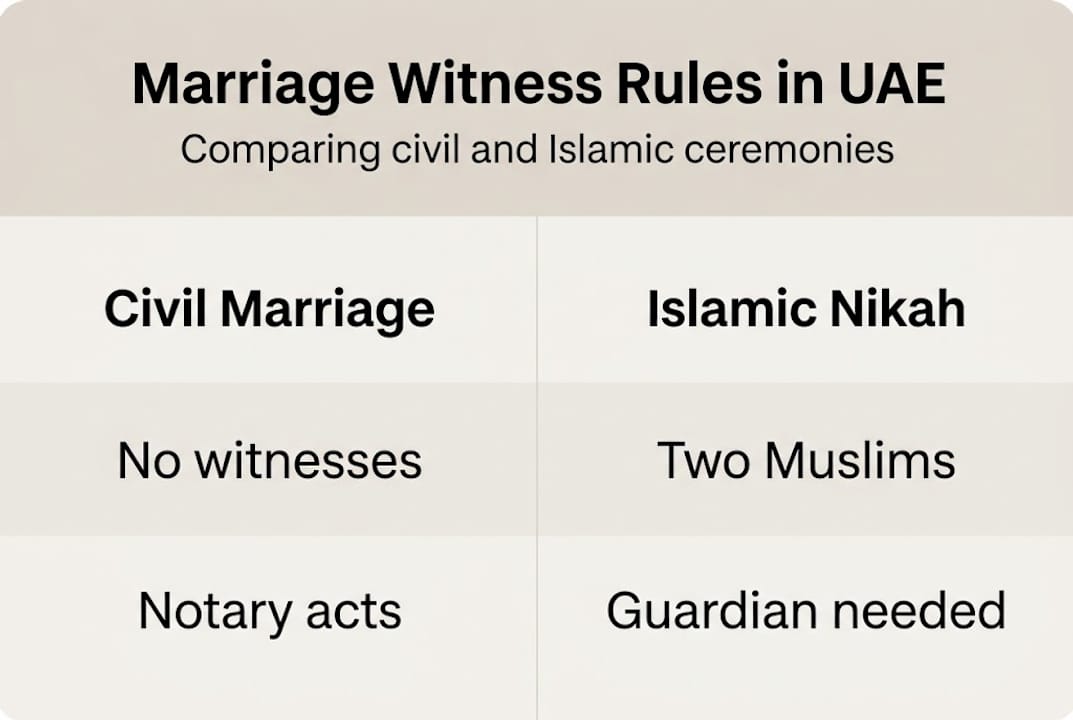
Here is a quick comparison to make this crystal clear:
Feature | Civil marriage (non-Muslim) | Islamic Nikah marriage |
Witnesses required | No | Yes, two |
Who acts as witness | Notary or marriage officer | Two adult Muslim males |
Legal framework | Federal/emirate civil law | Sharia law |
Applies to | Non-Muslims | Muslims |
Witness must be Muslim | Not applicable | Yes |
Knowing which category your ceremony falls into is not just useful, it is essential. The witness requirements in UAE marriages are legally binding, and errors can invalidate the ceremony. A few key points to keep in mind:
Civil marriages do not require you to arrange any witnesses personally.
Islamic marriages are invalid without two qualifying witnesses present.
The UAE’s system differs from many other countries, where witnesses are universally required.
Your ceremony type determines which legal framework applies to you.
If you are unsure which type of marriage applies to your situation, the Abu Dhabi civil marriage guide is a solid starting point for non-Muslim couples.
Witness requirements for civil marriage in the UAE
With a general understanding in place, let’s focus on what’s required if you opt for a civil marriage. Civil marriage in the UAE is available to non-Muslim couples, including expats from virtually any country. This was a landmark shift in UAE law, making the country far more accessible for international couples who want a legally recognized marriage without a religious ceremony.
The process itself is more streamlined than many couples expect. Here is what typically happens:
Submit your application through the relevant authority, such as the Abu Dhabi Judicial Department or the Dubai Courts.
Provide required documents, including passports, residency visas, and any previously required certificates like a certificate of no impediment.
Attend the civil ceremony, where a notary or civil marriage officer officiates.
Sign the marriage contract in the presence of the officiating officer, who acts as the legal witness.
Receive your marriage certificate, which is legally recognized across the UAE.
Notice that at no point do you need to bring your own witnesses. This surprises a lot of couples, particularly those from countries like the UK, the US, or Australia, where personal witnesses signing the register is standard practice. In the UAE civil system, that role is absorbed by the official.
“In civil marriages for non-Muslims under Federal Decree-Law No. 41/2022 and Abu Dhabi Law No. 14/2021, no witnesses are required; the notary or civil marriage officer serves as the official witness.”
This design actually makes the civil marriage process more efficient. You do not need to coordinate schedules, chase paperwork from witnesses, or worry about someone being unavailable on the day. The system is built for clarity.
Pro Tip: Even though witnesses are not legally required for a civil ceremony, many couples still invite close friends or family to attend as guests for the personal significance of the moment. There is no rule against it, it just is not a legal necessity.
One persistent myth is that bringing witnesses somehow makes the marriage “more official.” It does not. The legal process for non-Muslim marriages in the UAE is fully valid with the officiating officer alone. Save yourself the logistical headache and focus on what actually matters for your paperwork.
Witness requirements for Islamic (Nikah) marriages in the UAE
Now let’s turn to the rules for couples holding an Islamic marriage ceremony. The Nikah is the Islamic marriage contract, and in the UAE it is governed by Sharia law as applied through the local court system. The witness requirement here is not optional or ceremonial. It is a core condition of validity.
For a Nikah to be legally and religiously recognized, two adult Muslim male witnesses must be present at the ceremony. These witnesses must be:
Adult (post-puberty, generally 18 years or older in practice)
Sane and of sound mind
Muslim by faith
Male
Present in person at the ceremony, not via video call or proxy
The reasoning behind this requirement is both religious and practical. In Islamic jurisprudence, witnesses serve as the community’s acknowledgment that a valid marriage has taken place. Their presence protects both parties, particularly the bride, by ensuring the marriage is publicly known and documented within the community.
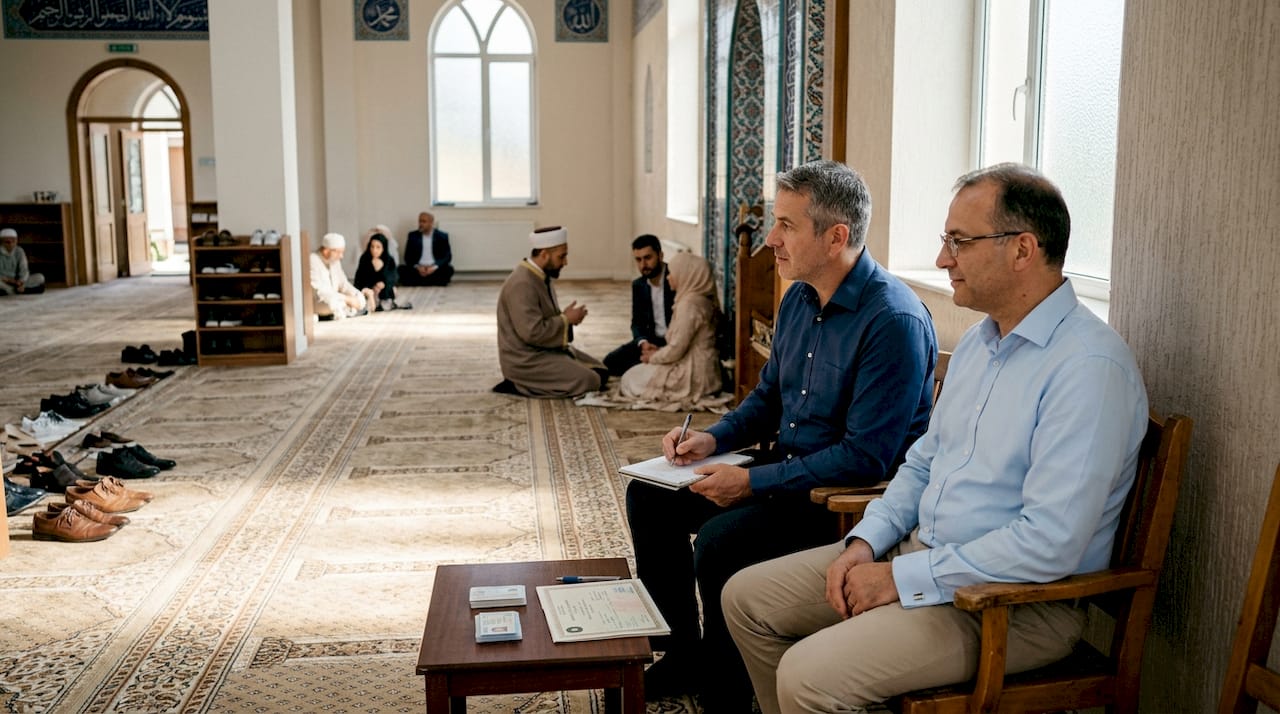
Here is a broader look at the key requirements for an Islamic marriage in the UAE:
Requirement | Details |
Witnesses | Two adult Muslim males, present in person |
Wali (guardian) | Required for the bride in most cases |
Mahr (dowry) | Must be agreed upon and stated |
Offer and acceptance | Must be clearly exchanged |
Officiating authority | UAE court-appointed Qadi or authorized official |
For a deeper look at all the rules, the Islamic marriage requirements page covers everything in detail. You can also review the Muslim marriage rules UAE guide for a current overview.
Pro Tip: Do not wait until the last minute to confirm your witnesses. Both men must bring valid identification to the ceremony. If either witness is unavailable on the day, the Nikah cannot proceed. Confirm their availability and documents well in advance.
A common mistake is assuming a female friend or a non-Muslim colleague can serve as a witness. Neither is valid under Islamic law for a Nikah ceremony. If you need guidance on how to get married in UAE as a Muslim couple, getting this detail right early prevents real problems later.
Common questions and practical scenarios for couples
Bringing these rules together, here’s how they play out for couples in real-life situations. The theory is clear enough, but the practical questions couples ask us are often more nuanced.
What if we cannot find two Muslim male witnesses for our Nikah? This is more common than you might think, especially for Muslim expats who are new to the UAE or have a small social circle here. The solution is to speak with the officiating authority in advance. In some cases, court-appointed witnesses can be arranged. Do not attempt to proceed without valid witnesses, as this renders the marriage contract void.
What about interfaith or mixed-nationality couples? If one partner is non-Muslim and the other is Muslim, the type of ceremony required depends on the faith of the Muslim partner and UAE law. Generally, a Muslim man may marry a non-Muslim woman of certain faiths, but a Muslim woman cannot marry a non-Muslim man under UAE Sharia rules. For non-Muslim couples of different nationalities, the civil marriage route is available and no witnesses are needed.
Here is a practical checklist before your ceremony:
Confirm your ceremony type: civil or Islamic, based on your faith and legal status.
Gather required documents: passports, visas, birth certificates, and any divorce or death certificates if previously married.
For Nikah: identify and confirm two qualifying witnesses, check their availability, and ensure they have valid ID.
For civil marriage: verify document requirements with the relevant authority and confirm your appointment.
Check marriage eligibility in the UAE to make sure both partners meet all legal conditions.
Organize UAE marriage documentation well ahead of the ceremony date to avoid last-minute delays.
As UAE law specifies, civil marriages under Federal Decree-Law No. 41/2022 require no personal witnesses, which removes one major variable from the process for non-Muslim couples. Working with an expert team that knows both systems means you spend less time second-guessing and more time actually planning your wedding.
Our perspective: The evolving role of witnesses in UAE marriages
Taking a step back, here is what these evolving rules mean from a local expert point of view. The UAE’s decision to remove the witness requirement from civil marriages is not a minor administrative tweak. It reflects a deliberate effort to make marriage accessible, internationally compatible, and free from unnecessary bureaucracy for non-Muslim residents.
What we find interesting is how often couples from abroad apply the rules of their home country to their UAE wedding. Someone from Germany assumes they need two witnesses because that is the German standard. Someone from India brings family members expecting them to sign documents. Neither of these assumptions is wrong in their original context, but they do not apply here.
The Islamic Nikah requirements, by contrast, have remained consistent because they serve a deeper purpose than administrative record-keeping. The two-witness rule is about community recognition and religious legitimacy, not just paperwork.
Our honest advice: always verify requirements based on your specific ceremony type and emirate, because rules can vary slightly between Abu Dhabi, Dubai, and other emirates. A quick review of the deep dive on witness roles before your ceremony can save you from a genuinely avoidable problem. Do not assume. Confirm.
Get tailored help for your UAE wedding ceremony
Navigating witness rules, documentation, and legal requirements for a UAE wedding is manageable, but it takes attention to detail. One missed step can delay your ceremony or require you to reschedule entirely.

At Harris & Charms, we work with couples every day to make sure nothing falls through the cracks. Whether you are planning a civil ceremony or an Islamic Nikah, our team knows exactly what each process requires. We handle the paperwork, confirm the legal steps, and guide you through witness arrangements where needed. Explore our Dubai civil marriage packages or browse our all-in-one wedding services to find the right level of support for your situation. Let us take the complexity out of your big day.
Frequently asked questions
Do I need witnesses for a civil marriage ceremony in the UAE?
No. For non-Muslim couples, UAE civil law does not require personal witnesses. The notary or civil marriage officer fulfills the official witness role on your behalf.
What are the requirements for witnesses in an Islamic marriage in the UAE?
Islamic Nikah ceremonies require two adult Muslim males who are present in person at the ceremony. Both must be sane, adult, and Muslim for the marriage contract to be valid.
Can a friend or family member be a witness in an Islamic wedding?
Yes, a friend or family member can serve as a Nikah witness as long as they meet all the conditions: adult, sane, Muslim, and male. Their personal relationship to the couple does not affect their eligibility.
Are witness requirements different for expats or mixed-faith couples in the UAE?
Yes. Non-Muslim expat couples using the civil marriage route do not need to arrange any witnesses at all. Mixed-faith situations depend on the specific faiths involved, and Islamic witness rules apply in full to any Nikah ceremony regardless of the couple’s nationalities.
Recommended
Marriage Certificate Services - Certified Copies | GovComplete
Comments