
What Is a Marriage Contract in Islam: 2026 Guide

TL;DR:
A marriage contract in Islam, known as the Nikkah, is a binding religious agreement defining spouses’ rights and responsibilities. It requires mutual consent, a named Mahr, two Muslim witnesses, and typically a wali, with each pillar being essential for validity. Civil registration is necessary for legal recognition of the marriage and related rights in most jurisdictions.
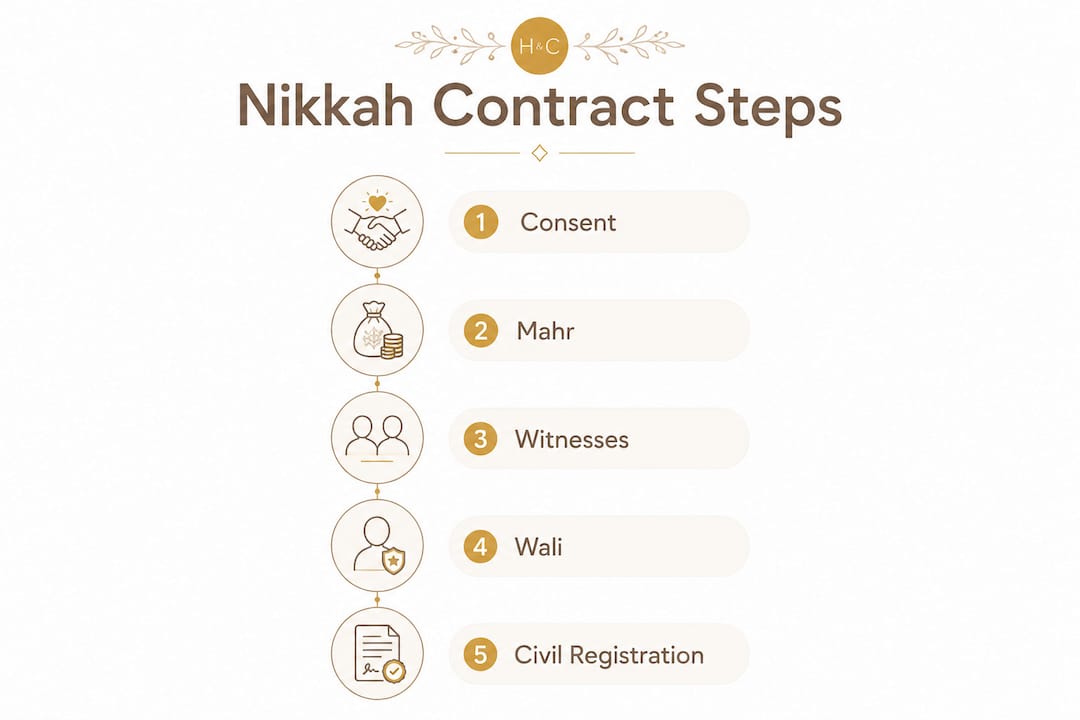
A marriage contract in Islam, known as the Nikkah, is the formal religious agreement that makes a marital relationship valid under Islamic law by defining the mutual rights and responsibilities of both spouses. The Nikkah is not simply a ceremony. It is a binding contract with specific legal and spiritual requirements, and understanding what is marriage contract in Islam matters deeply for any couple planning to wed under Islamic law. The contract requires four core pillars: mutual consent (Ijab and Qubool), a named Mahr (mandatory gift), at least two Muslim witnesses, and in most schools of thought, a wali (guardian). Harrisandcharms works with couples in the UAE every day who need clarity on exactly these requirements before they proceed.
What is a marriage contract in Islam and what makes it valid?
A valid Nikkah contract requires specific pillars including mutual consent, a named Mahr, two Muslim witnesses, and usually a wali, with coercion invalidating the contract entirely. Each pillar carries equal weight. Remove one, and the contract loses its religious validity.

Mutual consent means both parties freely agree to the marriage. No pressure from family, financial circumstances, or social obligation can substitute for genuine, spoken acceptance. The offer (Ijab) comes from the bride’s side, and the acceptance (Qubool) comes from the groom. Both must occur in the same sitting or session to form a valid agreement.
The Mahr is a mandatory financial obligation owed by the groom to the bride. It becomes her exclusive property the moment the contract is signed. The Mahr can be prompt, deferred, or split between immediate and future payment. Vague or unwritten Mahr terms cause the most disputes, particularly during divorce proceedings. Specifying the amount, type, and timing in writing removes that ambiguity entirely.
Witnesses serve a specific function beyond formality. At least two upright Muslim witnesses are required to legitimize and publicize the marriage contract. Islam strongly discourages secret marriages, and the witness requirement directly prevents them. The witnesses must be present at the moment of offer and acceptance, not simply informed afterward.
The wali is the bride’s male guardian, typically her father or a close male relative. Most Sunni schools of jurisprudence require the wali’s presence or authorization for the contract to be valid. The Hanafi school allows a woman to contract her own marriage under certain conditions, which is a notable exception worth knowing.
Lawful stipulations couples can add
Islamic marriage contracts may include lawful stipulations such as the wife’s right to education, the right to work, delegated divorce rights, or specific housing arrangements. These conditions, called shurut, must not contradict Islamic law. They must be documented clearly to carry any weight. A verbal agreement about housing or employment rights, made at the ceremony but never written down, is nearly impossible to enforce later.
Pro Tip: Consult a qualified Islamic scholar before finalizing any stipulations. A condition that seems reasonable may conflict with a specific school of jurisprudence, which could affect the contract’s validity.
The validity of a remote Nikkah, conducted via video call, remains debated among scholars. The International Islamic Fiqh Academy considers a remote contract invalid, while other scholars allow it under specific conditions. Couples in different countries should consult local religious authorities before proceeding with a remote ceremony.
How does the Islamic marriage contract interact with civil legal systems?
Religious validity and civil legal recognition are two separate standards, and confusing them creates real problems. Most jurisdictions do not recognize a Nikkah alone as a legal civil marriage. Couples must register separately with civil authorities to gain rights related to immigration, property, inheritance, and taxation.
The practical consequences of skipping civil registration are significant. Here is what couples risk when they rely solely on a religious contract:
Immigration rights: A spouse may not qualify for a dependent visa or residency permit without a civilly registered marriage certificate.
Inheritance: In most civil legal systems, an unregistered spouse has no automatic inheritance rights if the other spouse dies without a will.
Property: Joint property claims and mortgage applications typically require a civil marriage certificate.
Taxation: Tax benefits available to married couples, including joint filing status, require civil recognition.
Divorce proceedings: Civil courts cannot divide assets or enforce Mahr agreements from a Nikkah that was never civilly registered.
Courts inconsistently treat Mahr agreements from unregistered Nikkah contracts. Separate civil prenuptial agreements that incorporate Nikkah terms provide stronger legal protection than the religious contract alone.
The UAE applies a specific framework for Islamic marriages that differs from Western civil systems. Couples in Dubai and across the Emirates must register their Nikkah with the relevant authorities to receive a legally recognized marriage certificate. For expat couples, the civil vs. Islamic marriage distinction in the UAE carries direct consequences for visa status and residency.
An Islamic prenuptial agreement, drafted separately and reviewed by a civil attorney, can incorporate Mahr terms and other stipulations in a format that civil courts will recognize. This dual approach, religious contract plus civil registration, gives couples the fullest protection under both systems.
What practical steps should couples take when preparing an Islamic marriage contract?
Preparation is where most couples either protect themselves or leave themselves exposed. The Nikkah is a legally and spiritually binding document, and treating it with the same seriousness as a legal contract is the standard experts recommend.
Follow these steps before and during the contract process:
Negotiate the Mahr clearly. Agree on the exact amount, currency, and payment timeline before the ceremony. Write it into the contract with no ambiguity.
Identify a qualified officiant. The person conducting the Nikkah should be a recognized Islamic scholar or imam with authority in your jurisdiction. In the UAE, this means working with a licensed religious authority.
Draft stipulations in writing. Any conditions added to the contract, such as the right to work or pursue education, must appear in the written document. Verbal agreements at the ceremony do not hold up.
Register civilly. Complete civil registration in your country of residence. For UAE residents, follow the Islamic marriage registration steps required by local authorities.
Consider an Islamic prenup. A separate civil prenuptial agreement that mirrors your Nikkah terms gives those terms enforceability in court.
Keep certified copies. Both spouses should retain certified copies of the signed contract. Store them separately and securely.
Pro Tip: If you are an expat couple in the UAE, complete your civil registration before applying for any dependent visa. The Nikkah certificate alone will not satisfy immigration requirements.
Structured Islamic marriage contracts reduce disputes and promote family stability by clarifying obligations from the outset. Couples who document every term clearly report fewer conflicts over financial obligations and rights during the marriage. The written contract is not a sign of distrust. It is a sign of mutual respect and seriousness.
What are common misconceptions about Islamic marriage contracts?
Several widespread misunderstandings cause couples to enter the Nikkah without fully understanding what they are agreeing to.
Misconception | Reality |
The Nikkah is only a ceremony | The Nikkah is a binding religious contract with enforceable terms and obligations |
Mahr is a symbolic gift | Mahr is a mandatory financial right belonging exclusively to the wife |
A verbal contract is sufficient | Written contracts prevent disputes and are required for civil enforceability |
All schools require a wali | The Hanafi school allows a woman to contract her own marriage under certain conditions |
A Nikkah equals civil marriage | Civil registration is a separate requirement in most jurisdictions worldwide |
The most damaging misconception is treating the Mahr as optional or symbolic. The Mahr is a mandatory right, not a cultural gesture. A groom who fails to pay an agreed Mahr is in breach of the contract. Courts in some jurisdictions have enforced Mahr payments, but only when the terms were written clearly and the marriage was civilly registered.
Mut’ah marriage, a temporary marriage contract practiced in some Shia traditions, is a separate and distinct concept from the permanent Nikkah. Sunni jurisprudence considers mut’ah invalid. Couples should understand which tradition governs their contract and consult a scholar from that tradition specifically.
Key Takeaways
A valid Islamic marriage contract requires mutual consent, a written Mahr, two witnesses, and civil registration to carry full religious and legal weight.
Point | Details |
Nikkah is a binding contract | The Islamic marriage agreement establishes enforceable rights and duties, not just a ceremony. |
Mahr is a mandatory right | The wife owns the Mahr exclusively; vague terms lead to disputes, especially during divorce. |
Civil registration is separate | A Nikkah alone does not grant immigration, inheritance, or property rights in most countries. |
Written stipulations matter | Conditions like work rights or housing must appear in the written contract to be enforceable. |
Dual protection is best | Combining a valid Nikkah with civil registration and an Islamic prenup gives the fullest legal coverage. |
Why I think most couples underestimate the Nikkah
Most couples I work with arrive focused on the ceremony and the celebration. The contract itself gets treated as a formality, something to sign quickly before the real event begins. That attitude is the single biggest mistake I see.
The Nikkah is the foundation of the marriage, not the decoration. Every right a wife holds, every obligation a husband carries, every financial protection either spouse can claim, it all flows from what is written in that contract. When the Mahr is vague, when stipulations are agreed verbally but never recorded, when civil registration is skipped because it seems like extra paperwork, couples are building their marriage on an incomplete foundation.
The spiritual weight of the Nikkah is real. Islamic law treats this contract with the gravity of any serious legal agreement. The witnesses, the wali, the formal offer and acceptance, these are not traditions for tradition’s sake. They exist to protect both parties and to make the commitment public and accountable.
My honest advice: spend as much time reviewing your contract terms as you spend choosing your venue. Negotiate the Mahr openly. Write every condition down. Register civilly. And work with a qualified religious authority who will take the documentation as seriously as the ceremony.
The couples who do this report fewer conflicts, clearer expectations, and a stronger foundation from day one. That is not a coincidence.
— Harris
How Harrisandcharms supports your Islamic and civil marriage in the UAE
Harrisandcharms handles both the religious and civil sides of marriage in the UAE, so couples do not have to navigate two separate systems alone.

From Nikkah documentation and officiant coordination to civil registration and legal attestation, the team at Harrisandcharms manages every step. Couples planning an Islamic marriage in Dubai or across the Emirates can access complete marriage service packages that cover contract preparation, ceremony facilitation, and full civil registration support. Whether you are a UAE national, a resident expat, or a Golden Visa holder, Harrisandcharms provides the documentation expertise and personal guidance to make your marriage legally recognized and spiritually complete. Reach out directly to discuss your specific situation and get a clear plan in place before your ceremony date.
FAQ
What is the Nikkah in Islam?
The Nikkah is the formal Islamic marriage contract that establishes a valid marital relationship under Islamic law. It requires mutual consent, a named Mahr, two Muslim witnesses, and in most schools, a wali.
Is a Nikkah legally recognized without civil registration?
No. Most jurisdictions require separate civil registration for a marriage to carry legal rights related to immigration, inheritance, and property.
What happens if the Mahr is not specified in the contract?
A vague or unspecified Mahr creates disputes, particularly during divorce. Islamic law requires the Mahr to be a real, defined obligation, and courts can only enforce it when the terms are written clearly.
Can couples add conditions to an Islamic marriage contract?
Yes. Lawful stipulations such as the right to work, pursue education, or live in a specific location can be added, provided they do not contradict Islamic law and are documented in writing.
Is a Nikkah conducted via video call valid?
Scholarly opinion is divided. The International Islamic Fiqh Academy considers remote Nikkah contracts invalid, while other scholars allow them under specific conditions. Couples should consult a local religious authority before proceeding.
Recommended
Comments