
Civil Marriage Implications in the UAE: Expat Guide


TL;DR:
Civil marriage in the UAE offers non-Muslim couples a secular, equal, and internationally recognized legal framework.
It includes provisions for no-fault divorce, child custody based on the child’s best interests, and flexible inheritance options.
Proper document attestation and early legal planning are essential for navigating the marriage’s legal and international implications.
Civil marriage in the UAE is a legally recognized civil contract that grants non-Muslim couples equal, secular rights under Federal Decree-Law No. 41 of 2022, the country’s modern civil personal status law. The civil marriage implications for expatriates are significant: they cover divorce, child custody, inheritance, residency sponsorship, and international recognition of your marriage certificate. This framework replaced the default application of Sharia law for eligible non-Muslims and has been in effect since 2023. If you are a foreign national living in or visiting the UAE, understanding these legal consequences before you marry is not optional. It is the foundation of every decision you will make as a couple.
What are the civil marriage implications for non-Muslims in the UAE?
Civil marriage in the UAE is defined as a secular legal contract governed by civil personal status law, not religious doctrine. Federal Decree-Law No. 41 of 2022 applies to non-Muslim residents and tourists, provided both parties are at least 21 years old and have full legal capacity and genuine consent. This is the foundational law every expatriate couple needs to know.

The law creates a rights-based framework that removes gender disparities entirely. Both spouses carry equal legal standing in matters of property, divorce, and parental rights. That equality is the single most important distinction between civil marriage and Sharia-based personal status law in the UAE.
Abu Dhabi was the first emirate to act, passing Abu Dhabi Law No. 14 of 2021 before the federal law took effect. Dubai followed with its own civil marriage registration process. The federal decree unified the framework across all seven emirates, giving expatriates a consistent legal foundation regardless of where they live.
Who is eligible, and what documents do you need?
Eligibility under civil marriage laws in the UAE is specific. Meeting every criterion before you apply saves weeks of delays.
Core eligibility requirements:
Both parties must be non-Muslim. Mixed-faith couples where one party is Muslim fall under Sharia law by default.
Both parties must be at least 21 years old with full legal capacity.
Explicit, free consent from both parties is mandatory.
No close blood relations between the parties are permitted.
Abu Dhabi accepts both residents and tourists; Dubai requires at least one party to hold a Dubai resident visa.
Standard documents typically required:
Valid passports for both parties
UAE residence visas (required in Dubai; not mandatory in Abu Dhabi for tourists)
Original birth certificates, attested and translated into Arabic
Certificate of no impediment or single status certificate from your home country
Divorce decree or death certificate if either party was previously married
Pro Tip: Abu Dhabi’s broader eligibility rules make it the practical choice for tourist couples or those without UAE residency. Dubai offers a fast 24-hour marriage license for residents who qualify.
How does civil marriage differ from religious marriage in the UAE?
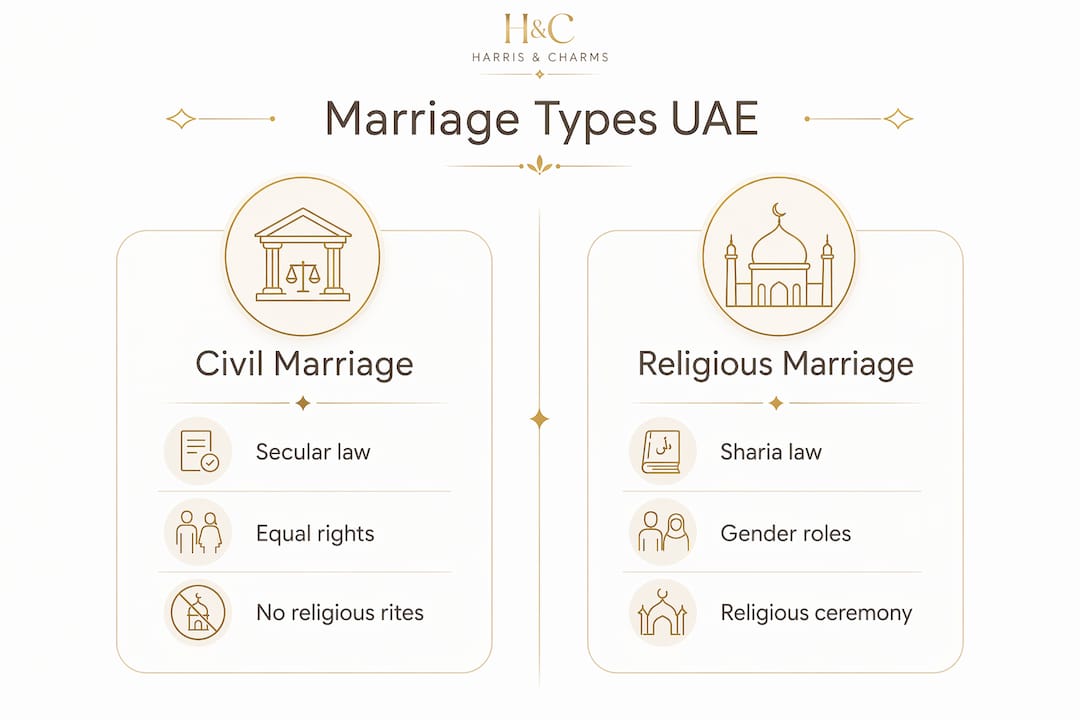
The legal consequences of civil marriage versus Sharia-based marriage are substantial. Understanding the gap between the two systems helps you choose the right framework for your family.
Feature | Civil marriage | Sharia-based marriage |
Governing law | Secular civil personal status law | Islamic Sharia law |
Gender equality | Full equality in rights and obligations | Gender-differentiated rights apply |
Divorce grounds | No-fault divorce available | Fault or specific grounds often required |
Guardian consent | Not required | Required in many cases |
Witnesses | Civil judge acts as witness | Religious witnesses required |
Pre-marital medical screening | Not required | Often required |
Inheritance default | Civil law or home country law | Sharia inheritance rules apply |
The civil ceremony is entirely secular, with a civil judge officiating. No religious rites, no guardian approval, and no pre-marital medical tests are required. That simplicity is deliberate. The law was designed to reflect the legal norms that most Western expatriates already know from their home countries.
Pro Tip: If you want to understand the full legal comparison before deciding, the civil vs. Islamic marriage differences breakdown covers every major distinction for 2026.
What are the legal consequences for divorce, custody, and inheritance?
The effects of civil marriage on family law are where the framework delivers its most practical value. Each area carries specific rights and procedures.
Divorce under civil law
No-fault divorce is available. Either spouse can file for divorce without proving wrongdoing. Courts handle equitable asset division with mandatory financial disclosure from both parties. That process mirrors divorce proceedings in most European and North American jurisdictions.
Residency visa cancellation follows divorce. If your residency is sponsored by your spouse, divorce cancels that visa. You must arrange an alternative visa or depart the UAE within the grace period granted by immigration authorities.
Alimony and financial maintenance are assessed by the court based on each spouse’s financial position and the length of the marriage. The civil framework gives judges clear authority to award maintenance without the gender-based limitations present in Sharia divorce.
Child custody
Equal parental rights apply from the moment of marriage. Child custody decisions are based on the best interests of the child, not the gender of the parent. Both parents carry financial maintenance obligations under civil personal status law.
Custody arrangements are court-supervised. If parents cannot agree, the civil court determines custody, visitation, and child support. The standard applied is the child’s welfare, not a parent’s religious or cultural preference.
Inheritance
Civil marriage gives you a choice of law. Non-Muslim couples can elect to have their home country’s inheritance law apply, or they can rely on UAE civil law. This flexibility is unique to the civil framework. Sharia inheritance rules do not offer the same election.
Drafting a will is strongly advised. Legal experts recommend that civil marriage couples prepare wills and prenuptial agreements early to protect assets and clarify inheritance intentions. The civil law’s autonomy is only as useful as the documents you put in place to use it.
For a detailed breakdown of the legal benefits of civil marriage in the UAE, including how Federal Decree-Law No. 41 of 2022 affects your specific situation, that resource covers the key provisions in plain language.
How does civil marriage affect residency and international recognition?
Civil marriage carries direct implications for UAE residency and for how your marriage is recognized when you move or travel abroad.
Residency and sponsorship rights:
A UAE civil marriage certificate is recognized by all UAE government entities as a valid legal document.
One spouse can sponsor the other’s UAE residence visa, provided the sponsoring spouse meets the minimum salary and housing requirements set by immigration authorities.
Divorce cancels the sponsored spouse’s residency visa. The affected spouse must apply for a new visa category or leave the UAE within the permitted grace period.
International recognition:
A UAE civil marriage certificate is valid for use abroad, but it requires attestation and legalization before foreign governments will accept it.
The standard process involves attestation by the UAE Ministry of Foreign Affairs, followed by legalization at the relevant embassy or consulate of your home country.
Some countries also require an Apostille stamp if they are signatories to the Hague Convention. The UAE is not a Hague Convention signatory, so full embassy legalization is the standard route.
Pro Tip: Start the attestation process before you need the certificate abroad. Processing times vary by country and embassy, and delays can affect visa applications, property transactions, or inheritance claims in your home jurisdiction.
For couples navigating the civil marriage process as expats, the documentation requirements and attestation steps are worth reviewing in full before your registration appointment.
The civil marriage framework provides predictability that expatriates from Western legal systems recognize immediately. That familiarity is a genuine advantage when you are managing a life across multiple countries and legal systems.
For couples who hold or are pursuing a UAE Golden Visa, civil marriage registration also supports family sponsorship applications under the Golden Visa program. Marriage registration for Golden Visa holders follows the same civil framework but intersects with specific immigration criteria worth confirming with a legal advisor.
Key Takeaways
Civil marriage in the UAE gives non-Muslim expatriates a secular, equal, and internationally portable legal framework that Sharia-based marriage does not provide.
Point | Details |
Eligibility is specific | Both parties must be non-Muslim, at least 21, and meet residency or tourist criteria by emirate. |
No-fault divorce applies | Either spouse can dissolve the marriage without proving fault, with equitable asset division by the court. |
Custody is interest-based | Child custody decisions follow the child’s best interests, with equal parental rights for both spouses. |
Inheritance is flexible | Couples can elect home country law or UAE civil law for inheritance, but a will is strongly advised. |
International use requires attestation | UAE civil marriage certificates need Ministry of Foreign Affairs attestation and embassy legalization for foreign use. |
What I have learned advising expatriate couples on civil marriage
The couples who handle civil marriage best are the ones who treat it as a legal structure, not just a ceremony. That sounds obvious, but most people focus entirely on the wedding day and leave the downstream legal work until a problem forces the issue.
The no-fault divorce provision is genuinely valuable, but it is only half the picture. What I have seen repeatedly is that couples who did not draft a prenuptial agreement or a will before marrying face real difficulty when assets are split across multiple countries. The civil framework gives you the tools. You have to use them.
The joint financial planning conversation needs to happen before the registration appointment, not after. Civil law’s asset division rules are equitable, but equitable does not mean automatic. Courts need documentation. Couples who arrive with clear financial records and a prenuptial agreement in place move through divorce proceedings far faster and with far less cost.
One thing I tell every couple: do not assume your home country’s legal system will simply recognize your UAE civil marriage without any action on your part. Attestation is not a formality. It is a legal requirement. I have seen inheritance claims delayed by months because a certificate was not properly legalized before the relevant deadline.
The civil marriage framework in the UAE is genuinely modern and well-designed for expatriate life. Use it fully. Get the will. Get the prenuptial agreement. Get the attestation done early. The spousal financial transparency work you do before marriage is the most protective thing you can do for your family.
— Harris
How Harrisandcharms supports your civil marriage in the UAE
Harrisandcharms works with expatriate couples across the UAE to make civil marriage registration straightforward and legally sound. From document preparation and court registration to ceremony planning and attestation support, the team handles every step so you can focus on the marriage itself.

Whether you are registering a civil marriage in Abu Dhabi or Dubai, planning an intimate ceremony, or need help with post-registration attestation for international use, Harrisandcharms offers civil and Islamic marriage packages built for the realities of expatriate life in the UAE. The team also supports couples navigating marriage registration under the Golden Visa program and premium registration services for those who want a fully managed experience from start to finish. Reach out to Harrisandcharms to discuss your situation and get a clear plan in place.
FAQ
What is civil marriage in the UAE?
Civil marriage in the UAE is a secular legal contract for non-Muslim couples governed by Federal Decree-Law No. 41 of 2022. It provides equal rights, no-fault divorce, and civil law protections for divorce, custody, and inheritance.
Can tourists get a civil marriage in the UAE?
Abu Dhabi allows both residents and tourists to register a civil marriage. Dubai requires at least one party to hold a Dubai resident visa.
Does civil marriage in the UAE affect my residency visa?
Yes. A spouse can sponsor the other’s UAE residence visa after civil marriage, provided salary and housing requirements are met. Divorce cancels the sponsored spouse’s visa, requiring a new visa arrangement or departure.
Is a UAE civil marriage certificate valid abroad?
A UAE civil marriage certificate is valid internationally after attestation by the UAE Ministry of Foreign Affairs and legalization at the relevant embassy or consulate of your home country.
Do I need a prenuptial agreement for civil marriage in the UAE?
A prenuptial agreement is not legally required but is strongly recommended. Legal experts advise civil marriage couples to draft prenuptial agreements and wills early to protect assets and clarify inheritance intentions under the civil personal status law.
Recommended
Comments