
What Court Handles Marriage in the UAE: 2026 Guide


TL;DR:
Marriage in the UAE depends on religion and residency, with civil courts for non-Muslims and Sharia courts for Muslims. Civil marriage in Abu Dhabi permits non-residents and tourists to apply online without a residency requirement, making it highly accessible. Muslim marriages follow Sharia law, requiring guardians, witnesses, and proof of Islamic faith, with courts protecting women’s rights to marry.
The court that handles marriage in the UAE depends on the couple’s religion, residency status, and nationality. Civil marriages for non-Muslims are processed through the Abu Dhabi Civil Family Court, while Muslim marriages fall under the jurisdiction of Sharia courts. These two systems operate under separate federal laws and follow distinct procedures, eligibility rules, and documentation requirements. Whether you are an expat, tourist, or foreign national, knowing which court applies to your situation is the first step toward a legally valid UAE marriage.
What court handles marriage in the UAE?
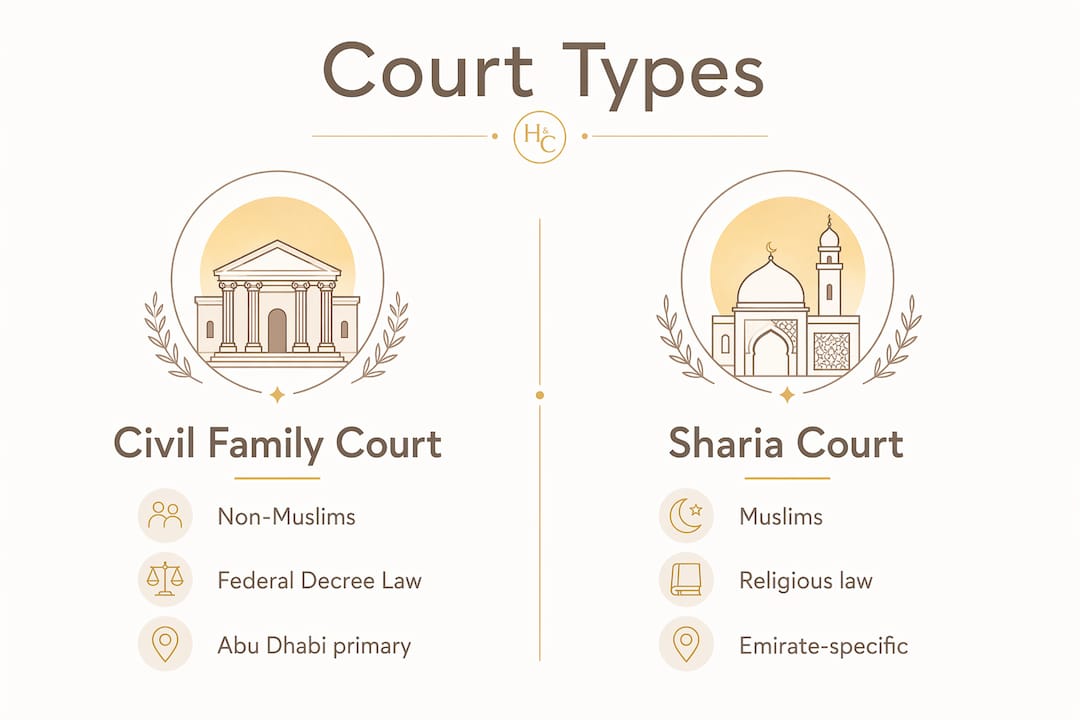
The UAE operates two legal marriage pathways: civil marriage for non-Muslims and Sharia marriage for Muslims. Federal Decree-Law No. 41 of 2022 governs civil marriages, while Federal Decree-Law No. 41 of 2024 governs Sharia marriages. Each law assigns jurisdiction to a specific court system, and couples cannot choose between the two based on preference alone.
The Abu Dhabi Civil Family Court is the primary venue for civil marriage registration in the UAE. It accepts applications from non-Muslims, non-UAE Muslim nationals, tourists, and expats regardless of residency status. Sharia courts, operating through judicial departments across the emirates, handle all marriages involving Muslim UAE nationals and Muslim expatriates where the groom is Muslim.
Religion is the single most decisive factor in determining which court handles your marriage. If both partners are non-Muslim, the civil family court applies. If either partner is a Muslim UAE national, or if the groom is Muslim, Sharia court procedures apply. Non-UAE Muslim nationals have access to civil family courts in Abu Dhabi under specific conditions.
Which court handles civil marriages and who is eligible?
The Abu Dhabi Civil Family Court is the designated civil marriage center for non-Muslims in the UAE. It operates under Federal Decree-Law No. 41 of 2022 and accepts applications from a wide range of couples, including tourists who have no UAE residency at all. This makes Abu Dhabi the most accessible emirate for international couples seeking a legally recognized marriage.
Eligibility for a civil marriage at this court includes:
Non-Muslim couples of any nationality
Non-UAE Muslim nationals (expatriates whose home country is not the UAE)
Tourists visiting the UAE without a residency visa
Expats holding UAE residency visas
Pro Tip: Abu Dhabi’s civil family court does not require residency, but Dubai’s civil marriage service does require at least one partner to hold a Dubai residency visa. If neither partner lives in Dubai, apply through Abu Dhabi.
The Abu Dhabi Judicial Department (ADJD) portal allows couples to apply for civil marriage online from anywhere in the world. Couples submit documents, pay fees, and schedule their ceremony digitally before traveling to Abu Dhabi for the brief in-person legal ceremony. Physical presence at the ceremony is required. Remote or fully virtual weddings are not currently permitted.

The court offers two service tiers. The Standard service issues the marriage certificate within three days. The Express service issues it the same day, with fees starting at AED 300. The ceremony itself takes approximately 15 minutes. For couples who want a more detailed breakdown of the Abu Dhabi process, Harrisandcharms publishes a step-by-step marriage guide covering documents, timelines, and ceremony logistics.
Which court handles Muslim marriages and what are the special considerations?
Muslim marriages in the UAE are governed by Sharia courts operating under Federal Decree-Law No. 41 of 2024. These courts handle marriage contracts, divorce, custody, and inheritance for Muslim couples. Jurisdiction covers both UAE Muslim nationals and Muslim expatriates, particularly in cases where the groom is Muslim.
The marriage procedure involves an authorized Mazoon (a licensed marriage officiant) or a judicial department officer who formalizes the contract. Key procedural elements include:
A wali (male guardian) representing the bride, typically her father or closest male relative
Two adult Muslim male witnesses present at the ceremony
A mahr (dowry) agreed upon and stated in the contract
Proof of Islamic faith for both parties
Valid identification and residency documents
A notable protection built into the Sharia court system addresses situations where a wali refuses to give consent. UAE Sharia courts can appoint a wakeel (a substitute guardian) to ensure that an adult woman’s right to marry is legally upheld. A guardian’s refusal cannot permanently block a marriage when the court determines the refusal is unjustified.
Pro Tip: Muslim women whose wali is unavailable or uncooperative should formally petition the Sharia court for a wakeel appointment. This is a recognized legal right under UAE family law, and the process is handled directly through the court’s judicial department.
For Muslim expatriates, residency status affects which emirate’s Sharia court handles the application. Couples typically apply through the court in the emirate where they reside. Harrisandcharms covers the full procedural requirements in their Islamic marriage guide for couples navigating this process.
How to apply for marriage at the correct court
Identifying the right court is step one. Applying correctly is what determines how quickly and smoothly the process moves. The steps below apply to civil marriage through the Abu Dhabi Civil Family Court, which handles the majority of expat and tourist marriage registrations.
Confirm eligibility. Verify that both partners qualify for civil marriage (non-Muslim status or non-UAE Muslim nationality). If either partner is a Muslim UAE national, the Sharia court pathway applies instead.
Create an account on the ADJD portal. The Abu Dhabi Judicial Department portal supports international applicants. Both partners can register and submit documents remotely.
Upload required documents. Typical documents include valid passports, proof of single status (a certificate of no impediment or equivalent), and any previously issued divorce or death certificates if applicable.
Pay the application fee. Fees start at AED 300 for the Standard service. Express processing carries a higher fee and delivers the certificate the same day as the ceremony.
Schedule the ceremony. Select a date and time through the portal. Both partners must appear in person at the Abu Dhabi Civil Family Court on the chosen date.
Attend the ceremony. The ceremony lasts approximately 15 minutes. The marriage certificate is issued immediately (Express) or within three days (Standard).
Attest the certificate if needed abroad. Ministry of Foreign Affairs attestation costs AED 150 and is required for the certificate to be recognized by foreign governments. Without attestation, the certificate is valid across all UAE government departments but may not be accepted internationally.
Pro Tip: Opposition from family members cannot legally prevent a civil marriage in the UAE. The marriage certificate is issued privately to the couple and is not entered into a public registry. Parental disapproval has no legal standing in the civil court process.
For couples planning a non-Muslim marriage in the UAE, document attestation from the home country is often the most time-consuming part of preparation. Starting that process early, ideally six to eight weeks before the planned ceremony date, prevents delays.
What are the key differences between civil and Sharia marriage courts?
The two court systems differ across every major dimension: eligibility, legal framework, process, and international recognition. The table below summarizes the core distinctions.
Category | Civil Family Court | Sharia Court |
Governing law | Federal Decree-Law No. 41 of 2022 | Federal Decree-Law No. 41 of 2024 |
Eligible couples | Non-Muslims; non-UAE Muslim nationals | Muslim UAE nationals; Muslim expats (Muslim groom) |
Residency required | No (Abu Dhabi accepts tourists) | Typically yes, in the emirate of residence |
Guardian requirement | Not required | Wali required; court can appoint wakeel if refused |
Certificate privacy | Private, no public registry | Registered within Islamic judicial records |
International attestation | MOFAIC attestation at AED 150 | Same attestation process applies |
Ceremony duration | Approximately 15 minutes | Varies; includes contract recitation and witnesses |
The most practical distinction for expats and tourists is residency. Abu Dhabi’s civil family court removes the residency barrier entirely, making it the go-to option for international couples. Sharia courts, by contrast, are tied to the emirate of residence and require the full guardian and witness structure. For a deeper comparison, Harrisandcharms has published a detailed civil vs. Islamic marriage breakdown covering rights, protections, and long-term legal implications.
Legal experts caution that UAE civil marriage laws differ significantly from those in most home countries, particularly around divorce and inheritance. Consulting a UAE family lawyer before choosing a marriage pathway is a sound step, especially for couples with assets in multiple countries.
Key Takeaways
The court that handles marriage in the UAE is determined by religion and residency, with the Abu Dhabi Civil Family Court serving non-Muslims and Sharia courts governing Muslim marriages under two separate federal laws.
Point | Details |
Two distinct court systems | Civil Family Court handles non-Muslims; Sharia courts handle Muslim marriages under separate federal laws. |
Abu Dhabi accepts tourists | The Abu Dhabi Civil Family Court requires no UAE residency, making it accessible to international couples. |
Sharia courts protect women | Courts can appoint a wakeel if a wali refuses consent, ensuring women’s right to marry is upheld. |
Digital applications available | The ADJD portal allows global document submission and fee payment before the in-person ceremony. |
Attestation for abroad use | MOFAIC attestation at AED 150 is required for UAE marriage certificates to be recognized internationally. |
What I’ve learned helping couples navigate UAE marriage courts
Most couples I work with arrive with the same assumption: that the UAE has one marriage process. The reality is that the system is split cleanly in two, and choosing the wrong path wastes weeks of preparation.
The civil family court in Abu Dhabi is genuinely one of the most accessible marriage registration systems I have seen for international couples. The fully digital application process, the absence of a residency requirement, and the 15-minute ceremony make it practical for tourists flying in specifically to marry. What surprises people most is that family opposition carries zero legal weight. The certificate is private. No public registry exists. That fact alone changes the conversation for many couples.
The Sharia court path is more structured, and rightly so. The wali requirement and witness structure are not bureaucratic obstacles. They are part of the legal contract. What I do caution couples about is the downstream effect of choosing one pathway over the other. Divorce law, inheritance rights, and custody rules differ significantly between the two systems. A civil marriage that ends in divorce is handled very differently from a Sharia marriage dissolution. Couples should think about those scenarios before the ceremony, not after.
My honest advice: get your documents attested from your home country before you book flights. That step takes the longest and is the one most couples underestimate. Everything else in the UAE marriage process moves quickly once your paperwork is in order.
— Harris
Harrisandcharms: marriage court services made simple
Navigating two separate court systems, federal decree laws, and document attestation requirements is a lot to manage while planning a wedding. Harrisandcharms handles the legal and administrative side so couples can focus on the day itself.

From civil marriage packages in Dubai that cover court bookings, documentation, and attestation, to full Islamic and civil wedding service packages designed for expats and tourists, Harrisandcharms manages every step. The team coordinates directly with the Abu Dhabi Civil Family Court and Sharia court departments, prepares your document checklist, and schedules your ceremony. Couples across more than 40 nationalities have used Harrisandcharms to complete their UAE marriage registration without a single courthouse visit on their own.
FAQ
What court handles marriage for non-Muslims in the UAE?
The Abu Dhabi Civil Family Court handles civil marriages for non-Muslims in the UAE. It accepts applications from tourists, expats, and non-UAE Muslim nationals regardless of residency status.
Do I need to live in the UAE to get married there?
No. The Abu Dhabi Civil Family Court allows non-residents and tourists to apply for marriage online and attend only the brief in-person ceremony. Dubai’s civil marriage service does require at least one partner to hold a Dubai residency visa.
Which court handles marriage for Muslims in the UAE?
Sharia courts handle Muslim marriages in the UAE under Federal Decree-Law No. 41 of 2024. These courts cover UAE Muslim nationals and Muslim expatriates, particularly when the groom is Muslim.
Is a UAE marriage certificate valid in other countries?
A UAE marriage certificate is valid across all UAE government departments. For international recognition, couples must obtain Ministry of Foreign Affairs attestation, which costs AED 150.
Can parents legally block a civil marriage in the UAE?
No. Family opposition has no legal standing in the UAE civil court process. The marriage certificate is issued privately to the couple and is not recorded in any public registry.
Recommended
Comments