
What Is Family Court in UAE – Key Facts for Expats


Sorting out marriage paperwork as an expat couple in the UAE can feel overwhelming, especially when you discover that each emirate has its own approach to family court procedures. Whether you are considering an Islamic or civil wedding, understanding the distinct dual legal framework that blends Islamic Sharia law and modern civil codes is crucial for a smooth process. This guide highlights the key differences, essential documents, and recent legal updates every expat needs to know before tying the knot in the United Arab Emirates.
Table of Contents
Key Takeaways
Point | Details |
Family Court Structure | The UAE Family Court operates under a dual legal framework, combining Islamic Sharia principles and modern civil law to accommodate its multicultural population. |
Case Types | The court handles various family law matters, including marriage registration, divorce, child custody, spousal maintenance, and inheritance disputes. |
Pathways for Expatriates | Non-Muslim expatriates can access the civil family court pathway, which offers more flexible legal interpretations compared to the Islamic court pathway for Muslims. |
Importance of Legal Expertise | Engaging a specialized family law attorney is crucial for navigating the complex legal landscape and avoiding common documentation and procedural pitfalls. |
Core Definition of Family Court in UAE
The Family Court in UAE represents a sophisticated legal institution designed to address personal status matters for both national and expatriate populations. Unlike traditional court systems, these specialized courts provide a nuanced approach to resolving family-related legal challenges within the United Arab Emirates’ complex multicultural environment.
At its core, the UAE Family Court operates under a unique dual legal framework that balances Islamic Sharia principles with modern civil law provisions. This system accommodates the diverse religious and cultural backgrounds of residents by offering different legal pathways depending on an individual’s nationality and personal status:
For Muslim residents and UAE nationals, Islamic Sharia law forms the primary legal foundation
Non-Muslim expatriates can opt for civil law procedures under recent legal reforms
Each emirate maintains some jurisdictional autonomy in implementing family court procedures
The court’s primary responsibilities encompass several critical areas of family law, including:
Divorce proceedings and legal separations
Child custody and guardianship determinations
Spousal and child maintenance settlements
Inheritance and estate distribution matters
Marital dispute resolutions
Recent legislative updates, particularly legal reforms affecting marriage in UAE, have significantly modernized the family court system. These changes aim to provide more transparent, equitable legal processes for both local and expatriate communities.
The UAE Family Court represents a sophisticated legal framework that bridges traditional Islamic principles with contemporary global legal standards.
Pro tip: Always consult with a legal professional specializing in UAE family law to understand the specific procedures and requirements that might apply to your unique situation.
Types of Family Court Cases and Marriages
The UAE Family Court handles a diverse range of personal status cases that reflect the complex legal landscape of marriage and family relationships in the Emirates. Understanding these case types is crucial for expatriates and nationals navigating the legal system, as the court’s jurisdiction covers multiple scenarios specific to different religious and cultural backgrounds.
The primary types of family court cases can be categorized into several key areas of legal intervention:
Marriage Registration: Formal documentation and legal recognition of marriages
Divorce Proceedings: Dissolution of marriages through judicial processes
Child Custody Determinations: Establishing guardianship and visitation rights
Spousal Maintenance: Financial support settlements
Inheritance Disputes: Distribution of assets and estate settlements
For marriages specifically, the UAE legal system recognizes multiple formats to accommodate its diverse population under UAE marriage laws. These include:
Islamic marriages governed by Sharia principles
Civil marriages for non-Muslim expatriates
International marriages requiring legal recognition
Marriages involving mixed nationalities
Marriages with specific religious or cultural requirements
The court’s approach varies significantly based on the parties’ religious affiliation and nationality. Muslim residents typically follow Islamic legal procedures, while non-Muslim expatriates can access more flexible civil law frameworks. Each case undergoes careful examination to ensure fair and culturally sensitive legal outcomes.
Family courts in the UAE represent a unique legal ecosystem that balances traditional Islamic principles with modern, multicultural legal standards.
The complexity of these legal proceedings underscores the importance of understanding individual rights and procedural nuances before entering any family law dispute.
Pro tip: Consult with a specialized UAE family law attorney who understands the intricate legal distinctions between different marriage types and court procedures.
Civil vs. Islamic Family Court Pathways
The UAE legal system offers a remarkable dual court pathway that reflects the country’s commitment to accommodating diverse religious and cultural backgrounds. This unique approach allows different legal frameworks for family law matters, ensuring that residents can navigate personal status issues through culturally appropriate judicial processes.
The two primary family court pathways are distinctly structured:
Islamic Family Court Pathway
Governed by Sharia principles
Applies to Muslim nationals and Muslim expatriates
Based on Federal Law No. 28 of 2005
Follows traditional Islamic legal interpretations
Civil Family Court Pathway
Designed for non-Muslim expatriates
Governed by Federal Decree-Law No. 41 of 2022
Provides more secular legal approaches
Offers flexible dispute resolution mechanisms
Key differences between these pathways become particularly evident in legal approaches to marriage and divorce. Islamic courts typically require more stringent religious compliance, while civil courts offer more contemporary legal interpretations that align with international standards.

Here’s a comparison of the Civil and Islamic Family Court pathways in the UAE:
Pathway Type | Main Governing Law | Typical Users | Procedural Flexibility |
Islamic Family Court | Federal Law No. 28 of 2005 | Muslim nationals and residents | Traditional, religiously strict |
Civil Family Court | Federal Decree-Law No. 41 of 2022 | Non-Muslim expatriates | Contemporary, more flexible |
The UAE’s dual family court system represents a sophisticated legal approach that respects religious diversity while ensuring comprehensive legal protection for all residents.
Each pathway has unique characteristics that impact critical family law matters such as marriage registration, divorce proceedings, child custody, and inheritance. Muslim residents predominantly follow Sharia-based procedures, which are deeply rooted in Islamic legal traditions. Non-Muslim expatriates, conversely, can access more flexible civil law frameworks that provide greater procedural flexibility.
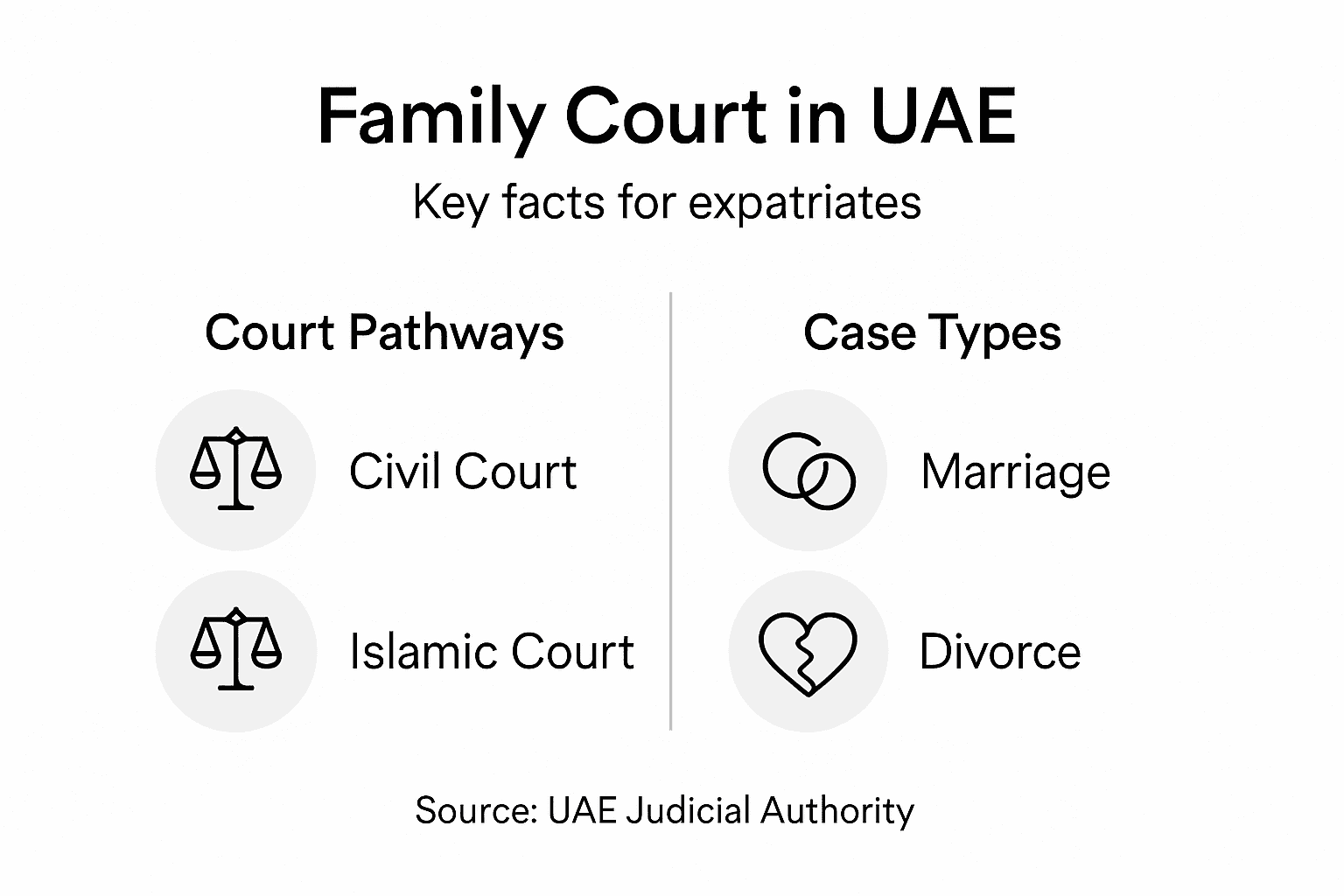
The emergence of these parallel legal systems demonstrates the UAE’s progressive approach to personal status law, recognizing that one-size-fits-all legal solutions cannot effectively serve a multicultural population.
Pro tip: Always verify your specific legal status and consult with a specialized family law attorney to understand which court pathway applies to your unique circumstances.
Legal Requirements and Process for Expats
Navigating the family court system in the UAE requires expatriates to understand a complex legal landscape that balances cultural traditions with modern legal frameworks. The process involves multiple steps and specific documentation requirements that can seem overwhelming to those unfamiliar with the local judicial system.
Key legal requirements for expatriates typically include:
Documentation Preparation
Valid passport and residency visa
Translated and authenticated marriage certificates
Proof of nationality and personal status
Recent passport-sized photographs
Completed official application forms
Court Filing Prerequisites
Statement of Claim detailing legal issues
Evidence supporting legal claims
Proof of jurisdiction eligibility
Translation of documents into Arabic
Applicable court filing fees
The legal process for civil marriage documentation in UAE follows a structured approach that demands meticulous attention to detail. Expatriates must navigate multiple administrative steps, including initial document verification, potential mediation, and formal court hearings.
Successful navigation of UAE family court processes requires understanding both legal requirements and cultural nuances.
The court proceedings typically involve several critical stages:
Initial document submission
Case registration and preliminary review
Mediation attempts
Formal hearing scheduling
Final judicial determination
Non-Muslim expatriates benefit from recent legal reforms that provide more flexible approaches to personal status matters. These changes allow greater latitude in applying legal principles that align with international standards while respecting local regulatory frameworks.
Pro tip: Engage a specialized UAE family law attorney who understands both expatriate legal challenges and local court procedures to ensure smooth navigation of your family court process.
Common Challenges and What to Avoid
Navigating the UAE family court system presents a complex landscape of legal and cultural challenges that can overwhelm even the most prepared expatriates. Understanding potential pitfalls is crucial to ensuring a smooth legal process and protecting your personal and familial interests.
Common challenges expatriates frequently encounter include:
Documentation Complexities
Incomplete or improperly translated documents
Failure to authenticate international certificates
Missing critical supporting evidence
Incorrect form submissions
Language barrier misunderstandings
Legal and Procedural Obstacles
Misunderstanding jurisdictional requirements
Signing agreements without comprehensive legal review
Inadequate understanding of local legal nuances
Overlooking cultural sensitivities in legal proceedings
Underestimating mediation importance
The legal implications of marriage under UAE law can be particularly challenging for expatriates who are unfamiliar with the local legal framework. Misinterpreting legal clauses or cultural expectations can lead to significant complications in family court proceedings.
Successful navigation of UAE family courts requires a combination of legal expertise, cultural understanding, and meticulous preparation.
Key areas where expatriates often make critical mistakes include:
The table below summarizes key challenges expatriates face in UAE family courts, with tips to avoid them:
Challenge Area | Typical Issue | Best Practice Tip |
Documentation | Incomplete translations | Use certified translators for all paperwork |
Legal Procedure | Jurisdiction misunderstandings | Verify court eligibility before filing |
Agreement Signing | Unreviewed legal documents | Consult an attorney before signing anything |
Mediation | Insufficient preparation | Prepare documents and understand local norms |
Rushing into legal agreements without professional counsel
Neglecting proper document translation and authentication
Misunderstanding child custody regulations
Failing to understand local mediation processes
Overlooking potential long-term legal consequences
Non-Muslim expatriates face additional challenges in understanding how different legal frameworks intersect with personal status matters. The nuanced approach of UAE family courts demands a sophisticated understanding of both legal and cultural dynamics.
Pro tip: Invest in a consultation with a specialized UAE family law attorney who can provide personalized guidance tailored to your specific expatriate circumstances.
Simplify Your Family Court Journey in the UAE with Harris & Charms
Navigating the complexities of the UAE Family Court can be overwhelming for expats dealing with marriage registration, divorce proceedings, or child custody matters. Whether you face challenges understanding the dual legal pathways of Islamic and civil family courts or require expert guidance on legal documentation and procedures, Harris & Charms is here to help. Our personalized services are designed to ease your legal journey by providing comprehensive support tailored to your unique situation.
Experience peace of mind knowing you have a trusted partner to assist you with:
Civil and Islamic marriage documentation and processing
Attestation and legal verification services
Expert planning for stress-free weddings and related events

Don’t let complex court systems and legal procedures delay your family matters. Take control today by connecting with Harris & Charms for trusted wedding and legal assistance in the UAE. Explore how we can support you through every step by visiting our main website. Discover the difference of a personalized approach that blends legal expertise with heartfelt care and begin your journey toward a smooth, hassle-free family court experience now.
Frequently Asked Questions
What types of cases does the Family Court in UAE handle?
The Family Court in UAE handles various personal status cases, including marriage registration, divorce proceedings, child custody determinations, spousal maintenance, and inheritance disputes.
What are the pathways for family law cases in the UAE?
There are two primary pathways: the Islamic Family Court, governed by Sharia law for Muslim nationals and expatriates, and the Civil Family Court, designed for non-Muslim expatriates governed by modern civil law provisions.
What legal requirements must expatriates meet to navigate the Family Court?
Expatriates need to prepare specific documentation, including a valid passport and residency visa, translated marriage certificates, proof of personal status, and complete official application forms, among other requirements.
What common challenges do expatriates face in the UAE Family Court system?
Common challenges include documentation complexities, misunderstandings of legal procedures, insufficient preparation for mediation, and navigating jurisdictional requirements. It’s crucial to consult with a legal professional to avoid these pitfalls.
Recommended
Comments