
Role of Witnesses in UAE Marriage – Ensuring Legal Validity

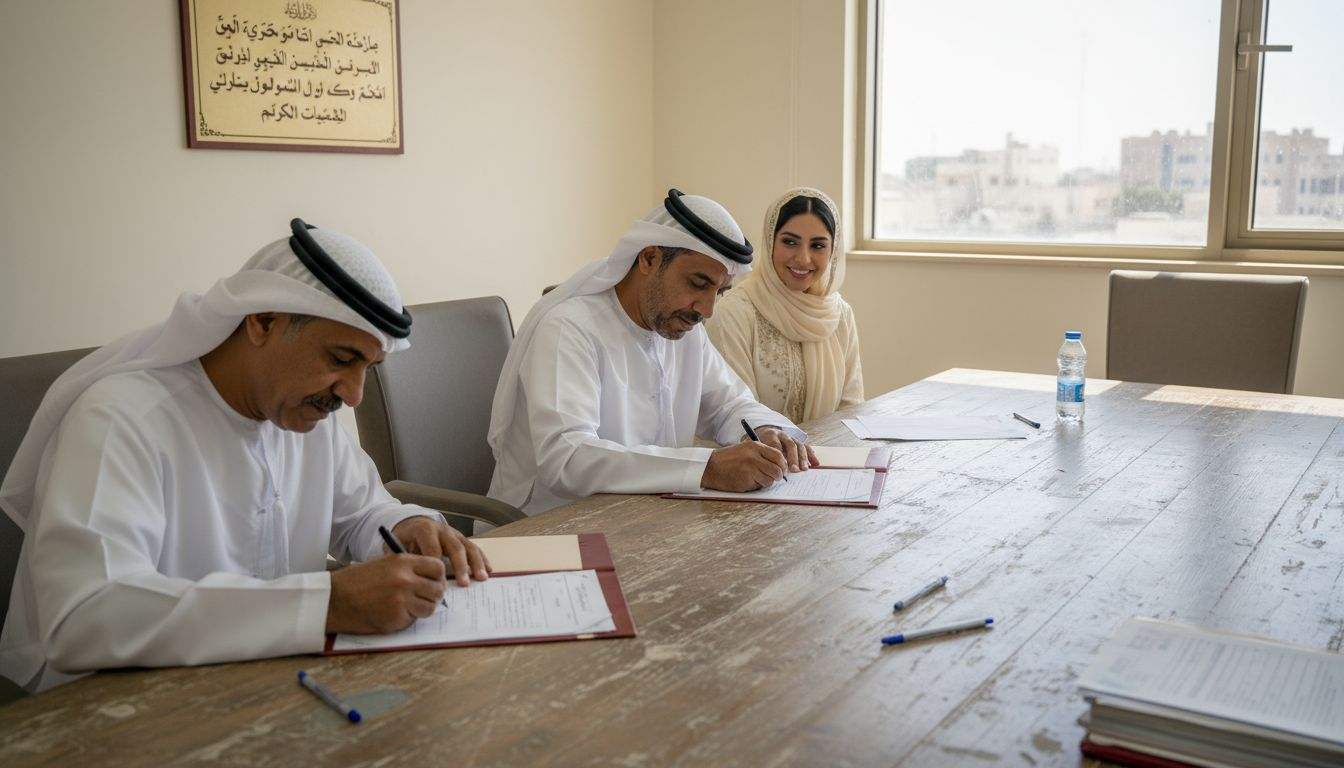
Planning a wedding in the United Arab Emirates can quickly become confusing without the right information about legal witnesses and documentation. For expats, choosing qualified witnesses is more than a formality. Whether you are preparing for an Islamic ceremony or a civil marriage, understanding the legal role of witnesses in UAE weddings protects your marriage contract from future disputes and guarantees its acceptance. This guide breaks down exactly what expat couples need to know for a smooth registration process.
Table of Contents
Key Takeaways of Role of Witnesses in UAE Marriage
Point | Details |
Importance of Witnesses | Witnesses are essential for legal validity in UAE marriages, providing verification and attestation of consent. |
Legal Requirements | Witnesses must be legally competent adults, free of familial ties to the couple, and able to understand the marriage proceedings. |
Differences in Ceremony Types | Islamic marriages require two male Muslim witnesses, while civil marriages have more flexible witness criteria. |
Common Pitfalls | Couples should avoid mistakes like selecting unqualified witnesses or failing to verify documentation to ensure legal compliance. |
Witnesses in UAE Marriage: Core Definition
In the context of UAE marriage law, witnesses play a pivotal role in establishing the legal validity of a marriage ceremony. These individuals are not mere bystanders but critical participants who provide official attestation and verification of the marriage contract. Their presence ensures transparency, prevents potential fraud, and validates the genuine consent of both marrying parties.
The legal framework in the United Arab Emirates mandates specific requirements for marriage witnesses, which vary slightly between Islamic and civil marriage procedures. Key characteristics of valid witnesses include:
Must be legally competent adults
Typically required to be of sound mind and judgment
Should have no direct familial relationship to the marrying couple
Must be able to understand and verify the marriage proceedings
Witnesses serve multiple crucial functions during the marriage registration process. They provide an independent confirmation that the marriage was conducted voluntarily, with both parties present and consenting. Exploring UAE marriage legal steps reveals that witnesses essentially act as impartial observers who protect the rights of both individuals entering the marriage contract.
Witnesses are not passive observers but active participants ensuring the legal integrity of the marriage ceremony.
In Islamic marriage contexts, typically two male witnesses are required, while civil marriages might have slightly different requirements. These witnesses must sign the marriage contract, confirming they were present during the ceremony and observed the mutual agreement between the marrying parties.
Pro tip: Always confirm the specific witness requirements with your local marriage registration office, as details can vary between Emirates and marriage types.
Legal Requirements for Marriage Witnesses
In the United Arab Emirates, the legal requirements for marriage witnesses are stringent and designed to ensure the authenticity and validity of marriage contracts. These requirements vary depending on the type of marriage being conducted - whether Islamic, civil, or involving expatriates - but maintain core principles of legal verification and consent.
The fundamental legal qualifications for marriage witnesses in the UAE include several critical criteria:
Must be mentally competent adults (minimum age typically 21 years)
Should have full legal capacity to understand the marriage proceedings
Cannot be directly related to either marrying party
Must be of sound judgment and free from any legal restrictions
Capable of providing credible testimony about the marriage ceremony
Specifically for Islamic marriage contracts, there are additional nuanced requirements. Understanding UAE marriage legal steps indicates that traditional Islamic marriage protocols typically require two male Muslim witnesses who are considered legally credible observers. These witnesses play a crucial role in validating the marriage’s religious and legal authenticity.
Legal witnesses are not mere spectators but critical legal authenticators who protect the rights and legality of the marriage contract.
Civil marriages in the UAE might have slightly different witness requirements, often allowing more flexibility in gender and religious background. However, the core principles remain consistent: witnesses must be impartial, legally competent individuals who can accurately attest to the voluntary nature of the marriage and the identity of the marrying parties.
For expatriate couples, additional documentation and witness verification might be necessary to meet both UAE legal standards and potentially international recognition requirements. This could involve providing passport copies, residency documents, and other supporting evidence to substantiate the witnesses’ credentials.
Pro tip: Always consult with official marriage registration authorities in your specific Emirate to understand the most current and precise witness requirements for your particular marriage type.
Differences in Civil and Islamic Ceremonies
The United Arab Emirates offers two distinct marriage ceremony frameworks that cater to the diverse population’s religious and legal needs: civil marriages and Islamic marriages. While both serve the fundamental purpose of legally uniting couples, they differ significantly in their procedural, religious, and cultural approaches to matrimonial unions.
Key differences between civil and Islamic marriage ceremonies include:
Witness Requirements
Islamic Ceremonies: Require two male Muslim witnesses
Civil Ceremonies: More flexible witness selection
Religious Involvement
Islamic Ceremonies: Deeply rooted in Sharia law and religious protocols
Civil Ceremonies: Secular, focusing on legal contract formation
Consent Mechanisms
Islamic Ceremonies: Often require male guardian’s explicit consent
Civil Ceremonies: Emphasize direct consent between marrying parties
Understanding UAE marriage legal steps reveals that Islamic marriage ceremonies are intrinsically linked to religious traditions, with specific protocols that extend beyond mere legal documentation. The process typically involves a nikah (marriage contract) signed in the presence of two male Muslim witnesses who can verify the voluntary nature of the union and the identities of the marrying parties.
Civil marriages represent a modern, inclusive approach to matrimonial unions in the UAE, designed to accommodate the country’s diverse expatriate population.
Civil marriages, in contrast, provide a more secular framework that allows non-Muslim couples and international residents to marry under UAE law. These ceremonies prioritize legal compliance and personal choice, with less emphasis on religious rituals. The witness requirements are more flexible, often allowing individuals from diverse backgrounds to serve as legal observers.
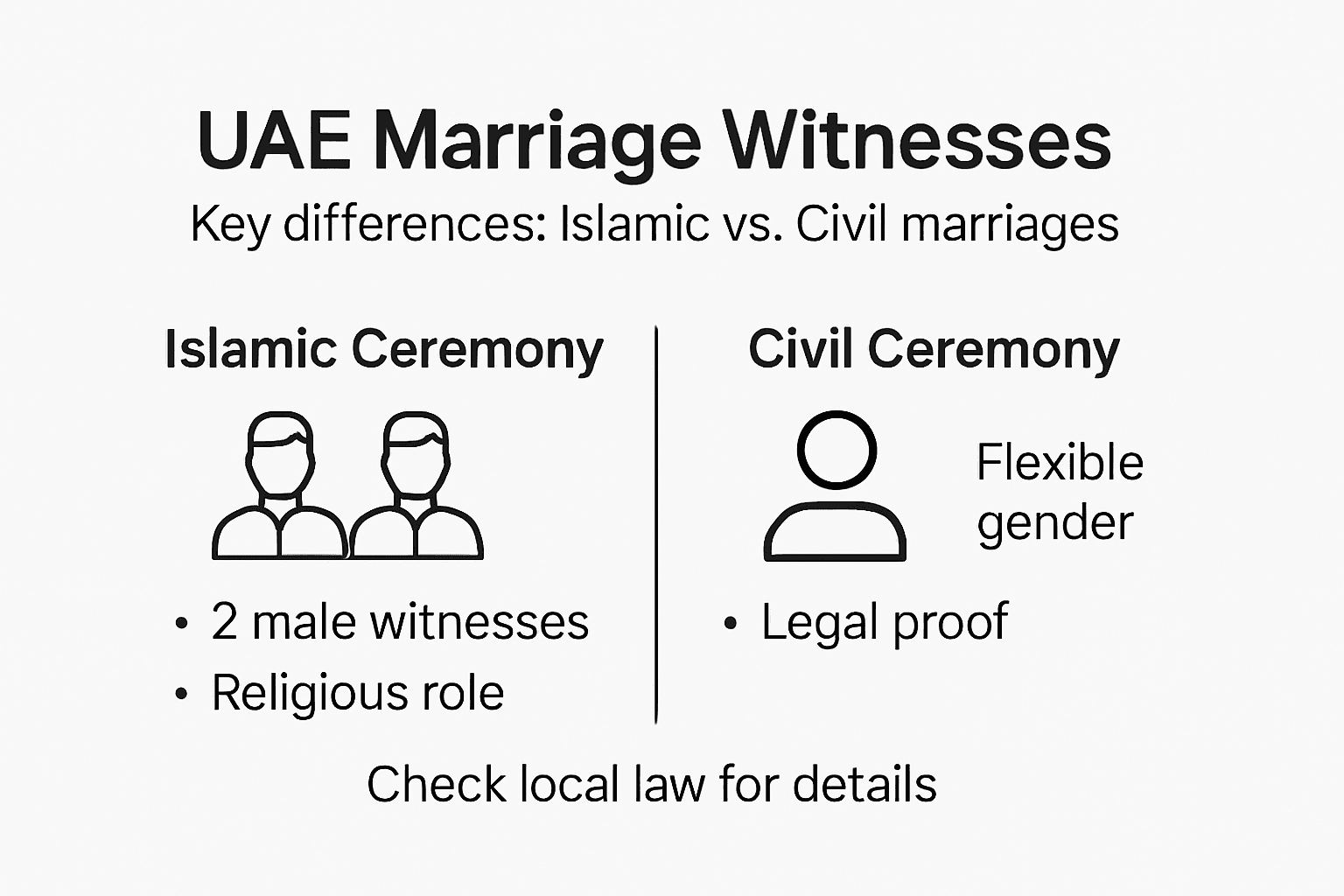
For expatriate couples, understanding these nuanced differences is crucial. While Islamic marriages follow traditional Sharia law principles, civil marriages offer a more adaptable legal mechanism that respects individual cultural and religious backgrounds while ensuring legal recognition within the UAE’s comprehensive matrimonial system.
The following table contrasts Islamic and civil marriage witness requirements in the UAE:
Aspect | Islamic Marriage | Civil Marriage |
Number of Witnesses | Two male Muslims | Two adults, flexible |
Religious Criteria | Must follow Sharia protocols | Religion/background flexible |
Gender Restriction | Only male witnesses accepted | Both genders generally allowed |
International Recognition | May require additional steps | Often accepted internationally |
Pro tip: Consult with official marriage registration authorities to understand the specific requirements for your particular marriage type and personal circumstances.
Responsibilities and Obligations of Witnesses
In the UAE’s marriage legal framework, witnesses bear significant legal and ethical responsibilities that extend far beyond mere ceremonial participation. Their role is critical in ensuring the integrity, authenticity, and legal validity of the marriage contract, serving as impartial guarantors of the matrimonial proceedings.
The primary responsibilities of marriage witnesses include:
Verifying Personal Identities
Confirm the true identity of both marrying parties
Validate identification documents and credentials
Ensure no fraudulent representation occurs
Witnessing Consent
Observe and confirm voluntary participation
Validate that both parties enter marriage willingly
Detect any signs of coercion or inappropriate pressure
Legal Documentation
Accurately sign marriage contract
Provide credible testimony if legal disputes arise
Maintain confidentiality about marriage proceedings
Understanding UAE marriage legal steps highlights that witnesses serve as critical legal authenticators who protect the rights of both marrying parties. Their presence ensures transparency and prevents potential legal complications by providing an independent verification of the marriage process.
Witnesses are not passive observers but active legal participants who guarantee the marriage’s procedural and ethical integrity.
For Islamic marriage ceremonies, witnesses carry additional religious responsibilities. They must be mentally competent Muslim males who understand the profound spiritual and legal significance of their role. In civil ceremonies, while the requirements might be more flexible, the fundamental obligation remains: to provide an unbiased, truthful account of the marriage proceedings.
Witnesses potentially face legal consequences if they knowingly provide false testimony or fail to fulfill their obligations. This underscores the gravity of their role - they are not merely signing a document, but actively participating in a legally binding social contract that will impact the lives of the marrying parties.
Here’s a summary highlighting the roles and risks for marriage witnesses in the UAE:
Role for Witnesses | Possible Risks if Neglected | Legal Impact |
Verifying identities | Falsified marriage records | Marriage may be annulled |
Confirming genuine consent | Unintentional coercion | Contract subject to dispute |
Signing official documents | Rejected certificates | Registration may be denied |
Providing truthful testimony | Legal penalties for false claims | Criminal liability for perjury |
Pro tip: Always maintain complete personal integrity and be prepared to provide accurate, truthful testimony about the marriage ceremony if legally required.
Common Issues and Mistakes to Avoid
Navigating the complex landscape of marriage witnesses in the UAE requires careful attention to detail and a thorough understanding of potential pitfalls. Legal complications can arise from seemingly minor oversights, making it crucial for couples and witnesses to be well-informed about common mistakes that could jeopardize the marriage’s legal validity.
Key issues and mistakes to avoid include:
Witness Qualification Errors
Selecting witnesses who do not meet legal requirements
Using relatives as witnesses
Choosing witnesses without proper legal capacity
Documentation Problems
Incomplete or incorrect marriage certificate information
Failure to properly verify identification documents
Inconsistent or unclear signatures
Procedural Misconceptions
Misunderstanding specific Emirate-level marriage regulations
Assuming universal witness requirements across different marriage types
Neglecting specific cultural or religious protocol nuances
Understanding UAE marriage legal steps highlights the critical nature of precise witness selection and documentation. Witness credibility can be compromised by seemingly minor errors that may invalidate the entire marriage contract.
A single overlooked detail can transform a joyous celebration into a legal nightmare.
Expatriate couples face additional challenges, as they must navigate both UAE legal requirements and potentially conflicting regulations from their home countries. Witnesses must be particularly careful to meet both local and international legal standards, which can involve complex documentation and verification processes.
Potential consequences of witness-related mistakes can be severe, ranging from marriage certificate rejection to potential legal challenges of the entire marriage contract. This underscores the importance of meticulous preparation and thorough understanding of the legal requirements specific to the type of marriage being conducted.
Pro tip: Consult with a legal professional specializing in UAE marriage law to ensure complete compliance and avoid potentially costly mistakes.
Ensure Your UAE Marriage Witnesses Meet All Legal Requirements with Expert Support
Navigating the complex responsibilities and legal qualifications of marriage witnesses in the UAE can be a major challenge. You want your union to be fully valid and recognized without risking delays or legal disputes caused by improper witness selection or documentation errors. Harris & Charms specializes in simplifying this critical part of your marriage process by providing tailored assistance focused on verifying witness credentials, ensuring compliance with both civil and Islamic marriage laws, and handling all necessary documentation with precision.
Our personalized approach draws on detailed knowledge of UAE marriage legal steps to protect your rights and guarantee your ceremony’s legal integrity. From verifying witness identities to managing official paperwork, we make sure every important detail is handled, so you can focus on your special day with confidence.

Ready to avoid common pitfalls and secure a stress-free marriage process with properly qualified witnesses? Visit Harris & Charms now to discover how our comprehensive wedding and legal support services can put your mind at ease. Let us help you transform your UAE marriage journey into a beautifully organized and legally sound celebration. Contact us today and take the first step toward your hassle-free wedding experience.
Frequently Asked Questions
What is the role of witnesses in a marriage in the UAE?
Witnesses are essential participants in a marriage ceremony in the UAE, providing official attestation and verification of the marriage contract, ensuring legal validity, and protecting the rights of both marrying parties.
What are the legal requirements for witnesses in UAE marriages?
Witnesses must be legally competent adults, typically over the age of 21, of sound mind, without a direct familial relationship to either marrying party, and able to understand the marriage proceedings.
How many witnesses are required for Islamic and civil marriages?
Islamic marriages require two male Muslim witnesses, while civil marriages have more flexible witness requirements, commonly allowing both genders and individuals from diverse backgrounds to serve as legal observers.
What responsibilities do witnesses have during the marriage process?
Witnesses are responsible for verifying the identities of the marrying parties, confirming mutual consent, signing the marriage contract, and providing credible testimony if legal disputes arise.
Recommended
Comments