
Civil Marriage Meaning in the UAE: A Legal Guide for Expats


TL;DR:
Civil marriage in the UAE is a government-recognized, secular contract for non-Muslim expatriates and tourists, established to ensure clear legal rights. It excludes religious ceremonies and requires thorough document attestation, which can take 8 to 12 weeks, but offers benefits like no-fault divorce and spouse visa eligibility. The process is administered by the Abu Dhabi Judicial Department and involves preparation, online application, and a government-conducted ceremony.
Civil marriage is defined as a legally binding union contracted and recorded by a government authority, with no requirement for a religious ceremony, religious affiliation, or guardian consent. For non-Muslim expatriates and tourists living in or visiting the UAE, this distinction carries real legal weight. The UAE introduced civil marriage for non-Muslims at the emirate level in 2021 and expanded it federally in 2022, creating a secular personal status framework that gives couples clear, equal, and predictable legal rights under UAE law.
What is the meaning of civil marriage under UAE law?
Civil marriage is a government-recognized contract between two people that derives its legal force entirely from state law, not religious doctrine. The UAE formalized this through two key pieces of legislation: Abu Dhabi Law No. 14 of 2021, which launched the emirate-level framework, and Federal Decree-Law No. 41 of 2022, which extended civil marriage rules across the country.

The civil marriage definition under these laws is specific. The union must be between two consenting adults of opposite sexes, neither of whom is an Emirati Muslim national. No religious rite, prayer, or ceremony is required. A government official acts as the legal witness and officiates the process.
This framework exists because the UAE’s default personal status law applies Sharia principles to Muslims. Non-Muslim residents previously had to navigate their home country’s laws or religious courts, which created legal uncertainty. Civil marriage solved that problem by giving non-Muslims a clear, local legal home for their marital status.
The civil marriage definition also matters for what it excludes. It is not a religious blessing, not a traditional ceremony, and not governed by any faith-based authority. Its legal meaning is purely contractual, which is exactly why it appeals to expatriates from dozens of different national and religious backgrounds.
What are the legal requirements for civil marriage in the UAE?
Eligibility for civil marriage in the UAE is defined by Federal Decree-Law No. 41 of 2022 and Abu Dhabi Law No. 14 of 2021. Both laws set out specific conditions that every applicant must meet before a registration can proceed.
Core eligibility conditions include:
Both parties must be at least 21 years old and have full legal capacity.
The couple must be of opposite sexes.
Neither party can be an Emirati Muslim national. Expatriate Muslims may apply under specific emirate rules.
The couple must not be related within prohibited kinship degrees as defined by the law.
Both parties must give free and informed consent. Guardian consent is not required, which is a significant departure from Sharia marriage rules.
At least one party must be a UAE resident or present in the UAE for the ceremony.
Required documents typically include:
Valid passports for both parties.
Proof of residency or visa status.
Birth certificates, attested through the home country’s official attestation chain.
Divorce or death certificates if either party was previously married, also attested.
No-objection letters where applicable.
Document attestation is the step that most applicants underestimate. Each document must pass through the home country’s foreign affairs ministry, then the UAE embassy in that country, and finally the UAE Ministry of Foreign Affairs. Skipping or rushing any step causes rejection.
Pro Tip: Start your document attestation at least 8–12 weeks before your planned ceremony date. Government offices in many countries process attestation slowly, and delays at this stage are the most common reason civil marriage applications stall.
The civil marriage requirements in the UAE are manageable when you plan ahead, but they are not simple. Treating the paperwork as an afterthought is the single biggest mistake couples make.
How does civil marriage differ from religious (Sharia) marriage?
The difference between civil and religious marriage in the UAE is not just ceremonial. It is a fundamental legal divide that affects how your rights are defined, protected, and enforced.
Category | Civil marriage | Sharia marriage |
Governing law | Federal Decree-Law No. 41 of 2022 | UAE Personal Status Law (Sharia-based) |
Who it applies to | Non-Muslim expatriates and tourists | Muslim nationals and residents |
Guardian consent | Not required | Required for the bride in most cases |
Divorce process | No-fault, court targets 30-day resolution | Fault-based; talaq or khul’ procedures apply |
Inheritance | Equal division based on civil law | Governed by Sharia inheritance shares |
Child custody | Joint custody principles apply | Typically mother for young children, father later |
Pre-marital medical exam | Not mandatory | Mandatory |
Ceremony | Government official, no religious rites | Religious officiant, Islamic rites |
Civil marriage provides gender-equal rights in divorce, inheritance, and child custody that Sharia law does not apply uniformly. That equality is the defining practical advantage for most non-Muslim couples.
The legal certainty gap is also significant. Under Sharia, outcomes in divorce or custody disputes can vary based on judicial interpretation. Under the civil framework, the rules are codified and consistent. For expatriates who may eventually return to their home countries, a civil marriage certificate is also far easier to recognize internationally than a religiously issued document.
Couples in mixed-faith relationships, or those where one partner comes from a country with no formal religious marriage system, find civil marriage the only workable option in the UAE. The legal meaning of civil marriage in this context is not just administrative. It is the foundation of every legal right the couple holds in the UAE.
What are the legal benefits of civil marriage for couples in the UAE?
Civil marriage delivers concrete legal protections that matter in everyday life and in worst-case scenarios alike.
Key legal benefits include:
No-fault divorce: Either spouse can initiate divorce without proving wrongdoing. Courts target a 30-day resolution, which is significantly faster than contested religious divorce proceedings.
Equal inheritance rights: Assets are divided based on contribution and civil law principles, not religious inheritance shares. This protects both spouses equally.
Joint child custody: Civil law applies joint custody principles as the default, giving both parents equal standing from the outset.
Spouse visa eligibility: A registered civil marriage certificate qualifies the non-resident spouse for a UAE spouse visa under Federal Decree-Law No. 4 of 2022.
Legal predictability: Civil marriage creates standardized outcomes in personal status matters, unlike the discretionary nature of religious law or the complexity of applying foreign home-country rules.
The spouse visa benefit is one that many couples overlook until it becomes urgent. A civil marriage certificate is the document that triggers spousal residency rights in the UAE. Without it, a partner has no legal basis to remain in the country on a dependent visa.
Civil marriage offers predictable legal outcomes that neither religious marriage nor informal arrangements can match for non-Muslim expatriates. That predictability is the framework’s core value.
Pro Tip: If you hold or are applying for a UAE Golden Visa, registering your civil marriage promptly protects your spouse’s residency rights and simplifies dependent visa applications. Harrisandcharms assists Golden Visa holders with marriage registration as part of its premium service packages.
What is the process to apply for civil marriage in the UAE?
The Abu Dhabi Judicial Department (ADJD) administers civil marriage registration in the UAE. The process follows a defined sequence that couples can begin remotely before traveling to the UAE.
Step-by-step registration process:
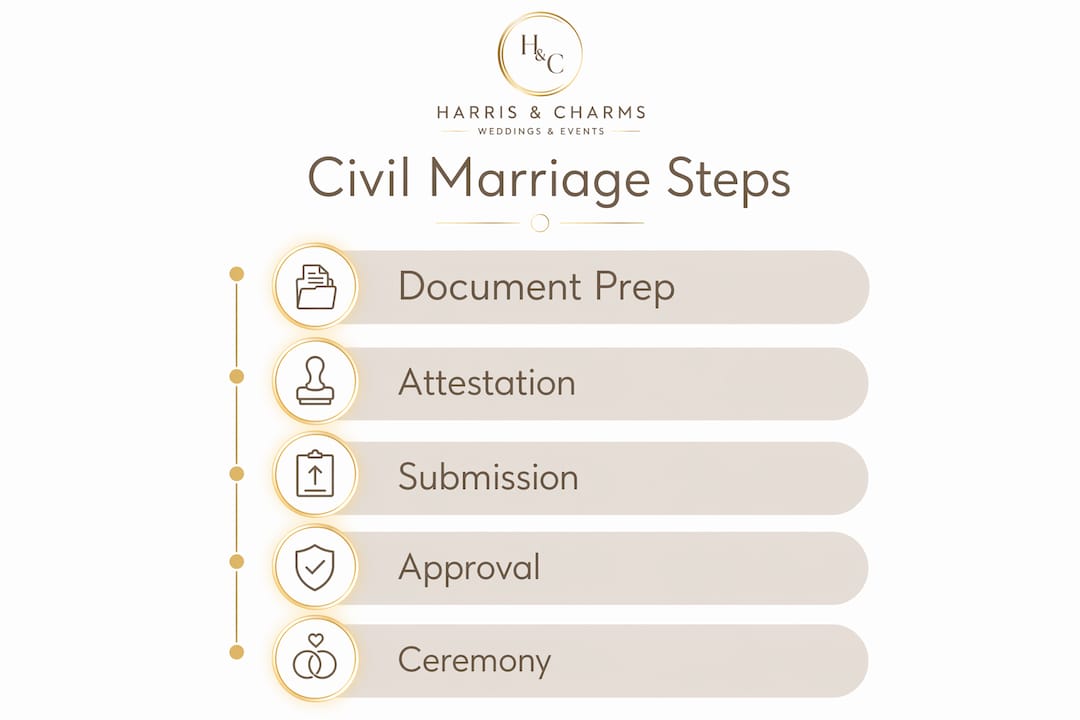
Gather and attest documents in your home country. This includes passports, birth certificates, and any prior divorce or death certificates. Each document must pass through your home country’s foreign affairs ministry, the UAE embassy there, and then the UAE Ministry of Foreign Affairs.
Submit the online application through the ADJD portal. Applicants can start the process online from anywhere in the world before traveling to the UAE.
Receive confirmation and a ceremony appointment from the ADJD. The department reviews your documents and schedules a date.
Attend the ceremony in the UAE. A government official conducts the ceremony. Vows are available in several pre-recorded languages. No religious rites are included. Two witnesses must be present.
Receive the civil marriage certificate from the ADJD. This document is your legal proof of marriage under UAE law.
Stage | Where it happens | Estimated timeline |
Document attestation | Home country + UAE embassy | 8–12 weeks |
Online application submission | ADJD portal (remote) | 1–2 weeks for review |
Ceremony appointment | Abu Dhabi, UAE | Scheduled by ADJD |
Certificate issuance | ADJD office | Same day or within days |
The civil marriage process for expats is straightforward in structure but demanding in document preparation. Most delays occur at the attestation stage, not at the ceremony itself.
Common questions and challenges about civil marriage in the UAE
Several misunderstandings repeatedly cause problems for couples applying for civil marriage in the UAE.
Frequently misunderstood points:
Can Muslim Emirati nationals use civil marriage? No. Emirati Muslims are excluded from the civil marriage framework. Expatriate Muslims may apply under specific emirate rules, but this varies and requires legal confirmation.
Is a pre-marital medical exam required? No. Unlike Sharia marriage, civil marriage in the UAE does not mandate a pre-marital medical screening.
What if one partner is a tourist? Tourists can participate in civil marriage ceremonies in the UAE. At least one party must be present in the UAE for the ceremony, but residency is not a strict requirement for both.
What causes the most application rejections? Incomplete or incorrectly attested documents are the leading cause. Legal practitioners consistently flag this as the most preventable mistake.
Where can you get legal support? The ADJD provides official guidance. Private legal practitioners and specialist wedding service providers like Harrisandcharms offer hands-on support for document preparation and application management.
Mixed-faith couples or those with complex residency situations should seek legal advice before submitting any documents. The civil marriage requirements are clear on paper but can interact in unexpected ways with individual circumstances.
Key Takeaways
Civil marriage in the UAE is a secular, government-registered union governed by Federal Decree-Law No. 41 of 2022, offering non-Muslim expatriates equal rights in divorce, inheritance, and child custody.
Point | Details |
Legal definition | Civil marriage is a state-recognized contract with no religious requirement, governed by UAE federal law. |
Who qualifies | Non-Muslim expatriates and tourists; Emirati Muslim nationals are excluded from this framework. |
Core benefits | No-fault divorce, equal inheritance, joint custody, and spouse visa eligibility under UAE law. |
Biggest challenge | Document attestation takes 8–12 weeks and is the leading cause of application delays and rejections. |
Where to register | The Abu Dhabi Judicial Department (ADJD) administers civil marriage; applications can begin online. |
Why civil marriage changed everything I thought I knew about UAE family law
When I first started helping couples navigate marriage in the UAE, the options for non-Muslims were genuinely limited. You either went through a religious process that did not reflect your beliefs, or you relied on your home country’s marriage laws and hoped the UAE would recognize them. Neither option gave couples real legal footing here.
The introduction of civil marriage through Abu Dhabi Law No. 14 of 2021 was not just a policy update. It was a signal that the UAE was serious about building a legal environment where expatriates could put down roots with confidence. What struck me most was the gender equality built into the framework. Equal inheritance, joint custody as a default, no-fault divorce. These are not small details. They are the difference between a marriage that protects both partners and one that leaves one person legally exposed.
The challenge I see most often is couples treating the ceremony as the hard part and the paperwork as a formality. It is the opposite. The ceremony takes an hour. The attestation process can take three months if you do not plan it correctly. My honest advice: treat the document preparation as the main event and let the ceremony be the celebration it deserves to be.
Civil marriage in the UAE is a genuine modernization of personal status law. For non-Muslim expatriates, it is the clearest path to legal certainty in one of the world’s most dynamic cities. I expect the framework to expand further as the UAE continues to attract long-term residents from every corner of the world.
— Harris
How Harrisandcharms supports your civil marriage in the UAE
Planning a civil marriage in the UAE involves legal paperwork, government portals, attestation chains, and ceremony logistics. Harrisandcharms handles all of it.

Harrisandcharms offers tailor-made civil marriage packages in Dubai and Abu Dhabi, covering document preparation, attestation guidance, ADJD application support, and ceremony coordination. Every package is built around your specific nationality, residency status, and timeline. For couples who want a complete solution, the full marriage services include legal registration, venue options, photography, and post-marriage documentation support. Harrisandcharms also assists Golden Visa holders with marriage registration and dependent visa applications. Reach out directly to start your application with a team that has done this before.
FAQ
What is civil marriage in the UAE?
Civil marriage in the UAE is a legally recognized union contracted through the Abu Dhabi Judicial Department under Federal Decree-Law No. 41 of 2022, with no religious ceremony required. It is available to non-Muslim expatriates and tourists.
Who can apply for civil marriage in the UAE?
Non-Muslim expatriates and tourists can apply. Emirati Muslim nationals are excluded, though expatriate Muslims may qualify under specific emirate-level rules.
How long does the civil marriage process take in the UAE?
Document attestation typically takes 8–12 weeks. Once documents are submitted to the ADJD, the review and ceremony appointment process takes an additional 1–2 weeks.
Does civil marriage in the UAE require a pre-marital medical exam?
No. Civil marriage does not require a pre-marital medical screening, unlike Sharia marriage, which mandates it.
Is a UAE civil marriage certificate recognized internationally?
A UAE civil marriage certificate issued by the ADJD is a government-issued legal document. Recognition abroad depends on the laws of the receiving country, but civil certificates are generally easier to authenticate internationally than religiously issued documents.
Recommended
Comments