
Civil Marriage Process Explained: UAE Expat Solutions


Misunderstandings about civil marriage persist among expats in the United Arab Emirates, with many American couples surprised to learn that nearly 40 percent of international marriages involve civil unions rather than religious ceremonies. Navigating the legal maze of civil marriage documentation in the UAE matters because every step influences your rights, future plans, and even residency status. This guide demystifies the process, offering clear facts and personalized solutions so you can plan your civil wedding confidently and avoid common pitfalls.
Table of Contents
Key Takeaways
Point | Details |
Understanding Civil Marriage | Civil marriage is a legally recognized union that emphasizes legal rights rather than religious practices, making it equally significant for couples. |
Documentation Requirements | Couples must gather comprehensive legal documentation, including passports and proof of single status, to navigate civil marriage registration successfully. |
Types of Marriages Available | Expats in the UAE can choose from civil, religious, and customary marriages, each with distinct legal frameworks and requirements. |
Legal Rights Post-Marriage | Couples gain essential legal protections and mutual rights after marriage, including financial support and medical decision-making capabilities. |
Civil marriage meaning and misconceptions
A civil marriage is a legally recognized union between two individuals, sanctioned by the government rather than a religious institution. Unlike traditional religious ceremonies, civil marriages are purely administrative contracts that grant legal rights and obligations to both partners. The legal requirements for civil marriage can vary significantly across different jurisdictions, especially for expats navigating marriage in the United Arab Emirates.
Common misconceptions about civil marriages often stem from cultural assumptions and traditional perspectives. Many people mistakenly believe that civil marriages lack emotional depth or significance compared to religious ceremonies. In reality, civil marriages are equally meaningful and provide robust legal protections for couples. They represent a formal commitment recognized by state authorities, ensuring both partners have equal rights regarding property, inheritance, medical decisions, and potential future separations.
For expats in the UAE, understanding civil marriage nuances becomes particularly important. The process involves specific documentation, residency requirements, and legal protocols that differ from marriage practices in other countries. Couples must navigate bureaucratic procedures, obtain necessary paperwork, and ensure compliance with local regulations. This might include medical certificates, passport validations, and potential translation services for international documents.
Pro tip: Always consult official government resources and potentially engage a legal professional specializing in international marriage regulations to ensure a smooth civil marriage process in the UAE.
Types of marriage in the UAE for expats
The United Arab Emirates offers several marriage types designed to accommodate the diverse needs of expatriate couples. Expats considering marriage in the UAE can choose from three primary marriage classifications: civil, religious, and customary marriages. Each type carries unique legal implications and documentation requirements, making it crucial for international couples to understand their options thoroughly.
Civil marriages represent a secular approach to legal union, specifically designed for non-Muslim couples and international residents. Introduced in Abu Dhabi in 2021, this marriage type allows couples to register a legal contract without religious prerequisites. Unlike traditional Islamic marriages governed by Sharia law, civil marriages provide a flexible framework that recognizes partnerships across different nationalities, religions, and cultural backgrounds.
Religious marriages remain predominantly structured around Islamic legal principles, primarily serving Muslim nationals and residents. These marriages follow traditional Sharia guidelines and involve specific ceremonial and legal protocols. For expatriate couples, understanding the nuanced differences between civil and religious marriage frameworks becomes essential in selecting the most appropriate option that aligns with their personal, cultural, and legal requirements.
Here’s a quick comparison of the main marriage types available to expats in the UAE:
Marriage Type | Who It Serves | Legal Framework | Flexibility |
Civil | Non-Muslim expats | UAE civil law | High—no religious requirements |
Religious | Muslim nationals & residents | Sharia law | Limited—must follow religious procedures |
Customary | Diverse communities | Mixed legal/custom practices | Varies—based on tradition and law |
Pro tip: Consult with official UAE marriage authorities or a legal professional specializing in international marriages to confirm the most current requirements and procedures for your specific situation.
Eligibility rules and required documentation
Navigating the eligibility requirements for marriage in the UAE can be complex for expatriates. Legal implications of marriage documentation are critical to understand before beginning the process. The Federal Decree Law No. 41 of 2022 establishes clear guidelines for civil marriages, with specific criteria that both partners must meet to legally wed in the United Arab Emirates.

Key eligibility requirements include age, nationality, and legal status. Both parties must be at least 18 years old, with some jurisdictions preferring participants to be 21. Non-Muslim couples are primary candidates for civil marriages, and individuals must be legally single at the time of marriage. This means providing comprehensive documentation proving no existing marital commitments, including divorce certificates or death certificates for previously married individuals. Couples cannot be closely related, and both must provide valid identification documents such as passports and Emirates IDs for resident expats.
The documentation process involves gathering and preparing multiple official papers. Essential documents typically include:
Valid international passports
Medical fitness certificates
Proof of single status (embassy-issued certificates)
Birth certificates
No-objection certificates from respective embassies
Translated and legally attested documents in Arabic
Each document must meet specific authentication requirements, often necessitating translation, notarization, and official attestation from relevant governmental bodies. The complexity of document preparation can be overwhelming, making professional assistance highly recommended for smooth processing.
Pro tip: Begin collecting and verifying your documentation at least three months before your intended marriage date to account for potential processing delays and unexpected authentication requirements.
Step-by-step civil marriage registration process
The civil marriage registration process in the UAE requires careful navigation and precise documentation. Civil marriage documentation steps can seem complex, but understanding the sequence helps expatriate couples approach the process confidently. The registration typically involves multiple stages that ensure legal compliance and mutual consent.
The initial phase involves comprehensive preparation and verification. Couples must first confirm their eligibility by ensuring they are non-Muslim, of legal age (typically 21), and legally single. This requires gathering critical documents including:
Valid international passports
Medical fitness certificates
Proof of single status
Embassy-issued no-objection certificates
Translated and attested personal documents
Once documentation is prepared, couples proceed to the official registration stages. This typically involves submitting applications to the competent court, completing detailed disclosure forms, and potentially participating in an interview to confirm mutual consent. The court reviews submitted documents, verifies authenticity, and schedules a formal marriage contract signing. During this session, both parties sign the marriage contract in the presence of a judge, who then authenticates and officially registers the marriage.
The final stage encompasses receiving the official marriage certificate, which serves as legal proof of the civil union. Some jurisdictions like Abu Dhabi offer online application options with varying processing speeds, allowing couples to choose between standard and expedited services. The entire process requires patience, meticulous document preparation, and adherence to specific bureaucratic protocols.
Pro tip: Consider hiring a legal consultant specializing in UAE marriage registration to streamline the process and ensure all documentation meets precise governmental requirements.
Legal rights and obligations after marriage
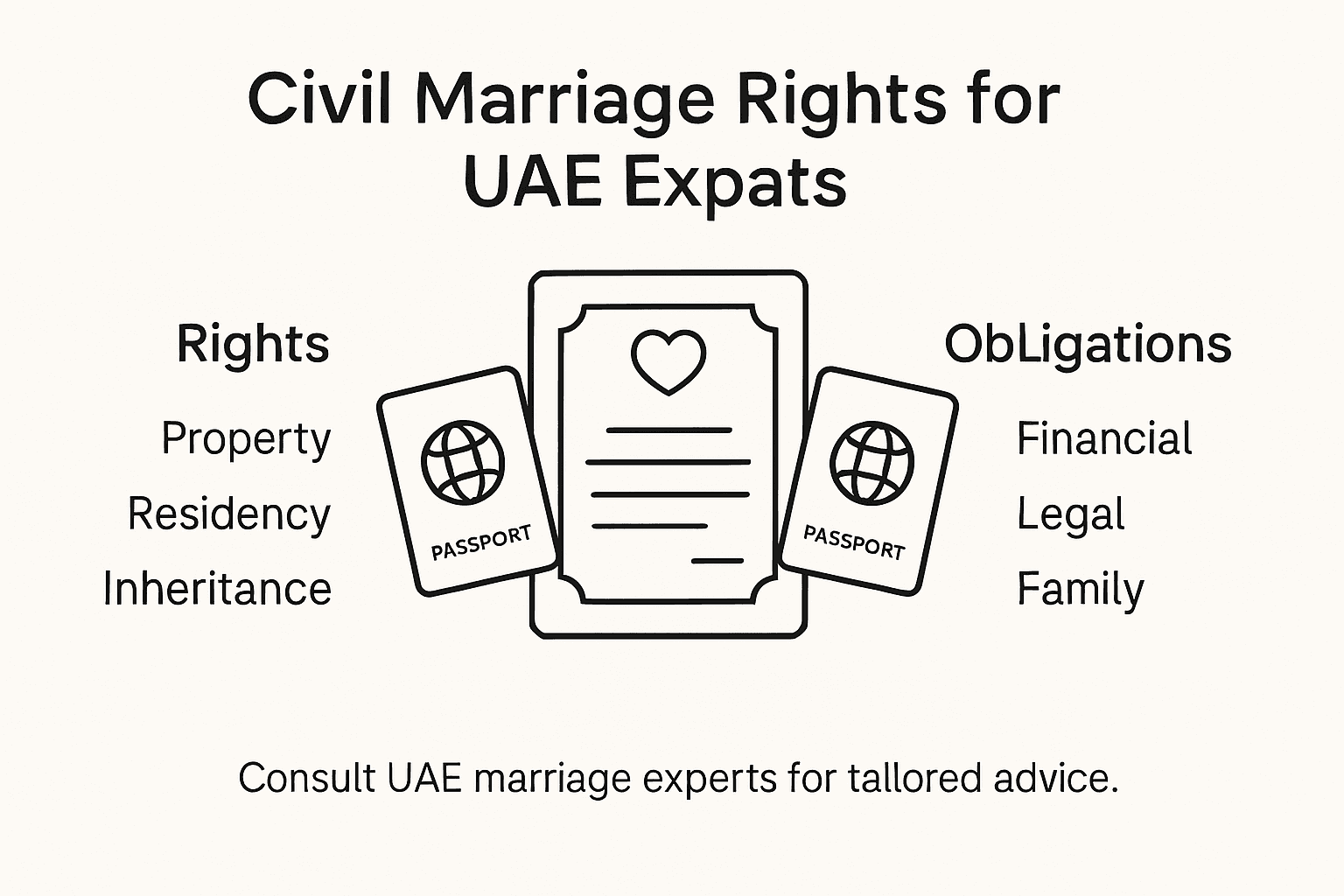
Understanding legal rights and obligations after marriage in the UAE is crucial for expatriate couples navigating a complex legal landscape. Why legalize marriage in the UAE involves more than just a ceremonial commitment, as it establishes critical legal protections and responsibilities for both partners.
The legal framework for married couples combines elements of federal law and traditional principles, creating a unique set of mutual rights and responsibilities. Key obligations for spouses typically include:
Financial mutual support
Shared responsibility for family welfare
Legal rights to inheritance
Medical decision-making capabilities
Joint property management
Potential sponsorship and residency rights
For expatriate couples, civil marriages offer particularly clear legal protections. Unlike traditional religious marriages, civil contracts explicitly outline each partner’s rights and responsibilities. This includes provisions for potential scenarios such as separation, financial disputes, and child custody. Specific legal considerations vary depending on the couple’s nationality, residency status, and the specific jurisdiction where the marriage is registered.
Financial and personal rights represent critical aspects of marital legal frameworks. Spouses gain important legal capabilities, including the potential to sponsor each other for residency, open joint bank accounts, and make critical medical decisions. These rights extend beyond emotional commitment, providing tangible legal and economic protections that safeguard both partners’ interests in the complex UAE legal environment.
Pro tip: Consult with a legal professional specializing in UAE marriage law to understand the specific rights and obligations that apply to your unique marital circumstances.
The table below summarizes the key advantages of civil marriage for expats in the UAE:
Advantage | Description | Business Impact |
Legal Protection | Equal rights and obligations for both spouses | Ensures property, inheritance security |
Residency Benefits | Potential for spousal sponsorship | Improves visa and residency options |
Administrative Ease | Recognized without religious process | Streamlines legal documentation |
Cultural Inclusion | Accommodates international couples | Facilitates multicultural unions |
Common mistakes to avoid during registration
Navigating the civil marriage registration process in the UAE demands meticulous attention to detail. Civil Marriage Step by Step highlights the complexity of documentation and legal requirements that can easily trip up unprepared couples. Understanding potential pitfalls is crucial to ensuring a smooth registration experience.
The most frequent mistakes expatriate couples encounter involve documentation and eligibility issues. Critical errors include:
Submitting incomplete or unverified documents
Failing to properly translate and attestate international paperwork
Misunderstanding age and religious eligibility requirements
Neglecting to provide comprehensive proof of single status
Overlooking specific jurisdictional requirements
Incomplete or incorrectly filled application forms
Paperwork and legal compliance represent the most challenging aspects of marriage registration. Many couples underestimate the importance of precise documentation, particularly for international documents. Each paper must be meticulously prepared, translated, and legally authenticated. This includes passports, birth certificates, divorce or death certificates for previously married individuals, and medical fitness documentation. Even minor errors can result in significant delays or complete application rejection.
Expats must also be prepared for potential interviews and additional verification processes. The UAE legal system requires comprehensive proof of mutual consent and individual eligibility. This means being ready to provide detailed personal information, demonstrate financial stability, and confirm the absence of legal impediments to marriage. Understanding these nuanced requirements can significantly reduce the risk of registration complications.
Pro tip: Create a dedicated folder with multiple copies of all required documents, and consider hiring a local legal consultant to review your application before submission to minimize potential registration errors.
Simplify Your Civil Marriage Journey in the UAE with Harris & Charms
Navigating the civil marriage process in the UAE can feel overwhelming with all the document requirements, eligibility rules, and registration steps. From gathering valid passports and medical fitness certificates to understanding legal rights and avoiding common mistakes, it is easy to get lost in the bureaucracy. If you want to protect your rights and ensure every detail is handled correctly, you need expert guidance tailored to expat couples like you.
Harris & Charms offers personalized support for every stage of your civil marriage. Whether you need help with document preparation, legal attestations, or coordinating your marriage ceremony, our experienced team is here to make your experience stress free and memorable. Learn more about our full range of services on our official website and discover how we can assist with the specific challenges explained in the article such as proof of single status and embassy no-objection certificates.

Ready to turn your civil marriage plans into reality without the hassle of paperwork and legal delays Make Harris & Charms your trusted partner today Visit Harris & Charms now to get started or ask about our expert help with civil marriage documentation and legal implications of marriage. Your smooth, legally sound union in the UAE awaits.
Frequently Asked Questions
What is a civil marriage?
A civil marriage is a legally recognized union between two individuals sanctioned by the government, rather than a religious institution. It provides legal rights and obligations to both partners.
What are the eligibility requirements for a civil marriage in the UAE?
Both parties must be at least 18 years old, legally single, and non-Muslim. They will also need valid identification documents and proof of single status.
What documents are required for civil marriage registration?
Necessary documents typically include valid international passports, medical fitness certificates, proof of single status, birth certificates, and no-objection certificates from respective embassies.
What is the step-by-step process for registering a civil marriage?
The process involves preparing and verifying eligible documents, submitting applications to the competent court, possibly participating in an interview, signing the marriage contract in the presence of a judge, and finally receiving the official marriage certificate.
Recommended
Comments